

SSC GD Constable: How to Analyse Your PYQs and Plan Practice
Old papers become useful when you record the method behind each question. Build a syllabus-backed topic map, separate repeated concepts from repeated wording, and turn mistakes into specific practice tasks.
KnowledgeGate Team
Exam prep & CS education
Updated 6 Nov 20265 min read
Finishing old SSC GD papers without identifying reusable methods leaves revision unfocused. A concept can repeat even when the wording and numbers change. Use a syllabus topic map, a recurrence log and error-ledger checks to turn each paper into the next set of practice decisions.
The earlier SSC MTS topic-pattern analysis owns cross-exam topic recurrence and MTS-specific examples. This post owns SSC GD: its four topic areas, Hindi or English practice, and method-level logs that distinguish repeated operations from repeated wording.
Build your GD topic map
Recent notifications have specified the topic framework; the cited SSC GD 2026 notification, issued 1 December 2025, section 12.1.11, lists reasoning, general knowledge and awareness, elementary mathematics, and English/Hindi understanding and comprehension.
Use GD papers with identifiable year, date, shift and answer-key provenance. Label a coaching recall as a recall, and remove reposts of the same shift before counting recurrence. Otherwise, one paper downloaded twice can look like a repeated pattern.
The government-exam course catalogue helps you locate practice resources. Use the GD notification to define your topic checklist.
Count recurring methods across distinct papers
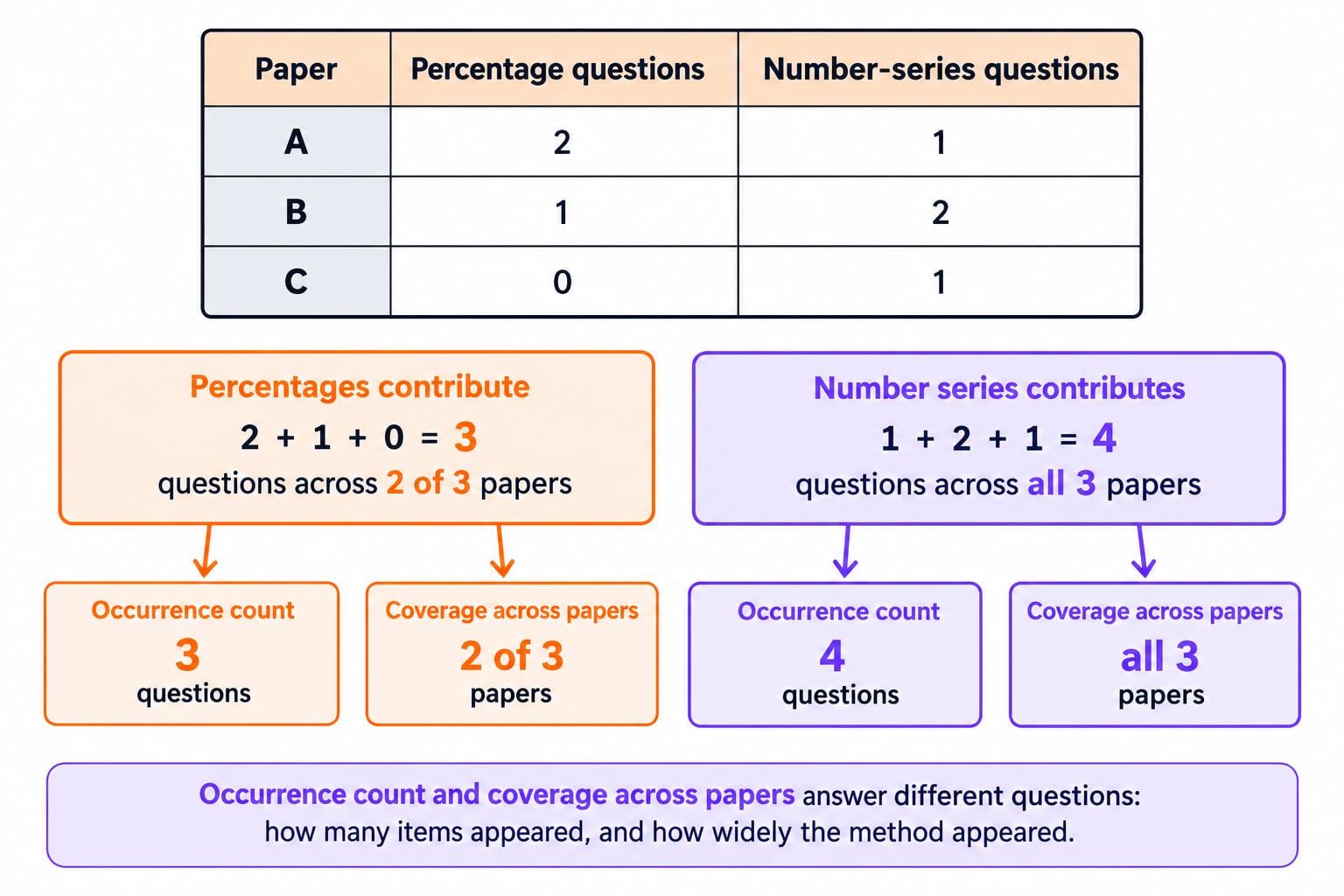
Start with a small log:
Paper | Percentage questions | Number-series questions |
|---|---|---|
A | 2 | 1 |
B | 1 | 2 |
C | 0 | 1 |
Percentages contribute 2 + 1 + 0 = 3 questions across 2 of 3 papers. Number series contributes 1 + 2 + 1 = 4 questions across all 3 papers. Occurrence count and coverage across papers answer different questions: how many items appeared, and how widely the method appeared.
For each real question, record source/shift, primary topic, solving operation, correctness, time and error cause. Give a percentage-based profit problem one primary topic so it is not counted twice.
The SSC CGL subject-priority mapping method owns ranking subject queues from a CGL baseline. For GD, use the same evidence discipline here to tag methods within each section, then choose drills from your own error ledger.
Arithmetic: practise the operation behind the wording
The elementary mathematics subsection names percentages, ratio and proportion, averages, and time and work. Use these as starting points for your arithmetic tags.
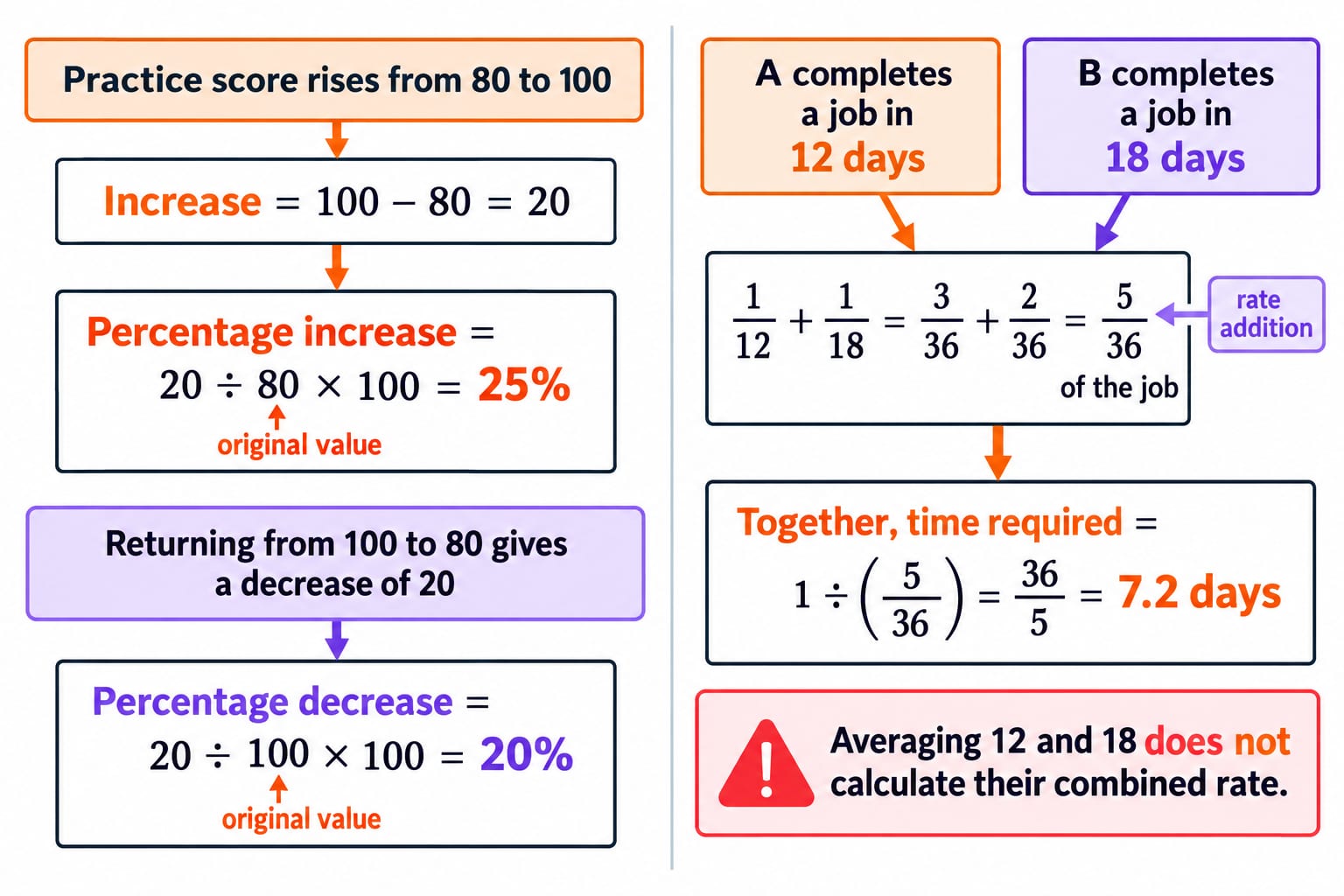
Consider this example: a practice score rises from 80 to 100.
Increase = 100 - 80 = 20.
Percentage increase = 20 / 80 * 100 = 25%.
Returning from 100 to 80 gives a decrease of 20.
Percentage decrease = 20 / 100 * 100 = 20%.
The reusable operation is choosing the correct base. Write "original value" beside the denominator before calculating.
Now suppose A completes a job in 12 days and B in 18 days, working at constant rates. Their combined daily rate is 1/12 + 1/18 = 3/36 + 2/36 = 5/36 of the job. Together, time required = 1 / (5/36) = 36/5 = 7.2 days.
Tag this as "rate addition". Averaging 12 and 18 does not calculate their combined rate. Your mistakes should decide whether tomorrow's drill targets bases or rates.
Reasoning: record the rule, not just the answer
The reasoning subsection names analogies, figural classification, arithmetic number series, non-verbal series and coding-decoding, and describes questions as principally non-verbal. Tag figure questions by rules such as rotation, reflection or adding an element. Include both figure-based and text questions in your review.
For the series 3, 8, 15, 24, 35, ?, successive differences are 5, 7, 9 and 11. Continuing with 13 gives 35 + 13 = 48. Record "first differences increase by 2".
For a letter code, shift every letter forward by one: CAT maps to DBU and DOG maps to EPH. Check all three letters. Recognising C maps to D alone does not establish the whole transformation.
Awareness and language need a different review method
The awareness subsection provides the broad general-knowledge remit. Separate static facts from dated events in your notes. Keep an old current-affairs answer attached to its historical date rather than treating it as today's fact.
Practise your chosen language. The language subsection specifies basic understanding and comprehension. Supporting drills can include:
English agreement: "She go to school every day" becomes "She goes to school every day". Tag third-person singular agreement.
Hindi vocabulary: उन्नति / अवनति, an opposite-word pair for vocabulary practice.
These drills support comprehension. A familiar topic can require a new fact or sentence-level interpretation. Memorising answer letters does not transfer.
Check whether difficulty changed or your execution slipped
Take two matched-topic practice sets of 10 questions each. In set A, you answer 8 correctly in 8 minutes. In set B, you answer 8 correctly in 12 minutes.
Accuracy remains 8 / 10 * 100 = 80%. Average time per question rises from 8 * 60 / 10 = 48 seconds to 12 * 60 / 10 = 72 seconds. Execution was slower in set B.
Inspect calculation length, unfamiliar wording and concept gaps. Match topic mix and testing conditions, and avoid equating raw scores under different scoring rules.
Use the error-ledger method to record an actionable entry: "percentage base | used 100 instead of original 80 | redo the base-identification drill". Give each error one next action.
Turn the analysis into the next week's practice
Try this 300-minute weekly allocation: 90 minutes arithmetic repair + 60 reasoning + 60 awareness + 45 chosen-language practice + 45 mixed retest/review = 300 minutes.
Spread the allocation across five 60-minute sessions. If you miss one, move its highest-priority repair into the next session before adding new work. Choose two repairs from your ledger, then compare accuracy and time on unseen questions using those methods. Repeated mistakes, cross-paper coverage and repairability jointly set priority; keep revising the remaining syllabus too.
The SSC GD preparation strategy owns phase-by-phase calendar sequencing. Keep that calendar separate from this paper-level diagnosis: use your recurrence counts and error causes to decide which drill each phase should contain.
Use the SSC CGL Tier 1 course for supplementary practice in basics shared with your GD topic checklist. Start by tagging one identifiable GD paper and selecting tomorrow's two drills.
SSC GD Constable: the short version and next practice step
Start with one identifiable paper and tag every question by section, topic, solving operation, correctness, time and error cause. Count a method only after removing duplicate shifts. Compare coverage across papers separately from occurrence count, then choose two repairs for the next practice session. Recheck those methods on unseen questions and let accuracy, time and recurring error causes update the following week. This keeps PYQ analysis tied to a decision you can execute.
Keep learning

SSC MTS Previous Year Analysis: Spot Topic Patterns and Plan Revision
Solved several MTS papers but unsure what to revise? Tag the operation behind each mistake, compare your practice fairly and turn the results into a manageable weekly plan.
Updated 29 Oct 20265 min readSSC MTS
IBPS SO IT Officer Previous Year Analysis: Find Repeating Topics and Set Prep Priorities
Use an evidence-led IBPS SO IT Officer previous year analysis to rank repeating topics, combine them with your errors, and plan a 14-hour study week.
Updated 30 Oct 20264 min read57 viewsIBPS Exams

RBI Grade B Previous Year Analysis: Recurring Topics and Study Priorities
Use recurring topic families to choose what to revise, then let your errors decide the time allocation. Work through DI, reasoning and reading examples before building a practical weekly plan.
Updated 30 Oct 20265 min readBanking Exams
IBPS PO Previous Year Analysis: Recurring Question Formats and Attempt Priorities
See what genuinely recurs across IBPS PO papers, solve representative format drills, and turn your own accuracy and speed into a practical attempt priority.
Updated 30 Oct 20265 min readIBPS Exams