HPSC PGT Computer Science Syllabus: Subject Knowledge, GK and the Haryana Layer
See how the computer-science core, Haryana GK, general awareness and pedagogy fit together, then turn that scope into a balanced preparation plan.
KnowledgeGate Team
Exam prep & CS education
Updated 7 Sep 20265 min read
HPSC PGT Computer Science preparation can go wrong even with strong CS fundamentals. The paper combines subject knowledge, general awareness, Haryana GK and sometimes a teaching component, so a CS-only timetable leaves a gap. Understand the blend first, then let the current notification set its proportions.
1. The exam structure
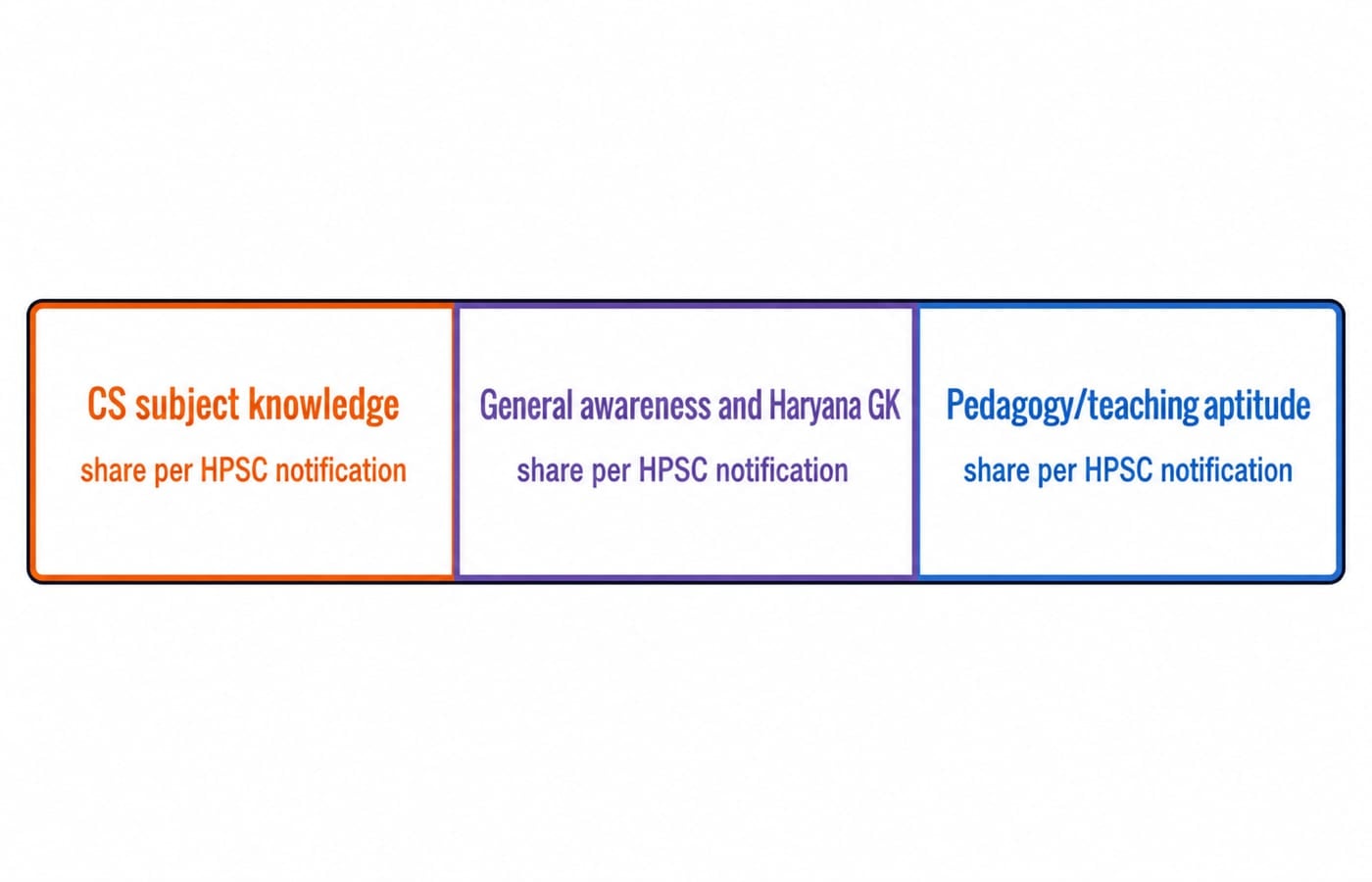
Think of the written examination as connected preparation blocks, not one long computer-science syllabus. The largest is the CS core. General awareness and Haryana-specific knowledge sit alongside it, with pedagogy or teaching aptitude where prescribed.
Each block needs a different method. CS rewards concepts and problem solving; general awareness needs regular revision; Haryana GK needs a bounded state-specific source list; pedagogy needs definitions and classroom application.
Do not copy marks or patterns from an old coaching page. The current notification controls stages, sections and marks. Organise learning around these preparation blocks, then verify official numbers before allocating time.
2. The CS subject-knowledge core, decoded
The subject portion is the familiar computer-science core, but it must be prepared at postgraduate teacher depth. Grouping the syllabus stops it from feeling like a random list:
Programming and problem solving: programming constructs, data structures and algorithms. Be able to trace code, choose an appropriate structure and reason about correctness and efficiency.
Systems: operating systems, computer organisation and architecture, and digital electronics. Learn the mechanism, then practise the numerical or state-transition question that follows from it.
Data and communication: database management systems and computer networks. Definitions matter, but schema reasoning, transactions, protocols and addressing need application.
Theory and construction: theory of computation, compiler ideas and software engineering. Keep formal concepts tied to small examples.
Aim for sound fundamentals plus application. For each chapter, ask: can I define the idea, solve a standard problem without notes and explain it to a school learner? The last test matters for a teaching post.
The HPSC PGT Computer Science course can provide the subject sequence, but your revision sheet should remain compact. One page of formulas, distinctions and frequent mistakes per subject is more useful near the examination than a second set of full notes.
Practise across operating systems, DBMS, networks, COA, data structures, algorithms, digital electronics and theory of computation. Use mixed sets diagnostically: a wrong answer should point to a concept to repair, not merely add to a score.
3. The general-awareness and Haryana layer
General awareness and Haryana GK should have their own line in the timetable. If they are left as “read when free”, the CS core will consume every available hour.
For general awareness, separate relatively stable areas from current affairs. Revise the stable part through short topic sheets, and keep current affairs to a regular, limited cycle. For Haryana GK, organise notes under state history, geography, economy, culture, current affairs and government schemes. Use the exact headings in the current syllabus if they differ.
This is a finite, high-return layer because the same names, places, institutions and relationships can be revised repeatedly. It is also where a candidate from outside Haryana may lose avoidable ground. A protected daily or alternate-day slot is better than a large catch-up session once a month.
The government teaching jobs category helps place HPSC beside other teaching recruitments, but do not let material for another state replace Haryana-specific study. Shared general awareness can transfer. State knowledge usually cannot.
4. The pedagogy and teaching-aptitude slice
Where the current cycle includes pedagogy or teaching aptitude, treat it as a small subject in its own right. Likely preparation themes include educational psychology, learning principles, teaching methods, classroom communication and assessment. The official syllabus remains the boundary.
Do not fold this material into CS revision. A question about formative assessment is not answered by knowing algorithms, and a pedagogy definition becomes useful only when you can distinguish it from a nearby term. Build a short glossary, attach one classroom example to every major idea, and practise choosing the best teaching response in a situation.
This block also supports later interview preparation. Explaining why a teaching method fits a learner or topic is better evidence of classroom thinking than reciting terminology.
5. How the split should shape preparation
Start with four rows in your weekly plan: CS core, general awareness, Haryana GK and pedagogy if applicable. Give the CS core the largest share, then reserve capped slots for the other blocks. “Capped” is important: non-CS study should neither disappear nor expand until it crowds out subject preparation.
A workable cycle looks like this:
Study one CS concept and solve a focused set on it.
Revise one short Haryana GK unit from memory.
Use a limited slot for general awareness or pedagogy.
End the week with a mixed test and classify every error by block.
If the error log shows that database questions are slow, repair DBMS. If Haryana facts are repeatedly confused, shorten the notes and revise them more often. If pedagogy options look interchangeable, build comparison tables. Allocation should follow evidence from tests, not the subject you most enjoy studying.
Use the HPSC PGT Test Series to test the blend under time pressure. A subject-wise score can hide a weak non-CS layer; a mixed paper exposes it.
6. How HPSC tests it and where to confirm
Strong computer science is necessary, but the full paper rewards coverage across every notified block. General awareness and Haryana GK can separate candidates whose CS preparation is otherwise similar. A teaching component, where present, adds another set of precise but learnable distinctions.
Read the actual notification and syllabus on the Haryana Public Service Commission portal before locking your timetable. Confirm the stage structure, section composition, marks and dates there. Recheck after any corrigendum rather than relying on a saved screenshot.
For wider context, Teaching jobs for Computer Science graduates compares the broad demands of teaching recruitments, while KVS and NVS Computer Science: exam structure and how to prepare shows how another teaching route combines subject and non-subject preparation. Use the comparison to understand transferable CS work, not to import another exam's pattern into HPSC.
7. Final preparation steps
Prepare HPSC PGT Computer Science as a blend. Build the CS core deeply, protect regular time for general awareness and Haryana GK, and add a separate pedagogy block when the current notification includes it. Let official section composition guide the final hour split.
Your next step is to download the current HPSC syllabus, place every line under one of those preparation blocks, and take a mixed diagnostic test. Then use the course for systematic coverage and the test series to keep all parts exam-ready, rather than waiting until the last revision week to discover the Haryana layer.
Keep learning
Browsers and Search Engines MCQs: 9 Solved Questions with Explanations
Solve nine published browser and search engine questions, check each answer, and rebuild the browser, cache, crawler and indexing distinctions that exam distractors blur.
Updated 6 Oct 20267 min readTeaching Recruitment (Computer Science)
IT Act, 2000 Explained: Key Sections, Digital Signatures and Worked Exam Examples
Build an exam-ready map of the IT Act, then apply it to an exact digital-signature walkthrough and a section 43, 66, 66C and 66D caselet.
Updated 2 Oct 20266 min readTeaching Recruitment (Computer Science)
Emerging Trends Introduction MCQs: 12 Solved Questions with Explanations
Solve 12 Emerging Trends Introduction questions with clear answer logic, exam-year labels and a compact trap check for focused revision.
Updated 27 Sep 20268 min readTeaching Recruitment (Computer Science)
MS Word Basics MCQs with Answers: 12 Solved Questions Explained
Work through 12 MS Word questions covering everyday commands, page layout, formatting, links, file features and mail merge. Each answer explains the decisive clue and the closest distractor.
Updated 25 Sep 20267 min readTeaching Recruitment (Computer Science)