

Python for GATE DA: A 6-Week Topic-by-Topic Preparation Plan
Build reliable Python tracing skills, cover the DA syllabus topic by topic, and finish with a disciplined error-repair loop in 48 focused hours.
KnowledgeGate Team
Exam prep & CS education
Updated 21 Nov 20265 min read

Everyday Python fluency can still fail when two names share a nested object, recursive activations are miscounted, or an algorithm is detached from its state changes. With six weeks and 48 focused hours, finish every session with a trace, implementation, error-log row, or retest; missed work replaces low-value repetition, not review. GATE DA names Python, while GATE CS names C, so CS aspirants cannot substitute Python for its programming requirement.
1. Python for GATE DA: Confirm the Paper Before Building the Plan
IIT Guwahati's official GATE 2026 material names Python, stacks, queues, linked lists, trees, hash tables, linear and binary search, selection, bubble and insertion sort, mergesort, quicksort, graph traversal and shortest path for DA. The completed-cycle CS syllabus names C. Recheck your cycle.
Trace semantics and the listed algorithms. Exclude web development, packages, libraries, frameworks and advanced interview DSA.
Use practice questions on mutable defaults, recursion call counts and recursive adjacent swaps. Treat them as drills, not weightage predictions.
2. GATE DA Python Baseline: Fix a 48-Hour Budget and Measure the Starting Point
Take a private 12-item, 30-minute diagnostic: four output traces; two recursion; two stack or queue; two search or sorting; one hashing; one BFS. Each earns one point for the answer and one for its trace. Ten correct answers plus five traces give 10 + 5 = 15/24, recognition without method.
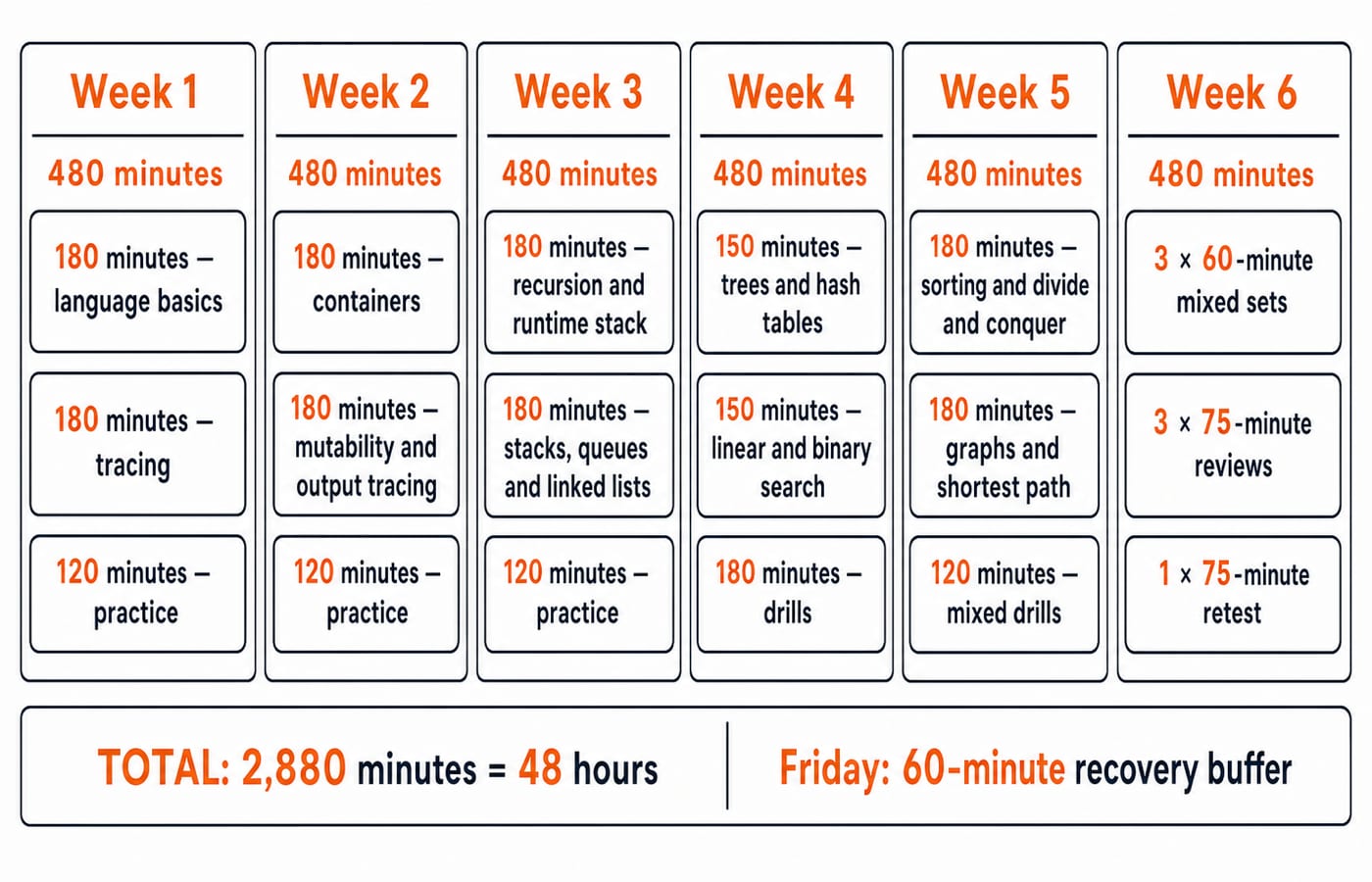
Weekly, use Monday to Thursday for 60 minutes daily, Saturday for 150 and Sunday for 90; Friday is a buffer. That is 480 minutes = 8 hours, so 6 x 480 = 2,880 minutes = 48 hours. End with a trace, implementation, error-log row or retest.
Week | Topic map |
|---|---|
1 | Expressions, types, control flow, functions, name binding |
2 | Strings, lists, tuples, sets, dictionaries, slicing, aliasing, mutability |
3 | Recursion, runtime stack, stacks, queues, linked lists |
4 | Trees, hash tables, linear search, binary search |
5 | Named sorts, divide and conquer, graph traversal, shortest path |
6 | Official-paper classification, three mixed sets, review, retest |
3. GATE DA Python Weeks 1-2: Learn Execution Before Memorising Syntax
Week 1 covers evaluation, short-circuiting, loops, calls, scope, defaults and returns. Week 2 covers containers, slicing, aliasing and mutability. Exclude OOP, generators and decorators unless they appear in the syllabus for your attempt.
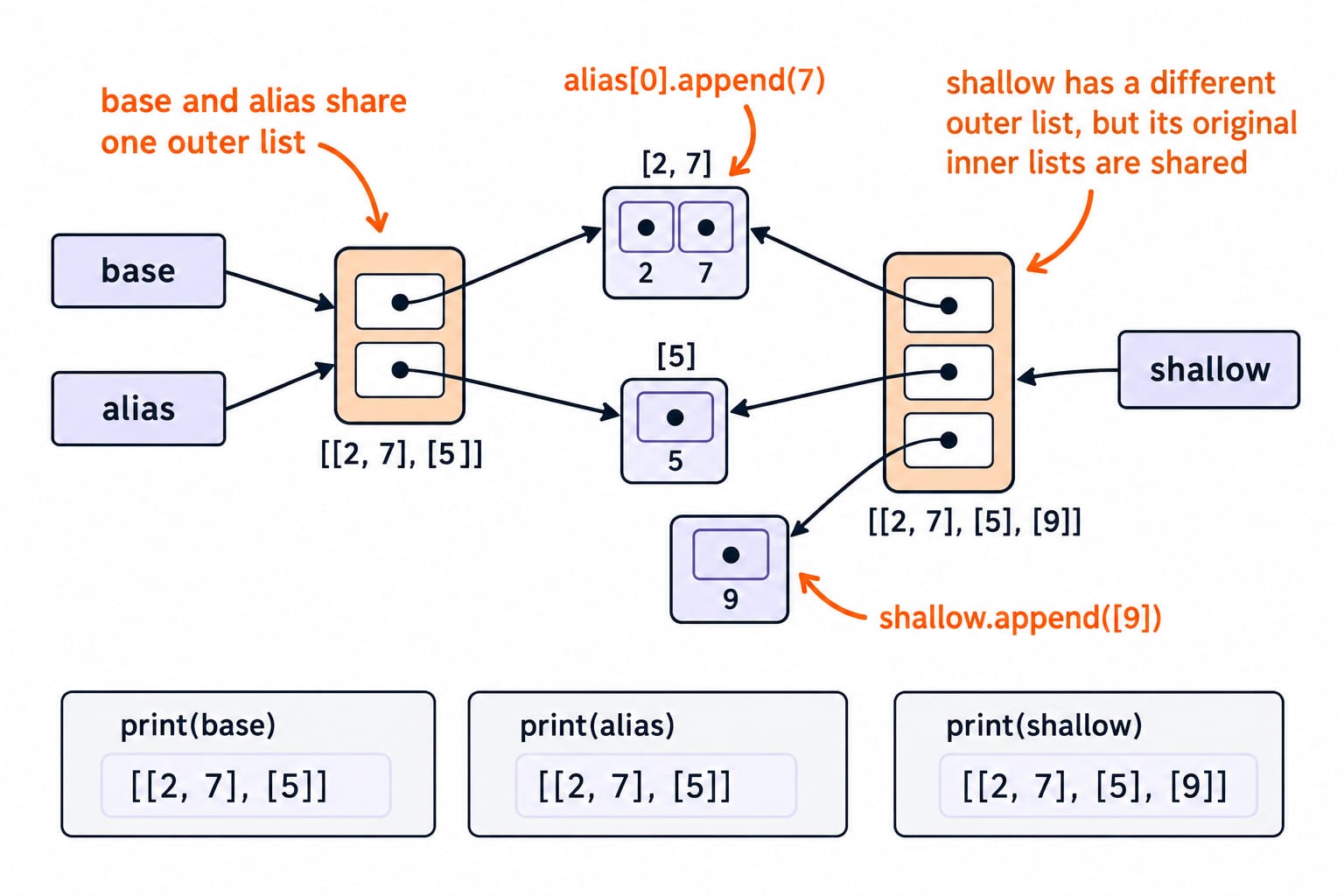
base = [[2], [5]]
alias = base
shallow = base[:]

alias[0].append(7)
shallow.append([9])

print(base)
print(alias)
print(shallow)[[2, 7], [5]]
[[2, 7], [5]]
[[2, 7], [5], [9]]base and alias share one outer list. shallow has a different outer list, so appending [9] affects only shallow, but its original inner lists are shared with base. Appending 7 through alias is therefore visible in all three names. Draw the outer and inner object identities before predicting output.
For extra aliasing and mutability patterns, work through Python Output-Based Questions: 13 Solved Snippets; it is practice material, not official weightage evidence.
4. GATE DA Python Week 3: Count Recursion and Model Linear Structures
def fold_gap(values, i=0):
    if i == len(values) - 1:
        return 0
    return abs(values[i] - values[i + 1]) + fold_gap(values, i + 1)

print(fold_gap([8, 3, 7, 4]))
The calls use i=0, 1, 2 and 3: four activations, not three differences. The returns unwind as 0, 3, 7 and 12, so the output is 12. Count the base call before adding the work performed by earlier frames.
push 6, push 2, pop, push 9 removes 2, leaving [6,9] bottom to top. enqueue 6, enqueue 2, dequeue, enqueue 9 removes 6, leaving [2,9] front to rear. Insert 16 after 12 in 12 -> 20 -> 31, then delete 20: 12 -> 16 -> 31. Mark changed ends or links. In 20 minutes, trace two recursion chains, two linear structures and one linked-list update.
5. GATE DA Python Weeks 4-5: Trace Search, Hashing, Sorting and Graphs
For target 50 in [3,7,11,18,24,31,43,56,72,88,95], binary search compares 5:31, 8:72, 6:43, 7:56. Four comparisons leave low=7, high=6: absent.
With m=7, h(k)=k mod 7, 18 occupies 4. Keys 25 and 39 hash to 4, then take 5 and 6. Key 47 hashes to 5, probes 6, then 0. Slots: 0:47, 4:18, 5:25, 6:39.
Insertion sort on [7,3,5,2] gives [3,7,5,2], [3,5,7,2], [2,3,5,7]: five shifts (1+1+3) and six comparisons (1+2+3). Mergesort splits [7,3]|[5,2], then merges [3,7]|[2,5] into [2,3,5,7]. Quicksort with final pivot 2 partitions to [2,3,5,7]; pivots 7 and 5 then remain. The latter two use divide and conquer.
For A:{B,C}, B:{D,E}, C:{E}, D:{F}, E:{F}, alphabetical BFS queues are [A], [B,C], [C,D,E], [D,E], [E,F], [F], []. Visit A,B,C,D,E,F; A to F is 3 edges. Classic Programs in C, Java, Python: Fibonacci, Prime, GCD provides additional implementation warm-ups after you can reproduce these traces by hand.
6. GATE DA Python Week 6: Turn PYQs into an Error-Repair Loop
Work through your cycle's official GATE DA papers on the organising institute's papers page, classify every missed question by family, and never treat the counts as a frequency forecast:
Question family | What to trace |
|---|---|
Mutable default arguments | Shared-list state across calls |
Recursion | Return values and total activations |
Stacks, queues and linked lists | State after each operation |
Search and sorting | Indices, comparisons, swaps and cumulative output |
Spend 3 x 60 + 3 x 75 + 75 = 480 minutes on three sets, three reviews and a retest. Classify errors: language state, recursion, data-structure state, algorithm trace, complexity or careless reading. Log prompt, answer, first error, correct state, repair and result.
A 20-item set yields 13 correct, 4 wrong, 3 unattempted: attempted accuracy is 13/17 = 76.5%. Repair two shared-list errors, one leaf-only call count and one early binary-search stop. A fresh 7/8 = 87.5% retest shows repair, not a score forecast.
7. GATE DA Python Missed Days: Protect Review and Drop Low-Value Repetition
Friday absorbs a missed 60-minute session. Lose Saturday's 150? Keep Sunday's 90-minute review; next Saturday, replace 120 new-work minutes with missed core work and drop 30 repetitive minutes. Avoid 300-minute punishment.
Below five hours, carry one topic. Protect state tracing, recursion, search, hashing and named structures. Defer extras; start with 20-minute recall.
Training gates: 8/10 output traces; 4/5 recursion problems separating values and calls; 4/5 search, sort or hashing traces; 80% attempted accuracy across two sets. Give only a failed family 60-minute repair.
8. Python for GATE DA: The Short Version and Next Step
Confirm DA. Spend 48 hours on execution, containers, recursion, structures, search, hashing, sorting and graphs, then review and retest.
Use Python Course: Concepts, MCQs & Coding for fluency, or DSA Using Python for algorithms. For official scope, compare both through Coding & DSA Courses for Placements, then verify the syllabus for your attempt.
Keep learning

Python for GATE: CS vs DA Syllabus, Past-Paper Evidence and a 10-Week Plan
Choose the right Python preparation path for GATE CS or DA, then use two worked traces and three diagnostic gates to test your progress.
Updated 30 Oct 20264 min read51 viewsPython

Python for GATE: DA Syllabus, Observed Weightage and Prep Order
Settle the DA-versus-CS language question, see what one official DA paper contained, and build Python, data structures and algorithms in the right sequence.
Updated 6 Nov 20265 min readPython

Python for GATE DA: Programming and Data Structures, the Output Questions to Master
Build the Python mental model that GATE DA output and complexity questions demand, with a complete aliasing trace, a structure-cost table and safe rules for common traps.
Updated 1 Aug 20265 min read109 viewsDSA & Algorithms

Knowledge of ICT for GATE: A 6-Week Topic-by-Topic Preparation Plan
Turn a scattered ICT syllabus into six connected weeks of study. This plan shows what to learn, what to calculate and how to repair weak areas in ten hours a week.
Updated 21 Nov 20265 min readGATE Strategy & Roadmap