

Knowledge of ICT for GATE: A 6-Week Topic-by-Topic Preparation Plan
Turn a scattered ICT syllabus into six connected weeks of study. This plan shows what to learn, what to calculate and how to repair weak areas in ten hours a week.
KnowledgeGate Team
Exam prep & CS education
Updated 21 Nov 20265 min read
Knowledge of ICT is not a standalone subject in the GATE CS syllabus. The umbrella term breaks into Digital Logic, Computer Organization, Operating Systems, Databases and Computer Networks, where recognition must become calculation and tracing. Six weeks can build a first technical pass with 10 honest hours a week, while the official syllabus decides the boundary and PYQs decide the depth.
1. GATE ICT scope: build the subject map before Week 1
Check the syllabus for your paper on the official GATE exam papers and syllabus page. A completed-cycle syllabus is evidence for that cycle, not a permanent promise, so recheck the document for your attempt.
Use ICT for GATE CS: Which Syllabus Areas It Maps To and the Weightage Pattern to settle the boundary and weightage questions. Organise the named subjects through the GATE CS Exam Preparation catalogue and treat office tools, e-governance and digital-literacy facts as out of scope unless your syllabus names them.
Before Week 1, attempt one representative problem from each of the five subjects without notes. For every failure, mark the first broken step: concept model, setup, execution or verification. That label determines the first repair block; a raw percentage cannot tell you whether you lacked the rule or merely lost a sign.
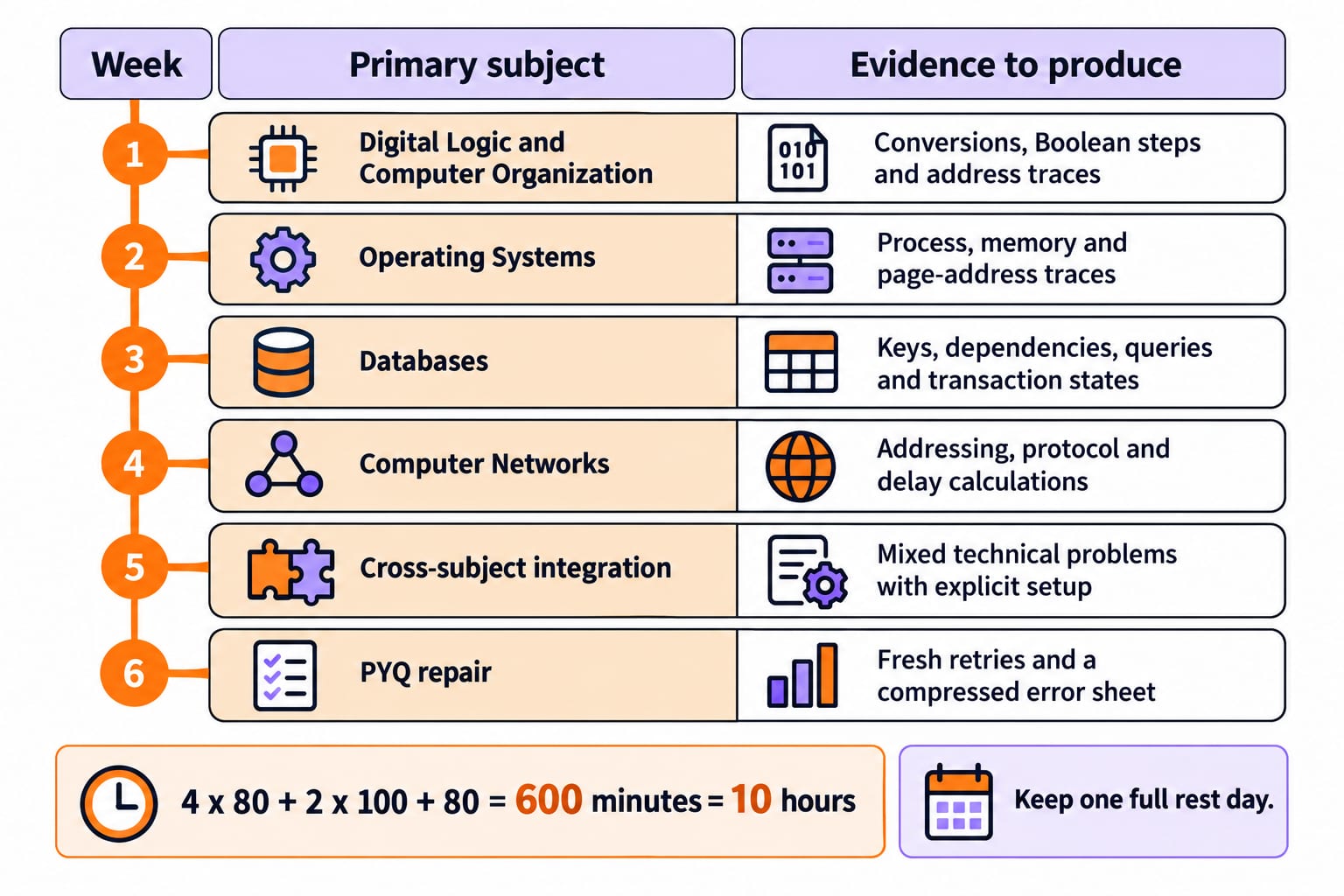
Each week uses four 80-minute concept-and-trace sessions, two 100-minute problem sessions and one 80-minute repair review. 4 x 80 + 2 x 100 + 80 = 600 minutes = 10 hours. Keep one full rest day. If the week contracts, protect the problem sessions and repair review, then move low-priority rereading forward.
Week | Primary subject | Evidence to produce |
|---|---|---|
1 | Digital Logic and Computer Organization | Conversions, Boolean steps and address traces |
2 | Operating Systems | Process, memory and page-address traces |
3 | Databases | Keys, dependencies, queries and transaction states |
4 | Computer Networks | Addressing, protocol and delay calculations |
5 | Cross-subject integration | Mixed technical problems with explicit setup |
6 | PYQ repair | Fresh retries and a compressed error sheet |
2. Week 1: binary representation, Digital Logic and Computer Organization
Start with number systems, signed representation and Boolean algebra, then connect registers, memory, cache and addressing. Do not stop at device names. Every session should end with a conversion, truth table, simplification or address calculation.
For binary storage, 1 MiB = 2^20 bytes. Therefore 2 MiB = 2 x 1,048,576 = 2,097,152 bytes, and multiplying by eight gives 16,777,216 bits. Decimal 2 MB is 2,000,000 bytes, so the label controls the arithmetic. Finish with four conversions, two Boolean simplifications and one memory-address trace, all redone from a blank sheet.
3. Week 2: Operating Systems through memory and process traces
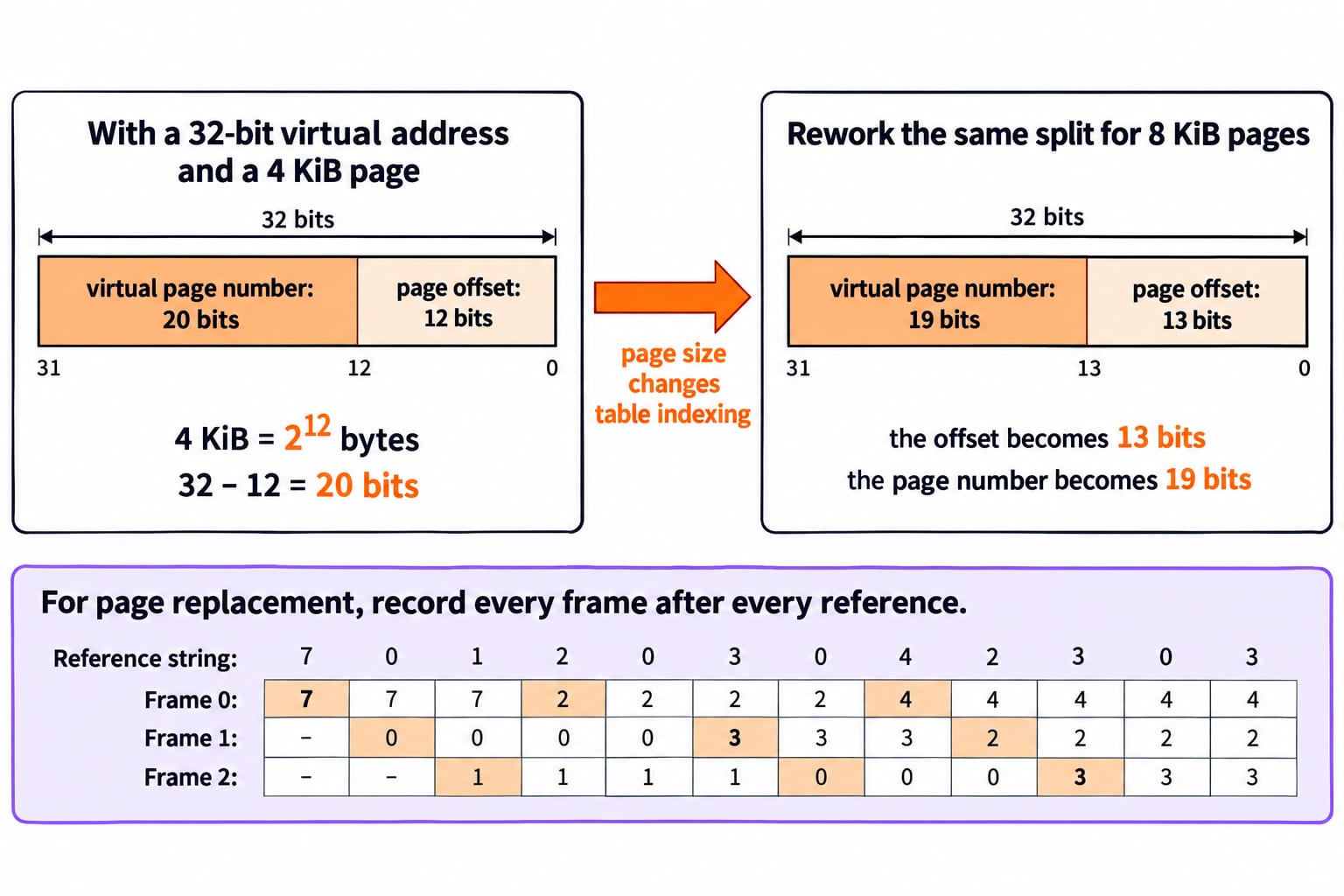
Study processes and threads, CPU scheduling, synchronisation, deadlock, virtual memory, file systems and I/O through state changes. For scheduling, draw the ready queue after each event. For page replacement, record every frame after every reference. A final fault count without the trace is not enough evidence.
With a 32-bit virtual address and a 4 KiB page, 4 KiB = 2^12 bytes, so the page offset needs 12 bits. The remaining 32 - 12 = 20 bits form the virtual page number. Rework the same split for 8 KiB pages: the offset becomes 13 bits and the page number becomes 19 bits. This single exercise checks powers of two, address fields and the reason page size changes table indexing.
4. Week 3: Databases as constraints, queries and transaction states
Cover relational keys, functional dependencies, normalisation, relational algebra, SQL, indexing and transactions. Use one small relation across the week instead of memorising disconnected definitions. Let Result(StudentID, CourseID, StudentName, Grade) have key (StudentID, CourseID) and dependency StudentID -> StudentName.
StudentName depends on part of the composite key, so the relation is not in second normal form. Decompose it into Student(StudentID, StudentName) and Result(StudentID, CourseID, Grade). Then write a join that reconstructs the report and trace one transaction from its initial state through update, rollback and commit. The week is complete only when you can defend the key, dependency and state transition.
5. Week 4: Computer Networks as addressing, protocols and delay
Move through layering, switching, error control, MAC, routing, IPv4, CIDR, transport and application protocols. Attach each protocol name to a job and a layer, then solve an addressing or timing problem. General statements such as “DNS converts names to addresses” are orientation; GATE preparation requires you to follow the data and units.
For 192.0.2.64/27, five host bits remain because 32 - 27 = 5. The block has 2^5 = 32 addresses, from 192.0.2.64 through 192.0.2.95. The network and broadcast addresses are not ordinary host addresses, leaving 32 - 2 = 30 usable host addresses, from 192.0.2.65 through 192.0.2.94. Verify each answer by writing the block boundary before counting hosts.
6. Week 5: connect the subjects through mixed technical problems
Week 5 is not another reading pass. Build sets that force a change of representation: binary to address fields, a process trace to a page reference, a relation to a query plan, and an IP prefix to a host range. For each problem, write four lines before checking the answer:
Given: the values and conventions stated in the question.
Find: the exact quantity, state or classification requested.
Model: the rule, invariant or data structure that applies.
Check: units, boundary cases and whether the result answers the stem.
Use one set from topics studied on different days and one from a single weak subject. The mixed set tests switching; the focused set tests depth. A question that was correct for the wrong reason still enters the repair queue.
7. Week 6: convert GATE PYQs into a repair queue
Use traceable previous-year questions from the syllabus areas you have actually studied. Run three mixed sets during the week. Review immediately, retry the same question from a blank page the next day, and use a fresh question on the same rule after 72 hours. Clear an error only after both retries work without notes.
Keep four repair columns: missing model, wrong setup, execution slip and failed verification. If the same model fails twice, return to teaching material. If setup fails, practise translating stems into givens and targets. If execution fails, slow the trace. If verification fails, add a unit or boundary check. Use the GATE Test Series for broader timed practice, not as evidence that a fixed number of ICT questions will appear.
When a week loses several sessions, carry one unfinished subject forward and keep the Week 6 retry cycle. Doubling the next day usually protects the calendar at the cost of understanding. The six-week endpoint is a verified error sheet and a reliable setup method, not the illusion that five GATE subjects are finished.
8. Knowledge of ICT for GATE: the short version and next step
First remove the false standalone-ICT bucket. Map the term to Digital Logic, Computer Organization, Operating Systems, Databases and Computer Networks. Build one subject trace each week, mix representations in Week 5, and let blank-page retries decide what survives Week 6.
For an optional subject-wise planning and performance framework, explore GATE Guidance by Sanchit Sir. Keep the current official syllabus and your own PYQ errors above any generic timetable.
Go deeper with the full courseGATE Guidance by Sanchit Sir
Keep learning
ICT for GATE CS: Which Syllabus Areas It Maps To and the Weightage Pattern
GATE CS has no standalone ICT subject. Learn where familiar ICT concepts appear in the engineering syllabus, how past-paper weightage tends to spread, and what to study first.
Updated 29 Oct 20264 min readTeaching Recruitment (Computer Science)

Information Security & Cyber Laws for GATE: A 6-Week Topic Plan
Build an adaptable six-week plan for security and cyber law topics, with a diagnostic hour budget, worked exercises, timed practice and a missed-day rule.
Updated 20 Nov 20265 min readGATE Strategy & Roadmap
Python for GATE DA: A 6-Week Topic-by-Topic Preparation Plan
Build reliable Python tracing skills, cover the DA syllabus topic by topic, and finish with a disciplined error-repair loop in 48 focused hours.
Updated 21 Nov 20265 min readPython

Algorithm for GATE: An 8-Week Topic-by-Topic Study Plan
Follow a dependency-aware eight-week Algorithm plan with nine focused hours each week, worked examples, delayed reattempts, and a practical rule for missed sessions.
Updated 30 Oct 20265 min readDSA & Algorithms