

Hexaware Placement Preparation: A 5-Week Aptitude-to-Interview Study Plan
Turn your current Hexaware drive instructions into a practical five-week schedule. Diagnose gaps, protect 12 hours each week, practise under time and finish with matched simulations.
KnowledgeGate Team
Exam prep & CS education
Updated 9 Nov 20266 min read

Studying aptitude, coding, CS fundamentals and interview answers wastes hours unless you convert the Hexaware drive notice into a weekly plan. This five-week, 60-hour route moves from diagnosis to simulations. Check the official Hexaware careers site and your drive communication. Drives differ by role, campus and assessment route, so follow their components and timings.
1. Map the current drive before allocating a single study hour
The Hexaware preparation curriculum covers quantitative, logical, verbal, C, C++, Java and Python, OOP, DBMS, SQL, operating systems, networks, coding, and HR and managerial interviews. Group these into seven buckets: quantitative, logical, verbal, programming plus core CS, coding, interview, and timed tests plus review. The Placement Preparation & Coding: Exams, Eligibility & Courses catalogue lists routes, but it does not define a Hexaware test. The LTIMindtree Placement Preparation: A 4-Week Section-Wise Study Plan owns the shorter 16-hour weekly model; Hexaware uses five weeks and seven buckets for its 60-hour balance.
Copy the stages, sections, languages, timings and navigation rules in your email or portal. Move hours from absent buckets to named ones, adding any new bucket before your first mock.
Run a two-hour diagnostic: 55 minutes for 50 objective questions, ten each on quantitative, logical, verbal, programming or pseudocode, and core CS; 30 minutes for one coding problem; 10 minutes for a 90-second project introduction; and 25 minutes to classify errors. Score objective accuracy, coding test cases and speaking separately.
2. Protect a 12-hour week and let the diagnostic control the balance
Suppose you score quantitative 5/10, logical 7/10, verbal 8/10, programming or pseudocode 6/10, and core CS 7/10. Then 5 + 7 + 8 + 6 + 7 = 33/50 = 66%. Record coding separately as 6/10 declared test cases passed and the introduction as 3/5 for structure, evidence, clarity, relevance and timing.
The 17 objective misses are quantitative 5, programming or pseudocode 4, logical 3, core CS 3, and verbal 2. Quantitative and executable technical work get the first repair blocks.
Protect this weekly clock: Monday to Thursday, 90 minutes x 4 = 6 hours; Friday, 1 hour for retrieval and the error log; Saturday, 3 hours for a timed set, coding and review; Sunday, 2 hours for recovery or the weakest bucket. Thus 6 + 1 + 3 + 2 = 12 hours, and 12 x 5 = 60 hours. The TCS 84-hour study plan owns the six-week, 84-hour calendar; Hexaware uses five weeks, seven buckets and a 60-hour balance.
3. Weeks 1 and 2: repair aptitude without postponing coding
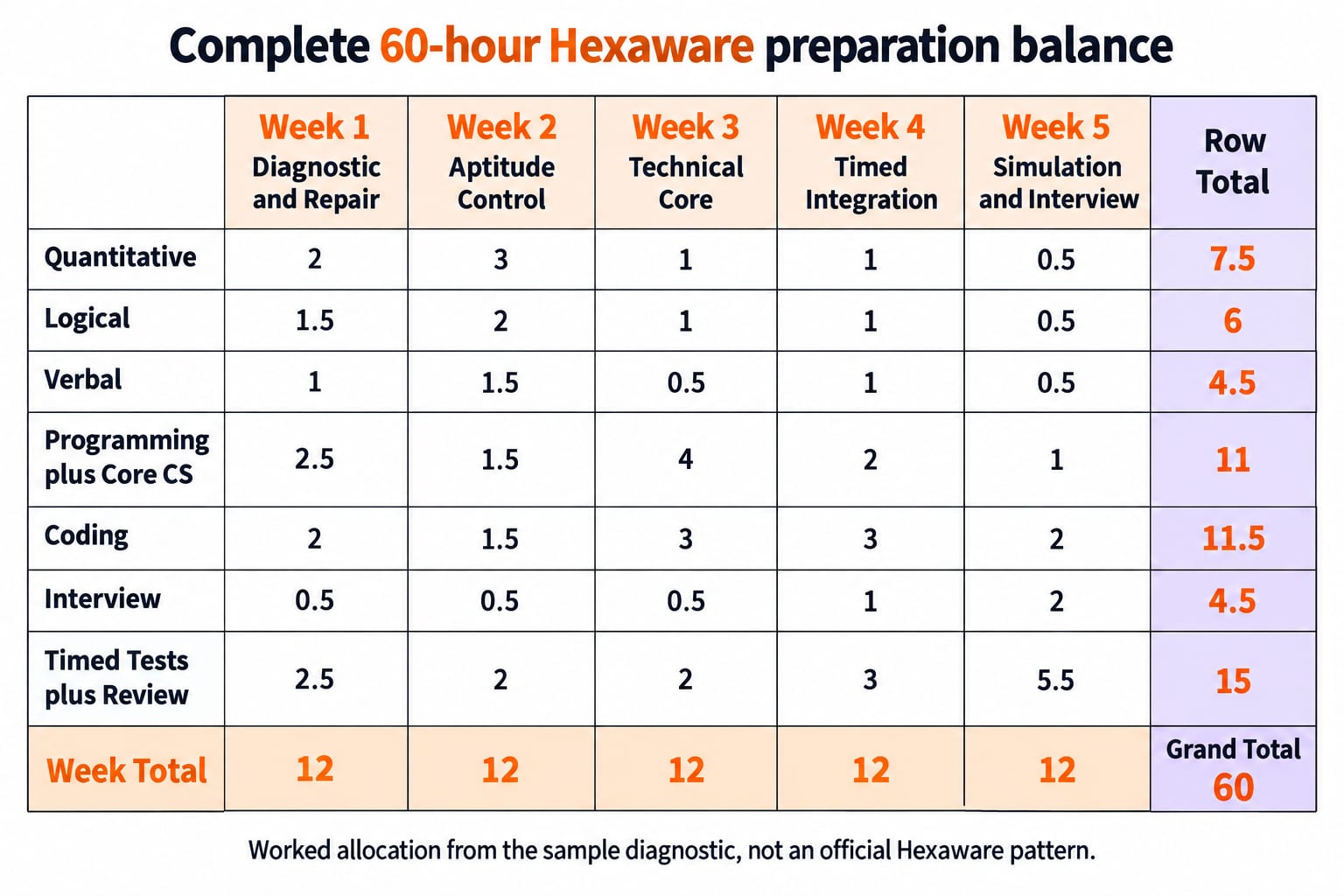
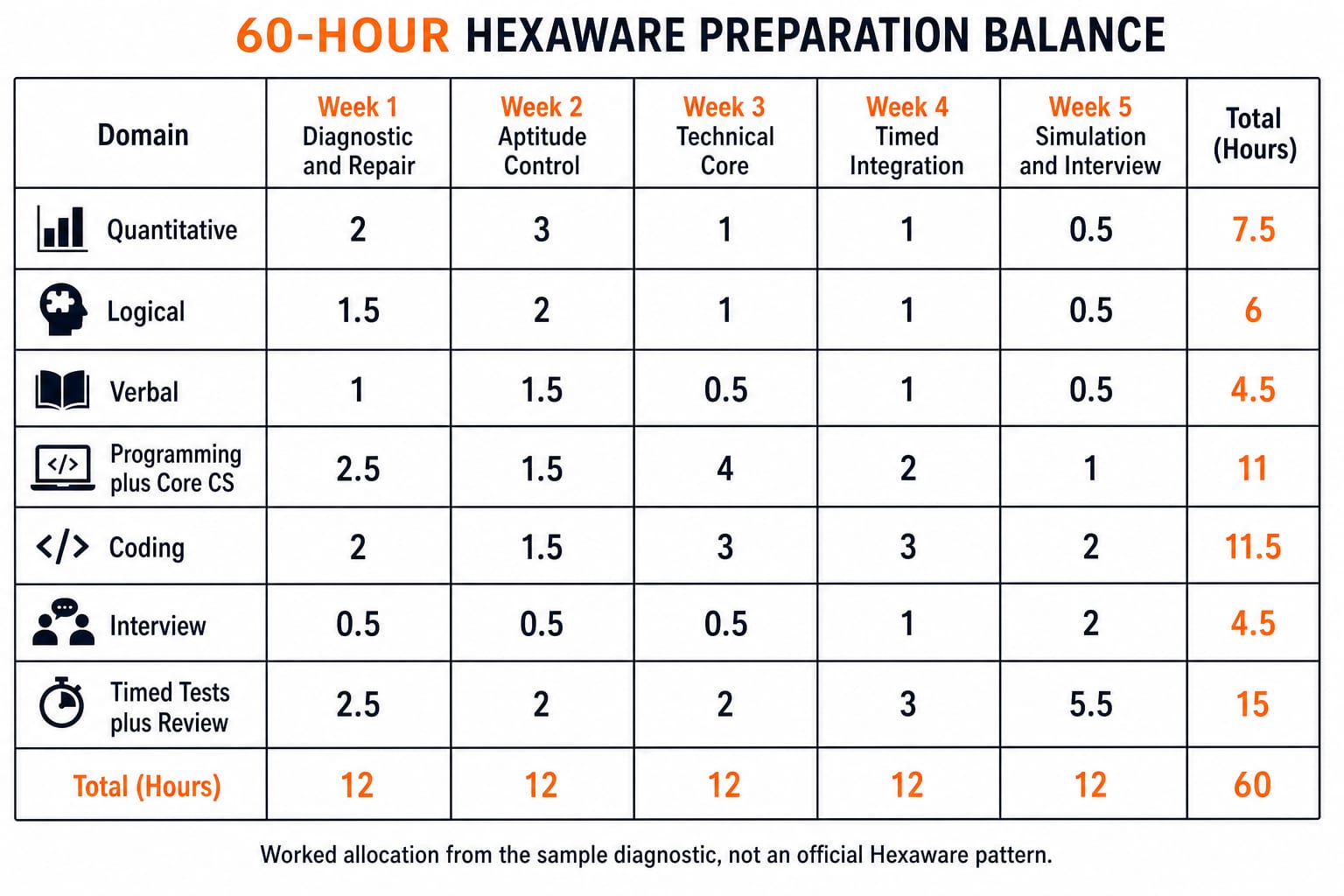
Week 1 uses quantitative 2 hours, logical 1.5, verbal 1, programming plus core CS 2.5, coding 2, interview 0.5, and tests plus review 2.5. Week 2 uses 3, 2, 1.5, 1.5, 1.5, 0.5, and 2 hours respectively. In each 90-minute aptitude block, spend 25 minutes on concepts, 45 solving, and 20 checking and logging.
Prioritise percentages, ratios, averages, time and work, number properties, series, coding-decoding, directions, arrangements, grammar and comprehension. If cost price is 800, marking it 25% higher gives 800 x 1.25 = 1,000. A 12% reduction gives 1,000 x 0.88 = 880. Profit is 880 - 800 = 80, so profit percentage is 80/800 x 100 = 10%. The reduction uses marked price; profit percentage uses cost price.
Use the Aptitude for Placement course for structured practice. Keep coding so Week 3 does not begin from zero.
4. Week 3: make programming and core-CS knowledge executable
Allocate quantitative 1 hour, logical 1, verbal 0.5, programming plus core CS 4, coding 3, interview 0.5, and tests plus review 2. Split 240 minutes into programming fundamentals 60, OOP 45, DBMS plus SQL 75, operating systems 30, and networks 30: 60 + 45 + 75 + 30 + 30 = 240. Each topic card needs a definition, mechanism, example and contrast.
Choose one permitted language rather than rotating among C, C++, Java and Python. Dry-run, implement, explain complexity and test edge cases in every coding block.
For hexaware, build frequencies h:1, e:2, x:1, a:2, w:1, r:1. A second left-to-right pass returns h, the first non-repeating character. Test aabb -> -1, empty string -> -1, and z -> z. Target O(n) time and O(k) space for k distinct characters. Two passes prevent returning before later duplicates are counted.
5. Week 4: combine sections under time and review decisions
Use quantitative 1 hour, logical 1, verbal 1, programming plus core CS 2, coding 3, interview 1, and timed tests plus review 3. Run a self-made 50-question mixed set in 60 minutes unless invitation differs. Label questions attack, park or leave: attack when the first step is clear, park when the route is valid but lengthy, and leave when no route is visible. The eLitmus accuracy-first plan is a separate selection reference; it does not define Hexaware sections or scoring.
For 42/50 attempted, 35 correct, 7 wrong and 8 skipped, attempt accuracy is 35/42 x 100 = 83.3%; coverage is 42/50 x 100 = 84%; 35/50 = 70% is overall correctness, not attempt accuracy.
Classify errors: three concept gaps, two misreads and two poor time decisions. Schedule two 30-minute concept repairs, a 15-minute slow-reading drill and a 20-minute selection drill: 30 + 30 + 15 + 20 = 95 minutes. Solve changed-value variants after 48 hours. Record four 90-second answers: introduction, project decision, technical disagreement, and failure with a concrete correction.
6. Week 5: simulate the current route and narrow revision
Allocate quantitative 0.5 hour, logical 0.5, verbal 0.5, programming plus core CS 1, coding 2, interview 2, and simulations plus review 5.5. Two illustrative simulations use 75 minutes of mixed objective work plus 30 minutes of coding each: 105 x 2 = 210 minutes. Two 45-minute reviews add 90 minutes; portal, device, network, identification and resume checks add 30. Total: 210 + 90 + 30 = 330 minutes = 5.5 hours.
Use the 75 + 30 split only when the invitation gives no different rule; then reproduce its sections, order, timing, navigation, languages and marking. Record uncertainty and ask the platform or recruiter before treating a rule as fixed.
Divide interview time into 30 minutes each for a project walkthrough, core-CS oral questions, HR or managerial responses, and one recorded mock. In the final two study days, revise only the error log, failed edge cases, retrieval cards and recorded answers. Do not start a new language, framework or large subject.
7. Recover honestly, use progress gates and take the next step
Move one missed 90-minute weekday into Sunday's two-hour block, leaving 30 minutes for weak-topic repair. If two are missed, recover the highest-priority two hours on Sunday and defer one low-priority hour. If 4 hours or more disappear, preserve the timed test, review, coding and sleep, then extend the plan by a week.
Internal gates, not cutoffs: after Week 2, score 16/20 in two fresh aptitude sets and explain repeated errors; after Week 3, implement hexaware with three edge cases and answer five technical cards without notes; after Week 4, maintain 80% attempt accuracy across the latest three comparable mixed sets, reviewing each first.
Short version: map the invite, diagnose, protect 12 hours, practise under its rules, review, repair and simulate. The Hexaware Preparation Course is the structured next step. AMCAT is a separate scheduling reference; use the Hexaware communication.
Keep learning

LTIMindtree Placement Preparation: A 4-Week Section-Wise Study Plan
Start with a diagnostic, turn your errors into a weekly timetable, and use four focused weeks for aptitude, coding, CS fundamentals, communication and interview practice.
Updated 6 Nov 20266 min readCompany-Specific Prep
Tech Mahindra Placement Preparation: A 6-Week, 72-Hour Study Plan
Build a realistic Tech Mahindra placement routine from a 90-minute audit, then use a fixed 12-hour weekly ceiling, worked drills and an error ledger to improve without copying an outdated pattern.
Updated 1 Nov 20265 min readCompany-Specific Prep

HCLTech Placement Preparation: 6-Week, 84-Hour Test Plan
Build your HCLTech test preparation around 84 planned hours, measurable diagnostics, timed practice and a recovery rule that survives missed days.
Updated 30 Oct 20266 min readCompany-Specific Prep
Capgemini Placement Preparation: An 8-Week Test-Matched Study Plan
Build an eight-week Capgemini preparation timetable from the route you are actually invited to take. Use two baselines and an error log to decide where every study hour goes.
Updated 30 Oct 20265 min readCompany-Specific Prep