

Hexaware Recruitment Process and Test Pattern: What to Prepare for Each Round
Do not prepare for a generic Hexaware pattern. Build your plan from the current invitation, then practise the skills and explanations each listed stage needs.
KnowledgeGate Team
Exam prep & CS education
Updated 8 Nov 20264 min read
Search results often present a fixed Hexaware process, but the Hexaware careers page lists opportunities rather than a universal fresher sequence. Your current job post or drive email controls the stages. Verify it, then prepare without inventing counts or cutoffs.
Hexaware drive verification: map only listed rounds
Use the latest post or email to identify these six fields before you choose a study sequence:
role title
location
assessment platform
named sections
scheduled duration
documents and system requirements
Use the verified Hexaware careers page to verify the role and application route. A request to pay money for a job offer is a warning sign, so confirm every instruction through the current official communication.
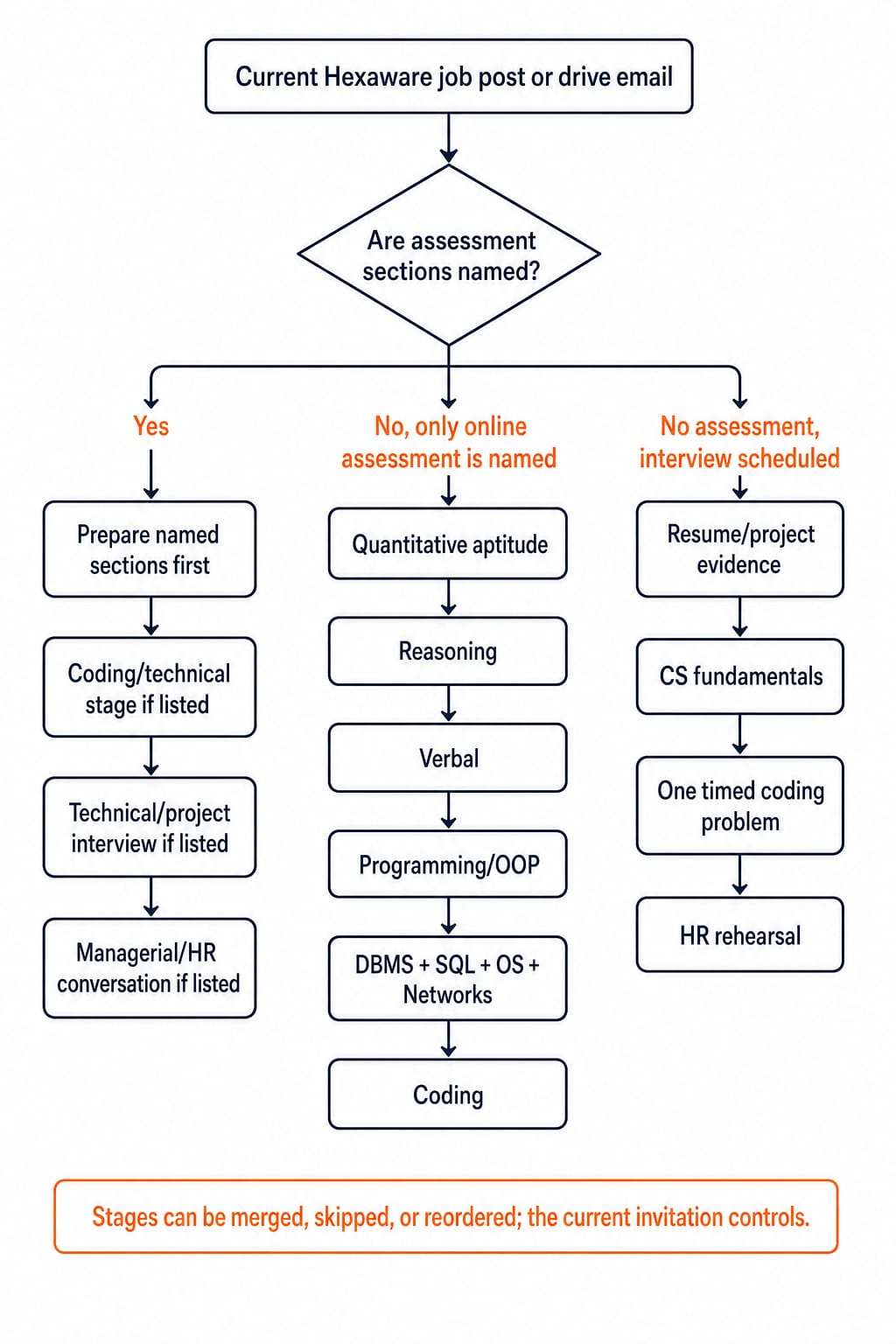
Rounds may be combined, skipped, or reordered, so follow the sequence in the current communication.
Build a candidate-specific recruitment map
A provisional path is application or shortlisting, assessment if named, coding or technical screening if named, technical or project interview, then a scheduled managerial or HR conversation. Produce its evidence: an assessment response, executable code, reasoned answer, concise project explanation, or truthful behavioural example.
Prepare listed sections first. If only "online assessment" is named, cover the six buckets. For direct interview, prioritise project evidence, CS fundamentals, one timed coding problem, and HR answers.
Decode the test pattern without making up counts
The Hexaware preparation course covers aptitude, reasoning, verbal ability, programming and OOP, DBMS, SQL, operating systems, networks, coding, and HR preparation. Use it as a study syllabus, not proof of an official pattern.
Bucket | Representative task | Ready when |
|---|---|---|
Quantitative | Percentage with a written shortcut | Steps and estimate agree |
Reasoning | Syllogism with a diagram | Every conclusion is tested |
Verbal | Para-jumble using an ordering clue | The clue is stated |
Programming/OOP | C, Java, or Python output trace | State changes are explained |
CS fundamentals | Normalisation plus SQL, OS, and networks | The reason follows the answer |
Coding | One complete solution | Normal, edge, and empty input are tested |
The Accenture recruitment process guide owns a generic stage-map treatment. This post owns Hexaware invitation verification and the diagnostic below. The Tech Mahindra recruitment process guide covers that employer's stages; use the current Hexaware communication for this drive. For broader practice, use the company-specific placement preparation category.
Turn a 24-item diagnostic into an 8-hour repair plan
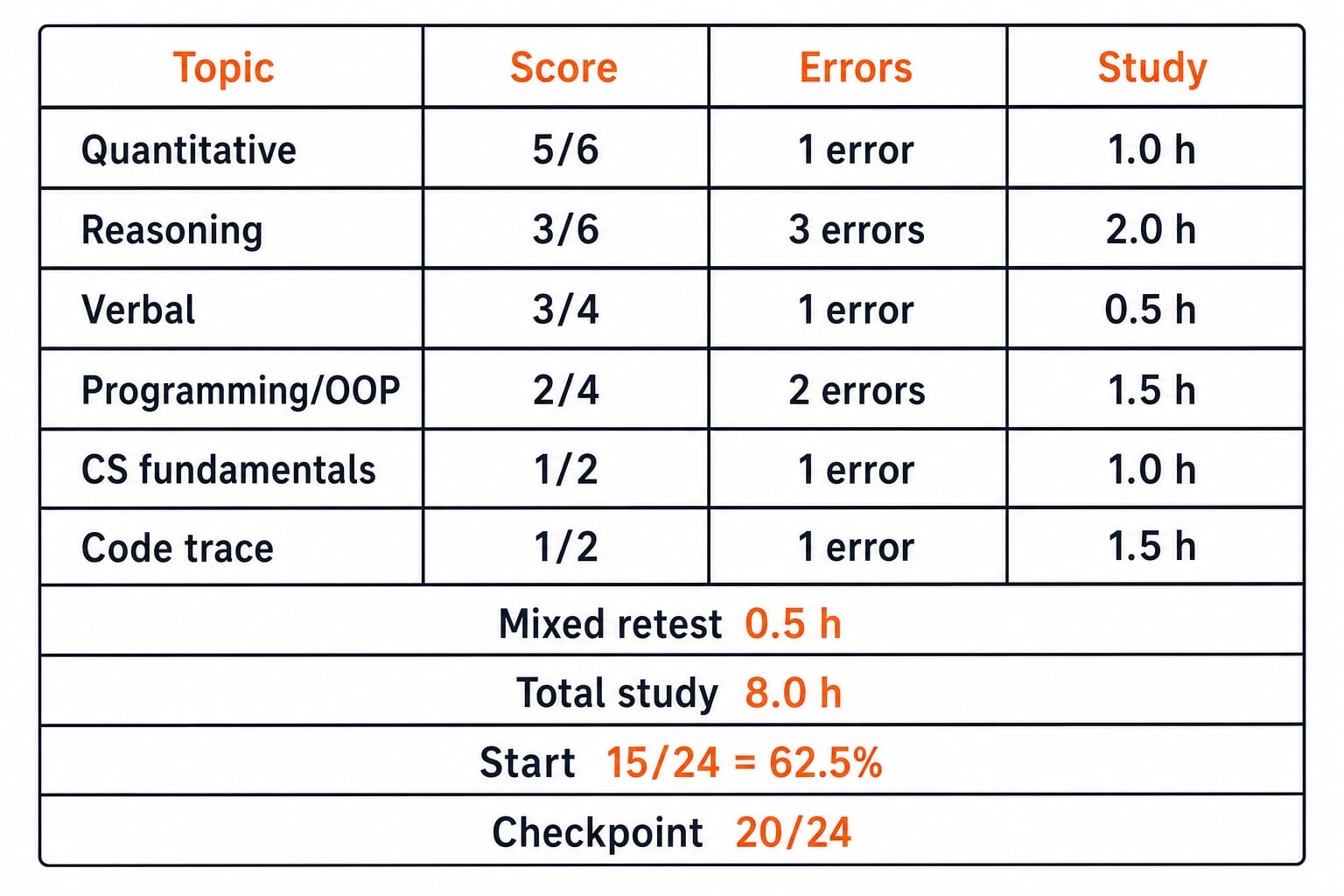
For an illustrative diagnostic, use 6 quantitative, 6 reasoning, 4 verbal, 4 programming/OOP, 2 CS-fundamentals, and 2 code-trace items.
Bucket | Score | Errors | Repair time |
|---|---|---|---|
Quantitative | 5/6 | 1 | 1.0 h |
Reasoning | 3/6 | 3 | 2.0 h |
Verbal | 3/4 | 1 | 0.5 h |
Programming/OOP | 2/4 | 2 | 1.5 h |
CS fundamentals | 1/2 | 1 | 1.0 h |
Code trace | 1/2 | 1 | 1.5 h |
5 + 3 + 3 + 2 + 1 + 1 = 15 correct out of 24. Thus 15/24 x 100 = 62.5%, with 24 - 15 = 9 errors. Add a 0.5-hour mixed retest: 1 + 2 + 0.5 + 1.5 + 1 + 1.5 + 0.5 = 8 hours. Aim for 20/24 on the retest, including at least 5/6 in reasoning and 3/4 in programming/OOP. These are self-study checkpoints, not Hexaware cutoffs.
Prepare explainable coding and technical answers
For [4, -1, 2, 1, -5, 4], find the maximum contiguous subarray sum. In Kadane's algorithm, running is the best sum ending at the current value, while best is the best seen overall.
Value | Running | Best |
|---|---|---|
4 | 4 | 4 |
-1 | 3 | 4 |
2 | 5 | 5 |
1 | 6 | 6 |
-5 | 1 | 6 |
4 | 5 | 6 |
The answer is 6 from [4, -1, 2, 1], in O(n) time and O(1) extra space. Trying every start and end pair takes O(n^2) time.
Before coding, clarify empty-array behaviour. State the invariant, code and tests: [5] -> 5, [-3, -2, -7] -> -2, and [0, 0] -> 0. Be ready to explain composite-index order in DBMS, WHERE versus HAVING in SQL, process versus thread in operating systems, and TCP versus UDP in networks.
Make project, managerial, and HR answers evidence-led
Use problem, action, result, and trade-off. Illustratively, an API's median latency was 420 ms over a 10,000-request test. Adding a composite index and removing an N+1 query reduced it to 180 ms, while write time rose by an illustrative 8%. Explain how each figure was measured and what you would test next.
Follow a seven-day, 14-hour plan
Day | Two-hour plan |
|---|---|
1 | Verify the drive for 30 min; diagnostic for 90 min |
2 | Quantitative for 60 min; reasoning for 60 min |
3 | Verbal for 45 min; programming/OOP for 75 min |
4 | DBMS, SQL, operating systems, and networks for 30 min each |
5 | Two coding problems for 60 min each |
6 | Project questioning for 60 min; technical mock for 60 min |
7 | Mixed mock for 60 min; error review and HR rehearsal for 30 min each |
Seven days at two hours gives 7 x 2 = 14 hours. Day 7 is the first recovery buffer. If two days are lost, retain verification, the diagnostic, one coding problem, the project mock, and the mixed mock. Cut duplicate drills instead of forcing a four-hour catch-up.
The short version
Trust the current official communication over generic patterns.
Verify the sender, and never pay for an offer.
Diagnose before revising.
Practise code plus explanation.
Rehearse evidence from your projects.
Start with the Hexaware preparation course above for company-focused practice. For broader aptitude, coding, CS, resume, and interview work, continue with the complete placement bundle.
Keep learning
Hexaware Interview Questions and Answers: Technical, Coding and HR Rounds
Prepare answers that survive follow-up questions. This guide covers CS fundamentals, a worked SQL query, a coding trace, project defence, HR responses and a timed mock.
Updated 11 Nov 20266 min readCompany-Specific Prep
Hexaware Coding Questions: 4 Patterns with Worked Examples
Learn four coding patterns through exact dry runs: a reverse scan, sliding window, prefix-suffix products and spiral traversal. Each example includes complexity and edge cases.
Updated 10 Nov 20265 min readCompany-Specific Prep
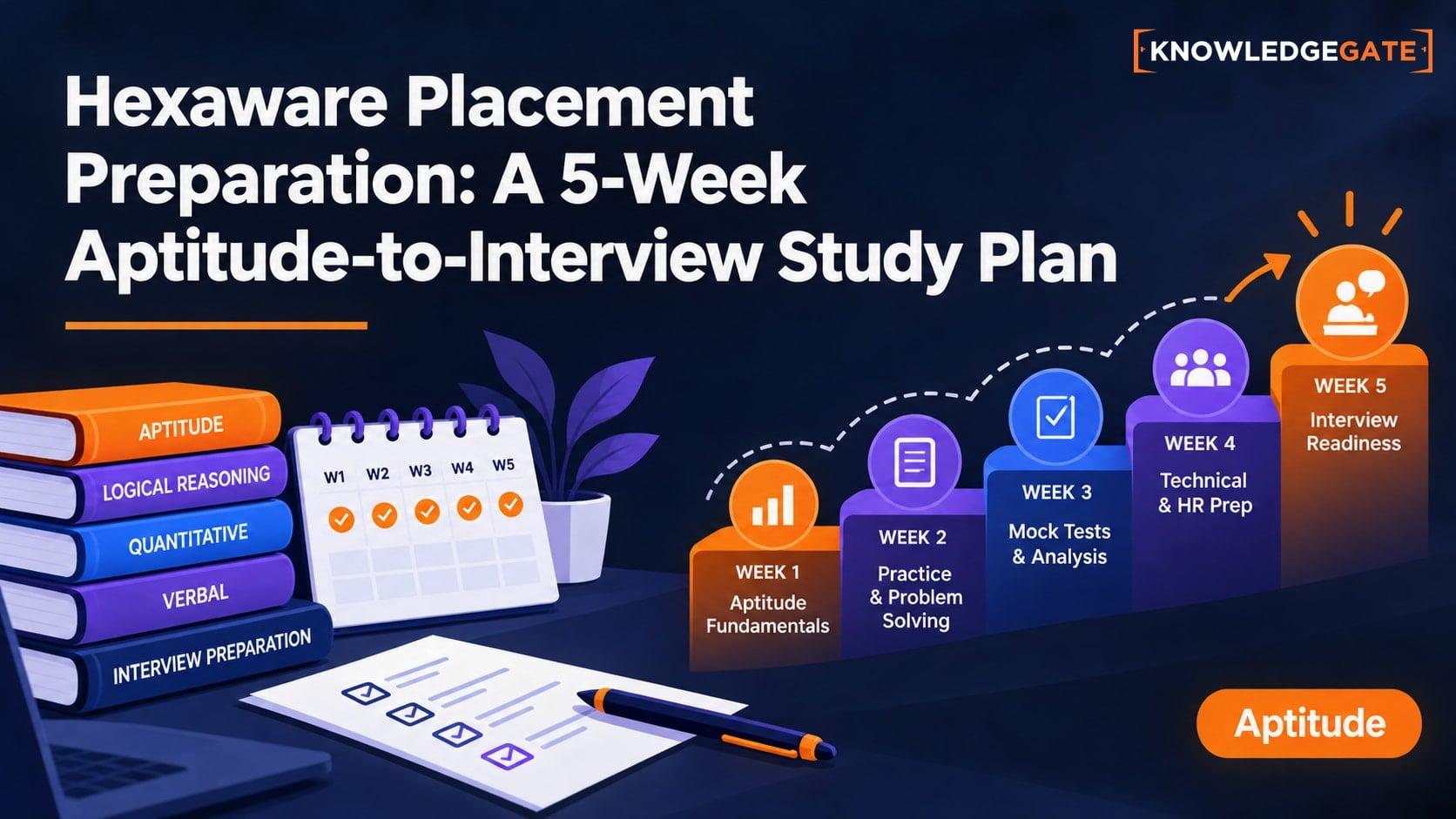
Hexaware Placement Preparation: A 5-Week Aptitude-to-Interview Study Plan
Turn your current Hexaware drive instructions into a practical five-week schedule. Diagnose gaps, protect 12 hours each week, practise under time and finish with matched simulations.
Updated 9 Nov 20266 min readCompany-Specific Prep
TCS NQT Coding Round Edge Cases: Pre-Submission Test Plan
Use this home-practice plan to expose boundary, duplicate, negative-value, overflow, state-reset, and output-format bugs before you submit code.
Updated 30 Oct 20265 min readCompany-Specific Prep