

GATE CS Backlog Recovery Plan: Rebuild in 14 Days Without Starting Over
Missed weeks do not require a complete restart. Use this 14-day method to triage pending work, preserve earlier learning, and rejoin your main study plan.
KnowledgeGate Team
Exam prep & CS education
Updated 24 Nov 20265 min read
Three missed weeks can turn your old timetable into red carry-forwards. Do not hide the backlog or erase completed subjects and return to Week 1.
This 14-day sprint audits unfinished work, protects earlier learning, and creates a gate back to the longer plan.
1. Freeze the old calendar and calculate the real recovery budget
Stop moving missed tasks into tomorrow. Preserve the old calendar as evidence, then list only repeatable hours. Ignore optimistic one-off Sundays.
Suppose the old plan allowed 18 weekly hours, but college and travel now leave 12. Keep 4 for completed-subject revision and PYQs, and 2 as slip buffer.
12 - 4 - 2 = 6 hours of backlog work per week
Across 14 days, 6 x 2 = 12 hours. If selected work exceeds that budget, shrink or park it before scheduling. Borrowing the maintenance floor only creates another backlog.
2. Sort unfinished work into finish, shrink, park, or protect
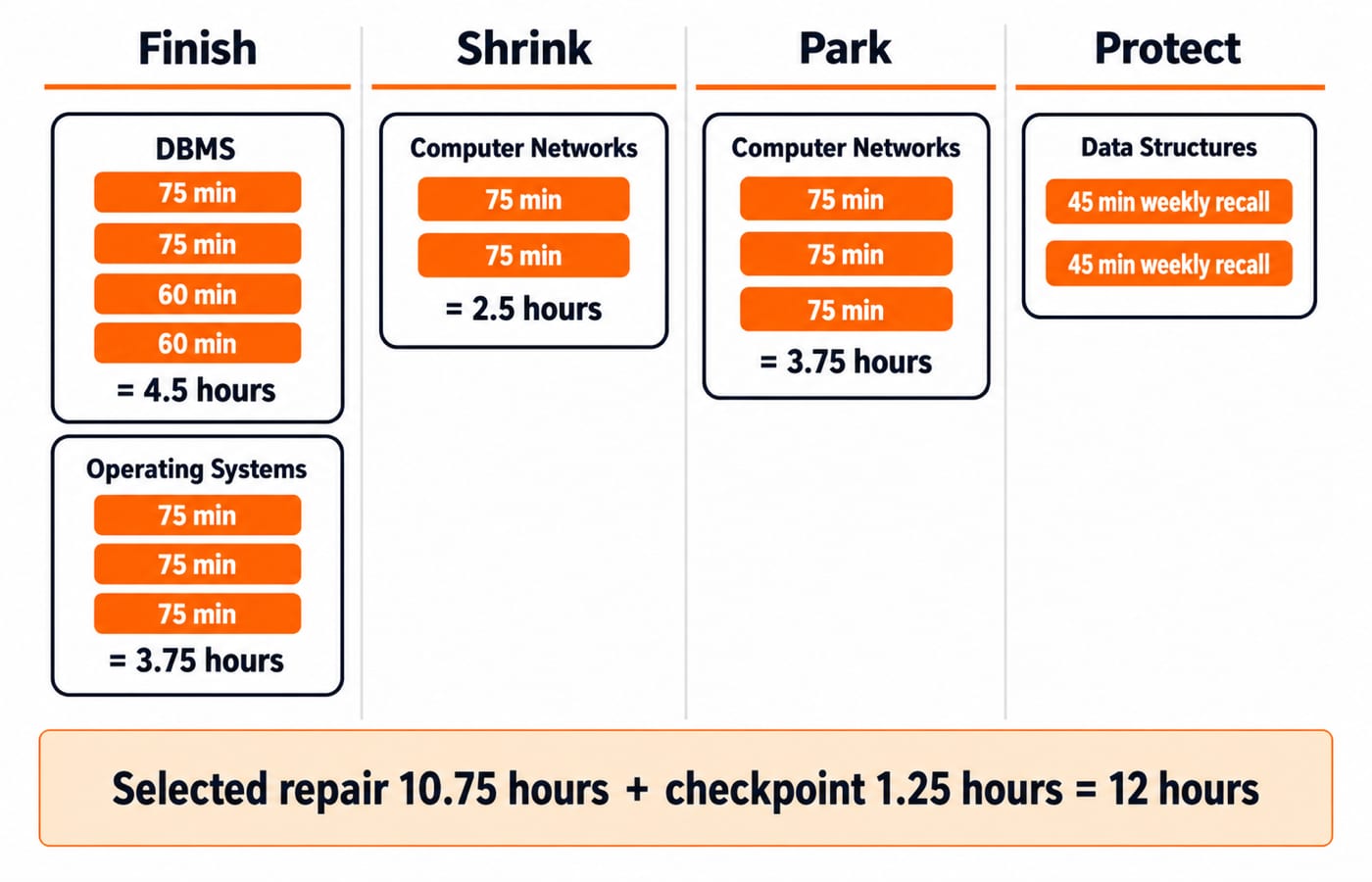
Use one audit table. The prerequisite-led GATE CS subject order owns the dependency question: which subject should come before another. This recovery board owns a different decision: which already-planned work to finish, shrink, park, or protect after time has been lost. Use prerequisites first, then combine weightage with mock and PYQ errors. Generic order is not personal diagnosis.
Subject or unit | Evidence of current level | Remaining task | Time estimate | Decision | Exit check |
|---|---|---|---|---|---|
DBMS | Recall intact, query errors remain | Four blocks: 75, 75, 60, 60 minutes | 4.5 hours | Finish | Four outputs plus checkpoint |
Operating Systems | Partly covered | Three 75-minute blocks | 3.75 hours | Finish | Three outputs plus checkpoint |
Computer Networks | Weak in subnetting and transport | Five 75-minute blocks | 6.25 hours | Shrink to two, park three | Two outputs now |
Data Structures | Covered | Weekly recall and PYQs | Maintenance | Protect | Recall and error log |
Selected repair is 4.5 + 3.75 + 2.5 = 10.75 hours. The remaining 12 - 10.75 = 1.25 hours funds one timed checkpoint and review, making exactly 12 hours.
3. Protect completed subjects with a maintenance floor
Recovery fails if DBMS improves while completed subjects decay. Maintenance is retrieval and error correction, not passive notes.
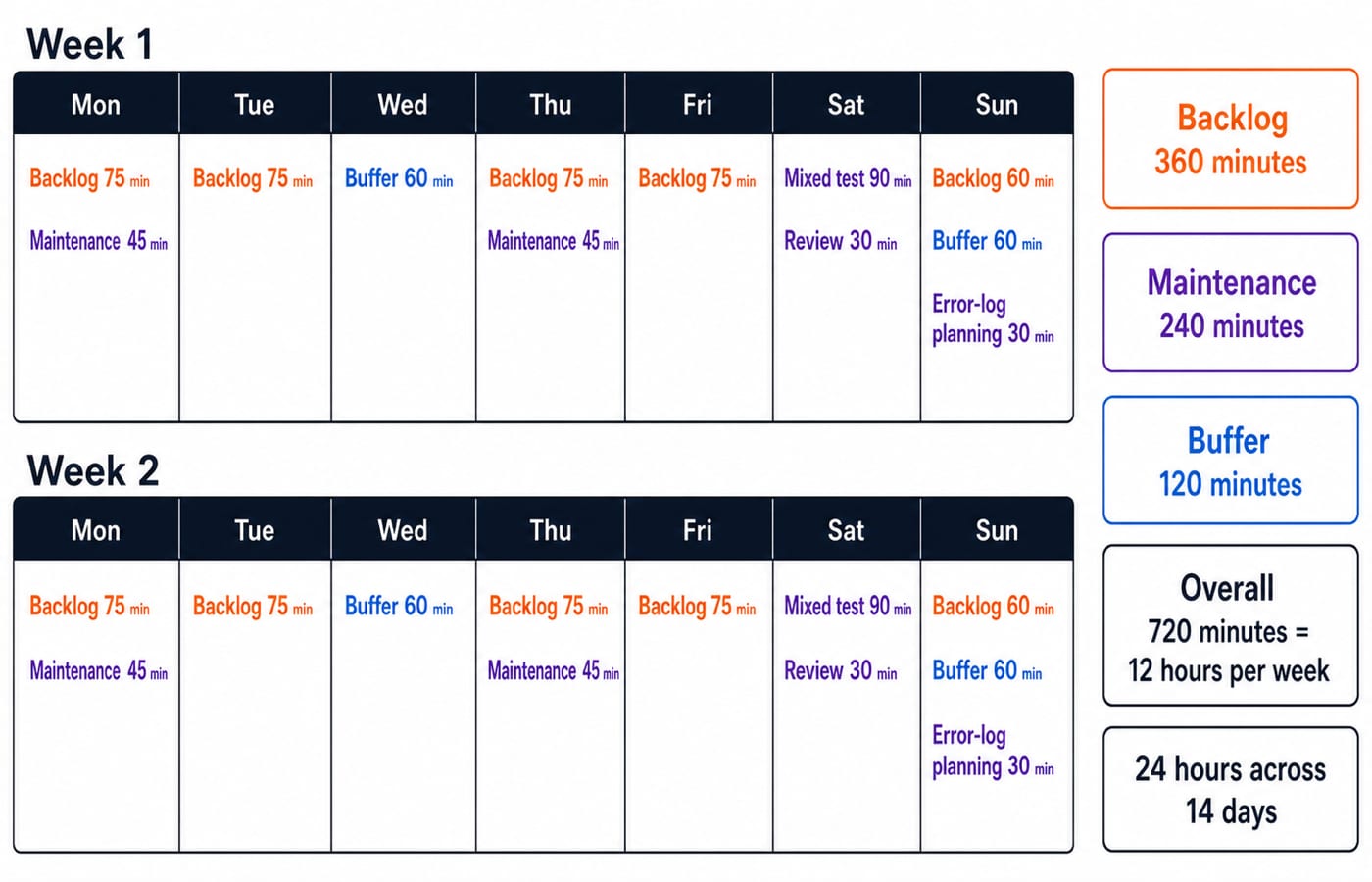
Monday gets 45 minutes of Data Structures PYQs, Thursday 45 minutes of Engineering Mathematics recall, Saturday a 90-minute mixed set plus 30-minute review, and Sunday 30 minutes for the error log.
45 + 45 + 90 + 30 + 30 = 240 minutes = 4 hours
Use previous-year questions and reattempts before collecting material. Seek visible recall.
4. Run the same recoverable week twice
Fix the weekly frame:
Day | Work |
|---|---|
Monday | 75 minutes backlog + 45 minutes maintenance |
Tuesday | 75 minutes backlog |
Wednesday | 60 minutes buffer |
Thursday | 75 minutes backlog + 45 minutes maintenance |
Friday | 75 minutes backlog |
Saturday | 90-minute mixed set + 30-minute review |
Sunday | 60 minutes backlog + 60 minutes buffer + 30-minute error-log planning |
Backlog is 75 + 75 + 75 + 75 + 60 = 360 minutes, or 6 hours. Maintenance is 45 + 45 + 90 + 30 + 30 = 240 minutes, or 4 hours. Buffer is 60 + 60 = 120 minutes, or 2 hours. Total: 12 hours.
Repeat in Week 2. Load nine repair blocks in order: DBMS, Operating Systems, then two Computer Networks blocks. The final 75-minute slot holds the checkpoint and review. Content changes, capacity does not.
The realistic six-month GATE CS plan is the long-range map. This sprint is the bridge back to it.
5. Make every recovery block end in visible evidence
A 75-minute block has 10 minutes closed-book recall, 35 repairing one concept, 20 attempting three questions without notes, and 10 recording errors and reattempts: 10 + 35 + 20 + 10 = 75 minutes.
For a 60-minute block, use 5 + 30 + 20 + 5 = 60 minutes. Explain the subtopic from a blank page, then take a 10-question checkpoint. Here, 7 correct is the exit threshold. Reattempt misses after 48 hours.
At 6/10, spend 45 of 75 checkpoint minutes on correction. At 4/10, park the next lower-priority block and repair the failed prerequisite. Never reopen the whole subject.
6. Absorb missed days without another restart
Classify the missed block before moving it. If the next repair block depends on it, swap their order. If it is independent, move it into the next named buffer. Preserve maintenance in either case.
Once missed work exceeds the two-hour weekly buffer, park the lowest-priority unstarted block and recalculate capacity. Do not stretch the next day or reopen completed subjects.
One isolated miss changes the order. More than 120 missed minutes changes the scope. Neither changes the 12-hour ceiling.
7. Rejoin the main plan after the Day 14 checkpoint
On Day 14, review nine repair outputs and the 75-minute checkpoint. Rejoin the main calendar when at least 8 of 9 outputs exist, both weeks' maintenance is complete, and the error log names no failed prerequisite. With only 6 or 7 outputs, run a three-day mini-sprint on named gaps.
For an outside benchmark, sit a full mock from the GATE Test Series, then use its topic-wise tests, detailed solutions, and performance analysis to name your next step.
The example carries three parked Computer Networks blocks, 3 x 75 = 225 minutes = 3.75 hours, into the next fortnight. DBMS and Operating Systems exit the backlog with evidence. Data Structures remains on maintenance.
8. The short version: your next 30 minutes
Freeze the old timetable.
Write your reliable weekly hours.
Subtract 4 hours of maintenance and 2 hours of buffer.
Choose no more than 12 backlog hours for the next 14 days.
Start the first 75-minute evidence-producing repair block today.
If rebuilding the schedule alone is the hard part, you can pick up subject courses, mathematics, aptitude, and testing from the GATE CS Exam Preparation Courses & Test Series, or work through goal setting, performance analysis, and weak-area prioritisation with GATE Guidance by Sanchit Sir.
Recover the plan you can now sustain, not the schedule you wish you had followed.
Go deeper with the full courseGATE Guidance by Sanchit Sir
Keep learning

PSU Through GATE CS Interview Preparation: A 14-Day Core-Subject Revision Map
Turn a broad CS syllabus into a focused interview plan. This 14-day map uses answer cards, whiteboard drills, diagnostics, and two feedback-led mocks.
Updated 30 Oct 20265 min readPSU Through GATE

NVS PGT Computer Science 60-Day Study Plan: Revision and Mock Strategy
Turn the final 60 days into four clear phases, with a worked 201-hour timetable, error-led revision blocks, timed mocks, recovery buffers, and a calm taper.
Updated 30 Oct 20265 min readKVS & NVS

IBPS SO IT Officer Mains Mock Analysis: Turn One Scorecard into a 14-Day Repair Plan
Turn one practice mock into a topic diagnosis, a classified error log and a realistic two-week study schedule with measurable retest gates.
Updated 30 Oct 20265 min read69 viewsIBPS Exams

IBPS SO IT Officer Interview Preparation: A 14-Day Technical and Banking Plan
Turn written-stage knowledge into clear spoken answers with a 28-hour plan, two scored mocks, worked technical scenarios, and a practical correction log.
Updated 30 Oct 20265 min read63 viewsIBPS Exams