

Programming Languages for GATE: An 8-Week Topic-by-Topic Plan
Turn a broad Programming Languages bucket into a focused eight-week plan. Use syllabus evidence, hand traces, timed sets, and an error log to decide what deserves your time.
KnowledgeGate Team
Exam prep & CS education
Updated 24 Nov 20265 min read
Programming Languages preparation becomes confusing when notes for C, C++, Java, OOP, scope, and parameter passing get treated as one GATE subject. For GATE CS, start with Programming Languages for GATE: Syllabus Map, Question Patterns and Study Order to settle the official boundary and preparation order; for another paper, use its entry on the official GATE 2027 papers and syllabus page. Only topics named for your paper enter the eight-week cycle. Use the 48 hours for concept traces, sourced PYQs, timed sets, and error repair.
1. Build a Syllabus and PYQ Evidence Map Before Week 1
Create keep, overlap, and outside current syllabus columns. Match each keep topic to the current official syllabus for your paper. Use overlap for related ideas and park the rest. The full practice bank is not a GATE topic list.
Run a diagnostic with sourced PYQs. Use the following 40-question practice log only to rank your own errors; it is not evidence of GATE weightage:
Topic | Questions | Wrong | Error rate |
|---|---|---|---|
Types and binding | 10 | 6 | 6 / 10 = 60% |
Parameter passing | 8 | 5 | 5 / 8 = 62.5% |
Scope and lifetime | 8 | 4 | 4 / 8 = 50% |
OOP and dynamic binding | 6 | 2 | 2 / 6 = 33.3% |
Syntax and semantics | 4 | 1 | 1 / 4 = 25% |
Translators and runtimes | 4 | 3 | 3 / 4 = 75% |
Totals are 10 + 8 + 8 + 6 + 4 + 4 = 40 attempted and 6 + 5 + 4 + 2 + 1 + 3 = 21 wrong. Translators have the highest rate but only four samples. Types and parameter passing recur with high error, so give them more time. Substitute your own evidence.
2. Use a 6-Hour Weekly Rhythm That Survives Missed Days
Repeat this loop each week:
Day | Work | Time |
|---|---|---|
Monday | Concept study | 60 minutes |
Tuesday | Hand tracing | 60 minutes |
Thursday | PYQs | 75 minutes |
Saturday | Mixed practice | 105 minutes |
Sunday | Error-log review | 60 minutes |
60 + 60 + 75 + 105 + 60 = 360 minutes, or 6 hours. Wednesday and Friday are buffers.
Candidate milestones: Week 1 syntax, semantics, translation; Week 2 types, binding, scope, lifetime; Week 3 parameter passing and control abstractions; Week 4 paradigms, OOP, dynamic binding; Week 5 comparison; Week 6 timed sets; Week 7 repair; Week 8 mixed mocks and compression notes. Assign them only after the evidence map. Cross out any item absent from your verified syllabus and use that week for the weakest named keep topic. Fit the cycle inside your wider subject calendar.
Miss a 60-minute or 75-minute session? Use Sunday for its essential trace. Below 240 minutes, repeat the milestone. Borrow at most one future session.
3. Weeks 1 and 2: Trace Meaning, Binding, Scope, and Lifetime
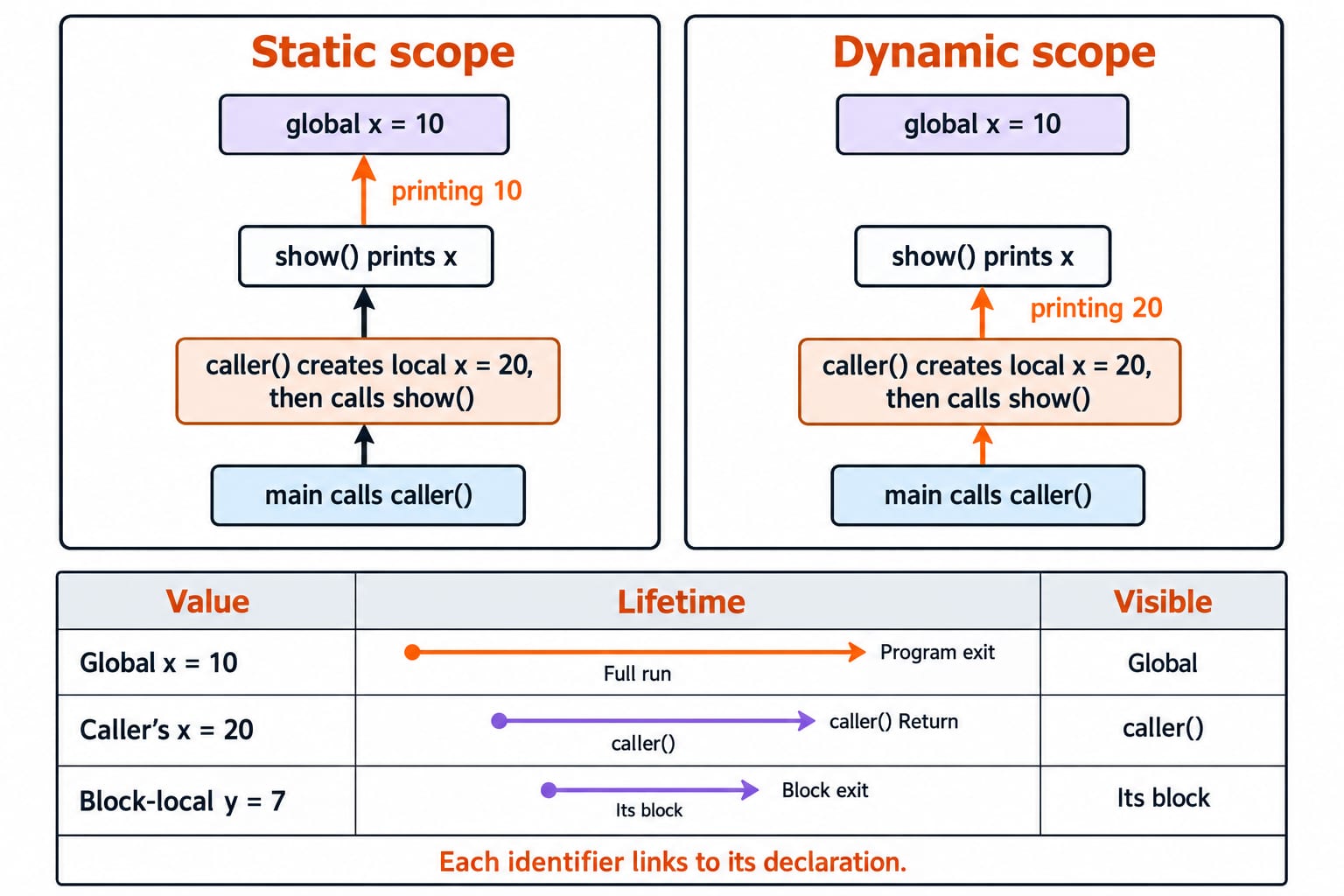
Start with this scope trace:
global x = 10
show() prints x
caller() creates local x = 20, then calls show()
main calls caller()
Static scope resolves x where show() was defined, printing 10. Dynamic scope follows the call chain, printing 20. Draw both environments first.
Value | Lifetime | Visible | Ends |
|---|---|---|---|
Global | Full run | Global | Program exit |
Caller's |
|
| Return |
Block-local | Its block | Its block | Block exit |
Mark each declaration point and bound value. For the checkpoint, draw one fresh static trace and one dynamic trace, linking every identifier to its declaration. A final number alone fails.
4. Weeks 3 and 4: Compare Parameter Passing and Dispatch with Values
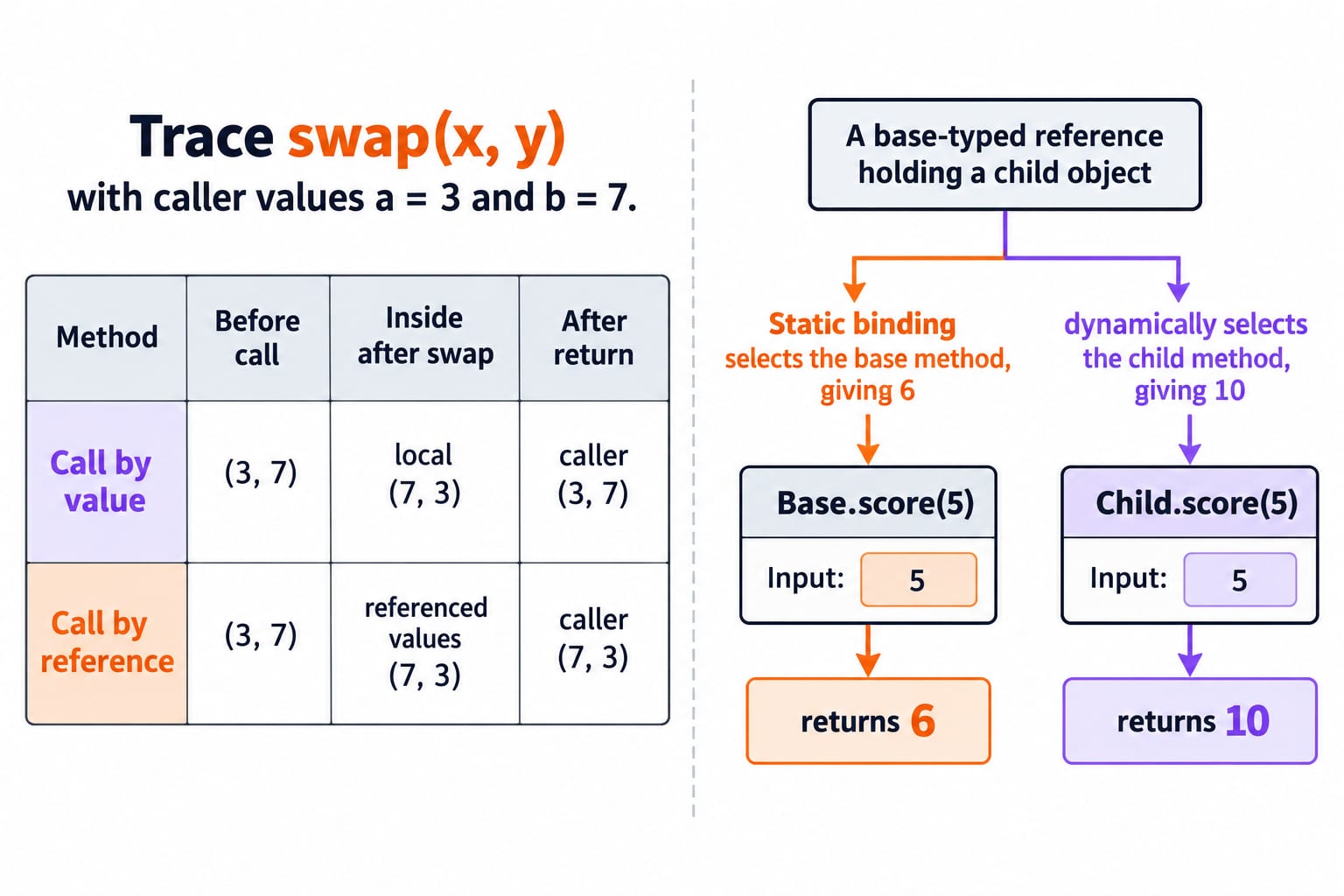
Trace swap(x, y) with caller values a = 3 and b = 7.
Method | Before call | Inside after swap | After return |
|---|---|---|---|
Call by value |
| local | caller |
Call by reference |
| referenced values | caller |
Next, Base.score(5) returns 6; overridden Child.score(5) returns 10. A base-typed reference holding a child object dynamically selects the child method, giving 10. Static binding selects the base method, giving 6. Use the Object Oriented Technology explainer as a refresher, not weightage evidence.
Make six two-line cards: value versus reference, static versus dynamic scope, overloading versus overriding, compile time versus run time, class versus object, and declared type versus runtime object.
5. Week 5: Compare Languages Only When a Question Earns It
Build a behaviour matrix instead of three tutorials.
Behaviour for | Result |
|---|---|
C with integer operands |
|
Java with integer operands |
|
Python 3 |
|
Python 3 |
|
Compare typing checks, integer division, parameter-passing vocabulary, and method dispatch. Each needs a runnable or traceable input and output. Remove anything outside your checked syllabus and questions.
After 12 questions, continue only where you made at least two errors. With zero division errors and three dispatch errors, give dispatch the next 45-minute block.
6. Weeks 6 and 7: Turn Question Patterns into an Error-Repair Loop
The practice bank has 1,300+ Programming Languages questions, but it is not a GATE topic list. Filter by your syllabus. In a 12-question, 36-minute set, eight first-pass questions use 8 x 2 = 16 minutes, three second-pass questions use 3 x 4 = 12, leaving 36 - 16 - 12 = 8 for one unresolved question and review.
A sample result is 7 correct, 2 concept errors, 1 trace error, 1 reading error, and 1 unattempted: 7 + 2 + 1 + 1 + 1 = 12. Repair both rules, redo the trace unaided, and rewrite the reading error as one instruction before a fresh set.
Exit Week 7 after two consecutive eight-question sets score at least six each, without a repeated error cause. The GATE Test Series offers broader timed practice, not these sets or a Programming Languages course.
7. Week 8: Prove Retention, Compress Notes, and Choose the Next Step
Take two 16-question mixed sets, each for 48 minutes, 48 hours apart.
Result | Correct | Concept errors | Trace errors | Reading errors | Total |
|---|---|---|---|---|---|
Set A | 10 | 3 | 2 | 1 | 16 |
Set B | 13 | 1 | 1 | 1 | 16 |
Totals are 10 + 3 + 2 + 1 = 16 and 13 + 1 + 1 + 1 = 16. The gain is 13 - 10 = 3, but the remaining concept error decides the final repair.
Compress notes into only the boxes that survived the syllabus audit: syntax and semantics, types and binding, scope and lifetime, parameter passing, paradigms and dispatch, translators and runtimes. Each retained box gets one rule, trace, and trap. Below 12 out of 16 in Set B, add a repair week.
Recheck the syllabus before the next cycle, and review the GATE course hub for the broader subject path. For structured planning and performance analysis, GATE Guidance by Sanchit Sir is optional, not a dedicated Programming Languages course. Your evidence still decides the work.
Go deeper with the full courseGATE Guidance by Sanchit Sir
Keep learning
C Programming for GATE: A 6-Week Topic-by-Topic Plan
Turn C revision into a 48-hour subject sprint. This plan moves from expressions and control flow to pointers, recursion, PYQ review, and timed mixed drills.
Updated 31 Aug 20265 min readC Programming & Data Structures
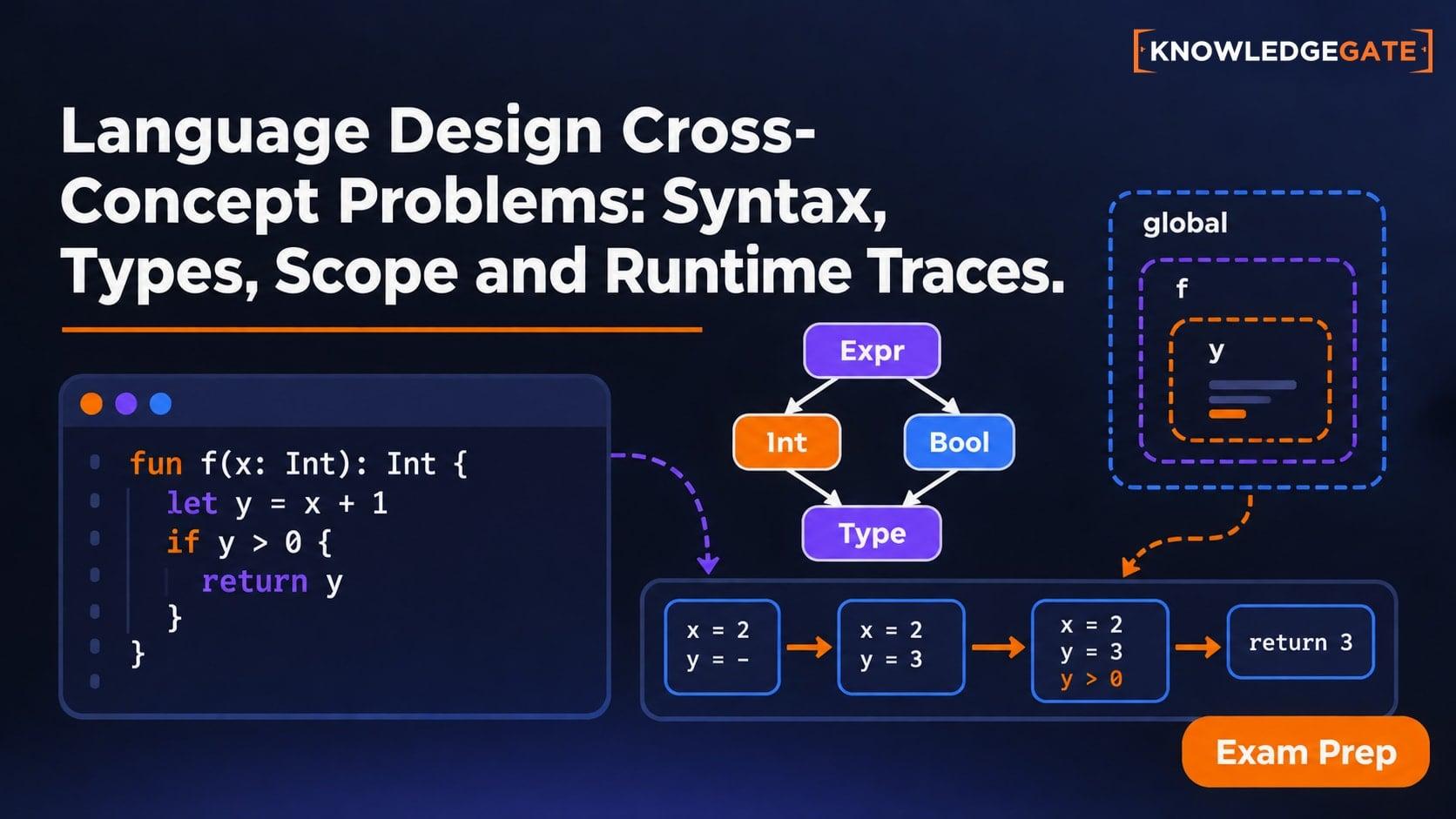
Language Design Cross-Concept Problems: Syntax, Types, Scope and Runtime Traces
Trace a small toy-language program from parse tree to type proof, closure bindings and the printed value 12. The method also shows where mixed-concept variants fail.
Updated 24 Nov 20267 min readProgramming Languages Survey

Object Oriented Technology Explained: Four Pillars, Worked Java Examples, GATE and Interview Patterns
Build object oriented technology on one running Java example. Learn the four pillars, trace exact outputs, and separate overloading from overriding.
Updated 30 Oct 20266 min read51 viewsProgramming Languages Survey
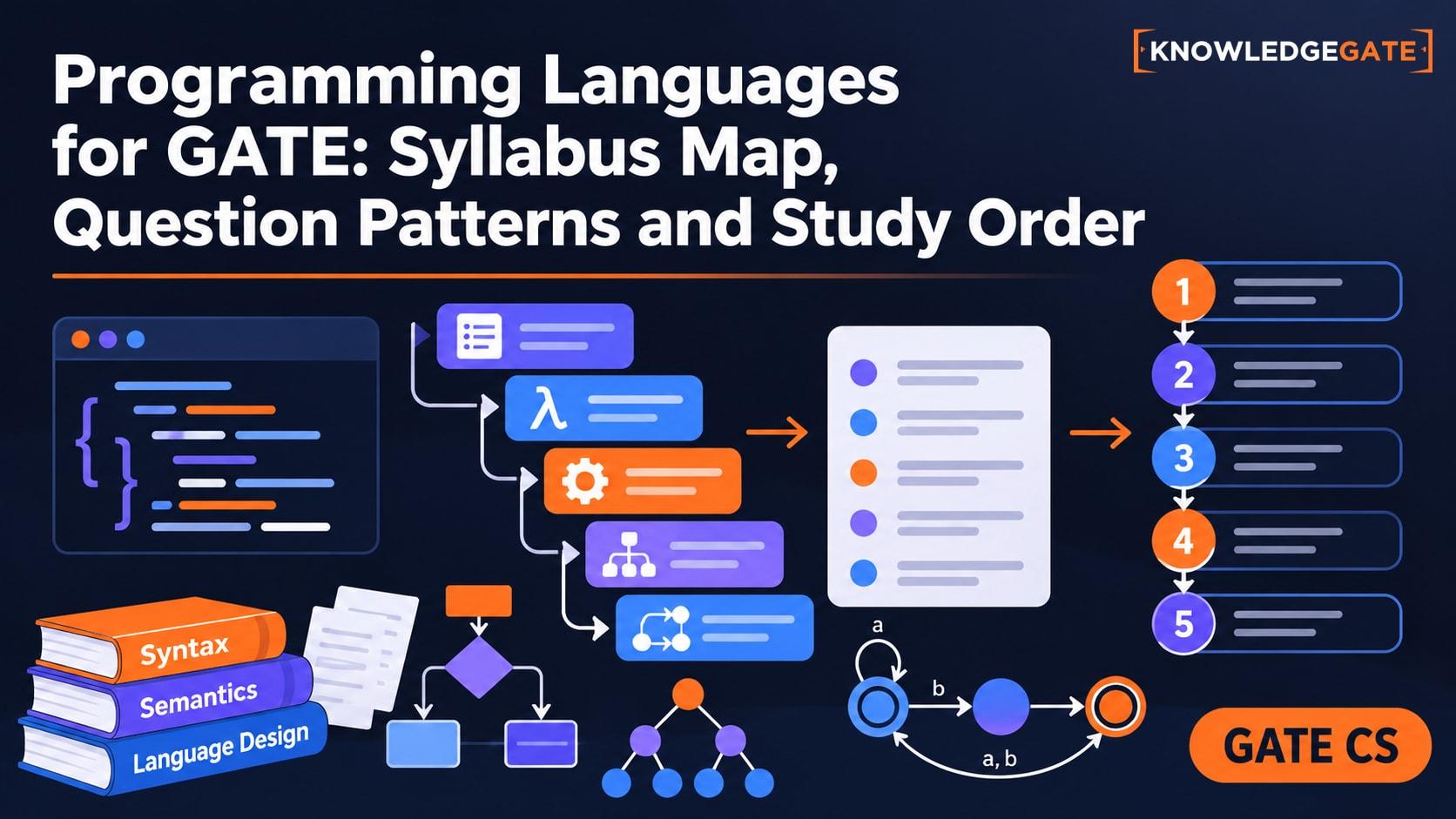
Programming Languages for GATE: Syllabus Map, Question Patterns and Study Order
Map the GATE programming scope correctly, trace C and recursion step by step, audit practice patterns honestly, and follow a 12-session study order.
Updated 16 Nov 20265 min readGATE Strategy & Roadmap