

GATE CS Subject Order: A Prerequisite-Led Plan That Avoids Relearning
Choose GATE CS subjects by what they unlock. This practical route combines dependency gates, a parallel mathematics lane, and an 18-hour weekly budget.
KnowledgeGate Team
Exam prep & CS education
Updated 22 Nov 20265 min read

Choosing the next subject by mood creates rework. You reach Algorithms, then stop to relearn linked lists, heaps, graphs, or discrete mathematics. A prerequisite-led first pass puts reusable ideas in place before the later subject begins. An 18-hour week leaves 13 hours for the main subject, three for mathematics, and two for recovery. Browse the GATE CS course catalogue for the wider course map.
Use prerequisites before weightage to choose the next subject
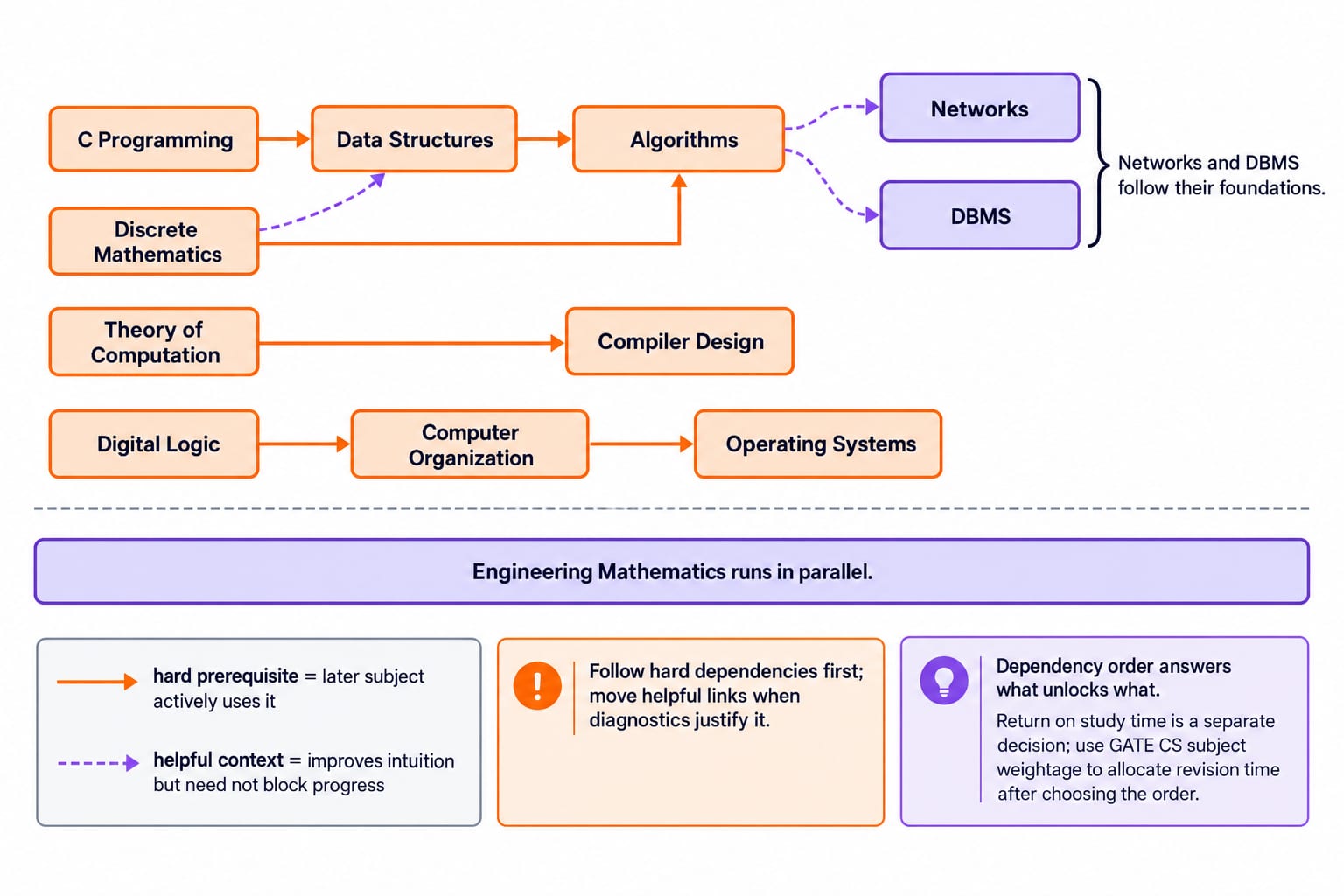
A hard prerequisite is knowledge a later subject actively uses, such as Data Structures inside Algorithms. Helpful context improves intuition but need not block progress, such as Operating Systems before parts of Networks. Follow hard dependencies first; move helpful links when diagnostics justify it.
The main route is C Programming to Data Structures to Algorithms; Discrete Mathematics to Algorithms and Theory of Computation to Compiler Design; and Digital Logic to Computer Organization to Operating Systems. Networks and DBMS follow their foundations. Engineering Mathematics runs in parallel.
Dependency order answers what unlocks what. Return on study time is a separate decision. Use GATE CS subject weightage to allocate revision time after choosing the order.
Weeks 1-8: build C and Data Structures before Algorithms
Use weeks 1 and 2 for C expressions, control flow, functions, arrays, pointers, structures, recursion, and memory references. In weeks 3 to 5, study arrays, linked lists, stacks, queues, trees, heaps, hashing, and graph representation. Practise each operation before waiting for perfect mastery.
Before Algorithms, try five tasks without notes in 60 minutes: trace one pointer update; write stack push and pop; write queue enqueue and dequeue; compare array and linked-list access costs; and build an adjacency list for A-B, A-C, B-D, and C-D. Four out of five unlocks Algorithms. Three or fewer triggers one four-hour repair block. This is a personal planning threshold, not an exam cutoff.
Use weeks 6 to 8 for asymptotic analysis, searching, sorting, greedy methods, dynamic programming, graph traversal, shortest paths, and minimum spanning trees. The prerequisite saving is practical: adjacency-list traversal comes from Data Structures, priority queues come from heaps, and the later lesson can concentrate on algorithm choice and correctness.
Weeks 1-11: run mathematics in parallel, then take Theory before Compiler Design
Reserve three weekly hours for mathematics. Weeks 1 to 8 give 24 hours of Discrete Mathematics. Put logic, sets, relations, functions, and graph basics in weeks 1 to 5, before Algorithms starts in week 6. The remaining nine hours cover counting and consolidation.
Use 24 hours in weeks 9 to 16 for probability and combinatorics, then 24 in weeks 17 to 24 for linear algebra and calculus. These first-pass allocations must expand when a readiness check reveals weakness. Engineering Mathematics for GATE can structure this parallel lane.
Take Theory of Computation in weeks 9 and 10 after the discrete base. Use week 11 for Compiler Design after finite automata, regular expressions, grammars, and parsing are familiar. The sequence lets you meet a grammar as a formal object, then reuse it in lexical analysis and parsing.
Weeks 12-24: move from Digital Logic to COA and Operating Systems
Use weeks 12 and 13 for number systems, Boolean algebra, combinational circuits, and sequential circuits. Weeks 14 to 16 then add instruction execution, arithmetic, control, memory hierarchy, cache, and addressing in Computer Organization. Weeks 17 to 19 reuse that base for processes, scheduling, synchronization, deadlocks, interrupts, and virtual memory in Operating Systems.
Computer Networks occupies weeks 20 and 21. Operating Systems is helpful context for sockets and resource sharing, but it is not a hard gate for layering, framing, addressing, routing, transport, and application protocols. DBMS uses weeks 22 to 24; Data Structures helps with hashing and tree indexes, while transaction topics benefit from prior synchronization work.
Networks or DBMS can move earlier when a diagnostic shows their foundations are strong. Keep the 13-hour block size and swap complete blocks instead of scattering two or three subjects across the same week. That preserves continuity without pretending one order is compulsory for every learner.
Audit the 24-week plan against an 18-hour study week
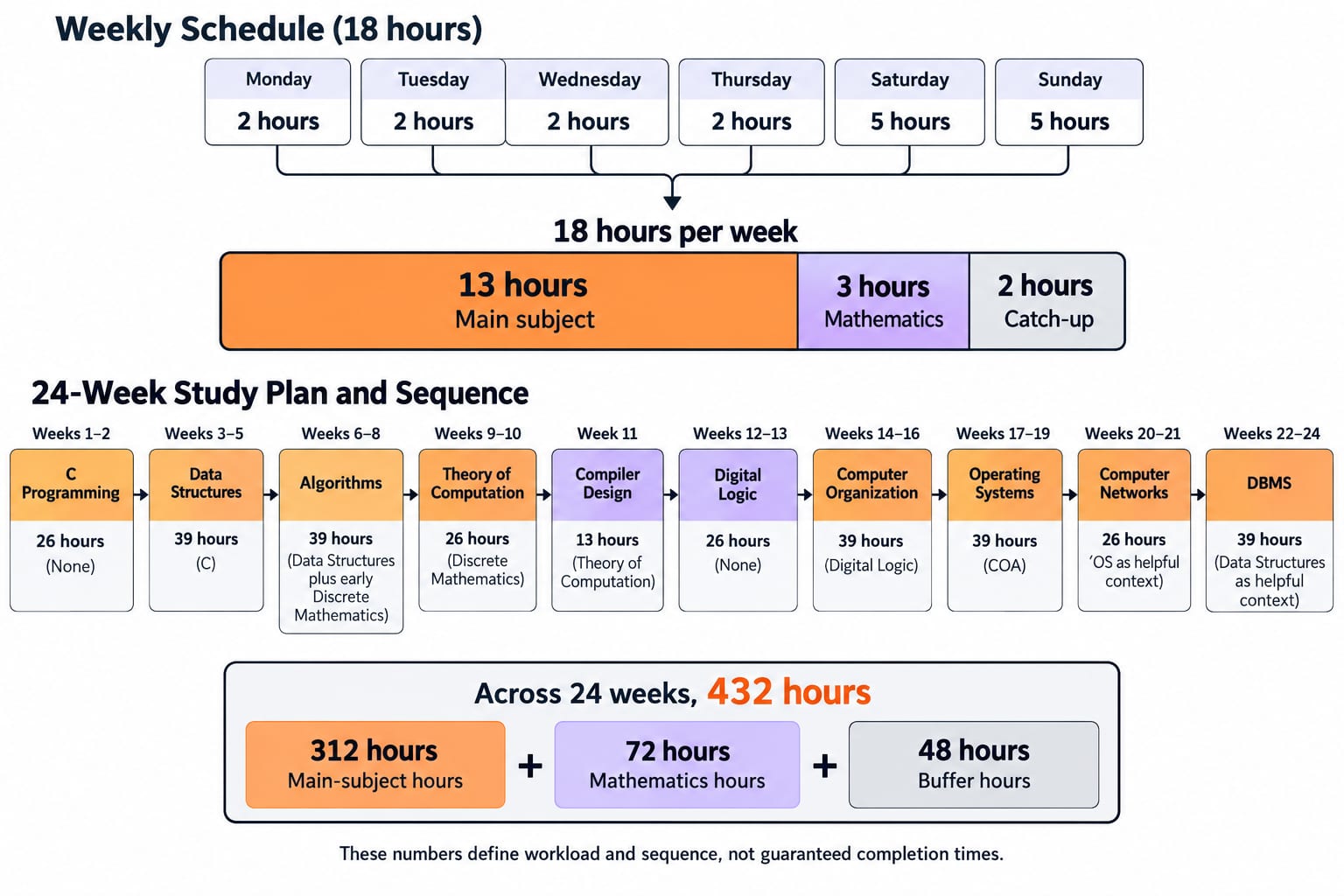
Monday to Thursday at two hours each, plus five on Saturday and five on Sunday, gives 18 hours. Assign 13 to the main subject, three to mathematics, and two to catch-up. Across 24 weeks, that is 432 hours: 312 main-subject hours, 72 mathematics hours, and 48 buffer hours.
Weeks | Subject | First-pass hours | Prerequisite reused |
|---|---|---|---|
1-2 | C Programming | 26h | None |
3-5 | Data Structures | 39h | C |
6-8 | Algorithms | 39h | Data Structures plus early Discrete Mathematics |
9-10 | Theory of Computation | 26h | Discrete Mathematics |
11 | Compiler Design | 13h | Theory of Computation |
12-13 | Digital Logic | 26h | None |
14-16 | Computer Organization | 39h | Digital Logic |
17-19 | Operating Systems | 39h | COA |
20-21 | Computer Networks | 26h | OS as helpful context |
22-24 | DBMS | 39h | Data Structures as helpful context |
These numbers define workload and sequence, not guaranteed completion times. Use the six-month GATE CS study plan to place revision and tests on the calendar.
Use readiness checks and buffer hours without breaking the chain
Inside each 13-hour main-subject block, begin with eight hours of concepts and notes, use three hours for worked problems, and keep two hours for mixed practice or PYQs. The split can move within the week, but the practice hours cannot disappear.
Miss Tuesday and Thursday, and four hours disappear. Use Saturday's protected two-hour buffer for the prerequisite unlocking the next lesson. Carry two hours of lower-priority new content forward. Do not add a four-hour Friday punishment session or cut cumulative recall.
End each subject block with eight mixed questions and one teach-back explanation. Six out of eight or better plus a coherent explanation permits the next node. Five or fewer schedules a four-hour repair block and a fresh check. This is a personal control rule, not an official qualifying mark.
Use PYQs from the first completed topic. They expose prerequisite gaps while repairs are still small. When the weekly buffer is unused, spend it on the error log and delayed recall rather than starting another subject early.
The short version and the next action
Put programming before structures, structures plus early discrete mathematics before Algorithms, discrete mathematics before Theory, Theory before Compiler Design, and Digital Logic before COA before Operating Systems. Run the rest of Engineering Mathematics in parallel; place Networks and DBMS where diagnostics support them.
Write the first three weekly blocks, assign 13 main-subject hours, three mathematics hours, and two buffer hours, then take the C readiness check before crossing the first prerequisite. For an optional structured route, use GATE Guidance by Sanchit Sir.
Go deeper with the full courseGATE Guidance by Sanchit Sir
Keep learning

CUET PG Computer Science Revision Map: Study Subjects in Prerequisite Order
Build CUET PG Computer Science revision in dependency order, then practise each block with the right kind of trace. Keep DBMS and networks in a separate programme-level lane.
Updated 5 Aug 20266 min readMCA Entrance
UGC NET CS Paper 2 Preparation Order: A Subject-Wise Roadmap
Start with prerequisites, use fresh diagnostic sets to choose between eligible units, and promote a subject only after testing retention and mixed-question transfer.
Updated 30 Oct 20265 min read104 viewsNET Strategy & Updates
Arrays and Pointers in C: 7 GATE Mistakes That Cost Marks
Stop treating arrays and pointers as interchangeable. Trace seven common C mistakes through small examples involving types, addresses, bounds and side effects.
Updated 11 Nov 20265 min readC Programming & Data Structures
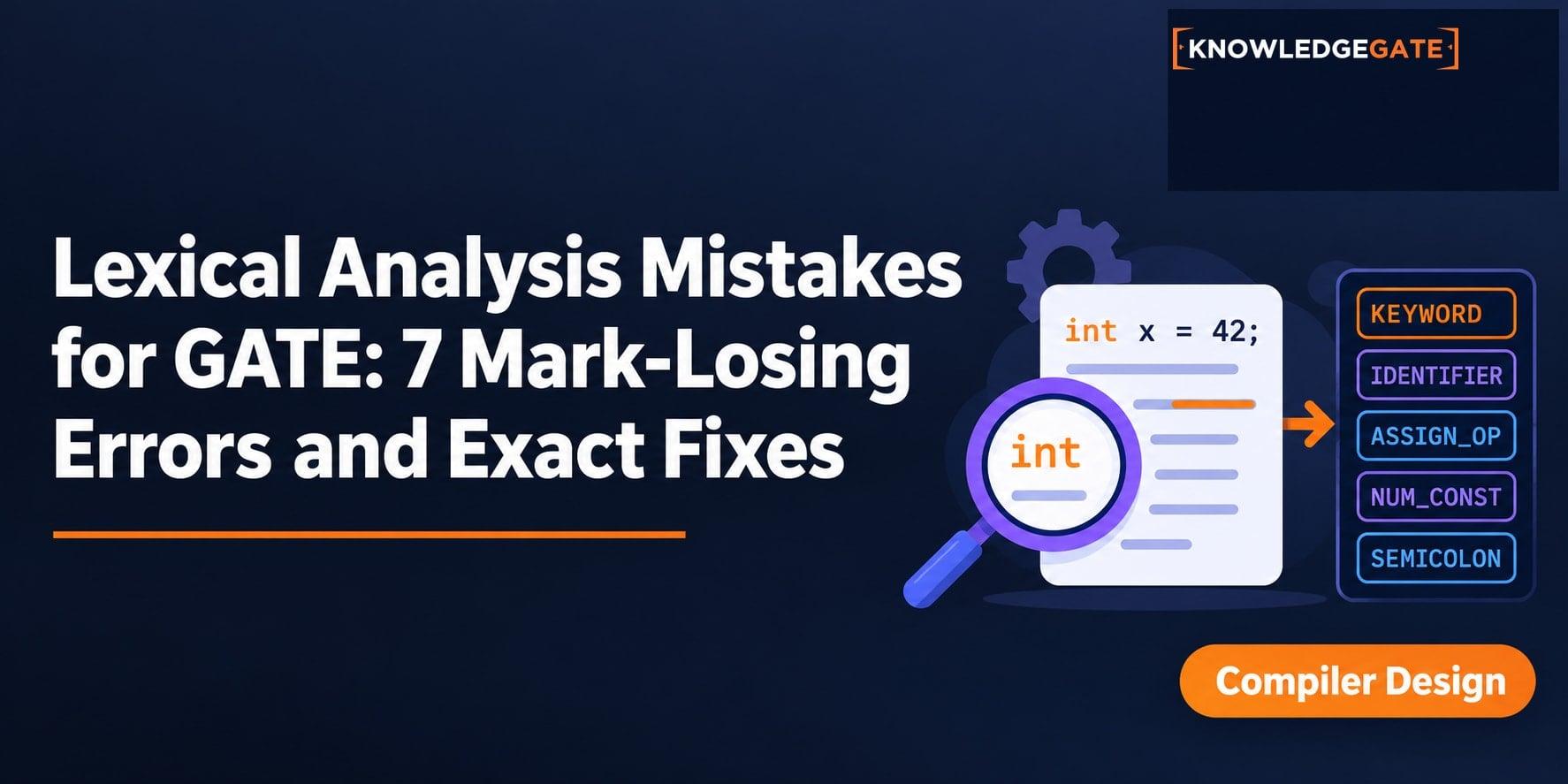
Lexical Analysis Mistakes for GATE: 7 Mark-Losing Errors and Exact Fixes
These seven repairs show exactly where lexical analysis answers go wrong. Trace one shared source, separate token counts from lexemes and categories, and keep each compiler phase in its lane.
Updated 30 Oct 20265 min readCompiler Design