

Functions in C Mistakes: Fix 11 Errors in Calls, Parameters and Recursion
Trace eleven common Functions in C errors without guessing the output. Learn what fails, why it fails, and the precise repair for each case.
KnowledgeGate Team
Exam prep & CS education
Updated 22 Nov 20265 min read
Functions questions go wrong when familiar syntax makes you assume a matching declaration, shared caller storage, a known array length, a safe lifetime, or a terminating recursive call. The eleven cases below pair each failure with its cause and a repair, then trace values that a conforming C implementation can determine. why it happens, what goes wrong, and what to do instead, using exact traces. Use CS Fundamentals for Exams & Placements for adjacent C and core CS notes.
1. Function declaration mistakes 1 and 2
Mistake 1, calling before a visible compatible declaration. Why it happens: A later definition seems sufficient. What goes wrong: Put
long add(long a, long b) { return a + b; }aftermain. Without a prototype,long result = add(7L, 5L);lacks a compatible visible declaration. A modern conforming implementation must diagnose this, so invent no output. Do instead: Putlong add(long, long);beforemainor in a header.Mistake 2, matching only name and parameter count. Why it happens:
int add(int, int);looks close. What goes wrong: It conflicts withlong add(long, long)and requires a diagnostic. Do instead: Make both agree. Thenadd(7L, 5L)returns12L, stored asresult = 12L.
For a syntax-first walkthrough with runnable examples, see Functions in C: Syntax, Parameters and Worked Examples. For syntax reset, use C Programming.
2. Function parameter mistakes 3 and 4
Mistake 3, expecting scalar parameters to change caller objects. Why it happens: Parameters seem like aliases. What goes wrong: For
int x = 6, y = 14; swap_bad(x, y);,swap_bad(int a, int b)startsa = 6,b = 14and endsa = 14,b = 6. Caller staysx = 6,y = 14. Do instead: Separate caller and callee boxes keep the copied values visible.Mistake 4, treating pointers as a different passing mode. Why it happens: Mutation is called pass by reference. What goes wrong: Passing
x,ytoswap_ok(int *p, int *q)mismatches types. Assigning only top,qchanges copied pointers. Do instead: Callswap_ok(&x, &y). Entry hasp = &x,q = &y,*p = 6,*q = 14. Swap leavesx = 14,y = 6. C copied both addresses.
For a concept-first explanation of definitions, parameters and recursion, see Functions in C: Call by Value, Recursion & Worked Examples.
3. Array-parameter mistake 5
Mistake 5, calculating the caller's element count with
sizeof. Why it happens:const int a[]looks like a complete array. What goes wrong: Inint sum(const int a[]), it adjusts toconst int *a. On a model withsizeof(int *) = 8andsizeof(int) = 4,sizeof a / sizeof a[0]is8 / 4 = 2, not four. For{3, 5, 7, 9}, it adds only3 + 5 = 8. Do instead: Defineint sum(const int a[], size_t n)and callsum(values, 4). Totals3,8,15,24give24. Passing length is portable;2depends on this size model.
4. Recursion mistakes 6 and 7
Mistake 6, using the wrong identity. Why it happens: The operation is ignored. What goes wrong: With
if (n == 0) return 0; return n * fact(n - 1);,fact(1) = 1 x 0 = 0, sofact(2),fact(3), andfact(4)are0. Do instead: Return multiplication's identity1whenn == 0.Mistake 7, making no progress. Why it happens: The call is copied as
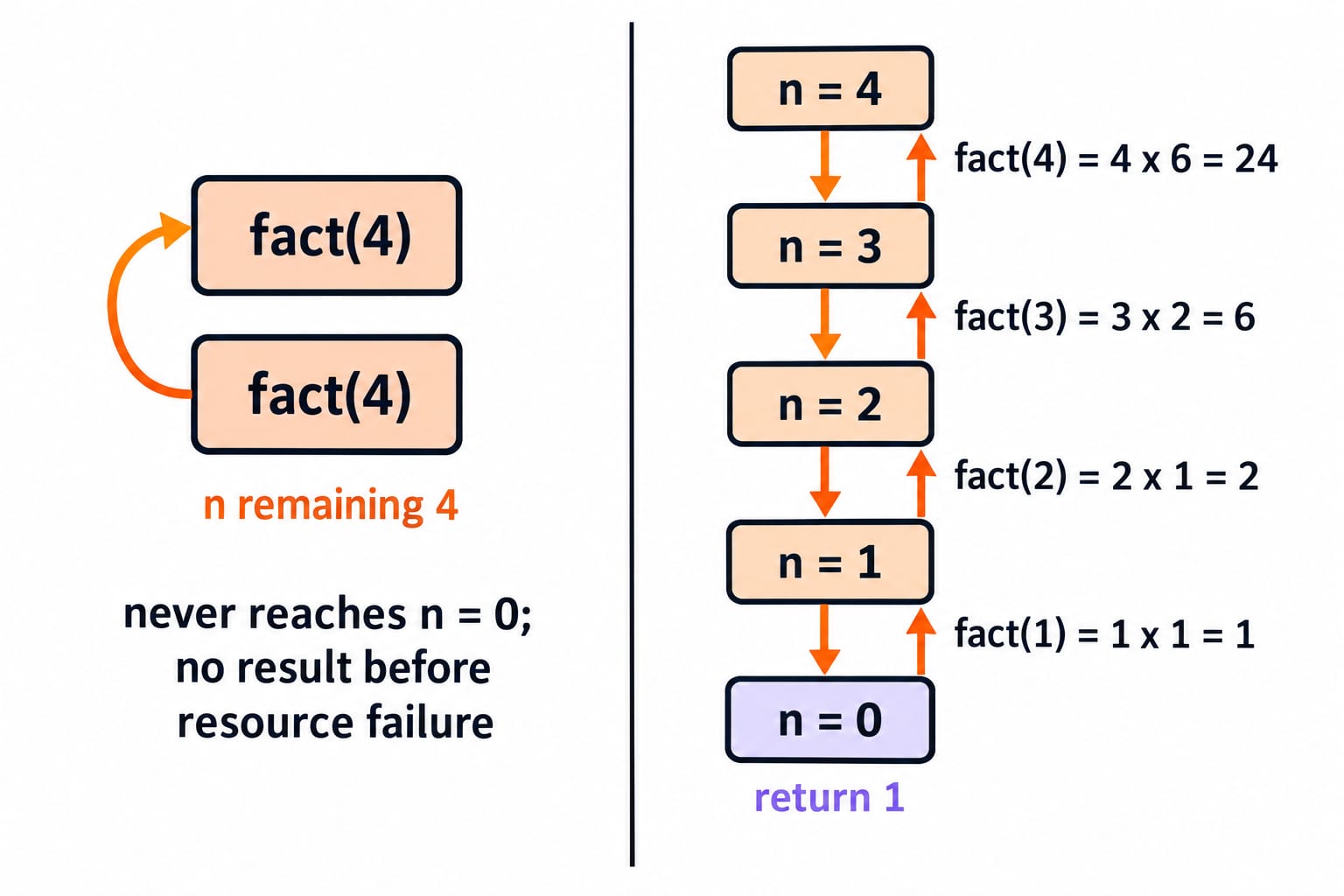
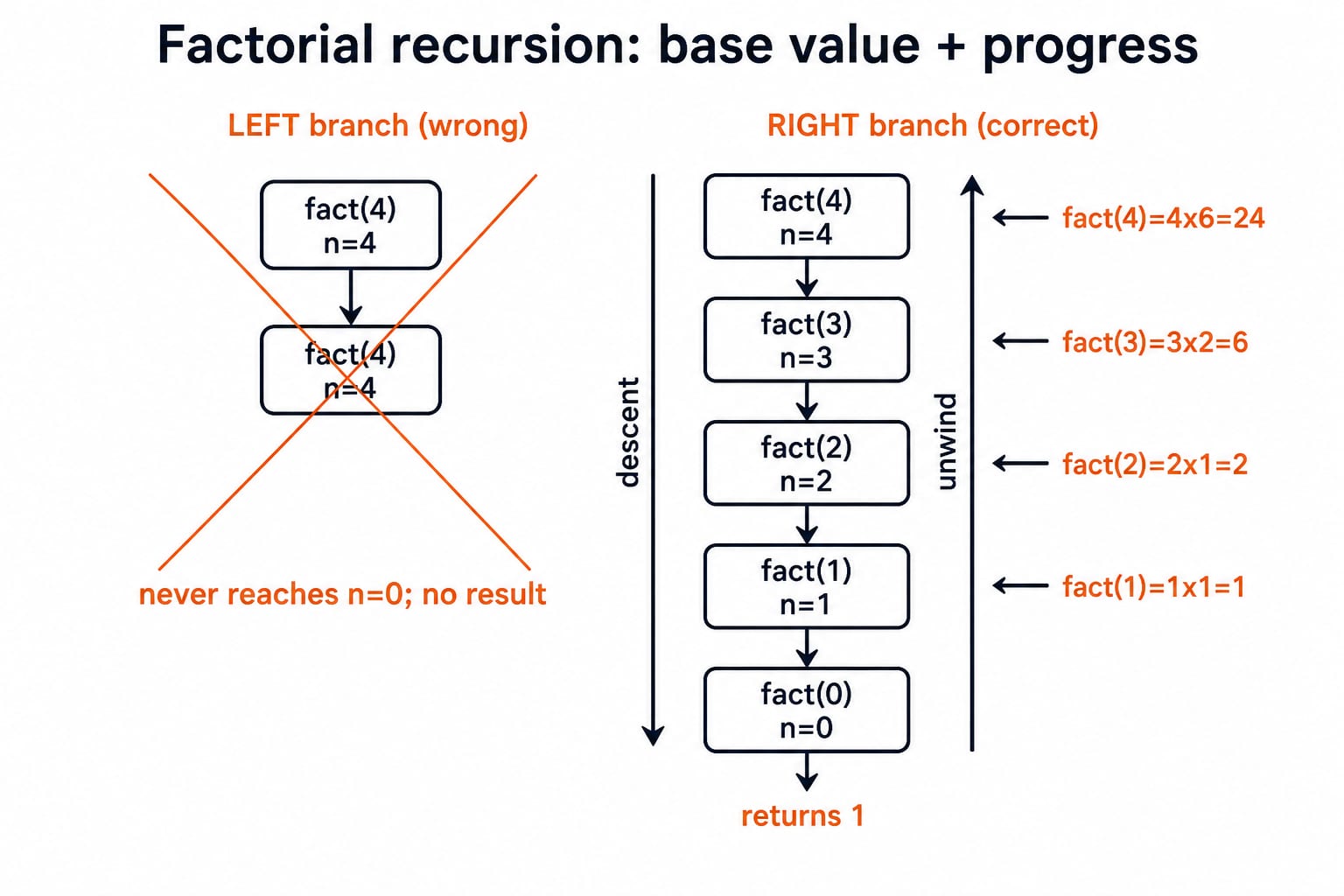
fact(n). What goes wrong:fact(4)keeps creating frames withn = 4, never reachesn = 0, and has no result before resource failure. Do instead: Trace arguments. Descent is4 -> 3 -> 2 -> 1 -> 0. Unwind isfact(0) = 1,fact(1) = 1,fact(2) = 2,fact(3) = 6,fact(4) = 24.
5. Function lifetime mistakes 8 and 9
Mistake 8, returning a dead local. Why it happens: Its address was valid during execution. What goes wrong:
int *bad(void) { int score = 17; return &score; }returns an address after the object's lifetime ends. Dereferencing it is undefined behaviour, not guaranteed17, garbage, or a crash. Do instead: Return17, accept caller storage, or use storage that outlives the call.Mistake 9, resetting a static local mentally. Why it happens: Scope and storage duration are merged. What goes wrong:
int next(void) { static int n = 4; n += 3; return n; }returns7,10,13across three calls, not7,7,7. Do instead: Track visibility and lifetime. Automaticint n = 4is recreated and returns7each call.
6. Function-expression mistakes 10 and 11
Mistake 10, misreading pointer parentheses. Why it happens: Declarations look similar. What goes wrong:
int (*op)(int, int)points to a function returningint;int *op(int, int)is a function returningint *. Do instead: Read outward from the identifier. Givenint subtract(int a, int b) { return a - b; }andint (*op)(int, int) = subtract;,op(11, 4)returns7.Mistake 11, ordering argument side effects. Why it happens: Arguments are assumed left to right. What goes wrong: In
int i = 3; show(i++, i++);, the two modifications are unsequenced, so behaviour is undefined. No portable argument pair or finaliexists. Do instead: Use full expressions.left = i++givesleft = 3, i = 4;right = i++givesright = 4, i = 5;show(left, right)receives3and4.
7. Functions in C mistakes: the 60-second audit and next step
Check seven things: compatible visible signature; caller objects versus parameter copies; valid pointers; array lengths; recursion's identity and progress; lifetime versus storage duration; side effects isolated before calls.
Closed-book anchors: add(7L, 5L) = 12L; swaps 6, 14 and 14, 6; array sum and fact(4) both 24; static 7, 10, 13; callback 7; arguments 3, 4, final i = 5. Continue with C Language Course: Concepts, MCQs & Coding.
Keep learning

C Fundamentals Mistakes: Fix 11 Data-Type, Operator and Flowchart Errors
Short C expressions can hide strict rules. Diagnose and repair 11 common errors involving initialisation, conversions, operators, increments and flowcharts.
Updated 18 Nov 20265 min readC Programming & Data Structures
Grammar and CFG Mistakes for GATE: 7 Traps and How to Fix Them
Seven small grammars expose the errors that make CFG answers go wrong, with reproducible checks for classification, ambiguity, FIRST sets and CNF.
Updated 24 Oct 20265 min readCompiler Design
C Programming Miscellaneous Mistakes: 10 Traps in Macros, Types, Memory and Files
Ten common C traps are diagnosed at the right stage, from macro expansion and declarations to allocation, streams and undefined expressions. Each mistake includes the failure mechanism and a concrete repair.
Updated 23 Nov 20265 min readC Programming & Data Structures
Control Flow in C: 7 Mark-Losing Mistakes and Precise Fixes
Trace seven common C control-flow mistakes step by step, see exactly where execution changes course, and learn a short routine for checking every branch and loop.
Updated 14 Nov 20265 min readC Programming & Data Structures