

Freshworks Drive Mistakes: Avoidable Errors at Each Hiring Stage
A correct solution needs careful reading, testing and a clear explanation. Use these stage-wise examples to strengthen your application, defend project claims and rehearse truthful interview answers.
KnowledgeGate Team
Exam prep & CS education
Updated 17 Nov 20265 min read
Freshworks hiring outcomes turn on evidence: a role-matched application, a controlled assessment, tested code and claims you can defend. The job description and recruiter invitation set the eligibility, stages and assessment instructions for a particular opening. Treat rejection as a signal to inspect your evidence, not as proof of one hidden cause. The examples use illustrative numbers, not Freshworks test specifications or candidate records.
Use the Wipro Drive Mistakes: Stage-by-Stage Fixes for that employer’s stage map; this Freshworks guide focuses on evidence checks that apply when an opening’s sequence varies by role.
Application screening: treating every Freshworks opening as the same role
A familiar company name can encourage a copy-paste application. But missing the advertised experience, location or role requirements can leave your strongest relevant work buried beneath unrelated details.
Suppose a role asks for backend/API work. You list Java, SQL and a ticket-tracker project, but your opening bullet discusses only page styling. If accurate, replace it with: “Implemented ticket creation and retrieval endpoints; wrote SQL queries for status filtering.” That gives the reader concrete evidence without invented traffic figures.
Create three columns: requirement, truthful evidence and gap. Save the source job description alongside them. A gap tells you what to clarify or practise, not what to disguise. Use Placement Preparation as a broader preparation menu after identifying those gaps.
Assessment setup: losing usable time before solving begins
Algorithm practice does not prepare your test environment. Ignoring the invitation, permitted language or input format can consume solving time; unauthorised assistance can also breach the stated rules.
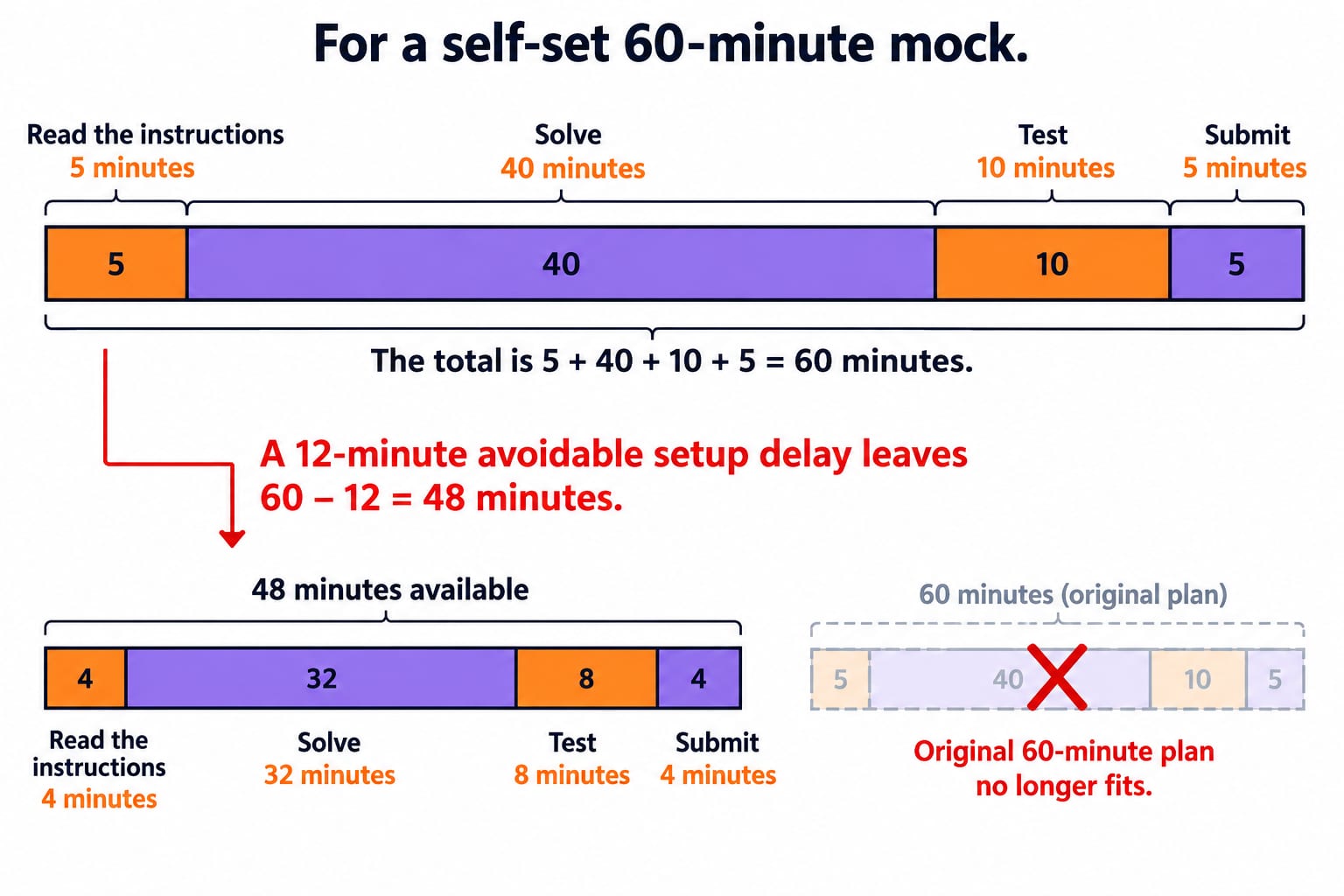
For a self-set 60-minute mock, allocate:
Activity | Minutes |
|---|---|
Read the instructions | 5 |
Solve | 40 |
Test | 10 |
Submit | 5 |
The total is 5 + 40 + 10 + 5 = 60 minutes. A 12-minute avoidable setup delay leaves 60 - 12 = 48 minutes, so the original plan no longer fits.
Check the supplied environment and allowed tools beforehand, then run a small input/output sample. The 7 Placement Preparation Mistakes to Avoid covers broader habits to audit alongside this setup check.
Coding submission: trusting the sample instead of the specification
Passing a sample feels like finishing. The danger is solving a nearby problem instead of the specified one.
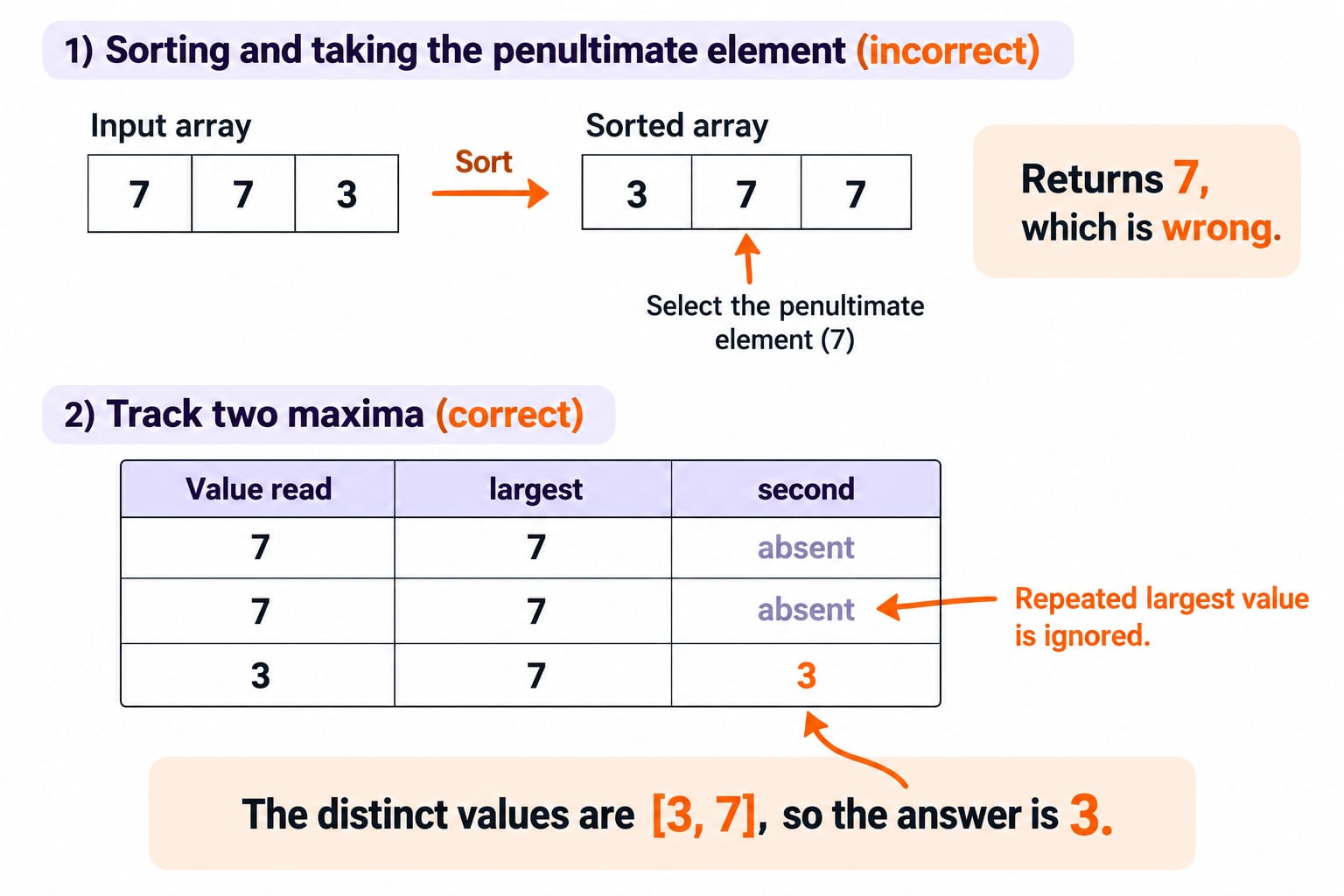
Consider this original exercise: return the second-largest distinct integer, or “not present” if fewer than two distinct integers exist. Sorting [7, 7, 3] gives [3, 7, 7]. Selecting the penultimate element returns 7, which is wrong. The distinct values are [3, 7], so the answer is 3.
Track two maxima instead, initialising largest and second as absent:
Value read | largest | second |
|---|---|---|
7 | 7 | absent |
7 | 7 | absent |
3 | 7 | 3 |
A new largest moves the previous largest into second place. Otherwise, update second only with a smaller, distinct value that improves it. Ignore repeats of the largest.
Do not initialise with zero: [-5, -2, -2] must return -5. Both [4, 4] and [] return “not present”. Check duplicates, all-equal values, negatives and empty inputs where the contract permits them. Tracking two distinct maxima takes O(n) time and O(1) auxiliary space.
Technical discussion: giving code without explaining the decision
A memorised answer hides your reasoning when constraints change. State the contract, explain a straightforward solution, then justify the improvement.
For the distinct-maximum exercise, comparison sorting generally costs O(n log n), while tracking two maxima takes O(n). To see why complexity matters, consider a separate task that checks every unordered pair among 10,000 elements:
Pair count = n(n - 1)/2.
Substitution gives 10,000 × 9,999 / 2.
Multiply to get 99,990,000, then divide by 2: 49,995,000 comparisons.
A single scan visits 10,000 elements. These operation counts do not guarantee execution times; the work per operation also matters.
Practise a 60-second explanation covering the duplicate rule, the absent marker and any unresolved assumption. When unsure, admit the unknown and reason from a smaller example instead of bluffing.
Project interview: making claims that cannot survive a follow-up
Broad team achievements can look stronger than precise personal contributions, until someone asks how you implemented or measured them. Distinguish “I implemented” from “our team built”, and retain evidence for both ownership and results.
Suppose you wrote “made the system 10 times faster”. Your actual local test query went from 240 ms to 150 ms after adding an index:
Time saved = 240 - 150 = 90 ms.
Percentage reduction = 90/240 × 100 = 37.5%.
Speedup = 240/150 = 1.6 times.
Neither result supports a tenfold claim. This single comparison does not establish a stable production improvement; repeat measurements under comparable conditions before claiming one.
Prepare the query, index choice, test conditions and your personal role. Use Resume Project Section: Defensible Interview Claims for a fuller audit. Put your own measured values on your resume, never these illustrative numbers.
Behavioural and HR conversation: replacing evidence with slogans
“I am a team player” does not explain what you did. Freshworks' careers page highlights customer focus and teamwork as company values, not a candidate scoring rubric.
Consider a three-person team disagreeing about ticket-priority labels. A useful account explains how you brought four sample tickets, agreed the expected labels with teammates, documented the rule and added four regression tests. The observable result is an agreed rule with test coverage. There is no need to invent customer satisfaction or business impact.
Rehearse a truthful short story and a role-specific reason for applying. State genuine location and joining constraints clearly. Ask for clarification before agreeing to a commitment you cannot meet.
The short version: repair the weakest stage before the next attempt
Check that you have:
Matched application evidence to the role.
Read assessment instructions and checked the environment.
Tested edge cases and explained complexity.
Substantiated project claims.
Prepared one truthful team example.
Use an actual recruiter rejection reason as feedback when supplied; otherwise, avoid guessing the cause.
If your gap is resume or interview preparation, the Interview & Resume Preparation Course offers general preparation support, without a Freshworks-specific selection assurance.
Run a 45-minute rehearsal: 15 minutes solving the distinct-maximum exercise, 15 defending one project claim and 15 recording and reviewing one behavioural answer. The total is 15 + 15 + 15 = 45 minutes. Record one corrective action, then repeat the task it addresses.
Keep learning
Tech Mahindra Drive Mistakes: Rejection Risks and Fixes at Each Stage
Question practice alone cannot fix a mismatched application or an unsupported project claim. Use these preparation checkpoints to spot avoidable mistakes and build a focused correction plan.
Updated 15 Nov 20265 min readCompany-Specific Prep
Mphasis Drive Rejection Reasons: Mistakes to Fix at Every Stage
Strong preparation is not enough if your application, timing, communication, resume claims, interview answers, or offer checks do not match. Use this stage-wise audit to remove preventable rejection risks.
Updated 12 Nov 20265 min readCompany-Specific Prep
Wipro Drive Mistakes: Stage-by-Stage Rejection Traps and Fixes
Preventable execution errors can waste solid preparation. Diagnose the risk at each Wipro drive step and replace it with a checkable habit.
Updated 30 Oct 20264 min readCompany-Specific Prep
Capgemini Drive Mistakes: Stage-by-Stage Rejection Risks and Fixes
Diagnose the controllable evidence gaps behind common Capgemini drive risks. Repair your CV, timed practice, code traces, project proof and behavioural stories with worked drills.
Updated 30 Oct 20265 min readCompany-Specific Prep