

Mphasis Drive Rejection Reasons: Mistakes to Fix at Every Stage
Strong preparation is not enough if your application, timing, communication, resume claims, interview answers, or offer checks do not match. Use this stage-wise audit to remove preventable rejection risks.
KnowledgeGate Team
Exam prep & CS education
Updated 12 Nov 20265 min read
Good preparation can still end in rejection because one record, answer, or instruction does not match. The cause may be a wrong source, inaccurate application, poor aptitude timing, incomplete communication, undefended resume claim, inconsistent interview answer, or careless post-selection check. Each mistake below names its cause, the failure it creates, and the check that prevents it. Use placement and exam courses for wider context, but current Mphasis communication always outranks an earlier drive story.
1. Mistake: Preparing from an old Mphasis drive story instead of the current invitation
Why: a friend's story is easy to copy. Risk: you prepare an absent activity or miss the correct login, document, or round. Fix: copy a six-field source card from the current post or invitation: role, eligibility wording, named rounds, assessment instructions, deadline, and requested documents. Mark missing fields UNCONFIRMED.
Mphasis's application-process page lists Aptitude Test, Personal Interview, and Communication Test as elimination rounds. Your invitation controls the applicable route and order.
Illustrative example: Arun has 6 hours. He replaces 2 hours on an unlisted group discussion, 2 on random coding, and 2 on interviews with 2 hours aptitude, 2.5 interview evidence, 1 communication, and 0.5 operational checks. 2 + 2.5 + 1 + 0.5 = 6. The earlier Wipro drive-mistakes guide owns Wipro-specific stage patterns; this arithmetic stays a Mphasis candidate rehearsal.
2. Mistake: Entering a convenient eligibility value instead of the documented value
Why: candidates round marks or use an internet CGPA formula. Risk: application, resume, and documents disagree. Fix: use the printed value or institution's stated conversion, save the calculation, and query the notice's official channel if needed.
For CGPA 6.80 and a certified formula % = (CGPA - 0.75) × 10, (6.80 - 0.75) × 10 = 6.05 × 10 = 60.5%. 68.0% from direct multiplication and 61% from rounding are wrong when one decimal place is accepted. Enter 6.80 CGPA or 60.5%, as requested. Mphasis currently attaches its minimum 60% course-programme average filter specifically to technology-school applicants on the official page. Do not generalise it or invent backlog rules.
3. Mistake: Letting one aptitude question consume the assessment
Why: abandoning a half-solved question feels like failure. Risk: easier questions and the review buffer expire. Fix: read the live marking rules and rehearse two passes. Guess only if those rules support it.
Illustrative, not official Mphasis pattern: in a 20-question, 24-minute simulation, Q1-Q3 at 45 seconds each plus 6 minutes on Q4 uses 8:15, leaving 15:45 for 16 questions: 945 ÷ 16 = 59.0625 seconds each. A 45-second scan takes 20 × 45 = 900 seconds = 15 minutes. Solving 12, flagging 5, and leaving 3 gives pass two 5 × 90 = 450 seconds = 7.5 minutes, with 24 - 15 - 7.5 = 1.5 minutes to verify and submit.
4. Mistake: Sounding fluent while dropping the communication task's key facts
Why: you optimise for accent or impressive words. Risk: meaning, action, or deadline disappears. Fix: extract audience, status, blocker, request, deadline, and next update.
Mphasis names a Communication Test for the stated technology-school route, but its official page gives no universal public prompt type or duration. Follow live instructions. In an illustrative 60-second rehearsal, say: "Seven of eight release checks have passed. The payment-callback check is blocked. I need a sandbox token by 4:30 pm. Deployment moves from 4:00 pm to 6:00 pm. I will update you at 5:15 pm." Saying deployment is cancelled, omitting 7 of 8, or making no request fails. Use status -> blocker -> request -> revised time -> next update.
5. Mistake: Putting a project metric on the resume that cannot survive one follow-up
Why: a large percentage sounds impressive. Risk: you cannot explain its baseline, dataset, method, change, or limitation. Fix: make a proof card with problem, action, before value, after value, conditions, trade-off, and limitation.
Illustratively, an attendance table has 12,000 seeded rows. Across the same 40 local requests, median lookup falls from 900 ms to 270 ms after adding index (student_id, submitted_at) and removing a repeated query. (900 - 270) ÷ 900 × 100 = 630 ÷ 900 × 100 = 70.0%. Call it a local median, not production performance, and explain write and storage costs. Remove unreproducible values. Use the Interview and Resume Preparation Course if you cannot build two proof cards.
6. Mistake: Improvising personal-interview facts to sound flexible or experienced
Why: you try to please the interviewer. Risk: dates, team size, ownership, availability, or location constraints change. Fix: keep a truth sheet and answer with exact fact, brief reason, then genuine flexibility.
If the resume says 8 January to 26 April, a 4-person team, 3 REST endpoints, and 12 unit tests, do not say February to May, 5 people, and full-stack ownership. Keep all four facts and admit you did not own deployment. Check dates, team size, role, tools, measured result, and limitation. Connect "Why this role?" to current job requirements and evidence, not fake praise.
7. Mistake: Treating a Letter of Intent as the end of verification, or trusting an offer-branded message
Why: clearing rounds feels final, while branding creates urgency. Risk: records fail joining checks, or fraudsters request money or sensitive information. Fix: maintain one master record, follow official next steps, and verify surprises independently.
Mphasis's application-process page says successful candidates in its stated technology-school route receive a Letter of Intent, are contacted when training batches are scheduled, and receive permanent offer letters after joining on the scheduled date, subject to joining formalities. A Letter of Intent is not a guaranteed permanent offer.
An application with 60.5%, internship 8 January to 26 April, and 3 REST endpoints fails three checks against a resume showing 68.0%, 1 January to 30 April, and "full product ownership". Separately, stop if a message requests an employment fee or comes from @Mphasis.info. Mphasis's fraud-awareness page says Mphasis takes no payment from candidates for employment and contrasts company email such as mphasis.com with fraudulent @Mphasis.info. Do not send sensitive information because a message has a logo.
8. The short version: a 30-minute Mphasis rejection-risk audit
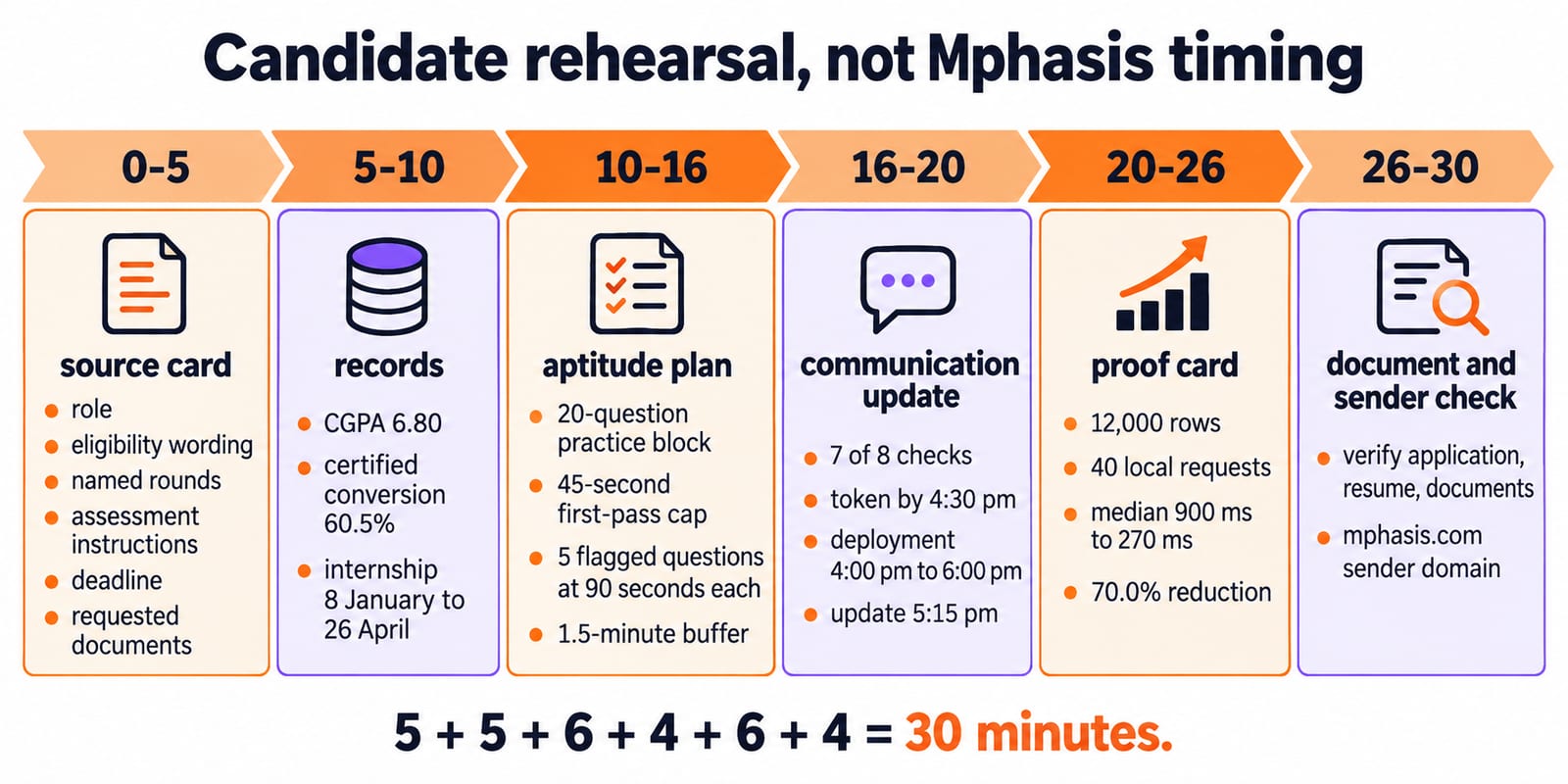
This is candidate rehearsal, not Mphasis timing: 0-5 source card; 5-10 records; 10-16 aptitude plan; 16-20 communication update; 20-26 proof card; 26-30 document and sender check. 5 + 5 + 6 + 4 + 6 + 4 = 30 minutes.
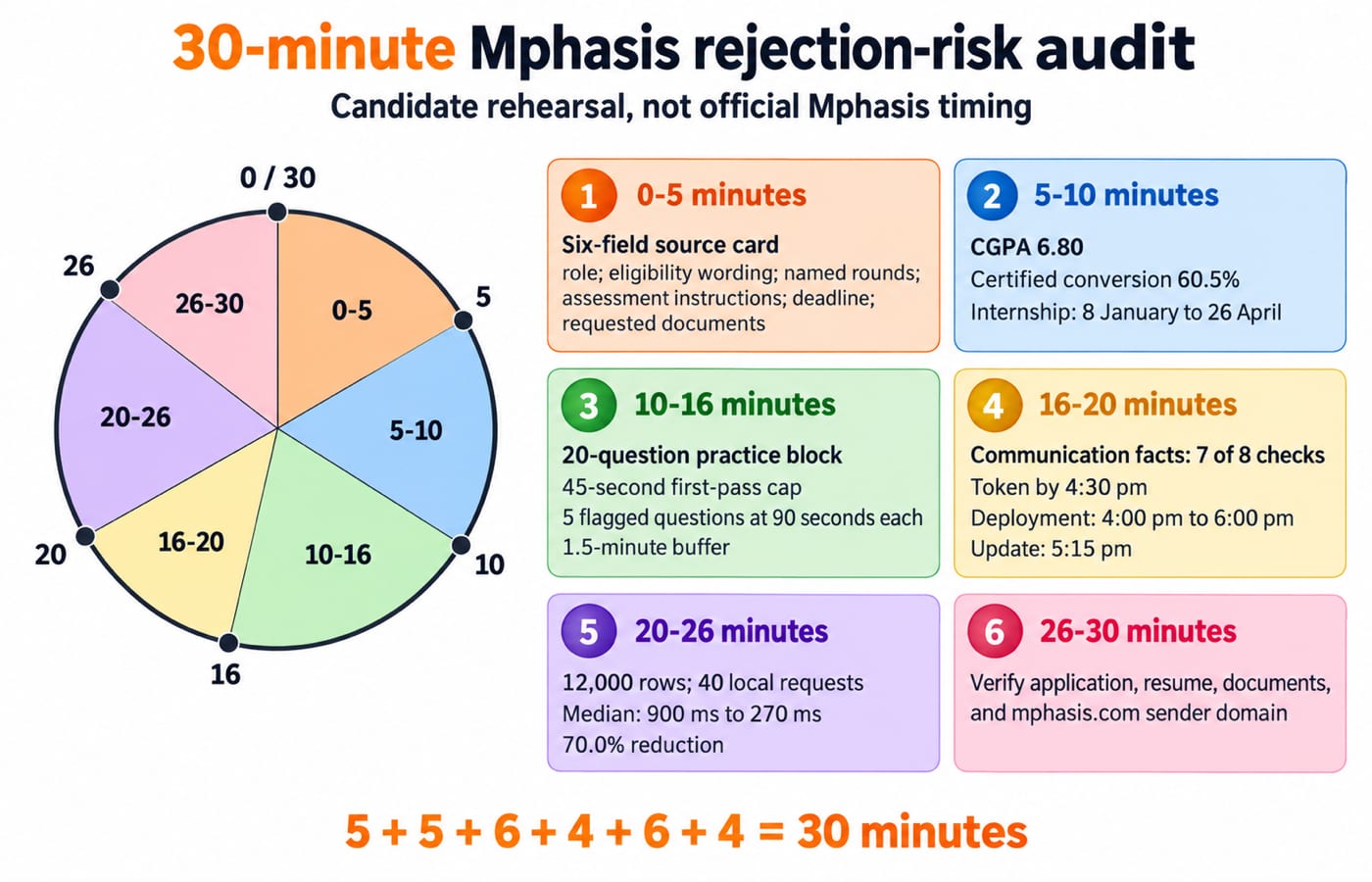
Trust the current source, enter exact records, protect assessment time, preserve communication facts, and defend only reproducible evidence. Turn the source card and proof cards into a checklist before your next attempt.
Keep learning

Accenture Drive Mistakes: Fix Common Rejection Risks at Every Stage
Use evidence sheets, diagnostic mocks, coding edge cases, response drills, and consistency checks to reduce controllable rejection risks in an Accenture drive.
Updated 29 Oct 20265 min readCompany-Specific Prep

TCS Drive Mistakes: Rejection Risks at Each Stage and How to Fix Them
A stage-by-stage audit of the mistakes candidates can control, from an incomplete drive application and weak attempt strategy to fragile code and unsupported resume claims.
Updated 30 Oct 20265 min readCompany-Specific Prep
Tech Mahindra Drive Mistakes: Rejection Risks and Fixes at Each Stage
Question practice alone cannot fix a mismatched application or an unsupported project claim. Use these preparation checkpoints to spot avoidable mistakes and build a focused correction plan.
Updated 15 Nov 20265 min readCompany-Specific Prep
Wipro Drive Mistakes: Stage-by-Stage Rejection Traps and Fixes
Preventable execution errors can waste solid preparation. Diagnose the risk at each Wipro drive step and replace it with a checkable habit.
Updated 30 Oct 20264 min readCompany-Specific Prep