

Concept of Remainders Questions with Solutions: 10 Worked MCQs
Try ten remainder questions, then follow each calculation to check your method. Learn when a divisor can change, how quotient conditions combine, and why huge powers need only small residues.
KnowledgeGate Team
Exam prep & CS education
Updated 4 Nov 20267 min read

A huge power or a thousand-digit number can make an ordinary remainder question look difficult, although you still need only the part left after complete groups. These ten bank questions show the working; attempt each one without a timer before reading its solution. For more practice, KnowledgeGate’s Placement Preparation & Coding bank has 30+ Concept of Remainders questions to help you practise these methods.
1. Start with the remainder, not the full number
For a positive divisor d, write N = dq + r, where q is an integer quotient and 0 <= r < d. A remainder of zero means exact divisibility. Two integers are congruent modulo d when they have the same remainder on division by d; we write this as a = b (mod d).
Q1
What is the largest 4 digit number exactly divisible by 88?
(a) 9900
(b) 9999
(c) 9988
(d) 9944
Solution: Start from 9999, the largest four-digit number:
9999 = 88 x 113 + 55.
Remove the remainder to reach the multiple immediately below it:
9999 - 55 = 9944 = 88 x 113.
The next multiple is 88 x 114 = 10032, which has five digits. Therefore (d) 9944 is correct. The question asks for the largest multiple; 55 is only the amount removed.
Revisit this worked largest-multiple question to check that distinction. The related guide to divisibility rules develops exact-divisibility checks further.
Q2
What is the remainder when 4^13 is divided by 3?
(a) 1
(b) 2
(c) 4
(d) 6
Solution: Since 4 = 3 + 1, we have 4 = 1 (mod 3). Multiplying numbers preserves congruence, so:
4^13 = 1^13 = 1 (mod 3).
Answer: (a) 1. Options 4 and 6 can be rejected immediately because a remainder on division by 3 must be smaller than 3.
2. Change the divisor only when the relationship allows it
Suppose N = Dk + r and the new divisor d divides D exactly. Then Dk is also divisible by d, so the new remainder is r mod d. Check this divisibility condition before transferring a remainder.
Q3
A number leaves remainder 32 when divided by 75. What remainder does it leave when divided by 15?
(a) 2
(b) 5
(c) 4
(d) 7
Solution: Write the given division first:
N = 75k + 32.
Since 75 = 15 x 5 and 32 = 15 x 2 + 2:
N = 15(5k + 2) + 2.
The bracket gives an integer quotient, leaving (a) 2 as the remainder. We do not need to determine k because its entire contribution is divisible by 15.
Q4
A number leaves remainder 39 when divided by 357. What remainder does it leave when divided by 17?
(a) 2
(b) 3
(c) 4
(d) 5
Solution: Here N = 357k + 39. Use 357 = 17 x 21 and 39 = 17 x 2 + 5:
N = 17(21k + 2) + 5.
Answer: (d) 5. Merely being a smaller divisor is insufficient. If the new divisor did not divide 357, the term 357k could contribute an unknown remainder, and reducing 39 alone would not determine the answer.
3. Reconstruct additions and successive quotients
An addition changes the original number. A condition on a quotient describes an intermediate result. Write an equation for each statement before combining them.
Q5
Which number must be added to 2345 to leave remainder 55 when divided by 276?
(a) 194
(b) 198
(c) 192
(d) 199
Solution: First find the present remainder:
2345 = 276 x 8 + 137.
For the required addition x, we need 137 + x = 55 (mod 276). Hence:
x = 55 - 137 = -82 = 194 (mod 276).
Adding 194 takes the current remainder through the next complete group: 137 + 194 = 331 = 276 + 55. Check the full number:
2345 + 194 = 2539 = 276 x 9 + 55.
Answer: (a) 194. Subtracting 82 also produces remainder 55, but the question asks which listed positive number must be added.
Q6
A number leaves remainder 1 when divided by 13. If its quotient is divided by 5, the remainder is 3. What is the remainder when the number is divided by 65?
(a) 16
(b) 28
(c) 40
(d) 18
Solution: Call the first quotient t. The two conditions give:
N = 13t + 1, and t = 5k + 3.
Substitute the second equation into the first:
N = 13(5k + 3) + 1 = 65k + 39 + 1 = 65k + 40.
This successive-quotient worked solution leaves (c) 40. The remainder 3 belongs to the quotient, so its contribution to N is 13 x 3. Simply adding 3 + 1 loses that factor.
4. Reduce huge powers with a short residue cycle
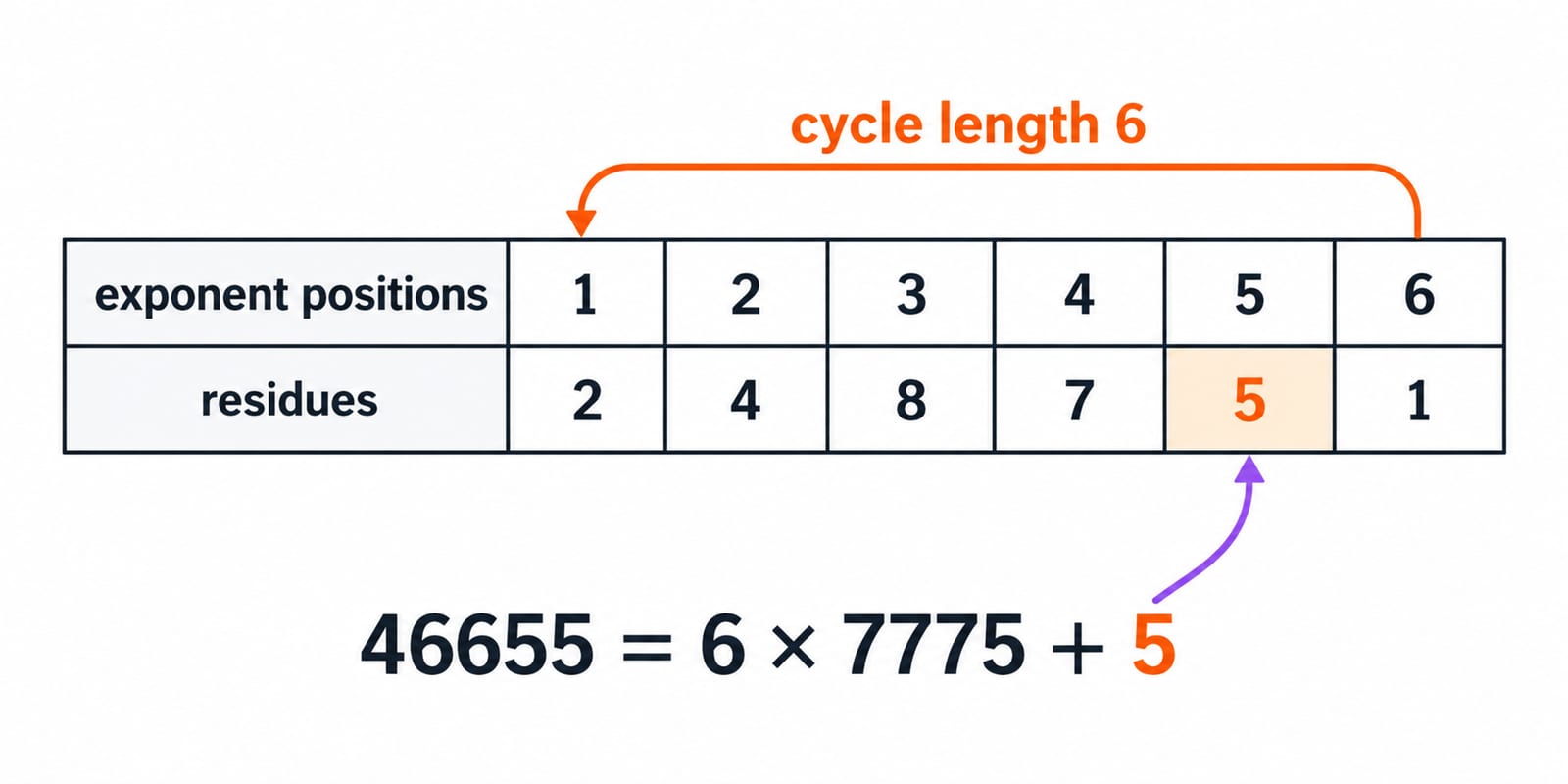
Repeated multiplication often returns to residue 1, after which the residues repeat. Establish the cycle before reducing the exponent by its length.
Q7
What is the remainder when 2^46655 is divided by 9?
(a) 2
(b) 4
(c) 5
(d) 6
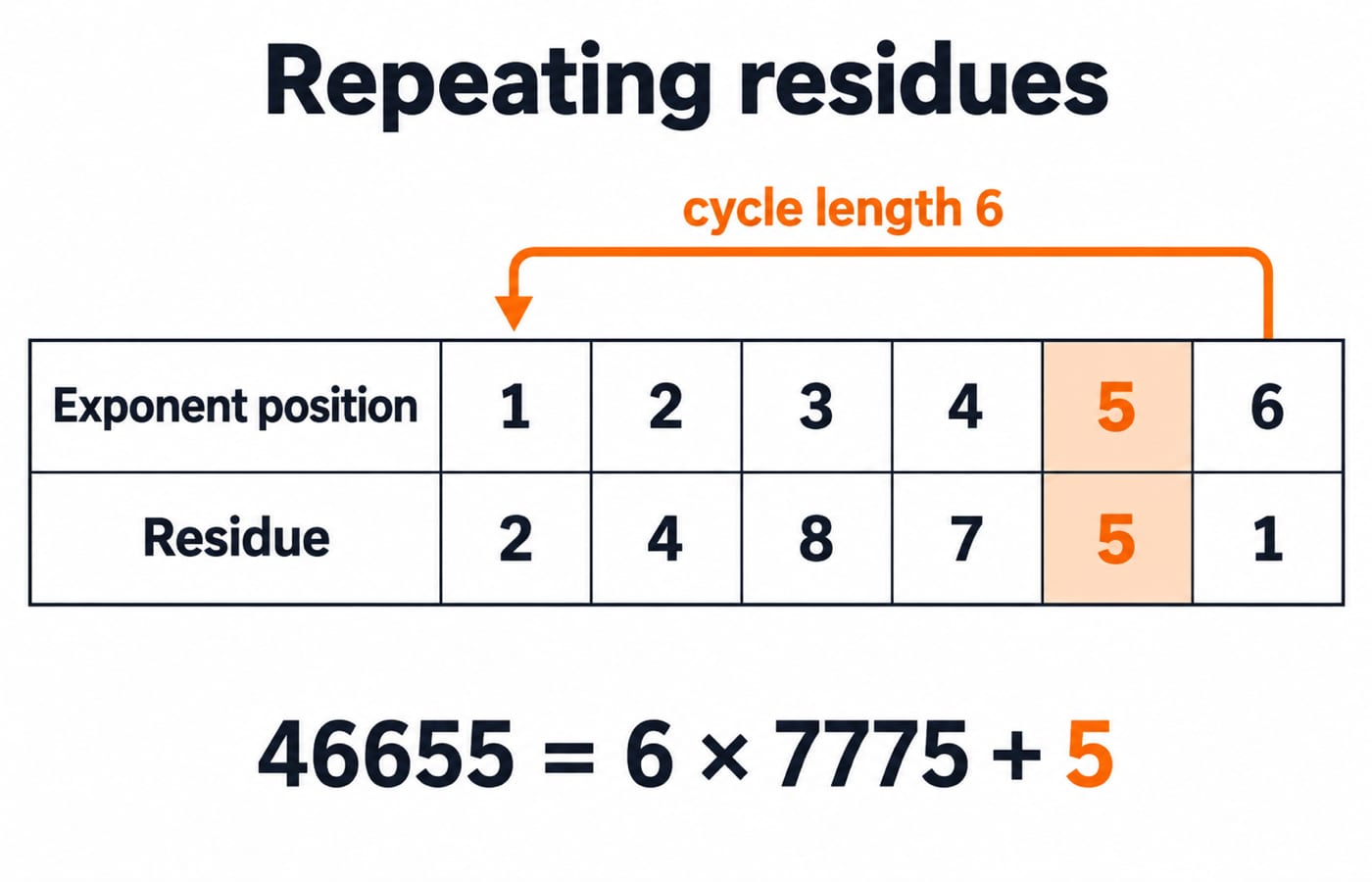
Solution: The first six powers are 2, 4, 8, 16, 32 and 64. Their remainders on division by 9 are:
2, 4, 8, 7, 5, 1.
Since 2^6 = 1 (mod 9), every complete group of six factors contributes residue 1. Now divide the exponent by 6:
46655 = 6 x 7775 + 5.
The fifth residue is 5, giving (c) 5. Use the cycle length 6 to reduce the exponent; the divisor 9 is used to reduce the powers.
Q8
Find the remainder when 54^124 is divided by 17.
(a) 8
(b) 4
(c) 16
(d) 9
Solution: Reduce the base: 54 = 17 x 3 + 3. Thus 54 = 3 (mod 17). Repeated squaring gives, throughout modulo 17:
3^2 = 9.
3^4 = 81 = 13.
3^8 = 169 = 16 = -1.
3^16 = (-1)^2 = 1.
Since 124 = 16 x 7 + 12, remove seven groups of sixteen factors:
3^124 = 3^12 = 3^8 x 3^4 = (-1) x 13 = -13 = 4 (mod 17).
Answer: (b) 4. Add 17 to -13 to express the remainder in its required range. The guide to modular arithmetic extends this method.
5. Solve a cycle boundary and a repeated-block number
Pay attention to what you are counting: exponent positions in Q9 and four-digit blocks in Q10. Both questions become small calculations once that unit is clear.
Q9
What is the remainder when 222^222 is divided by 7?
(a) 6
(b) 0
(c) 1
(d) 5
Solution: Since 222 = 7 x 31 + 5, reduce the base to 5. Modulo 7:
5^2 = 25 = 4, and 5^3 = 4 x 5 = 20 = 6 = -1.
Therefore 5^6 = (-1)^2 = 1. As 222 = 6 x 37:
222^222 = (5^6)^37 = 1 (mod 7).
Answer: (c) 1. An exponent divisible by the cycle length selects the cycle-ending residue. A zero remainder after dividing the exponent by 6 selects the cycle-ending residue; it does not make the original number divisible by 7.
Q10
If 235723572357... (a 1000-digit number formed by repeating 2357) is divided by 101, what is the remainder?
(a) 16
(b) 34
(c) 68
(d) 12
Solution: Each block has four digits, so there are 1000/4 = 250 blocks. Moving one block to the left multiplies its place value by 10^4:
N = 2357 x (1 + 10^4 + ... + 10^(4x249)).
Modulo 101, 10^2 = 100 = -1, so 10^4 = 1. Every term in the bracket therefore contributes 1. Also:
2357 = 101 x 23 + 34.
Thus N = 34 x 250 = 8500 = 101 x 84 + 16 (mod 101).
The repeated-block solved question gives (a) 16. There are 250 contributions of 34, one per block, rather than one per digit.
6. Check your answers and diagnose the mistake
Use the key after completing your attempt:
Question | Answer | Value |
|---|---|---|
Q1 | (d) | 9944 |
Q2 | (a) | 1 |
Q3 | (a) | 2 |
Q4 | (d) | 5 |
Q5 | (a) | 194 |
Q6 | (c) | 40 |
Q7 | (c) | 5 |
Q8 | (b) | 4 |
Q9 | (c) | 1 |
Q10 | (a) | 16 |
For each error, check three things. Is the remainder smaller than the divisor, as Q2 requires? Did you weight a quotient’s remainder by the earlier divisor, as in Q6? Did an exponent remainder of zero select the final cycle entry, as in Q9?
Write the decisive equation before retrying: N = 65k + 40 for Q6, or 222 = 6 x 37 for Q9. This identifies the step to repair more clearly than memorising an option letter.
7. Turn the set into a focused second attempt
For a second attempt, you can choose a 15-minute practice window. This is a study routine, not an official time limit. Group your mistakes into divisor transfer (Q3–Q4), adjustment and quotient reconstruction (Q5–Q6), or cycles and blocks (Q7–Q10).
Redo the group that caused difficulty, writing each defining equation before calculating. Then attempt all ten again and explain why each method applies. If you need structured aptitude study beyond this set, explore the Aptitude for Placement course as your next step.
Go deeper with the full courseDiscrete Mathematics
Keep learning

Circular and Grouping Permutations: 10 Questions with Solutions
Decide what counts as a different arrangement before choosing a factorial. Work through ten questions on circular seating, contiguous groups, repeated letters and separated groups, with each solution explained immediately.
Updated 9 Nov 20267 min readDiscrete Mathematics MCQs

Basic Concepts & Counting Principles Questions with Solutions: 10 Worked MCQs
Decide what to count before choosing a formula. These ten worked MCQs explain repetition, unordered groups, restricted positions and disjoint cases, with the common mistake behind each model.
Updated 8 Nov 20267 min readDiscrete Mathematics MCQs

Advanced Counting Theorems Questions with Solutions: 10 Worked Problems
Choose the counting model before reaching for a formula. Solve six MCQs and four numerical-answer questions, with worked explanations of overlaps, initial conditions and identical objects.
Updated 6 Nov 20268 min readDiscrete Mathematics MCQs
Basic Concepts and Classification of Numbers: 10 Questions with Solutions
Can an odd number be composite, and can a negative number be real? Work through ten number-classification questions with clear definitions, counterexamples and exact calculations.
Updated 3 Nov 20267 min readDiscrete Mathematics MCQs