Encoding Schemes MCQs: 12 Solved ASCII, Unicode and UTF Questions
Test your understanding with 12 solved encoding-scheme MCQs. Each answer explains the standard, bit width or byte equation, followed by a worked UTF-8 and UTF-32 trace.
KnowledgeGate Team
Exam prep & CS education
Updated 10 Aug 20267 min read
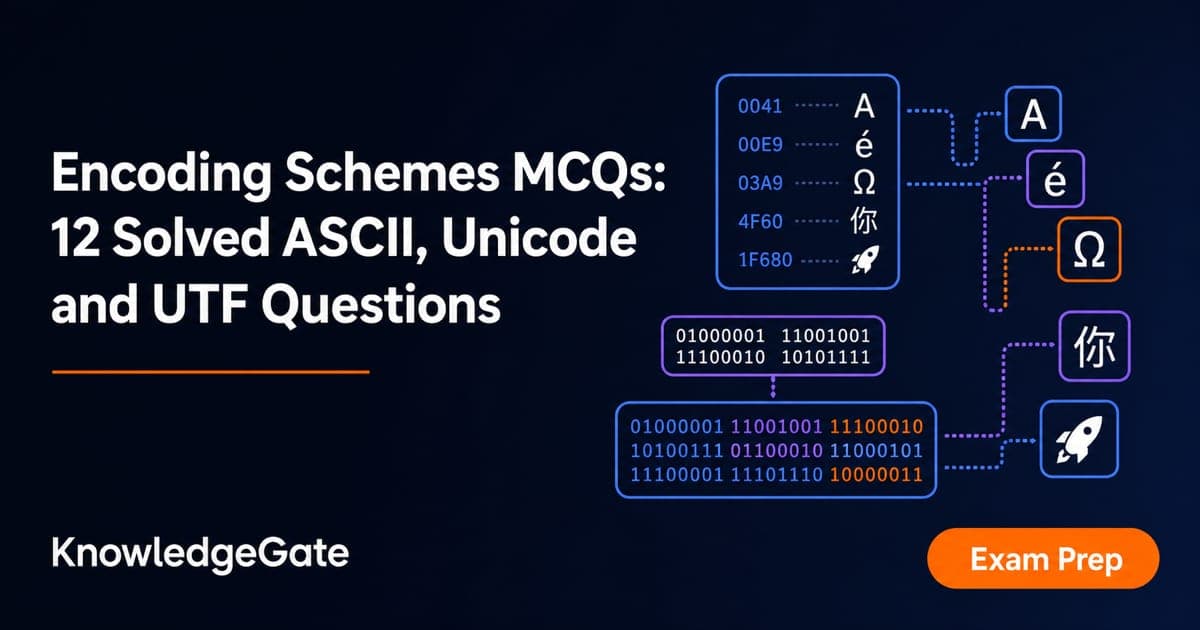
Encoding MCQs mix three levels: a character standard such as Unicode, a format such as UTF-8, and the bits or bytes stored for one character. These 12 solved questions turn them into repeatable checks. Choose an option before reading its explanation.
Identify the standard before decoding the bytes (Q1-Q3)
Unicode assigns code points to characters. UTF-8 and UTF-32 encode those code points as code units or bytes. ASCII covers fewer characters, whose byte values are retained in UTF-8.
Q1
NVS, Computer Science, 2017.
The following is a computing industry standard for the consistent encoding, representation and handling of text.
(a)
QRCode(b)
ASCII(c)
Unicode(d)
EBCDIC
Answer: (c) Unicode. View the solved question.
Unicode provides a shared code-point system across scripts and platforms. QRCode represents data visually, while ASCII and EBCDIC cover narrower repertoires.
Q2
KVS, Computer Science, 2026.
What is the full form of ASCII?
(a)
American Service Code for Information Interchange(b)
American Standard Code for Interchanging Information(c)
American Standard Code for Information Interchange(d)
American System Code for Information Interchange
Answer: (c) American Standard Code for Information Interchange. View the solved question.
The distractors alter Standard or Information. The exact expansion uses both words: American Standard Code for Information Interchange.
Q3
KVS, Computer Science, 2026.
__________ a universal character encoding standard that assigns a unique numeric “code point” to every character, symbol and emoji across all languages and platforms. (Fill in the blank with most appropriate option from the following)
(a)
Unicode(b)
HTML(c)
XML(d)
ASCII
Answer: (a) Unicode. View the solved question.
HTML and XML are markup systems, while ASCII lacks the stated multilingual scope. As an anchor, A is ASCII decimal 65 and Unicode code point U+0041.
Convert ASCII values without losing the requested width (Q4-Q6)
For numerical ASCII, find the decimal code, decompose it into powers of two, write seven bits, then pad left only if eight bits are requested. Thus 65 = 64 + 1 = 2^6 + 2^0, giving 1000001 or padded 01000001.
Q4
BPSC, TGT, 2023.
When a key is pressed on keyboard, which standard is used for converting the keystroke into the corresponding bits?
(a)
ANSI(b)
ASCII(c)
EBCDIC(d)
More than one of the above(e)
None of the above
Answer: (b) ASCII. View the solved question.
ASCII is the intended textbook answer among these choices. A modern keyboard first produces scan or key events, then software maps a character to Unicode and an encoding such as UTF-8. ASCII alone does not directly convert the physical keystroke.
Q5
EMRS, Computer Science, 2026.
In the ASCII system, which of the following represents the decimal value of the character ‘A’?
(a)
32(b)
48(c)
65(d)
97
Answer: (c) 65. View the solved question.
Use these anchors: 32 is space, 48 is 0, 65 is A, and 97 is a. Changing case therefore changes the ASCII value.
Q6
A character has decimal value 65 in ASCII. What will be its binary representation in 7-bit ASCII?
(a)
01000001(b)
1000001(c)
00100001(d)
11000001
Answer: (b) 1000001. Open the Encoding Schemes topic lesson.
Since 65 = 64 + 1, bits 2^6 and 2^0 give 1000001. The equal-valued 01000001 occupies eight positions, but the stem asks for seven.
If that conversion was not immediate, revise Number Systems and Base Conversions before continuing.
Separate Unicode code points from UTF storage formats (Q7-Q9)
Use two columns: Unicode identifies the character and code point; UTF represents that code point. UTF means Unicode Transformation Format, not a separate character set. Later, A uses one UTF-8 byte, € three, and 🙂 four.
Q7
EMRS, Computer Science, 2026.
UTF-8 and UTF-32 are widely used character encoding standards in computer systems. What does the abbreviation UTF stand for?
(a)
Universal Translation Framework(b)
Unicode Transformation Format(c)
Uniform Translation Framework(d)
Uniform Translation Format
Answer: (b) Unicode Transformation Format. View the solved question.
The expansion begins with Unicode, not Universal or Uniform. It ends with Format, not Framework.
Q8
Which of the following is TRUE regarding Unicode and UTF encodings?
(a)
Unicode defines storage format only(b)
UTF defines the character set(c)
Unicode defines characters while UTF defines storage format(d)
UTF-32 uses variable length encoding
Answer: (c) Unicode defines characters while UTF defines storage format. Open the Encoding Schemes topic lesson.
Unicode assigns code points and defines the repertoire; UTF-8, UTF-16 and UTF-32 encode those points. UTF-32 uses one fixed four-byte code unit per code point, whichever character it holds.
Q9
UP Police, Computer Science, Paper 2 - Subject Oriented (Shift II), 2016.
UTF-8 uses up to _________ byte(s) for non-ASCII characters.
(a)
8(b)
4(c)
1(d)
2
Answer: (b) 4. View the solved question.
Up to means a maximum, not a constant. Non-ASCII code points can use two, three or four UTF-8 bytes; 🙂 at U+1F642 uses four.
Solve the byte-count and capacity questions arithmetically (Q10-Q12)
Write a unit equation so you do not swap the encoding order or assume the wrong width.
Q10
If a system stores the character 'A' using UTF-32 and UTF-8, how many bytes will be required respectively?
(a)
1 byte, 4 bytes(b)
2 bytes, 4 bytes(c)
4 bytes, 1 byte(d)
4 bytes, 2 bytes
Answer: (c) 4 bytes, 1 byte. Open the Encoding Schemes topic lesson.
Keep UTF-32 first and UTF-8 second. For A, 1 x 4 bytes = 4 bytes and 1 x 1 byte = 1 byte, respectively.
Q11
A text file contains 100 characters, all English letters. If stored in UTF-8, what will be the approximate storage required?
(a)
100 bytes(b)
200 bytes(c)
400 bytes(d)
800 bytes
Answer: (a) 100 bytes. Open the Encoding Schemes topic lesson.
English letters occupy one UTF-8 byte each, so 100 x 1 byte = 100 bytes. This estimates only the character payload, excluding headers, line endings and metadata.
Q12
If ASCII uses 7 bits, how many unused combinations exist if a system stores ASCII characters in 8 bits?
(a)
64(b)
96(c)
128(d)
256
Answer: (c) 128. Open the Encoding Schemes topic lesson.
Eight bits give 2^8 = 256 patterns and seven-bit ASCII uses 2^7 = 128, so 256 - 128 = 128. Extended encodings assign no single universal meaning to that upper half. In Q6, 01000001 simply pads valid seven-bit 1000001.
One worked trace that joins code points, bytes and file size
Trace the illustrative string A€🙂 into UTF-8 bytes.
Character | Unicode code point | UTF-8 hex bytes | Size |
|---|---|---|---|
|
|
| 1 byte |
|
|
| 3 bytes |
|
|
| 4 bytes |
The UTF-8 payload is 1 + 3 + 4 = 8 bytes. UTF-32 is fixed width, so the same three characters take 3 x 4 bytes = 12 bytes. ASCII represents A, but replacing unsupported € or 🙂 with a guessed byte corrupts the text.
Together, A is decimal 65, seven-bit 1000001, padded 01000001, one UTF-8 byte, and four UTF-32 bytes.
The exam traps behind these 12 answers
Trap | Correct check |
|---|---|
Unicode always has one fixed byte width | Unicode assigns code points; different UTF forms encode them differently. |
UTF-8 uses four bytes per character | Four bytes is the maximum; ASCII-range characters use one. |
Decimal 65 is always written | Read the requested width; seven-bit 65 is |
100 English letters require 400 bytes | In stated UTF-8, |
A keyboard event directly becomes an ASCII byte | Hardware events and software character encoding are separate layers. |
Repeat five operations: expand the name, identify the scope, convert decimal at the requested width, separate code point from encoding, and multiply characters by bytes. Revisit the Number Systems and Base Conversions guide for binary arithmetic. Then use Memory Hierarchy and Virtual Memory to place encoded bytes in the storage hierarchy.
Short version and the next practice move
ASCII
Ais decimal65.Seven-bit
65is1000001.Unicode assigns code points.
UTF encodes those code points.
UTF-8 uses one to four bytes.
UTF-32 uses four bytes per code point, always.
The totals are A€🙂 = 8 UTF-8 bytes and 12 UTF-32 bytes. Retry all 12 with answers hidden. Label each name, code point, bit pattern, byte count or capacity, and write the equations 65 = 64 + 1, 100 x 1 = 100, and 256 - 128 = 128.
The Encoding Schemes practice set carries around 30 questions in total, so there is more to drill once these 12 feel routine.
For structured GATE CS study, use GATE Guidance by Sanchit Sir. For broader semester-level CS, use Zero to Hero, or compare paths in CS Fundamentals. Next, encode your own three-character string in UTF-8 and verify its byte count.
Keep learning
Instruction Formats and Addressing Modes MCQs: 12 Solved Cross-Concept Questions
Solve 12 cross-concept COA questions that connect addressing-mode choices with PC rules, memory references, opcode fields, and byte-aligned instructions.
3 Oct 20267 min readComputer Organization MCQs
Interrupt-Driven I/O MCQs: 12 Solved Questions with Explanations
Attempt 12 previous-year interrupt-driven I/O questions, then check each answer with a concise explanation. The set covers ISR order, vectoring, priority, and CPU-time numericals.
28 Sep 20268 min readComputer Organization MCQs
Bitmap and Pixmap MCQs: 12 Solved Pixel Depth and Memory Questions
Build a reliable pixel-memory method through 12 live MCQs covering bitmaps, pixmaps, lookup tables, uncompressed storage, refresh rates, masks, and dithering.
Updated 25 Sep 20267 min readComputer Organization MCQs
Assembly & Assembler Design MCQs: 11 Solved PYQs Explained
Attempt 11 published PYQs on assembler directives, language levels, tables, register-pair instructions, debugging and fixed-width arithmetic, then check each worked explanation.
Updated 24 Sep 20267 min readComputer Organization MCQs