EMRS Computer Science Syllabus: A Core CS, Pedagogy and ICT Study Map
Turn the official EMRS PGT or TGT syllabus into a clean 12-card inventory. Separate core CS, pedagogy, ICT and support areas, then plan the first ten study blocks.
KnowledgeGate Team
Exam prep & CS education
Updated 30 Jul 20265 min read98 views
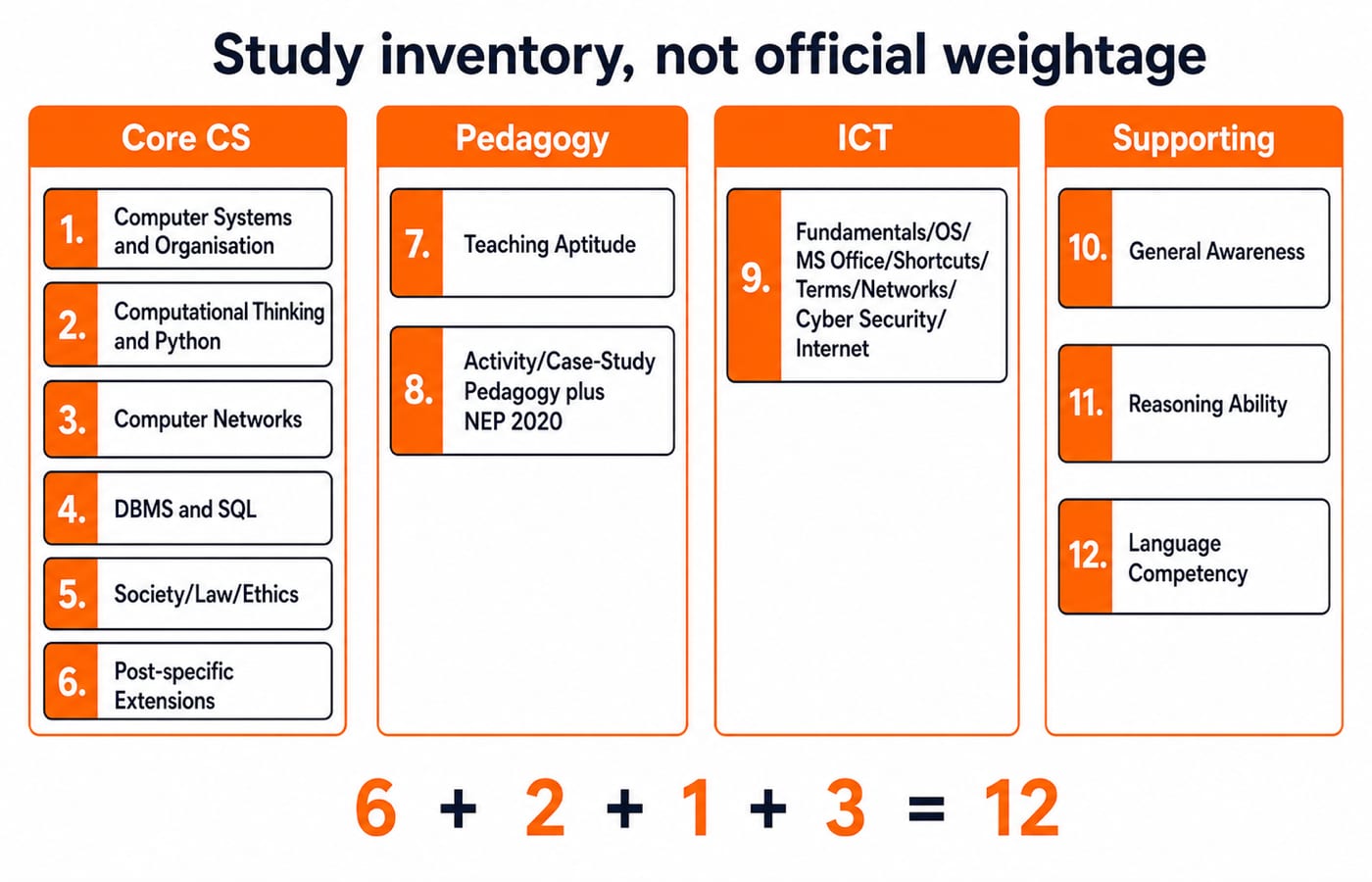
The official EMRS material is split by post and by tier, so one term can appear twice and look like two topics. Operating systems, computer networks and cyber security sit in the Tier I ICT part and again in the Tier II Computer Science syllabus. Twelve numbered cards in four lanes stop that double counting: six core Computer Science, two pedagogy, one ICT, three supporting.
EMRS Computer Science syllabus: choose the PGT or TGT document first
NESTS published separate ESSE-2025 PGT and TGT syllabus PDFs on 19 September 2025. Read your own PDF in two layers: Tier I carries the common assessment areas, Tier II the post-specific subject syllabus. Do not merge the two lists, because the PGT and TGT Computer Science papers do not carry the same topics.
Tier I runs in six parts: General Awareness, Reasoning Ability, Knowledge of ICT, Teaching Aptitude, Domain Knowledge (experiential activity-based pedagogy with case-study questions, and NEP 2020), and Language Competency. PGT lists General English and General Hindi; TGT adds a third, a regional language the candidate opts for, pitched above the general paper if that choice is English or Hindi.
Current KnowledgeGate coaching for this recruitment sits on the EMRS Computer Science Exam Preparation page. Scope is settled by the NESTS PDF, never by a coaching index.
EMRS Tier II core CS: turn long topic lists into six revision folders
Six folders cover the Tier II core, cards 1 to 6 on the map:
Computer systems and organisation: hardware, software types, memory units, operating-system functions, Boolean logic, number systems, encoding.
Computational thinking and Python: control flow, strings, lists, tuples, dictionaries, functions, modules, files.
Computer networks: data communication terms, transmission media, devices, topologies, web services.
Databases and SQL: the relational model and its keys, MySQL, GROUP BY, HAVING, ORDER BY.
Society, law and ethics: digital footprints, net etiquette, intellectual property rights and their violation, cyber-crime, cyber safety.
Post-specific extensions from the PDF you selected.
TGT adds Application Software (word processor, spreadsheet, presentation tools), Emerging Trends, and a separate Artificial Intelligence block. PGT adds Pandas data handling, Matplotlib plotting, and SQL maths, text, date and aggregate functions. Transfer nothing between the lists unless it appears in your own post's PDF.
Build prerequisites in this order: number systems and Boolean logic, computer organisation, Python control flow, files, DBMS and SQL, then networks. Binary 101101 is 32 + 8 + 4 + 1 = 45, and a reader who cannot do that conversion cannot follow addressing or memory-unit questions either, which is why number systems come before CPU organisation. Computer Fundamentals for CS Teaching Exams strengthens that base.
EMRS teaching aptitude and pedagogy: keep the two official boxes separate
Card 7 is Teaching Aptitude, Part IV: the nature, characteristics, objectives and basic requirements of teaching, learner characteristics, factors affecting teaching, methods, aids and evaluation systems. Card 8 is the separate Domain Knowledge box, Part V: experiential activity-based pedagogy with case-study questions, and NEP 2020. Two official parts, two cards.
Here is a classroom case of the shape Part V sets. Ten learners predict the output of x = 4 followed by if x == 4: print("match"). Four are right on the first ask. Each pair then runs the two lines and compares the printed match against what they wrote down, and eight are right on the exit check: 8 - 4 = 4 additional correct responses. The method is experiential and activity-based, not expository, because the prediction came before the explanation. The aid is the running interpreter, which settles the disagreement instead of the teacher. The evaluation evidence is formative, a before-and-after count on one narrow skill. Teaching Aptitude for CS Recruitment Exams works that vocabulary through in more depth.
EMRS ICT syllabus: separate tool literacy from domain depth
Card 9 is the whole Tier I ICT part, Part III: fundamentals of computer systems, basics of operating systems, MS Office, keyboard shortcuts, important computer terms and abbreviations, computer networks, cyber security, the Internet.
Belongs on card 9 (ICT) | Belongs on a core CS or ethics card |
|---|---|
Basics of Operating System, MS Office, shortcuts and safe Internet use | CPU structure, memory hierarchy, SQL and Python |
Tool literacy and everyday cyber awareness | IT Act, IPR and societal impacts |
Sort Ctrl+C and a phishing email onto card 9; cache memory, SELECT ... WHERE and Python list slicing onto their core CS cards; copyright infringement onto society, law and ethics. Where a term truly sits in both tiers, record it twice on purpose: card 9 for the tool-level question, its core CS card for the depth question. ICT for Teaching Exams: Fundamentals Explained gives the ICT side more room.
EMRS supporting sections: inventory what sits outside Computer Science
Supporting card | What to record |
|---|---|
Card 10: General Awareness | The official line is only general knowledge and current affairs, so build it from a daily habit, not a topic list. |
Card 11: Reasoning Ability | Puzzles and seating arrangements, data sufficiency, statement-based verbal reasoning, inequalities, blood relations, sequences and series, direction tests, assertion-reason, Venn diagrams. |
Card 12: Language Competency | PGT: General English and General Hindi. TGT: both, plus the opted regional language. |
Confirm marks, question counts, qualifying rules and negative marking in the notification for your recruitment cycle.
EMRS syllabus audit: work a 12-card inventory into the next 10 blocks
One aspirant's audit comes out like this. Red, weak: cards 2 (Python), 4 (databases and SQL), 8 (activity-based pedagogy and NEP 2020), 9 (ICT). Amber, shaky: cards 1 (systems), 3 (networks), 6 (post-specific extensions), 11 (reasoning). Green, safe for now: cards 5 (society, law and ethics), 7 (teaching aptitude), 10 (general awareness), 12 (language). Red 4, Amber 4, Green 4, and 4 + 4 + 4 = 12, so no card has been quietly dropped.
Ten 45-minute blocks then allocate themselves. Two blocks to each Red card: 4 x 2 = 8. One block each to the two Amber cards the rest depend on, systems and networks: 8 + 1 + 1 = 10. The other cards wait for the next ten. Set the colours from a short diagnostic, not a feeling, and re-colour after each full paper.
Need | Where to go | What is there |
|---|---|---|
The official scope | The NESTS syllabus page linked above | The PGT and TGT PDFs as published on 19 September 2025. |
One route across both tiers | Tier I and Tier II prepared as one sequence. |
EMRS Computer Science syllabus: the short version and next step
Choose PGT or TGT, download that official PDF, copy every line onto one of the twelve cards, colour each Red, Amber or Green, then give the first ten blocks to the Red ones. The 6/2/1/3 grouping and the ten-block split are study devices, not official weightages.
If you would rather not assemble that sequence yourself, the EMRS Complete Bundle (Computer Science) is one option. If only one card is weak, the fundamentals, pedagogy or ICT guide above is the smaller step.
Keep learning
EMRS Teacher Selection Process: Tier-wise Weightage and Verification
Passing screening, earning merit marks and proving eligibility are separate tasks. Follow the PGT/TGT stage map with worked score examples and a practical document checklist.
5 Oct 20265 min read52 viewsEMRS
EMRS PGT Computer Science Preparation: 7 Mistakes to Fix
Watched the lectures but still repeating errors? Use seven checks to separate reading from tested understanding, repair mock-test mistakes and choose resources against actual gaps.
29 Sep 20264 min readEMRS
EMRS vs State PSC Teaching Jobs: Choose by Work Setting, Mobility and Fit
Compare an EMRS post with a named State PSC route using official clauses, personal mobility limits, syllabus overlap and a worked 100-point fit score.
Updated 7 Aug 20266 min readEMRS
EMRS Computer Science: DBMS, Networks and Cyber Safety Through One Lab Scenario
A fictional residential-school lab connects normalization, SQL, subnetting and cyber safety. Follow one sign-in from PC-B12 to the database boundary.
Updated 5 Aug 20266 min readEMRS