EMRS Computer Science PYQs: Build a Study Plan from Sparse Papers
A small PYQ archive can still guide revision if you verify sources, remove duplicates, track your errors and keep supplemental practice in a separate lane.
KnowledgeGate Team
Exam prep & CS education
Updated 2 Aug 20266 min read
A thin, scattered PYQ archive can make one repeated topic look like a permanent weightage trend. EMRS Computer Science recruitment runs in two stages, a Tier-1 general paper and a Tier-2 subject paper, across both TGT and PGT posts, so a downloaded pile usually mixes stages and post levels before you have counted anything. Separate verified PYQ evidence, reasonable inference and extra practice first, then build the plan on the part you can stand behind.
Verify an EMRS paper before counting its topics
Use three provenance labels. verified PYQ requires an identifiable EMRS paper or official answer record. A memory-based compilation is recalled/reconstructed; a teacher-made, platform, book or cross-exam question is practice. Never promote either to PYQ. A paper with no printed cycle label and no matching NESTS record stays recalled/reconstructed however many sites reprint it.
Record the source URL or file name, printed recruitment cycle, post, paper or tier label, page, exact question number, provenance label and duplicate fingerprint. Use the first 12 meaningful words plus the option set as the fingerprint, so two copies of one scan count once.
The tier and post fields do real work here. Tier-1 is the common paper: general awareness, reasoning ability, ICT knowledge, teaching aptitude, activity-based pedagogy and language competency. So a Tier-1 ICT question says nothing about Tier-2 Computer Science depth, and a TGT paper is not evidence about a PGT one. The stage-wise pattern for the current cycle is in the NESTS notification at nests.tribal.gov.in.
Use EMRS Computer Science Exam Preparation to navigate the subject blocks while you build the sheet.
Turn sparse EMRS PYQs into one evidence sheet
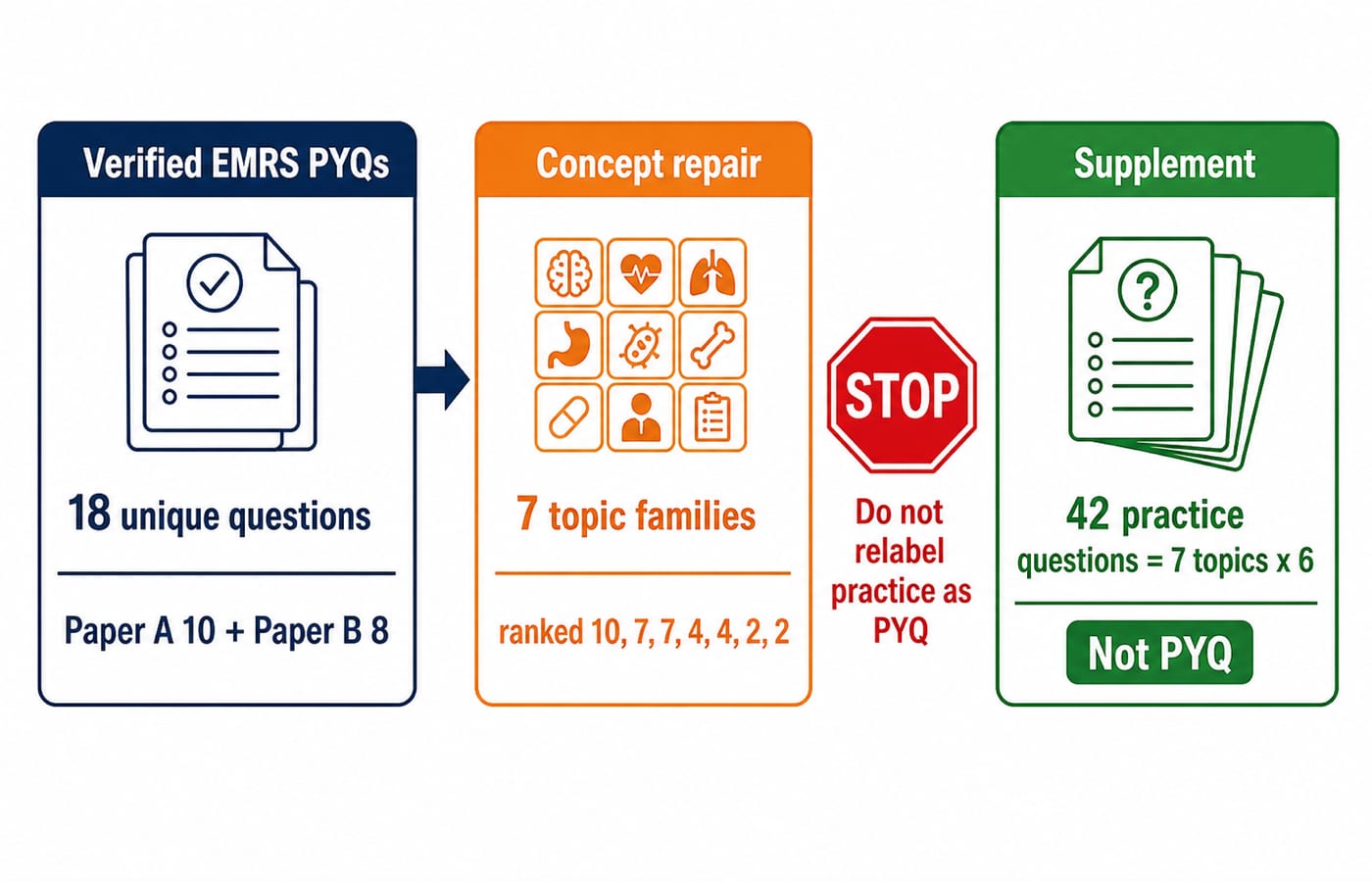
Suppose your archive settles at 18 unique questions after deduplication, 10 in Paper A and 8 in Paper B. One sheet then holds everything you actually know: questions per topic family, how many of your papers each family appears in, and how many you missed on first attempt.
Topic family | Questions | Papers represented | First-attempt errors | Revision priority |
|---|---|---|---|---|
C programming and data structures | 5 | A and B | 3 | 10 |
DBMS | 4 | A and B | 1 | 7 |
Operating systems | 3 | A and B | 2 | 7 |
Computer networks | 2 | One paper | 2 | 4 |
Computer organisation | 2 | A and B | 0 | 4 |
Software engineering | 1 | One paper | 1 | 2 |
Digital logic | 1 | One paper | 1 | 2 |
Check the totals: 5 + 4 + 3 + 2 + 2 + 1 + 1 = 18; 3 + 1 + 2 + 2 + 0 + 1 + 1 = 10 errors. Tag depth separately as recall, direct application or multi-step.
Use priority = question count + a 2-point both-papers bonus + first-attempt errors. C and data structures scores 5 + 2 + 3 = 10; networks scores 2 + 0 + 2 = 4. It ranks revision, not future probability.
Read concept depth and distractors, not just frequency
Practice drill, not an EMRS PYQ: Under SRTF, P1 is (arrival 0, burst 5), P2 is (arrival 1, burst 3) and P3 is (arrival 2, burst 1). Average-waiting-time options are 1.00, 1.33, 1.67 and 3.33 units.
The timeline is P1 from 0 to 1, P2 from 1 to 2, P3 from 2 to 3, P2 from 3 to 5, then P1 from 5 to 9. Waiting times are P1: 9 - 0 - 5 = 4, P2: 5 - 1 - 3 = 1, and P3: 3 - 2 - 1 = 0. The average is (4 + 1 + 0) / 3 = 5/3 = 1.67.
The 3.33 distractor is the FCFS average. 1.33 follows if P1's wait is undercounted as 3, while 1.00 suggests only one waiting interval was retained. Revise preemption, remaining time and waiting-time calculation from this drill. The transferable part is the distractor family: in average-waiting-time questions the FCFS value and an off-by-one wait are the two options that punish a rushed timeline.
Build coverage bands without inventing a trend
Band A combines cross-paper recurrence with weakness: C and data structures, DBMS and operating systems. Band B covers networks, computer organisation, software engineering and digital logic, where evidence is limited or errors are lower. Band C holds Tier-2 Computer Science syllabus areas your archive does not touch at all. Two sparse papers will leave several of those, so list them from the current cycle's syllabus rather than from what your papers happen to contain.
Once the sheet exists, split each nine-hour week 50:30:20 across the bands: 4.5 hours for Band A, 2.7 for Band B and 1.8 for Band C. Check: 4.5 + 2.7 + 1.8 = 9. Recalculate after every timed set, because the ranking moves as errors clear. Band C ordering is a syllabus job rather than an archive job, so take it from EMRS CS Subject Weightage: Score Revision Blocks, which scores the official blocks directly.
Supplement PYQ gaps without changing the label
Give each topic family two recall, two direct-application and two multi-step questions. This makes 7 × 6 = 42 supplements. Keep verified PYQ attempted = 18 separate from supplemental practice attempted = 42; never report “60 PYQs”.
Use DSSSB Computer Science PYQs: Fix 3 Practice Gaps for adjacent concepts and a comparable attempt-and-repair loop. Keep imported items labelled DSSSB or practice, never EMRS PYQ.
Run a four-week, nine-hour cycle
Week | Nine-hour plan |
|---|---|
1 | Use 2 hours for provenance and duplicates, 3 hours for the 18 verified items under a timer you set yourself, and 4 hours for topic, depth, distractor and error tags. |
2 | Give each Band A family 2 hours of concepts and 1 hour for a six-question drill plus review. Three families at 3 hours each make 9. |
3 | Give four Band B families 1.5 hours each, which completes the 42 supplements started in Week 2, then 3 hours to Band C reading from the current syllabus. Total: |
4 | Attempt two self-made 18-question sets in 45 minutes each, review for 4 hours, then repair the top two error clusters for 3.5 hours. Total: |
The first cycle front-loads archive work, so Band C reaches its full 20% share only from the second cycle onward. If you lose two hours, drop that cycle's Band C reading block first. Never double the next day, and never delete source-checking or review.
Audit sparse-paper traps every Sunday
Mistake | Consequence | Correction |
|---|---|---|
Count duplicate scans as separate papers | False recurrence | Deduplicate by fingerprint |
Treat reconstructed questions as exact | False option-pattern claims | Keep the reconstructed label |
Call one repeated topic high weightage | Overfitting | Say “seen in both available sets” |
Call cross-exam drills EMRS PYQs | Corrupted evidence | Keep separate source counters |
Discard unanswered questions | Hidden weakness | Record an error with reason |
On the worked numbers, provenance coverage is 18/18 = 100%, first-attempt accuracy is (18 - 10) / 18 = 8/18 = 44.4%, errors are 10, and supplemental completion is 42/42 = 100%. Recompute all four from your own sheet each Sunday; accuracy is the one that should move.
The short version and your next study action
Verify provenance, deduplicate, tag topic, depth and distractor, rank personal revision, then add separately labelled practice and retest. Sparse PYQs are strong diagnostic evidence but weak evidence for exact future weightage.
For focused Computer Science concept repair, use EMRS CS Tier-2 (PGT/TGT). If you want a linked Tier-1 and Tier-2 preparation path, use the EMRS Complete Bundle (Computer Science).
Keep learning
EMRS Teacher Selection Process: Tier-wise Weightage and Verification
Passing screening, earning merit marks and proving eligibility are separate tasks. Follow the PGT/TGT stage map with worked score examples and a practical document checklist.
5 Oct 20265 min read52 viewsEMRS
EMRS PGT Computer Science Preparation: 7 Mistakes to Fix
Watched the lectures but still repeating errors? Use seven checks to separate reading from tested understanding, repair mock-test mistakes and choose resources against actual gaps.
29 Sep 20264 min readEMRS

EMRS vs State PSC Teaching Jobs: Choose by Work Setting, Mobility and Fit
Compare an EMRS post with a named State PSC route using official clauses, personal mobility limits, syllabus overlap and a worked 100-point fit score.
Updated 7 Aug 20266 min readEMRS
EMRS Computer Science: DBMS, Networks and Cyber Safety Through One Lab Scenario
A fictional residential-school lab connects normalization, SQL, subnetting and cyber safety. Follow one sign-in from PC-B12 to the database boundary.
Updated 5 Aug 20266 min readEMRS