EMRS Computer Science Eligibility: Degree Checks and Selection Map
Audit your EMRS Computer Science post, degree title, marks evidence and qualification date before following the Tier I to Tier II selection flow.
KnowledgeGate Team
Exam prep & CS education
Updated 28 Jul 20265 min read105 views

Your Computer Science degree list may not tell you whether to choose PGT or TGT, whether an adjacent title counts, or which score creates merit. Start with a post-first eligibility audit, then follow the selection flow. Every rule below is taken from the NESTS ESSE-2025 bulletin, the last published cycle.
Choose the exact EMRS Computer Science post first
Computer Science was not one eligibility box. The ESSE-2025 Information Bulletin gave PGT and TGT different routes and age ceilings. Copy the exact post name from your applicable notice before testing a qualification.
Post | Degree route stated in ESSE-2025 | Age ceiling stated there |
|---|---|---|
PGT (Computer Science) | M.Sc. in Computer Science or IT, MCA, or M.E./M.Tech. in Computer Science or IT from a recognised institution, with at least 50% aggregate | Not exceeding 40 years |
TGT (Computer Science) | BCA with at least 50%; or an undergraduate degree in Computer Science/IT with at least 50% in the concerned subject and aggregate, with Computer Science as the main subject in all years; or B.E./B.Tech. in Computer Science/IT with at least 50% | Not exceeding 35 years |
These are ESSE-2025 values; your NESTS notification controls. In these rows, B.Ed. was a future-promotion requirement, not an extra direct-entry route. CTET, KVS and state TGT boards each publish their own Computer Science degree list, so compare them through the Govt Teaching Jobs category and the teaching Computer Science exams comparison rather than carrying an EMRS rule across to them.
Test the degree name with four candidate files
Candidate A: MCA, 52% aggregate, recognised university. This matches an ESSE-2025 PGT route, subject to other conditions.
Candidate B: B.Tech. Computer Science, 72% aggregate, recognised university. This matches a TGT route, but not a named PGT route in that bulletin.
Candidate C: B.Sc. Computer Science, 58% aggregate and 64% in Computer Science, with CS recorded as the main subject across all six semesters. This maps to the TGT undergraduate route.
Candidate D: B.Sc. Data Science, 71% aggregate. Data Science was not a title named in that row, so mark the file clarification needed, neither eligible nor ineligible on its face.
Degree equivalence must come from the competent official authority or an explicit notice clause. Similar syllabi, recruiter precedent, or another board's accepted degrees cannot substitute. Seek written clarification before applying with an adjacent degree.
Separate degree equivalence from marks equivalence
Ask two questions in order: is the degree title an allowed route, and do the evidenced marks meet its threshold? ESSE-2025 required qualifications to match the notification strictly and required a marksheet showing equivalent percentage when grades or CGPA were used.
Candidate E has an MCA with 7.2 CGPA. Suppose the university's official certificate says percentage = (CGPA - 0.75) x 10:
7.2 - 0.75 = 6.456.45 x 10 = 64.5%64.5% > 50%, so the evidenced percentage clears that bulletin's PGT threshold.
Simply multiplying 7.2 by 10 and entering 72% leaves the evidence incomplete without an official conversion rule. Conversely, Candidate D's clearly recorded 71% does not settle whether B.Sc. Data Science is an accepted degree title.
Audit the cut-off date and documents
ESSE-2025 measured eligibility on 23 October 2025 and required the requisite certificate by that date. Candidate F's final MCA result and certificate, dated 22 October, existed by the cut-off. Candidate G's result, dated 24 October, came after it and did not satisfy that cycle merely because the portal remained accessible. Do not reuse this date for a later recruitment.
Pack the selected post, degree, all marksheets, recognition evidence, official CGPA conversion, proof of CS as the main subject in all years where required, date-of-birth proof, applicable category or PwBD evidence, and application confirmation. Match names, spellings and percentages to source records.
Follow the ESSE-2025 selection map
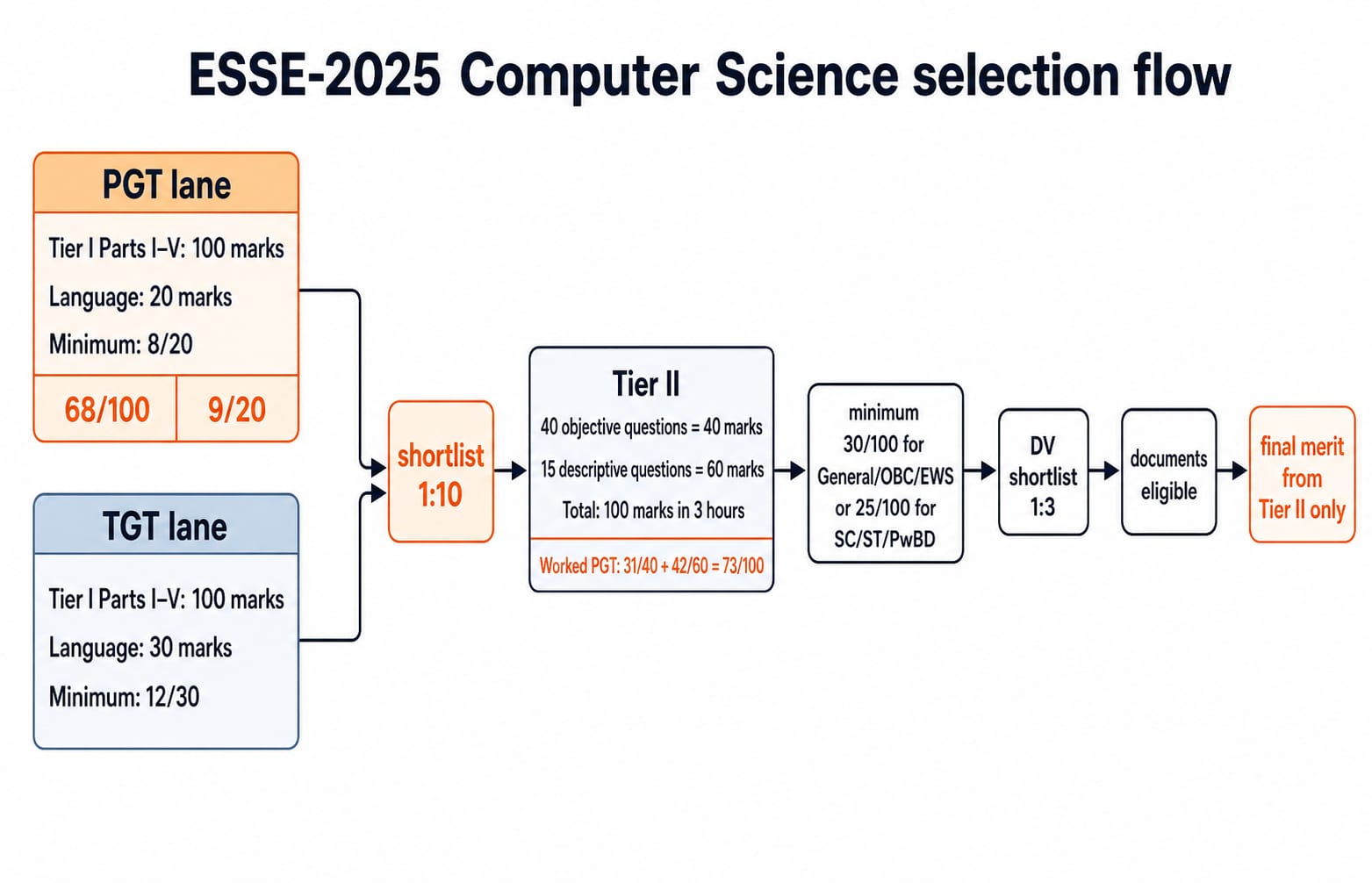
The bulletin gave PGT Tier I Parts I-V 100 marks plus a 20-mark qualifying English/Hindi component, requiring 8/20. TGT had Parts I-V for 100 marks plus a 30-mark qualifying language component, requiring 12/30. Tier II shortlisting was 1:10 against notified vacancies.
Tier II had 40 objective questions for 40 marks and 15 descriptive questions for 60 marks: 40 + 15 = 55 questions and 40 + 60 = 100 marks, over three hours. PGT and TGT merit came from Tier II only, as the EMRS Tier I versus Tier II guide explains.
For a PGT example, 68/100 in Parts I-V and 9/20 in language clears the 8/20 gate. If shortlisted, 31/40 objective plus 42/60 descriptive gives 31 + 42 = 73/100. For a General candidate, 73 exceeds the ESSE-2025 minimum consideration threshold of 30%, but document-verification shortlisting still depends on rank within 1:3. Merit is 73, not 68 + 73 = 141.
Treat document verification as an eligibility gate
ESSE-2025 described exam admission as provisional, required original certificates, and allowed only eligible candidates into the panel after verification. A high score cannot cure a qualification mismatch.
Candidate H enters B.Sc. Computer Science, 58%, and scores 82/100 in Tier II. The marksheets, however, show CS as a main subject in only four of six semesters. The advertised TGT route required it in all years, so 82 does not repair the missing evidence.
Compare post with degree route, names with certificates, aggregate with subject marks, CGPA with its conversion source, qualification date with cut-off, and category certificate with requirements. NESTS decides eligibility at verification, not the portal that accepted your form.
Use a three-colour decision, then prepare
Green: MCA 52% for the ESSE-2025 PGT route, with recognition and percentage evidence. Amber: B.Sc. Data Science 71%, or MCA 7.2 CGPA without the university conversion document. Red for that cycle: qualification after 23 October 2025, or 49% aggregate against the stated 50% TGT threshold.
Re-open your applicable NESTS notification and repeat the post, degree-title, marks, cut-off-date and document checks before submitting. Once the file is green, separate preparation by stage:
Stage | Preparation resource |
|---|---|
Tier I general paper | |
Tier II Computer Science |
Work Tier I for breadth and speed across the general paper, and Tier II for Computer Science depth, since ESSE-2025 built merit from Tier II alone.
Keep learning

EMRS Teacher Selection Process: Tier-wise Weightage and Verification
Passing screening, earning merit marks and proving eligibility are separate tasks. Follow the PGT/TGT stage map with worked score examples and a practical document checklist.
5 Oct 20265 min read50 viewsEMRS

EMRS PGT Computer Science Preparation: 7 Mistakes to Fix
Watched the lectures but still repeating errors? Use seven checks to separate reading from tested understanding, repair mock-test mistakes and choose resources against actual gaps.
29 Sep 20264 min readEMRS

EMRS vs State PSC Teaching Jobs: Choose by Work Setting, Mobility and Fit
Compare an EMRS post with a named State PSC route using official clauses, personal mobility limits, syllabus overlap and a worked 100-point fit score.
Updated 7 Aug 20266 min readEMRS
EMRS Computer Science: DBMS, Networks and Cyber Safety Through One Lab Scenario
A fictional residential-school lab connects normalization, SQL, subnetting and cyber safety. Follow one sign-in from PC-B12 to the database boundary.
Updated 5 Aug 20266 min readEMRS