

Society, Law and Ethics in ICT: Concepts, Cases and Exam Traps
Learn to separate social impact, legal rules, ethical duties and cyber safety in ICT, then apply the framework to a fully worked campus-portal case.
KnowledgeGate Team
Exam prep & CS education
Updated 18 Nov 20266 min read

A campus portal can create a social barrier, misuse personal data, expose records, exceed a software licence and waste energy in the same week. Build the vocabulary through the definitions and separate mini-examples in Society, Law and Ethics in ICT: Privacy, Cybercrime and Worked Examples, then audit one portal by turning its evidence into five distinct findings, five reproducible calculations and an exam-ready response order.
Society, law and ethics in ICT: follow the evidence chain
Start with evidence, not an offence label. An audit answer becomes clearer when it moves through five questions in order:
Purpose: What service is being delivered, and which people must be able to use it?
Inventory: Which data, accounts, software assets and devices exist?
Measure: What proportion is unnecessary, stale, exposed or outside permission?
Classify: Is the finding primarily social, legal, ethical, security-related, intellectual-property-related or environmental?
Respond: What must be contained now, what needs evidence, and what requires a current authoritative rule?
The categories can overlap, but they do not mean the same thing. A design may be secure yet exclude users with limited connectivity. An action may satisfy a licence while remaining ethically unfair. A legal conclusion needs the applicable current rule and facts; a security response can begin before liability is decided.
Campus portal case file: establish the facts before judging them
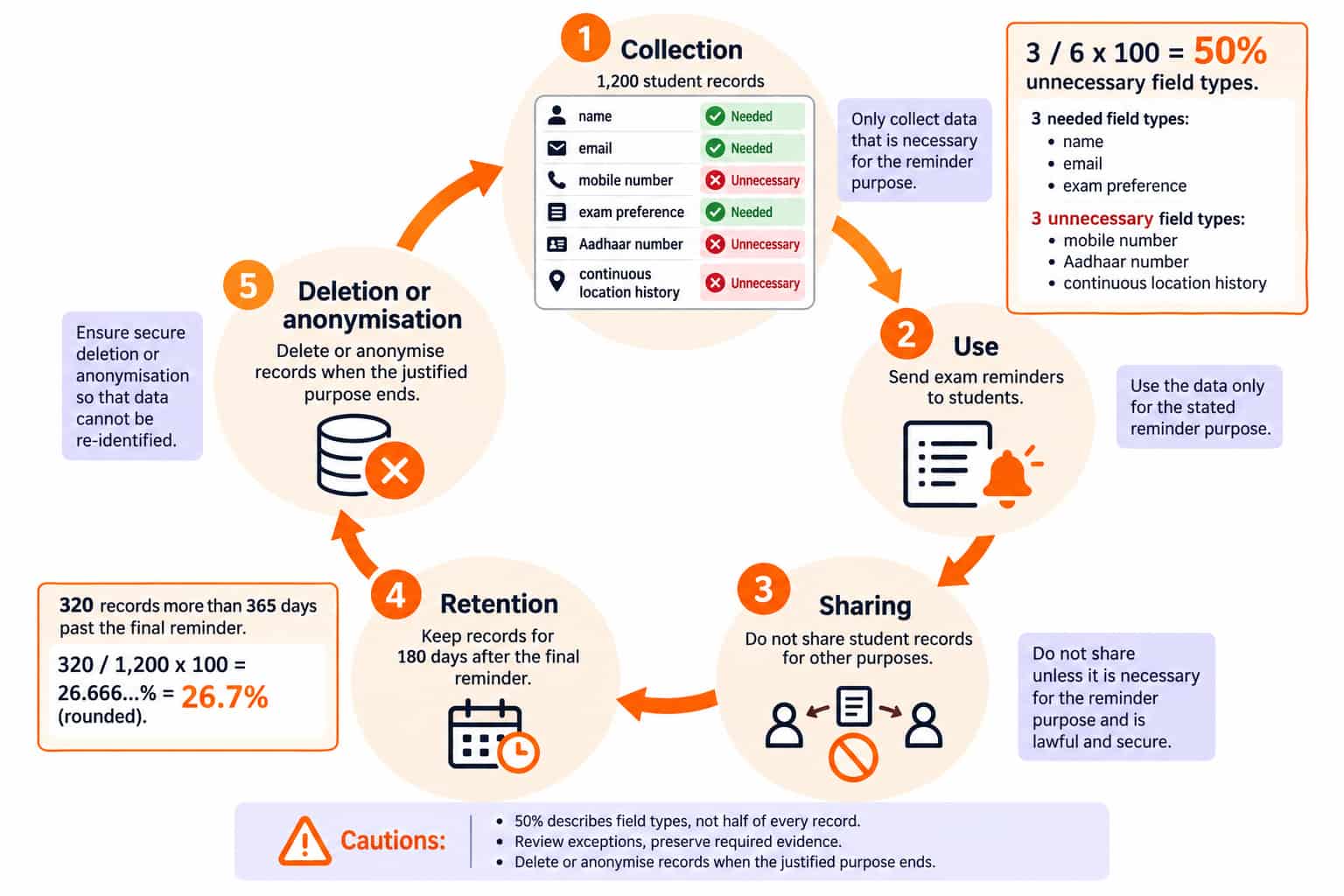
Consider a hypothetical exam-reminder portal with 1,200 student records. It collects name, email, mobile number, exam preference, Aadhaar number and continuous location history. Its stated purpose needs only name, email and exam preference, and its internal retention rule is 180 days after the final reminder.
The portal also records login times, device identifiers and access logs. A student deliberately changing an exam preference creates an active digital footprint. The server recording an IP address and access time creates a passive footprint. Passive does not mean anonymous, harmless or optional, and deleting a local file does not prove that server copies, backups or screenshots disappeared.
A lifecycle review follows collection, use, sharing, retention and deletion or anonymisation. Purpose limitation asks why each field exists. Minimisation asks whether it is needed. Access control asks who can see it. Retention asks when the justified need ends.
Data minimisation and retention: quantify two separate failures
Three of the six collected field types are unnecessary for the stated reminder purpose:
3 / 6 x 100 = 50%
The 50% result describes field types, not half of every record and not a legal severity threshold. Removing mobile number, Aadhaar number and continuous location history reduces the data surface while preserving the stated service. Consent would not make unrelated collection necessary.
The audit also finds 320 records more than 365 days past the final reminder. Against the portal's stated 180-day rule, the stale-record rate is:
320 / 1,200 x 100 = 26.666...% = 26.7% (rounded)
This is a retention-control failure under the hypothetical policy. Review exceptions, preserve required evidence and delete or anonymise records that no longer have a justified purpose. Live-row deletion must be coordinated with backups and downstream copies.
Public-link exposure: measure impact and contain the incident
A spreadsheet containing 80 student records is available through a public link for 45 minutes. The exposed share of the portal inventory is:
80 / 1,200 x 100 = 6.666...% = 6.7% (rounded)
The denominator is all 1,200 records because the question asks what share of the inventory was exposed. The 45-minute duration matters to the investigation, but it does not change that percentage. Neither figure proves how many people opened the file.
Disable the link first. Preserve relevant logs, record the time window and fields involved, restrict access, inform the responsible team and follow the applicable current process. Deleting logs would destroy evidence; waiting for a complaint would prolong risk. Phishing, malware and unauthorised access are different mechanisms, so name only what the facts support.
India's Information Technology Act, 2000 forms part of the legal context. Use India Code's consolidated IT Act record for current statutory text rather than inferring an offence, section or penalty from a short classroom stem.
Intellectual property and licences: count the deployment gap
The same campus lab has a proprietary application installed on 26 devices under a 20-device licence. The deployment gap is:
26 - 20 = 6 installations over the limit
That result shows non-compliance with the hypothetical agreement, not a statutory penalty. Reconcile the inventory, remove or properly license the excess installations, and retain proof of entitlement. Copyright protects qualifying original expression such as code; trademarks identify source; patents may protect qualifying inventions; trade secrets depend on confidentiality.
Open source software is still licensed. Permissive and copyleft licences grant different permissions and impose different conditions. Publicly accessible, public domain and open source are three separate ideas, and credit alone does not establish permission.
E-waste and green computing: separate disposal from energy use
E-waste concerns discarded electrical and electronic equipment and components. Reuse, repair, refurbishment, secure data erasure and authorised recycling solve different parts of the lifecycle. Formatting a drive handles data; it does not create a responsible end-of-life route.
Energy is a separate measure. Forty lab computers draw 120 W each, and an idle-control change avoids two operating hours per computer on each working day:
40 x 120 W x 2 h = 9,600 Wh = 9.6 kWh per day
The calculation assumes all 40 machines would otherwise draw 120 W during those hours. It establishes an energy quantity only. Cost needs a current tariff, and emissions need a sourced factor. Cloud use moves some equipment; it does not erase environmental impact.
Campus portal audit: combine findings without collapsing the lenses
The audit board now contains four numeric findings: 50% of field types are unnecessary, 26.7% of records are stale under the internal rule, 6.7% of records were exposed, and six software installations exceed the licence. They share one portal, but each has its own denominator, evidence and corrective owner.
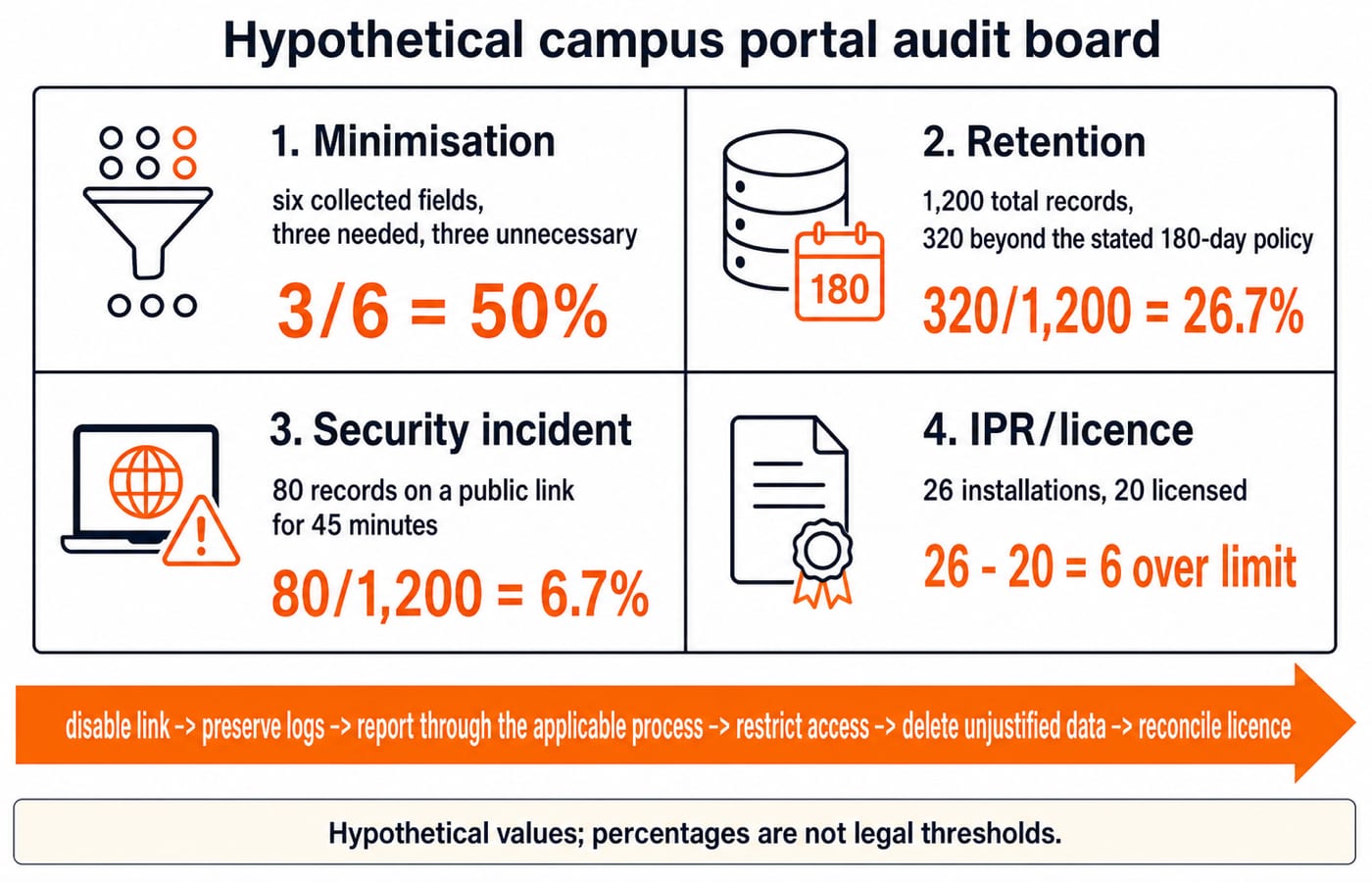
Social analysis asks who may be excluded by the service design. Ethics asks whether collection, reuse and defaults are fair and proportionate. Security deals with the public link and protection of people, devices and data. Intellectual-property review deals with licence permission. The legal layer determines which current enforceable duties apply. The energy calculation adds an environmental measure without turning kilowatt-hours into a legal conclusion.
Exam and interview traps: classify the statement before choosing
Exams commonly change one word in the classification. A deliberate post is active footprint; a server access log is passive. A backup supports recovery; it does not prevent an incident. Open source is not automatically public domain. Ethical concern is not proof of an offence. A privacy problem is not limited to secrecy, because purpose, minimisation, access and retention also matter.
For the public-link scenario, reject (A) delete every log, (B) wait for a complaint and (C) buy more licences. Choose (D) disable public access and preserve relevant logs, then follow the applicable process. The response contains the exposure while retaining evidence; it does not decide liability. In an interview, state the assumed policy, separate facts from legal conclusions and name the immediate containment step before long-term corrections.
Use UGC NET Paper 1 vs Paper 2 to place ICT reasoning in the wider exam route. The UGC NET Paper 1 plus Paper 2 test series provides mixed practice. Use the audit method to separate evidence, calculation and classification.
Society, law and ethics in ICT: the short version and next step
Record the purpose, inventory the assets, calculate with a named denominator, classify each finding, contain urgent exposure, preserve evidence and verify current law from an official source. The correct audit results are 50%, 26.7%, 6.7%, six excess installations and 9.6 kWh per day.
Rework the five calculations without looking, then explain what each number can and cannot prove. For a structured ICT sequence, continue with the NTA UGC NET Paper 1 course. The UGC NET preparation category groups related courses and test-series routes.
Go deeper with the full courseGATE Guidance by Sanchit Sir
Keep learning

Society, Law and Ethics in ICT: Privacy, Cybercrime and Worked Examples
Learn to separate social, legal, ethical and security questions through worked ICT cases on access, privacy, phishing, intellectual property and e-waste.
Updated 11 Aug 20266 min readGATE Strategy & Roadmap

Society, Law and Ethics in ICT: Concepts, Worked Example and Exam Traps
Learn a three-lens method for separating social impact, legal requirements and ethical judgment in ICT, then apply it to an exact hypothetical AI-proctoring audit.
Updated 24 Oct 20265 min readUGC NET Computer Science

ICT Terms and Abbreviations: Complete Guide with Worked Examples
Build a functional map of common ICT abbreviations. Learn the differences that matter, then apply them in two step-by-step examples.
Updated 14 Nov 20266 min readGATE Strategy & Roadmap

Keyboard Shortcuts in Knowledge of ICT: Windows, MS Office and Browser Commands with Worked Examples
Learn to decode keyboard shortcuts by application and focus. Compare Windows, browser and MS Office commands, then check each idea through exact text and Excel traces.
Updated 14 Nov 20266 min readGATE Strategy & Roadmap