SMTP, POP3 and IMAP MCQs: 12 Solved Email Questions with Explanations
Solve 12 email MCQs on SMTP, POP3, IMAP, MIME, TCP support, default ports and webmail. Each answer includes a direct explanation and exam trap.
KnowledgeGate Team
Exam prep & CS education
Updated 31 Jul 20269 min read50 views
SMTP, POP3 and IMAP look like a small set of definitions, but exam questions mix sending, server-to-server relay, mailbox access, webmail, TCP support, MIME and default ports into a single scenario. Every one of the twelve questions here is a previous-year question, drawn from GATE, UGC NET, ISRO, BPSC and Beltron Programmer papers.
Use one decision rule throughout: identify the job first, then choose the protocol, layer or port. The broader GATE CS Exam Preparation path can help you place this topic inside the full syllabus.
Related reading: Email protocols and TCP/IP layers.
1. SMTP, POP3, IMAP and MIME: build the protocol map first
Task | Correct protocol or standard | Layer | Common plain TCP port used in exam questions |
|---|---|---|---|
Client submission | SMTP | Application | 587 |
Server-to-server mail transfer | SMTP | Application | 25 |
Retrieve mail | POP3 | Application | 110 |
Access and synchronise a server-held mailbox | IMAP | Application | 143 |
Describe message content and attachments | MIME | Application content standard | No transport port |
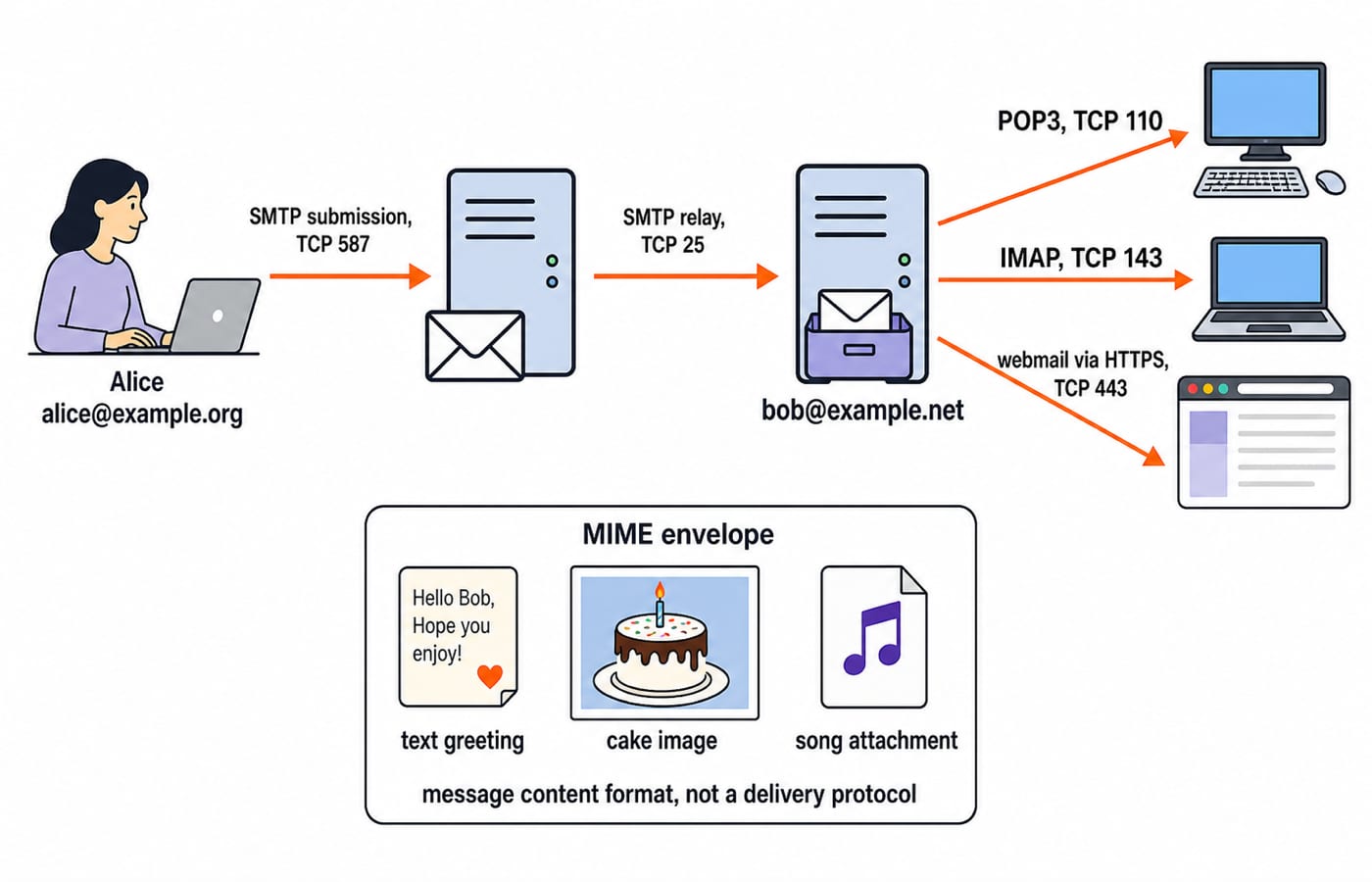
Alice at alice@example.org submits by SMTP on TCP 587. Her server relays by SMTP on TCP 25 to the server holding bob@example.net. Bob can use POP3 on TCP 110, IMAP on TCP 143, or webmail, commonly HTTPS on TCP 443. SMTP delivers but does not retrieve Bob's inbox. Secure variants exist too (SMTPS on 465, POP3 over TLS on 995, IMAP over TLS on 993, and STARTTLS upgrades on the plain ports), but exam questions want these plain defaults. Webmail uses HTTP or HTTPS at the browser interface even though SMTP handled delivery, as explained further in Application Layer Protocols: DNS, HTTP, and email.
2. SMTP sending and TCP support MCQs
Question 1: Send first, retrieve second
Question (GATE 2019)
Which of the following protocol pairs can be used to send and retrieve e-mails (in that order)?
Options
IMAP, POP3
SMTP, POP3
SMTP, MIME
IMAP, SMTP
Correct answer: Option 2, SMTP, POP3.
Explanation: SMTP sends the message, then POP3 retrieves it. MIME defines what an email can carry, not how a client retrieves a mailbox.
Exam trap: IMAP, SMTP has the right protocols in the wrong order, and IMAP, POP3 pairs two retrieval protocols with nothing that sends.
Question 2: Do not confuse application and transport layers
Question (GATE 2012)
Which of the following transport layer protocols is used to support electronic mail?
Options
SMTP
IP
TCP
UDP
Correct answer: Option 3, TCP.
Explanation: TCP provides the reliable byte stream used by SMTP, POP3 and IMAP. SMTP is application-layer, while IP is network-layer.
Exam trap: SMTP is the reflex pick, but it is application layer. UDP is the harder distractor because it really is transport, yet mail needs TCP's ordered, loss-free stream.
Question 3: Map each activity independently
Question (GATE 2011)
Consider the different activities related to email.
m1: Send an email from mail client to mail server
m2: Download an email from mailbox server to a mail client
m3: Checking email in a web browser
Which is the application level protocol used in each activity?
Options
m1: HTTP, m2: SMTP, m3: POP
m1: SMTP, m2: FTP, m3: HTTP
m1: SMTP, m2: POP, m3: HTTP
m1: POP, m2: SMTP, m3: IMAP
Correct answer: Option 3, m1: SMTP, m2: POP, m3: HTTP.
Explanation: SMTP submits mail, POP downloads it, and a browser uses HTTP, normally HTTPS in deployment. FTP is not a normal mailbox-access protocol.
Exam trap: Option 2 differs from the key in one slot only, putting FTP where POP belongs. Label each activity before scanning the options.
3. MIME and multimedia email MCQs
Question 4: MIME enables multimedia content
Question (UGC NET 2021)
In electronic mail, which of the following protocols allows the transfer of multimedia?
Options
IMAP
SMTP
POP3
MIME
Correct answer: Option 4, MIME.
Explanation: MIME describes non-ASCII text, images, audio and other body parts through content types and encodings. SMTP transports that message; POP3 and IMAP access the mailbox. Strictly, MIME is a message-format standard, not a transport protocol.
Exam trap: The word transfer makes the question read like SMTP's job. What it really asks is which standard defines the content, and only MIME does that.
Question 5: Choose the multipart subtype from the ordering rule
Question (ISRO 2007)
An email contains a textual birthday greeting, a picture of a cake and a song. The order is not important. What is the content-type?
Options
Multipart/mixed
Multipart/parallel
Multipart/digest
Multipart/alternative
Correct answer: Option 2, Multipart/parallel.
Explanation: “The order is not important” points to multipart/parallel, whose independent parts need no significant display order. multipart/alternative gives representations of the same content; multipart/digest groups messages.
Exam trap: Multipart/mixed is the reflex answer, and it is right when the parts have a set display order. The words about order not mattering decide this one.
4. POP3 modes and default-port MCQs
Question 6: Delete mode versus keep mode
Question (UGC NET June 2020)
Post office protocol (POP) is a message access protocol which is used to extract message for client. In this regards, which of the following are true?
(A) POP has two modes, Delete mode and keep
(B) In Delete mode, mail is deleted from mail box after each retrieval
(C) In Delete mode, mail is deleted from mail box before each retrieval
(D) In keep mode, mail is deleted before retrieval
(E) In keep mode, mail remains in mail box after retrieval
Choose the correct answer from the options given below:
Options
(A) and (B) only
(A), (D) and (E) only
(A), (B), (C) and (D) only
(A), (B) and (E) only
Correct answer: Option 4, (A), (B) and (E) only.
Explanation: POP3 has exactly two modes. In delete mode the message is removed from the mailbox after retrieval, and in keep mode it stays on the server. So A, B and E hold, while C and D reverse the timing.
Exam trap: C and D are B and E with the timing reversed, so verifying only A and B lands you on option 1.
Question 7: POP3's plain default TCP port
Question (Beltron Programmer 2025)
Which TCP port does POP3 use by default?
Options
25
143
110
587
Correct answer: Option 3, 110.
Explanation: POP3's standard plain TCP endpoint is port 110. The distractors map to SMTP relay on 25, IMAP on 143 and message submission on 587.
Exam trap: Every distractor here is a genuine mail port, so recognising the number is not enough. Store each port with its job attached to it.
5. IMAP central-mailbox and synchronisation MCQs
Question 8: Access the same repository from different machines
Question (UGC NET August 2016)
Which of the following protocols is used by email server to maintain a central repository that can be accessed from any machine ?
Options
POP3
IMAP
SMTP
DMSP
Correct answer: Option 2, IMAP.
Explanation: IMAP retains the mailbox on the server, so clients on different machines can access server-side messages and state. SMTP sends and relays mail instead.
Exam trap: POP3 does retrieve mail, but it pulls messages down to one machine. DMSP is a real distributed mail protocol, which is what makes it a plausible distractor.
Question 9: Identify IMAP's multi-device advantage
Question (Beltron Programmer 2025)
Which of the following is a key advantage of using IMAP over POP3?
Options
IMAP does not support email folders.
IMAP keeps messages stored on the server and synchronized across devices.
IMAP sends emails faster.
IMAP deletes emails from the server automatically.
Correct answer: Option 2, IMAP keeps messages stored on the server and synchronized across devices.
Explanation: IMAP treats the server mailbox as shared state, keeping folders, read status and changes aligned across devices. Sending email and automatic deletion are not its defining advantage.
Exam trap: Faster sending and automatic deletion are POP3 habits dressed up as IMAP benefits. The advantage is where mailbox state lives, not speed.
6. Complete email flow, SMTP roles and ESMTP MCQs
Question 10: Send, cache and browse in one sequence
Question (ISRO December 2017)
Consider the set of activities related to e-mail
A : Send an e-mail from a mail client to mail server
B : Download e-mail headers from mail box and retrieve mails from server to a cache
C : Checking e-mail through a web browser
The application level protocol used for each activity in the same sequence is
Options
SMTP, HTTPS, IMAP
SMTP, POP, IMAP
SMTP, IMAP, HTTPS
SMTP, IMAP, POP
Correct answer: Option 3, SMTP, IMAP, HTTPS.
Explanation: A is client to server submission, so SMTP. B fetches headers first and caches messages that remain on the server, and that selective server-resident access is IMAP rather than POP. C is a browser session, so HTTPS.
Exam trap: SMTP, POP, IMAP wins on familiarity but puts two protocols in the wrong slots, and option 1 sends the browser protocol to activity B.
Question 11: A mail server can act as an SMTP client
Question (BPSC PGT 2023)
When the mail server sends mail to other mail servers it becomes
Options
SMTP client
SMTP server
peer
More than one of the above
None of the above
Correct answer: Option 1, SMTP client.
Explanation: Client and server describe connection roles. The sending server initiates the SMTP relay connection on TCP 25, so it is the SMTP client; the receiving server takes the server role.
Exam trap: SMTP server is the reflex answer because the machine is a mail server. Roles are per connection, and this machine opened it.
Question 12: EHLO announces ESMTP capabilities
Question (Beltron Programmer 2025)
What is the purpose of the EHLO command in Extended SMTP (ESMTP), which enhances the basic SMTP protocol?
Options
It replaces the HELO command and announces support for extended SMTP features.
It encrypts the email content before transmission.
It initiates the direct transfer of binary files without MIME encoding.
It checks the availability of DNS servers before sending email.
Correct answer: Option 1, It replaces the HELO command and announces support for extended SMTP features.
Explanation: An ESMTP client greets with EHLO so the server can advertise supported extensions. EHLO does not itself encrypt content, bypass MIME or check DNS. STARTTLS, when advertised, is a separate capability and command.
Exam trap: Encryption tempts because STARTTLS is advertised in the same ESMTP handshake. EHLO only asks what the server supports.
7. SMTP, POP3 and IMAP exam traps and the next practice step
Use this correction checklist:
Send or relay: SMTP.
Retrieve to a client: POP3.
Server-held synchronised mailbox: IMAP.
Browser interface: HTTP or HTTPS.
Attachments and multipart content: MIME.
Then check the layer and the port. SMTP, POP3 and IMAP all sit at the application layer, and all three rely on TCP underneath. The plain defaults are submission 587, SMTP relay 25, POP3 110 and IMAP 143.
The KnowledgeGate question bank carries over 40 more questions on this subtopic. Continue with Application Layer MCQs: 12 Solved DNS, HTTP and Email Questions for mixed practice, then use Computer Networks MCQs as the subject-level practice map. For a structured course path across the syllabus, move next to GATE Guidance by Sanchit Sir.
Keep learning
Computer Networks Basics & Criteria MCQs: 12 Solved Questions with Explanations
Solve 12 Computer Networks questions, then use clear explanations and worked criteria checks to separate similar terms confidently.
3 Oct 20268 min readComputer Networks MCQs
TCP Timers, RTT Estimation & SWS: 10 Solved MCQs and NATs
Solve 10 TCP exam questions covering timer roles, Silly Window Syndrome, recursive RTT estimates, Jacobson/Karels RTO and Karn's rule.
Updated 28 Sep 20267 min readComputer Networks MCQs
RSA Algorithm MCQs: 12 Solved Questions with Step-by-Step Explanations
Practise RSA key generation, modular inverses, encryption, signatures and defining equations, with concise working for conceptual and numerical answers.
25 Sep 20268 min readComputer Networks MCQs
Firewall, VPN, IDS and IPS MCQs: 11 Network Security Questions Solved
Solve 11 previous-year questions on firewalls, VPNs, IDS and IPS. Learn rule filtering, connection state, DMZ design, IPsec modes, tunnels and signatures.
Updated 24 Sep 20267 min readComputer Networks MCQs