E-Waste Management Explained: Lifecycle, Worked Recovery Example and Exam Traps
Learn how e-waste moves from use to reuse, recycling and controlled residue. A hypothetical 600 kg batch shows how to close the mass balance and avoid denominator traps.
KnowledgeGate Team
Exam prep & CS education
Updated 16 Oct 20266 min read
An old electronic device is not automatically waste. Donating a working laptop is not recycling, and collecting 600 kg does not mean recovering 600 kg of material. E-waste management is a lifecycle and responsibility problem; any 600 kg batch must close at mass balance, and every recovery percentage needs a named denominator. Legal targets come from current rules, while recycler performance comes from measured records; neither can be inferred from this example.
1. What counts as e-waste, and why it needs a separate system
E-waste is electrical or electronic equipment, parts or components that the holder discards, intends to discard or must discard. A working laptop transferred for continued use is used equipment; a broken laptop sent for material extraction is e-waste. Age alone is insufficient, and legal boundaries vary.
Products may contain recoverable steel, aluminium, copper, plastics and glass, while some components need controlled handling. A circuit board can carry valuable metals, a cable has conductor and insulation, a display combines glass and electronics, and a battery needs a separate safe route. Not every device contains every substance.
The lifecycle runs from purchase, use and repair through collection, secure storage, data sanitisation, reuse testing, dismantling, recovery, treatment and residue disposal. Data deletion protects information; recycling manages material.
2. Reuse, refurbishment, recycling and disposal are different outcomes
Term | What is preserved | Output | Common exam trap |
|---|---|---|---|
Repair | Device or part | Corrected fault | Confusing it with refurbishment |
Reuse | Product or part | Continued service | Calling donation recycling |
Refurbishment | Suitable equipment | Tested, repaired equipment | Calling it simple repair |
Dismantling | Separated parts | Material fractions | Treating separation as recovery |
Recycling | Material value | Secondary material | Equating feed with output |
Recovery | Useful output | Measured output | Hiding the input denominator |
Disposal | Nothing | Controlled residue route | Ignoring unrecovered mass |
Prevent unnecessary replacement where practical, extend useful life, reuse or refurbish suitable equipment, recycle the rest, then dispose of controlled residue. Add reuse and recycling only when streams are mutually exclusive and belong to the same batch.
Extended producer responsibility means a producer retains defined end-of-life responsibility through collection or take-back, suitable downstream handling, fulfilment mechanisms and records. Current duties depend on the applicable official rules and authority. For wider context, revise ICT for Teaching Exams.
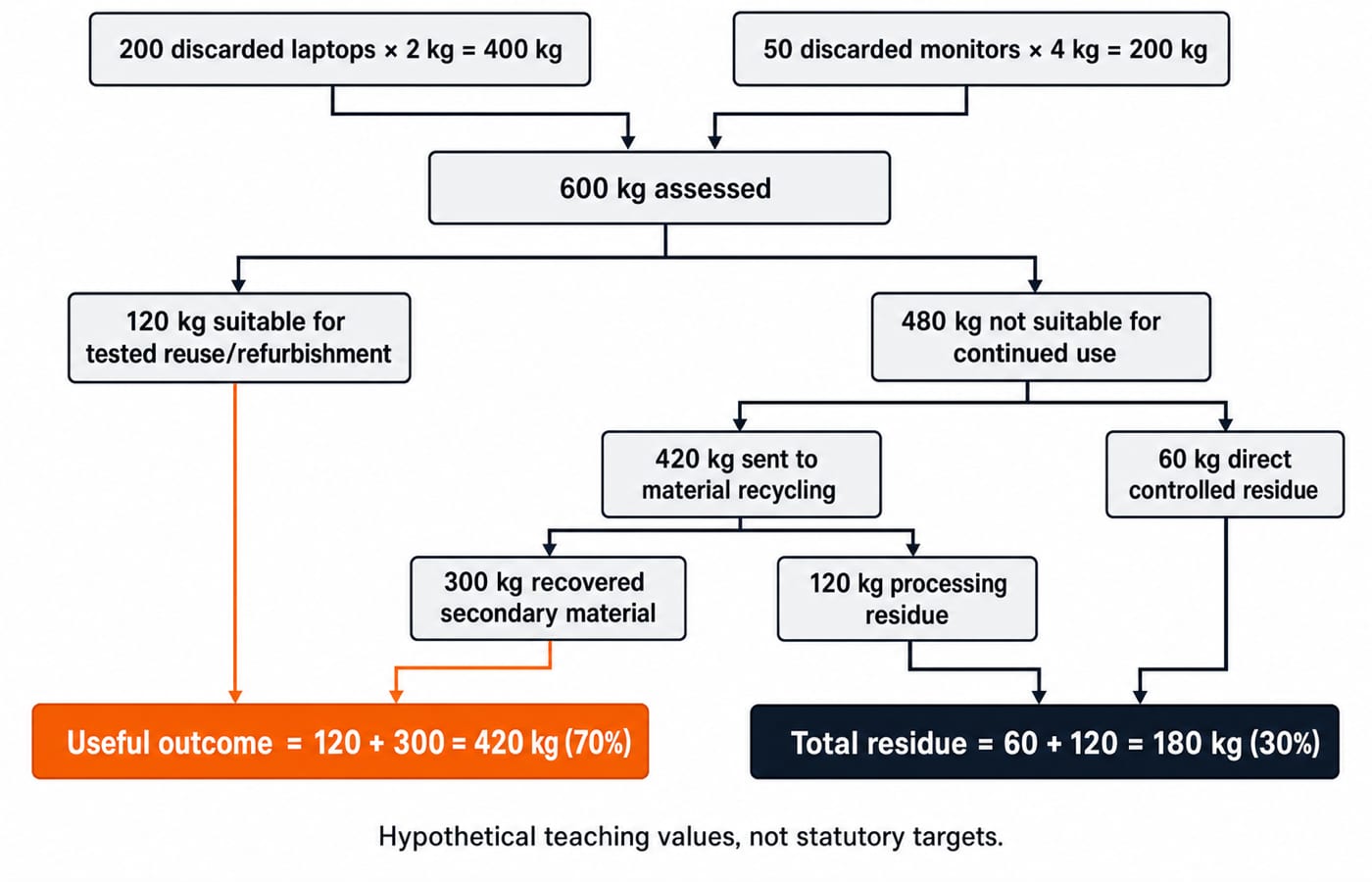
3. Worked example: close the mass balance for a 600 kg batch
An institution retires 200 laptops at 2 kg each and 50 monitors at 4 kg each:
Laptop mass =
200 x 2 = 400 kgMonitor mass =
50 x 4 = 200 kgIncoming mass =
400 + 200 = 600 kg
Testing sends 120 kg to reuse or refurbishment, 420 kg to recycling and 60 kg to direct residue. Balance: 120 + 420 + 60 = 600 kg.
The recycling feed has mutually exclusive fractions:
Fraction | Feed | Recovery rate | Recovered | Residue |
|---|---|---|---|---|
Ferrous material | 180 kg | 90% |
| 18 kg |
Aluminium | 90 kg | 80% |
| 18 kg |
Plastics | 60 kg | 50% |
| 30 kg |
Glass or mixed material | 90 kg | 40% |
| 54 kg |
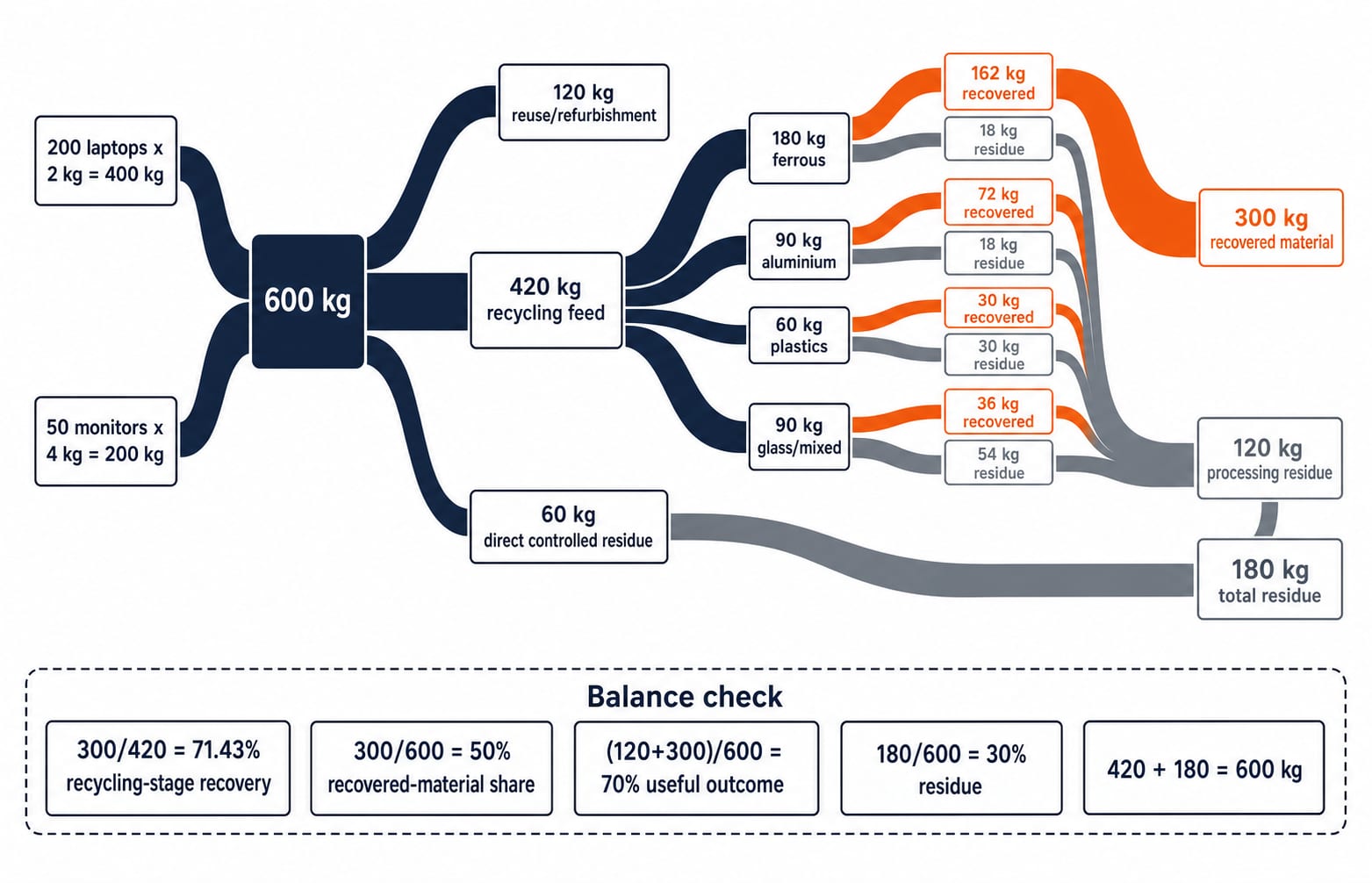
Feed is 180 + 90 + 60 + 90 = 420 kg. Recovery is 162 + 72 + 30 + 36 = 300 kg; processing residue is 420 - 300 = 120 kg.
Keep each denominator visible:
Recycling-stage recovery =
300 / 420 x 100 = 71.43%.Recovered-material share of the original batch =
300 / 600 x 100 = 50%.Reuse or refurbishment share =
120 / 600 x 100 = 20%.Total useful outcome =
(120 + 300) / 600 x 100 = 70%.Total residue =
60 + 120 = 180 kg, or180 / 600 x 100 = 30%.
Overall, 420 kg useful outcome + 180 kg residue = 600 kg. The 71.43%, 50% and 70% results answer different questions; regulatory targets are separate values set by current official rules.
4. Responsibility and chain of custody: who must record what
Role | Concept-level action and record |
|---|---|
User or bulk holder | Inventory, separate, protect and record handover |
Collection system | Record source and weight |
Refurbisher | Document equipment returned to use |
Recycler | Record input, recovery and residue |
Treatment or disposal facility | Close unrecovered routes |
For batch EW-17, 600 kg leaves the institution and the receiver acknowledges 600 kg. Records show 120 kg reused or refurbished, 300 kg recovered and 180 kg residue. The difference is 600 - (120 + 300 + 180) = 0 kg. A non-zero result needs reconciliation for measurement error, moisture, packaging, stock carried forward or an unrecorded stream.
Asset-transfer, data-sanitisation and material-recovery records prove different outcomes. One certificate does not automatically prove all three.
5. Environmental and safety reasoning without unsafe shortcuts
The risk pathway is hazardous component -> release during uncontrolled processing -> exposure through air, dust, soil or water -> possible harm. Composition varies. Controlled systems use collection, ventilation, containment, worker protection, recovery and residue treatment instead of burning or crude extraction.
Do not break, burn or open devices. Isolate visibly damaged or leaking energy-storage components from ordinary handling, keep electronics dry and secure, and use an appropriate authorised local route.
A recovery figure is incomplete if input weight is wrong, residue is untracked, data is mishandled or outputs lack a destination. EW-17 needs a zero difference and a documented 180 kg residue route.
6. Common e-waste traps and the correction for each
Trap | Why it fails | Correct rule |
|---|---|---|
Every old device is e-waste | Age is insufficient | Check whether it is discarded |
Donating a working device is recycling | Product life continues | Classify it as reuse |
Repair equals refurbishment | Refurbishment adds testing and preparation | Keep them distinct |
Dismantling proves recovery | It only separates fractions | Measure usable output |
Collected mass equals recovered mass | Mass can go to reuse or residue | Follow every stream |
Reuse and recycling may be double-counted | Overlap inflates results | Use exclusive streams |
A data wipe proves safe disposal | Data and material records differ | Verify both processes |
Informal extraction is acceptable | Output does not erase risk | Use a controlled route |
300 / 420 = 71.43% measures recycling-feed recovery. 300 / 600 = 50% measures recovery against the full batch. (120 + 300) / 600 = 70% includes reuse. Name the numerator, denominator and excluded stream.
The conservation trap is calling 420 kg recovered. It is input producing 300 kg recovery and 120 kg residue. The full equation is 120 + 300 + 60 + 120 = 600 kg.
7. How objective exams test e-waste management
Objective questions use classification, sequence, matching, and assertion and reason. A working laptop transferred for service is reuse; a discarded broken unit sent for extraction is e-waste. Collection precedes testing, dismantling and recovery. Match refurbisher with return to use, recycler with secondary material, and disposal facility with residue. Collection is not recycling because collected mass can follow several routes.
For numericals, 300 / 420 x 100 = 71.43% is recycling-stage recovery, while (60 + 120) / 600 x 100 = 30% is residue share. The 50%, 70% and 20% values measure other outcomes.
The same batch can be asked as a classification question or as a percentage numerical, so practise both forms. Use UGC NET Paper 1 vs Paper 2: What Each Tests for orientation, and confirm applicability from your examination authority's official syllabus or notice.
8. E-waste management: the short version and next practice step
Use six checks: classify the item, preserve product life, separate reuse from recycling, track every kilogram, state the denominator and document residue. For EW-17, 600 kg input closes as 120 kg reuse or refurbishment, 300 kg recovered material and 180 kg residue.
Test the method by hiding the outcome column of the recovery table. Recalculate each fraction, prove that recovered mass plus residue equals its feed, then decide whether 71.43%, 50% or 70% answers a given denominator.
Choose the NTA UGC NET Paper 1 Course for structured teaching, the UGC NET Paper 1 Test Series for timed practice, or UGC NET Preparation Courses and Test Series to compare both routes.
Keep learning
Function Keys F1-F12 Explained: Uses, Worked Shortcut Map and Exam Traps
Learn what F1 through F12 do in named Windows and Microsoft application contexts, then solve a nine-command classification and avoid common modifier traps.
Updated 20 Oct 20266 min readUGC NET Computer Science
Data Protection, IPR and Open Source Explained: Two Worked Cases and Exam Traps
Separate privacy from security, match IP rights to software assets, and solve two numerical cases on data minimisation and mixed-licence releases.
Updated 12 Oct 20266 min readUGC NET Computer Science

Common Software & Tools MCQs: 12 Solved ICT Questions Explained
Attempt 12 previous-year ICT MCQs before reading concise explanations that separate applications, hardware, web tools, abbreviations, malware and operating systems.
8 Oct 20267 min readUGC NET Computer Science

ICT in Education MCQs: 12 Solved Questions on Digital Learning Tools
Solve 12 ICT in Education MCQs, then use clear explanations and a five-layer model to separate files, tools, platforms and public initiatives.
Updated 3 Oct 20268 min readUGC NET Computer Science