Switching Techniques MCQs: 12 Solved Questions on Circuit, Packet and Message Switching
Practise 12 switching-techniques questions on circuit, packet and message switching, packet-header arithmetic and legacy WAN standards.
KnowledgeGate Team
Exam prep & CS education
8 Sep 20267 min read64 views
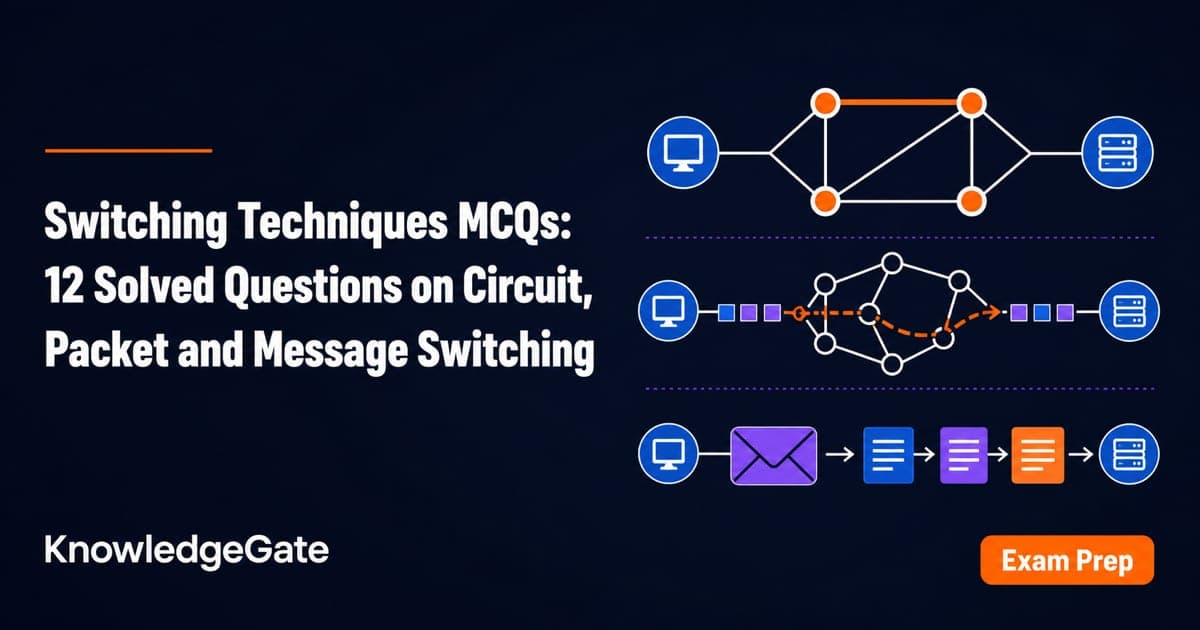
Switching questions often look like pure definitions, but their distractors mix path reservation, store-and-forward behaviour, packet ordering, setup, headers and older WAN standards. One missed word can flip an otherwise easy answer.
First separate circuit, packet and message switching by the forwarding unit, path reservation and ordering behaviour. Then apply header arithmetic and the legacy WAN distinctions: X.25 supports virtual circuits, Frame Relay reduces hop-by-hop recovery, and ATM uses fixed cells. Choose before reading each answer. KnowledgeGate has over 25 questions on switching techniques, so keep practising through GATE CS exam preparation. Select a question number to open its full worked solution, and use the key clue to eliminate each distractor.
Switching techniques MCQs: build the comparison sheet first
Technique | Unit forwarded | Dedicated path | Store-and-forward behaviour | Ordering and delay clue | Typical exam phrase |
|---|---|---|---|---|---|
Circuit switching | A data stream after dedicated end-to-end circuit setup | Yes. Resources remain reserved for the conversation | No whole-message hop-by-hop forwarding after setup | The same path preserves order and gives low delay variation |
|
Packet switching | A message is divided into addressed packets | No dedicated end-to-end circuit in the standard datagram comparison | Packets are forwarded hop by hop and can meet different queues or routes | Variable delay and possible reordering |
|
Message switching | The complete message | No | Each intermediate node stores the whole message before forwarding it | Large buffers, so it is unsuitable for real-time traffic |
|
Legacy map: X.25 is connection-oriented packet switching with switched virtual circuits and a DTE/DCE interface. Frame Relay detects damaged frames without X.25-style hop-by-hop acknowledgement and recovery. ATM uses fixed-size cells and is the historical long-haul telephone-network answer.
For numericals, write payload per packet = message size / packet count, then packet size = payload per packet + header size. Circle FALSE, not, only or requires before comparing conceptual options.
Switching techniques basics MCQs 1-2: identify the forwarding unit
Question 1
Eklavya Model Residential Schools (EMRS), Computer Science, 2023
Identify the switching technique in which the message is sent in one go, but it is divided into smaller pieces, and they are sent individually. The pieces are given a unique number and address to identify their order at the receiving end.
A. Message Switching
B. Packet Switching
C. Binary Switching
D. Circuit Switching
Answer: B. Packet Switching
The clues divided into smaller pieces, sequence number and address identify packet switching and receiver-side reassembly. Message switching forwards one whole-message unit, while circuit switching reserves a path first.
Question 2
DSSSB, Computer Science, 2021
Which of the following statement(s) is/are true regarding switching techniques in Data communication?
Statements:
I. In circuit switching a dedicated path is identified between the sender and the receiver.
II. In packet switching each information to be transmitted between sender and receiver is broken down into smaller packets.
A. Only I
B. Only II
C. Both I and II
D. Neither I nor II
Answer: C. Both I and II
Test the statements separately. Statement I correctly identifies circuit switching by its dedicated path, and Statement II correctly identifies packet switching by its smaller packets, so both are true.
Circuit switching and packet switching MCQs 3-6: reservation, delay and order
Question 3
UGC NET, Computer Science, 2021
Which of the following statement is False?
A. Packet switching leads to better utilization of bandwidth resources than circuit switching.
B. Packet switching results in less variation in the delay than circuit switching.
C. Packet switching sender and receiver can use any bit rate, format or framing method unlike circuit switching.
D. Packet switching can lead to reordering unlike circuit switching.
Answer: B. Packet switching results in less variation in the delay than circuit switching.
After circuit setup, a reserved route makes delay comparatively stable. Datagram packets can meet different queues or routes, causing variable delay and possible reordering, so option B is false.
Question 4
UGC NET, Computer Science, Paper 2 (July), 2018
Which of the following statements are true ?
(a) Three broad categories of Networks are
(i) Circuit Switched Networks
(ii) Packet Switched Networks
(iii) Message Switched Networks
(b) Circuit Switched Network resources need not be reserved during the set up phase.
(c) In packet switching there is no resource allocation for packets.
Code :
A. (a) and (b) only
B. (b) and (c) only
C. (a) and (c) only
D. (a), (b) and (c)
Answer: C. (a) and (c) only
Statement (a) lists the three categories, and (c) describes packet switching without pre-reserved end-to-end resources. Statement (b) is false because circuit setup reserves the path and resources.
Question 5
UGC NET, Computer Science, Paper 2 (June), 2015
Which transmission technique guarantees that data packets will be received by the receiver in the same order in which they were sent by the sender ?
A. Broadcasting
B. Unicasting
C. Packet switching
D. Circuit switching
Answer: D. Circuit switching
An established circuit carries data along one reserved path, preserving order. Datagram packets may be routed or queued independently; broadcasting and unicasting only describe delivery scope.
Question 6
HTET, Computer Science, 2024
Which switching technique establishes a dedicated physical path between source and destination nodes through intermediate nodes of communication network?
A. Packet Switching
B. Message Switching
C. Physical Switching
D. Circuit Switching
Answer: D. Circuit Switching
The phrase dedicated physical path identifies circuit switching. Packet and message switching share intermediate resources, while Physical Switching is not a standard category.
Packet switching numerical MCQ 7: payload plus header
Question 7
UGC NET, Computer Science, Paper 2 (January), 2017
In a packet switching network, if the message size is 48 bytes and each packet contains a header of 3 bytes. If 24 packets are required to transmit the message, the packet size is ________.
A. 2 bytes
B. 1 byte
C. 4 bytes
D. 5 bytes
Answer: D. 5 bytes
Dividing the 48-byte payload across 24 packets gives 48 / 24 = 2 bytes each. Adding the 3-byte header gives 2 + 3 = 5 bytes. Check it with 24 x (5 - 3) = 48 bytes. Option A gives only the payload.
Message switching MCQs 8-9: whole-message store and forward
Question 8
Navodaya Vidyalaya Samiti (NVS), Computer Science, 2017
In this switching technique entire data is sent as a complete unit from the sender Node and delivered to the recipient Node via a number of intermediate Nodes:
A. Data switching
B. Circuit switching
C. Packet switching
D. Message switching
Answer: D. Message switching
The clues entire data and complete unit identify message switching, where each intermediate node stores and forwards the whole message. Packet switching divides the data, while circuit switching reserves a path first.
Question 9
MPPSC, Computer Science, 2025
What is the key feature of message switching?
A. Real Time Transmission
B. Store and forward
C. Dedicated circuits
D. No addressing needed
Answer: B. Store and forward
Each intermediate node stores the complete message before forwarding it, so Store and forward is defining. Message switching still needs addressing, reserves no dedicated circuit and is not characterised by real-time transmission.
X.25, Frame Relay and ATM MCQs 10-12: legacy WAN distinctions
Question 10
UGC NET, Computer Science, 2021
Which of the following statements are true?
A. X.25 is connection‐oriented network
B. X.25 doesn’t support switched virtual circuits.
C. Frame relay service provides acknowledgements.
D. Frame relay service provides detection of transmission errors.
Choose the correct answer from the options given below:
A. A and D only
B. B and D only
C. C and D only
D. B and C only
Answer: A. A and D only
X.25 is connection-oriented and supports switched virtual circuits, so A is true and B false. Frame Relay detects damaged frames but lacks X.25-style hop-by-hop acknowledgement and retransmission, so C is false and D true. The answer is A and D.
Question 11
UGC NET, Computer Science, Paper 2 (December), 2013
Which of the following is widely used inside the telephone system for long-haul data traffic ?
A. ISDN
B. ATM
C. Frame Relay
D. ISTN
Answer: B. ATM
Historically, fixed-cell ATM carried voice and long-haul data in telecommunications backbones. ISDN and Frame Relay miss the intended clue, while ISTN is not the requested standard. This does not describe present-day deployments.
Question 12
Kendriya Vidyalaya Sangathan (KVS), Computer Science, 2013
The X.25 standard specifies a
A. Technique for start-stop data
B. Technique for dial access
C. DTE/DCE interface
D. Data bit rate
Answer: C. DTE/DCE interface
X.25 specifies the interface between data terminal equipment (DTE) and data circuit-terminating equipment (DCE) for packet-network access. It is not a start-stop technique, dial-access method or data-rate specification.
Switching techniques MCQs: traps, score and the next practice step
Five traps to check:
Do not confuse a reserved circuit with shared packet capacity.
Do not assume packets always arrive in order.
Remember that message switching stores the whole message.
After dividing the payload, add the header to every packet.
Do not transfer X.25 acknowledgement and recovery features to Frame Relay.
At 10-12, move to Subnetting MCQs: 12 Solved IP Addressing Questions. At 7-9, redraw the table and retry Questions 3, 4, 7 and 10. At 0-6, rebuild the sequence through GATE Guidance by Sanchit Sir before timing another set.
For protocol-level practice, use TCP and UDP MCQs: 12 Solved Transport Layer Questions. For timed mixed-subject practice, use the GATE Test Series.
Keep learning
Computer Networks Basics & Criteria MCQs: 12 Solved Questions with Explanations
Solve 12 Computer Networks questions, then use clear explanations and worked criteria checks to separate similar terms confidently.
3 Oct 20268 min readComputer Networks MCQs
TCP Timers, RTT Estimation & SWS: 10 Solved MCQs and NATs
Solve 10 TCP exam questions covering timer roles, Silly Window Syndrome, recursive RTT estimates, Jacobson/Karels RTO and Karn's rule.
Updated 28 Sep 20267 min readComputer Networks MCQs
RSA Algorithm MCQs: 12 Solved Questions with Step-by-Step Explanations
Practise RSA key generation, modular inverses, encryption, signatures and defining equations, with concise working for conceptual and numerical answers.
25 Sep 20268 min readComputer Networks MCQs
Firewall, VPN, IDS and IPS MCQs: 11 Network Security Questions Solved
Solve 11 previous-year questions on firewalls, VPNs, IDS and IPS. Learn rule filtering, connection state, DMZ design, IPsec modes, tunnels and signatures.
Updated 24 Sep 20267 min readComputer Networks MCQs