Data Structures Basics and Types MCQs: 12 Solved Questions with Explanations
Attempt 12 data structures basics MCQs, then use the concise solutions to correct common errors about representation, classification, access, and operations.
KnowledgeGate Team
Exam prep & CS education
Updated 11 Sep 20267 min read
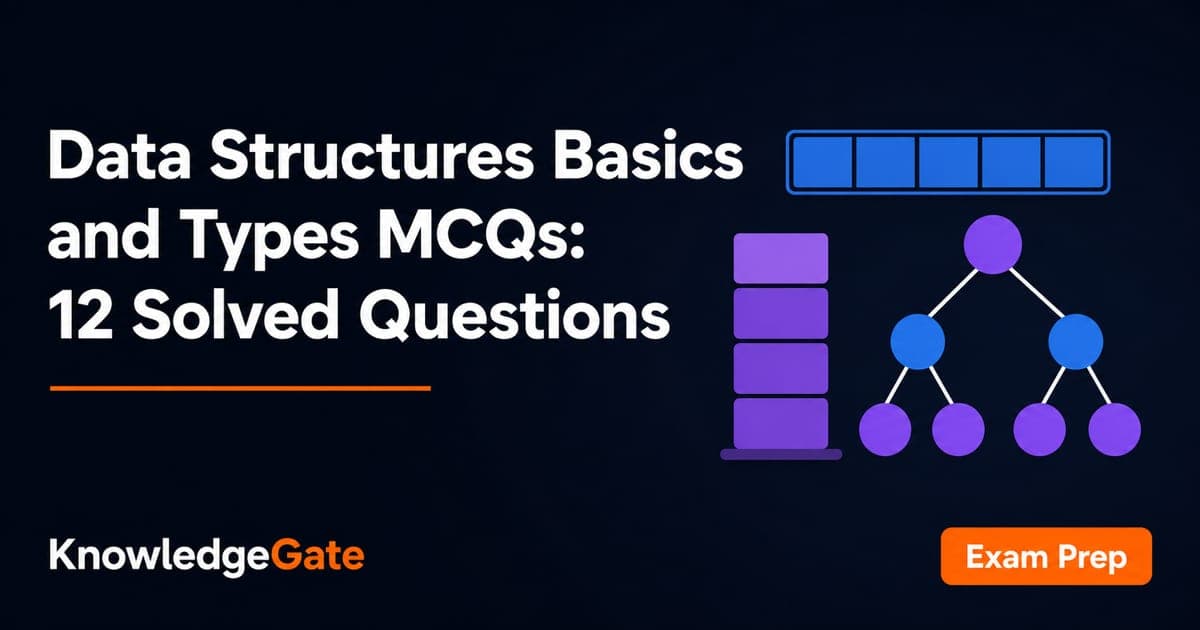
Words such as type, structure, linear, and dynamic sound interchangeable until an option changes the classification criterion. Distinguish logical relationships from memory representation, access rules, and allocation strategy before choosing an answer.
Attempt each question before checking the explanation, then compare its deciding rule with your reasoning. Use the exam and year labels to recognise recurring terminology across recruitment and teaching exams. For a wider learning route alongside this practice, browse the Coding & Skills courses.
Related reading: data structure MCQs and stack and queue MCQs.
Data structure meaning, storage representation, and data types
A data structure organises data and relationships. A storage structure represents them in memory, while a data type defines legal values and operations.
Q1. Memory representation
KVS 2013
Representation of data structure in memory is known as
A. Recursive
B. Abstract Data Type
C. Storage structure
D. File structure
Answer: C. Storage structure.
A storage structure is a logical data structure's physical memory representation. For example, int marks[4] = {10, 20, 30, 40} uses four contiguous slots, whereas linked nodes holding those values may occupy non-contiguous addresses. An ADT specifies allowed values and operations without fixing either layout.
Q2. What a data structure refers to
Bihar STET 2019
Term Data Structure refers to ______ and interrelationship between them.
A. Organization of data
B. Programming standard
C. Coding
D. Program design
E. Data security
Answer: A. Organization of data.
The missing idea is organisation: a data structure specifies how items are arranged and related. For employee records E1, E2, and E3, an array gives positional order, while a graph can encode reporting links. Programming style and security do not define that organisation.
Q3. Data type versus data structure
HTET 2024
A ........... is the specification of legal values for variable of the type.
A. Data Types
B. Data Structure
C. Scope Rules
D. Control Structures
Answer: A. Data Types.
A data type defines a variable's legal values and operations. A Boolean has the legal values true and false, while int scores[3] = {62, 75, 81} is a structure built from integers. Scope rules decide where a name is visible.
Basic classification of data structures
Apply one classification criterion at a time: the top level has primitive and non-primitive types.
Q4. Number of top-level types
Bihar STET 2019
In the basic/top-level classification of data structures, data structures are generally of how many main types?
A. 1
B. 2
C. 3
D. 4
E. 5
Answer: B. 2.
The standard top-level split has two branches: primitive and non-primitive. The exact tree is Data structures -> Primitive {int, char} | Non-primitive -> Linear {array, stack} | Non-linear {tree, graph}. The last two are nested branches, not parallel top-level types.
Q5. A list containing only linear structures
BPSC PGT Tier-3 2024
Which of the following data structures stores elements in a non-linear relationship?
A. Stack
B. Queue
C. Array
D. More than one of the above
E. None of the above
Answer: E. None of the above.
Stack, queue, and array each form one logical sequence, although their access rules differ. With 10, 20, 30, the stack top is 30, the queue serves 10 first, and the array uses positions 0, 1, 2. None branches like a tree or networks like a graph.
Q6. Identifying the non-linear member
DSSSB 2018
Identify the non-linear data structures from among the following.
(i) Linked List (ii) Stack (iii) Tree
A. Both (i) and (ii)
B. Only (iii)
C. Both (i) and (iii)
D. (i), (ii) and (iii)
Answer: B. Only (iii).
A linked list's next pointers form one sequence, and a stack follows one LIFO order, so both are linear. A tree is non-linear: from root 10 to children 6 and 14, then child 4 below 6, an element can lead to several branches.
Linear versus non-linear structures and access rules
Linearity describes logical relationships, not static or dynamic allocation. Access is separate.
Q7. Sequential access in a linked list
TCS 2024
Which of the following statement is true?
A. Arrays is dynamic data structure whose size can be changed while stacks are static data structures whose size are fixed
B. An array can have elements of different data types
C. Array elements can be accessed and modified (elements can be added or removed) only at the ends of the array while any element of stacks can be accessed/modified randomly through their indices.
D. Elements of a linked list can be accessed only sequentially
Answer: D. Elements of a linked list can be accessed only sequentially.
To reach the third node in 4 -> 9 -> 15 -> 22, traversal visits 4, 9, and then 15; no index jump exists. The array A = [4, 9, 15, 22] reads A[2] = 15 directly, while a stack exposes only its top.
Q8. One unambiguous non-linear structure
Bihar STET 2019
Which one is a non-linear data structure?
A. Stack
B. Queue
C. Linked List
D. Tree
E. None of these
Answer: D. Tree.
Stack, queue, and linked list each define one linear order. A tree can branch from root A to children B and C, then from B to D, so it has no fixed predecessor-successor chain unless a traversal is imposed.
Next, use the binary tree MCQs to practise the non-linear branch.
Q9. Recognising a linear structure
BPSC 2024
Which data structures are considered linear?
A. Binary tree
B. Graph
C. Stack
D. More than one of the above
E. None of the above
Answer: C. Stack.
A stack has one LIFO order: after pushing 5, 8, and 12, the next pop is 12. Binary trees and graphs can branch to multiple adjacent elements, so they are non-linear.
Q10. Array and linked-list access trap
DSSSB 2018
Which of the following statements is NOT true?
A. The size of an array is generally fixed, whereas the size of a linked list is dynamic.
B. Inserting a new element in an array is expensive compared to inserting a new element in a linked list.
C. Both, random access and direct access are allowed in a linked list.
D. Deleting an element from array is expensive compared to deleting an element from a linked list.
Answer: C. Both, random access and direct access are allowed in a linked list.
A linked list requires sequential traversal, so the random-access claim is false. Inserting 12 at index 2 in [4, 9, 15, 22] shifts 15 to index 3 and 22 to 4; inserting 12 between linked nodes 9 and 15 changes links once those nodes are located. This comparison assumes the position is already known.
Basic operations and choosing a supporting structure
Operations change or examine stored items. Algorithms can also depend on FIFO or LIFO access.
Q11. Operation versus security mechanism
BPSC PGT Tier-3 2023
Which of the following is NOT a basic operation performed on a data structure?
A. Encryption
B. Deletion
C. Insertion
D. More than one of the above
E. None of the above
Answer: A. Encryption.
Insertion and deletion change contents; search, traversal, sorting, and merging are also common operations. Encryption transforms data for confidentiality, so encrypting 42 is not an array, list, stack, tree, or graph operation.
Q12. Match algorithms to queue, array, and stack
BEL Probationary Engineer 2023
Match the following algorithms with the data structure it uses.
Algorithm | Data structure |
|---|---|
I. Breadth first search | 1. Stacks |
II. Heap sort | 2. Queue |
III. Depth first search | 3. Arrays |
A. I - 1; II - 2; III - 3
B. I - 3; II - 1; III - 2
C. I - 2; II - 3; III - 1
D. I - 3; II - 2; III - 1
Answer: C. I - 2; II - 3; III - 1.
When A connects to B and C, and B to D, a FIFO queue gives BFS order A, B, C, D; a LIFO stack can give DFS order A, B, D, C. Heap sort can store [9, 7, 5, 2, 1] in an array, with children of zero-based index i at 2i+1 and 2i+2. Thus BFS maps to queue, heap sort to array, and DFS to stack.
Next, test the queue-stack distinction with stacks and queues MCQs.
Common data structures MCQ traps
Mistake | What goes wrong | One-line check |
|---|---|---|
Confusing an ADT with a storage structure | An interface specification is mistaken for a memory layout. | Ask whether the statement fixes operations or physical representation. |
Treating nested branches as top-level types | Primitive, non-primitive, linear, and non-linear are counted at one level. | Draw the classification tree before counting. |
Equating dynamic allocation with non-linearity | A linked list is wrongly called non-linear because its nodes may be allocated dynamically. | Follow the logical links and check whether they form one sequence or branches. |
Forgetting the word | A true statement is selected when the question asks for the false one. | Restate the task as “find the false option” before evaluating choices. |
Treat every miss as one of four diagnosis buckets: definition, classification, access or layout, and operation matching. Re-attempt the relevant question, then explain the deciding rule aloud without looking at the options.
The short version and the next practice set
Keep four rules fixed: data type means legal values, storage structure means physical representation, linear means one logical sequence, and non-linear means hierarchical or network relationships.
After practising classification and access here, use Hashing MCQs for hash functions and collision resolution. For a wider implementation path across arrays, lists, stacks, queues, trees, and graphs, use the DSA using Java course.
Keep learning
Stack Basics and Operations MCQs: 12 Solved Questions with Step-by-Step Explanations
Test stack fundamentals through 12 exam MCQs on LIFO, TOP, array bounds, queue transfers and permutations. Complete traces make every state and answer checkable.
Updated 3 Oct 20268 min readData Structures MCQs
Evaluation of Expressions MCQs: 12 Solved Questions with Stack Traces
Solve 12 expression MCQs step by step. Trace postfix and prefix evaluation, nesting depth, precedence and notation conversion without reversing operands.
Updated 27 Sep 20267 min readData Structures MCQs
Priority Queue MCQs: 12 Solved Questions on Heaps, Deques and Variants
Attempt 12 verified priority queue and queue-variant MCQs, then learn from concise heap, array, circular queue and deque traces.
Updated 25 Sep 20267 min readData Structures MCQs
Infix, Postfix and Prefix MCQs: 12 Solved Questions with Step-by-Step Explanations
Solve 12 expression-notation MCQs in increasing difficulty, from basic stack use to conversions, associativity and maximum operand-stack depth.
Updated 24 Sep 20268 min read53 viewsData Structures MCQs