

Data Link Layer Error Control: Detection, Correction and ARQ with One End-to-End Example
Follow one frame through error detection, local correction and retransmission, with explicit CRC, ARQ timing and Hamming(7,4) calculations.
KnowledgeGate Team
Exam prep & CS education
Updated 11 Nov 20266 min read

Parity, checksum, CRC, Hamming code and ARQ are often memorised separately, so a mixed question can blur what detects, corrects and triggers retransmission. One frame moves from added redundancy across a noisy link to acceptance, local correction or retransmission. CS Fundamentals is the wider home for core Computer Networks notes. Use the stated assumptions to re-derive each number.
Data Link Layer error control has three different jobs
Error detection asks whether the received unit violates a redundancy rule. Forward error correction adds enough redundancy to identify and repair a bounded error pattern locally. Error recovery uses acknowledgements, sequence numbers, timers and retransmission after corruption or loss.
The chain is data bits, encoder, frame, noisy link and receiver check, followed by accept, correct or retry. Parity, checksum and CRC detect, Hamming-style codes can correct limited patterns, and ARQ closes recovery. A lost frame gives CRC no bits to inspect, so a timer is still needed. For separate parity, CRC, Hamming and checksum derivations, use Data Link Layer Error Control in Computer Networks. The chain here follows one rejected frame through ARQ and asks when Hamming correction avoids retransmission.
Parity, checksum, CRC, Hamming code and ARQ: roles and limits
Method | Redundancy or feedback | Receiver test | What it can do | What it cannot promise |
|---|---|---|---|---|
Even parity | One parity bit | Number of 1s must be even | Detect every odd number of flips | Detect all even-numbered flips |
Checksum | Fixed-width one's-complement sum | Data plus checksum should give all 1s | Detect many changed-bit patterns | Locate or repair the change |
CRC |
| Divide and inspect the remainder | Strong structured detection | Repair the corrupted bit |
Hamming code | Parity at power-of-two positions | Read parity checks as a syndrome | Correct one-bit errors in Hamming(7,4) | Safely correct two-bit errors |
ARQ | ACK or NAK, sequence numbers and timers | Track accepted, missing and timed-out frames | Recover by retransmitting | Detect changed data without a detector |
For even parity, 1101101 has five 1 bits, so append 1 to send 11011011. If the third bit changes to give 11111011, the receiver counts seven 1 bits and rejects it. Flipping the third and sixth bits together gives 11111111, which is still even, so parity accepts a corrupted frame.
For a 4-bit checksum, the three words are 0110, 1011, and 0001. First, 0110 + 1011 = 10001. Wrap the carry to get 0010, then add 0001 to get 0011. Complement it for checksum 1100; the receiver gets 0011 + 1100 = 1111. Detection still does not repair data, and ARQ needs a trustworthy detector.
CRC gives the detection verdict for the worked frame
For a standalone treatment of this same 101101/1101 division, use Checksum and CRC Error Detection. Here the non-zero verdict feeds the ARQ timeline. Let data D = 101101 and generator G = 1101. The generator represents x^3 + x^2 + 1, so its degree is r = 3. Append three zeroes: 101101000. Modulo-2 division uses XOR, with no carry or borrow.
The sender trace, using zero-based generator alignments, is:
Start with
101101000.XOR
1101at position0to get011001000.XOR at position
1to get000011000.XOR at position
4to get000000010.
The last three bits give R = 010, so transmit D || R = 101101010. Dividing it by 1101 gives 000, so it passes. Flip the third transmitted bit and the receiver sees 100101010, whose remainder is 110. The block is corrupt, but CRC alone does not identify the changed bit.
ARQ timing connects detection to acknowledgements and windows
For error-free window sizing and sequence-space rules, use Flow Control in the Data Link Layer. The model below instead measures the retransmission cost of a CRC rejection. Use this idealised link: L = 1,024 bits, R = 2.048 Mb/s, T_p = 4 ms one way, negligible ACK and NAK transmission time, modulo-8 sequence numbers and W = 4.
Frame transmission time is
T_t = 1,024 / (2.048 x 10^6) = 0.0005 s = 0.5 ms.
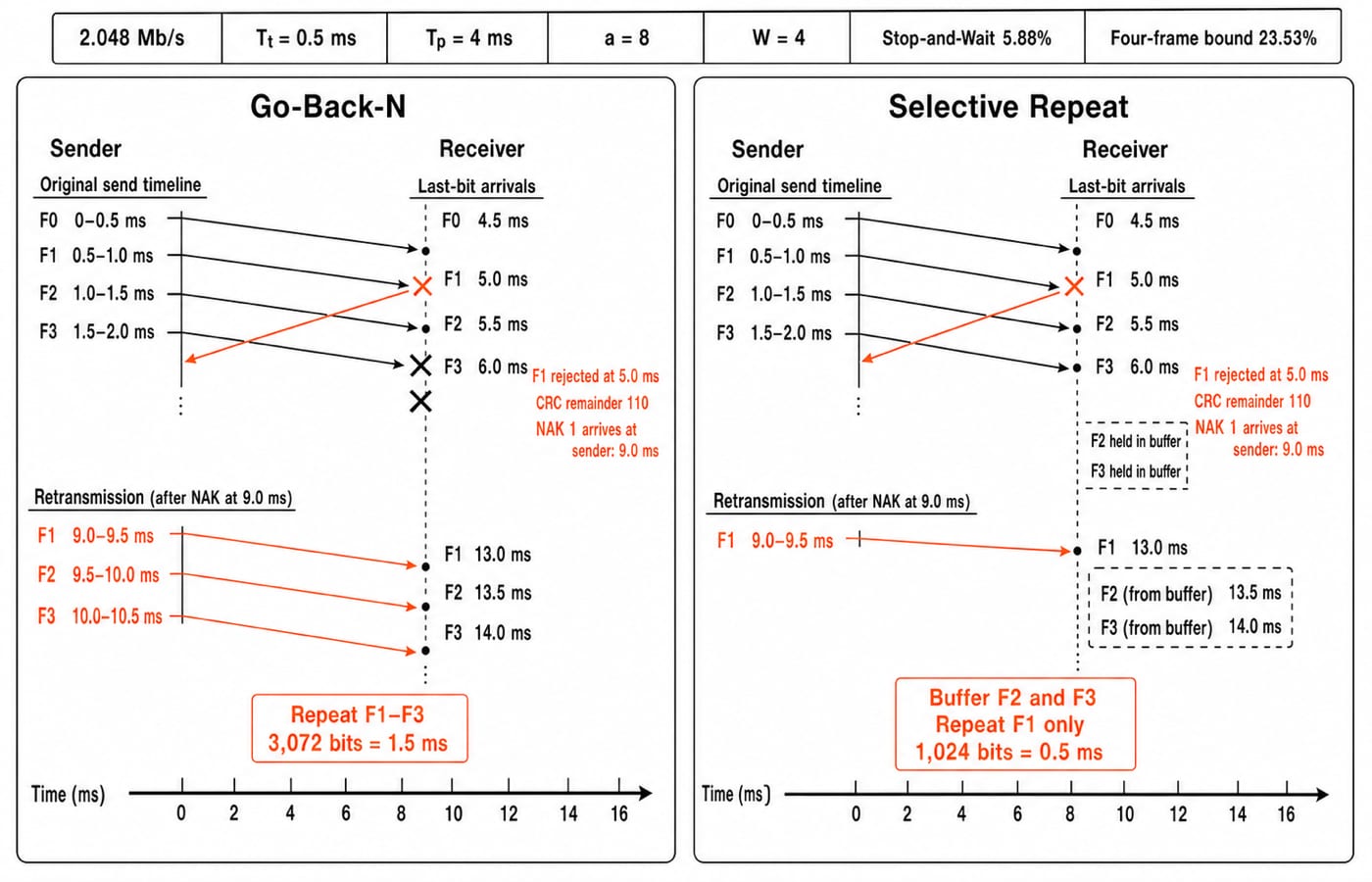
Thus a = T_p/T_t = 4/0.5 = 8. A no-error Stop-and-Wait cycle takes T_t + 2T_p = 0.5 + 8 = 8.5 ms, so utilisation is 0.5/8.5 = 1/17 = 5.88%. With four pipelined frames, the bound is min(1, W/(1+2a)) = 4/17 = 23.53%. Continuous filling needs at least 1 + 2a = 17 frames.
Frames 0, 1, 2 and 3 occupy sender intervals 0-0.5, 0.5-1.0, 1.0-1.5 and 1.5-2.0 ms. Their last bits arrive at 4.5, 5.0, 5.5 and 6.0 ms. At 5.0 ms, frame 1 produces CRC remainder 110, so the receiver rejects it and sends NAK 1. With the stated feedback assumption, that NAK reaches the sender at 9.0 ms.
Go-Back-N and Selective Repeat recover differently
In this textbook NAK model, Go-Back-N is waiting for frame 1, so it discards frames 2 and 3. At 9.0 ms, NAK 1 makes the sender repeat frames 1, 2 and 3: 3 x 1,024 = 3,072 bits, taking 3,072/(2.048 x 10^6) = 1.5 ms to serialize.
Selective Repeat buffers frames 2 and 3 and repeats only frame 1: 1,024 bits in 0.5 ms. With three sequence bits, Go-Back-N allows up to 2^3 - 1 = 7, while Selective Repeat allows at most 2^(3-1) = 4. Thus W = 4 is valid for both.
Selective Repeat saves 3,072 - 1,024 = 2,048 bits, but needs out-of-order buffering and per-frame state. Go-Back-N is simpler at the receiver but repeats correct frames after the gap.
Hamming correction changes the recovery decision
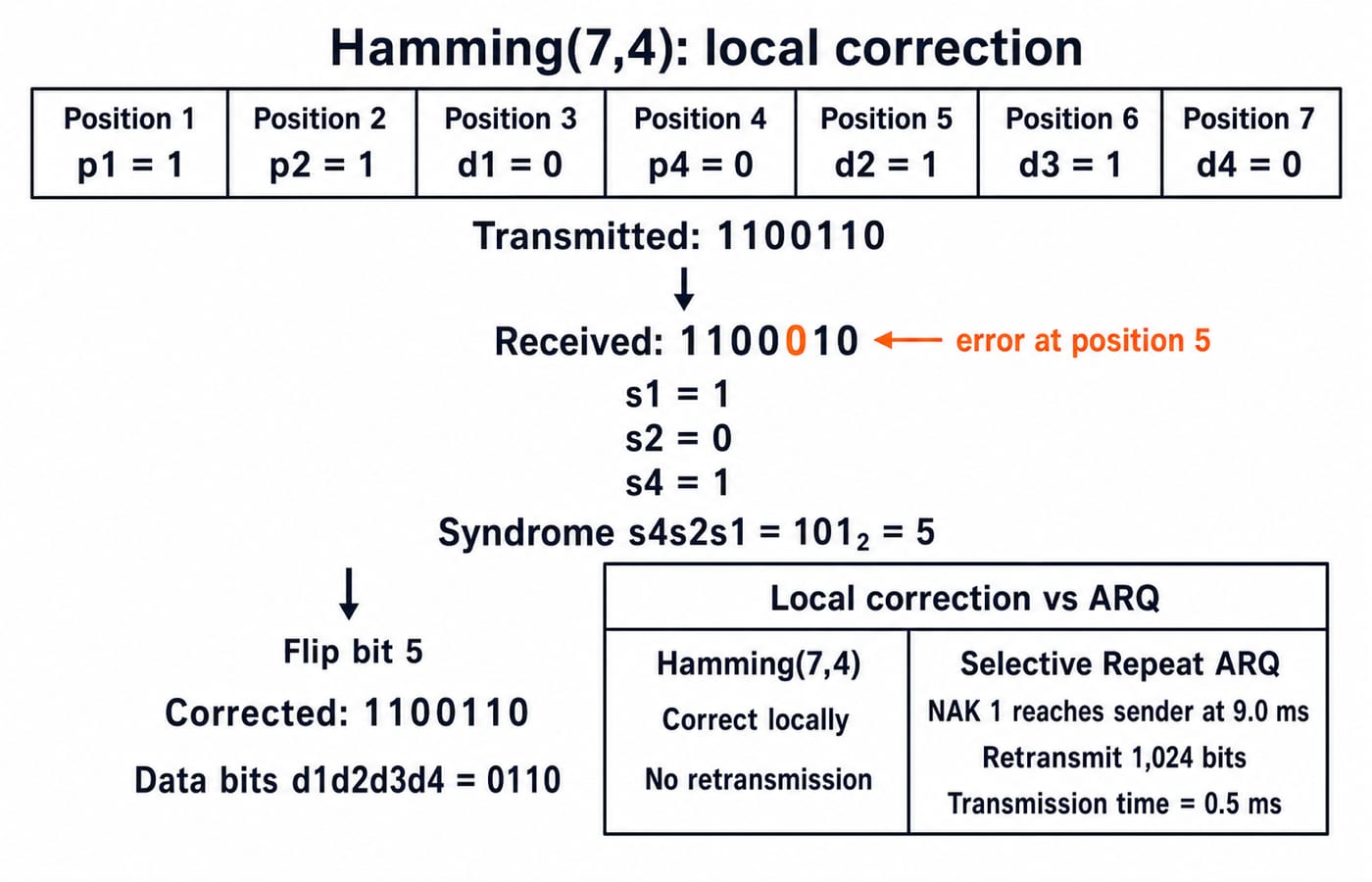
Use even-parity Hamming(7,4) with data 0110 in positions 3,5,6,7. The layout is [p1,p2,0,p4,1,1,0].
Group
{1,3,5,7}givesp1 = 1.Group
{2,3,6,7}givesp2 = 1.Group
{4,5,6,7}givesp4 = 0.
The codeword is 1100110. Flip bit 5 to receive 1100010. The parity checks are s1 = 1, s2 = 0, s4 = 1, so syndrome s4s2s1 = 101 base 2 = 5. Flip position 5 back and extract data 0110. Three parity bits protect four data bits, giving code rate 4/7 = 57.14%.
This one-bit error is repaired locally, without feedback or replacement transmission. Ordinary Hamming(7,4) guarantees single-error correction, not safe double-error correction. SECDED adds an overall parity bit. FEC spends redundancy on every block; detection plus ARQ spends retransmission bandwidth when an error or loss occurs.
Error-control question patterns and cross-concept traps
Typical questions ask you to classify a method; compute parity, checksum or CRC bits; calculate utilisation; trace the two ARQ schemes; or decode a Hamming syndrome.
Remember these correction rules:
CRC division uses XOR. A zero remainder means the frame passes the test, not that it is certainly error-free.
A CRC remainder flags corruption but is not a bit-position syndrome.
Hamming correction cannot replace a timer for a lost frame.
ACK, NAK and sequence numbers do not detect changed data without a detector.
Go-Back-N repeats from the first missing frame. Selective Repeat repeats only the missing or corrupt frame.
Three checks catch the common numerical errors. Generator 1101 has degree 3, so append three zeroes and return three remainder bits. With a = 8, W = 4 gives 4/17 = 23.53%, not full utilisation. With three sequence bits, W = 4 is valid for both and exactly the Selective Repeat maximum.
Data Link Layer error control: detection, correction and recovery
Parity, checksum and CRC reveal changed bits. Hamming-style redundancy can repair a bounded pattern. ARQ uses feedback, numbering and timers to replace corrupt or missing frames. Windowing keeps data moving while feedback travels.
Reproduce the joined example once: CRC codeword 101101010 changes to 100101010 and produces remainder 110; frame 1 then causes 3,072 retransmitted bits with Go-Back-N but only 1,024 with Selective Repeat. The CRC verdict determines whether the receiver accepts, corrects or requests retransmission.
For a GATE-focused Computer Networks sequence, continue with GATE Guidance by Sanchit Sir.
Keep learning

Data Link Layer Error Control in Computer Networks: Concepts, CRC, Hamming and Worked Examples
Build error control from first principles, then work through parity, CRC, Hamming code and checksum using bits you can verify by hand.
Updated 6 Aug 20266 min read140 viewsComputer Networks
CRC, Checksum and Hamming Code for GATE: Error Detection and Correction Numericals Solved
Work through CRC division, an Internet checksum, and Hamming(7,4) encoding and correction without losing marks to convention slips.
Updated 1 Sep 20265 min read214 viewsGATE Strategy & Roadmap
Hamming Distance MCQs: 12 Solved Error Detection and Correction Questions
Practise 12 Hamming distance and error-control MCQs with faithful options, direct answers and step-by-step explanations for every calculation.
Updated 3 Nov 20267 min readComputer Networks MCQs

Data Link Layer Flow Control: Stop-and-Wait, Sliding Windows and Worked Numericals
Build a reliable method for DLL flow-control problems by tracing one link from frame timing to windows, receiver credit, sequence-space limits and ACK policy.
Updated 12 Nov 20266 min readComputer Networks