

CSMA Variants Explained: Persistence Rules, CD/CA and Exam Numericals
Learn how 1-persistent, non-persistent and p-persistent CSMA differ, then solve probability and minimum-frame numericals step by step.
KnowledgeGate Team
Exam prep & CS education
Updated 9 Nov 20266 min read

CSMA variants sound similar because each one changes a different decision after sensing: transmit, wait, retry, detect or avoid. In 1-persistent CSMA, idle means transmit now; non-persistent CSMA randomises re-sensing after busy; p-persistent CSMA randomises each idle-slot decision. CSMA/CD adds collision detection on a shared wire, while CSMA/CA uses avoidance and acknowledgements on wireless links; carrier sensing reduces avoidable collisions but cannot remove propagation-time races. CS Fundamentals is the broader home for Computer Networks and other core subjects.
CSMA starts with carrier sensing, not collision elimination
A shared broadcast medium is one channel used by multiple stations. A CSMA station senses idle or busy before sending, then follows listen -> decide -> transmit or defer. ALOHA transmits without first sensing.
Let tau be one-way propagation delay. Frame transmission time is how long placing all frame bits takes. B's new signal may still be travelling when A senses, so A observes idle and also starts. Both locally correct decisions can collide. Sensing narrows this situation but cannot eliminate it.
Variant | If idle | If busy | After collision or failure |
|---|---|---|---|
1-persistent | Transmit immediately | Sense continuously | Use the collision policy, then sense again |
Non-persistent | Transmit immediately | Wait randomly, then re-sense | Use the collision policy, then re-sense |
p-persistent | Transmit with | Wait for an idle slot | Back off, then resume slotted decisions |
CSMA/CD | Follow its persistence rule | Defer by that rule | Detect, abort, back off and retry |
CSMA/CA | Finish quiet time and backoff | Defer and pause countdown | Missing acknowledgement triggers backoff |
CSMA/CD and CSMA/CA extend access behaviour with collision handling. They do not replace persistence policies.
1-persistent, non-persistent and p-persistent CSMA use different defer rules
In 1-persistent CSMA, a station transmits immediately on idle and senses continuously on busy. That reduces idle waiting but can synchronise queued stations.
In non-persistent CSMA, idle still means transmit immediately. Busy means wait for a random interval before sensing again. This spreads attempts but can leave capacity unused.
In slotted p-persistent CSMA, a ready station transmits in the current idle slot with probability p, or defers one slot with probability 1-p and repeats while idle. It controls aggressiveness explicitly and requires slotted decisions.
Suppose A and B become ready while C transmits. Under 1-persistent CSMA, both may transmit together when C finishes. Under non-persistent CSMA, random re-sensing times can separate their attempts but add delay. The trade-off is idle time versus synchronisation, not an absolute ranking.
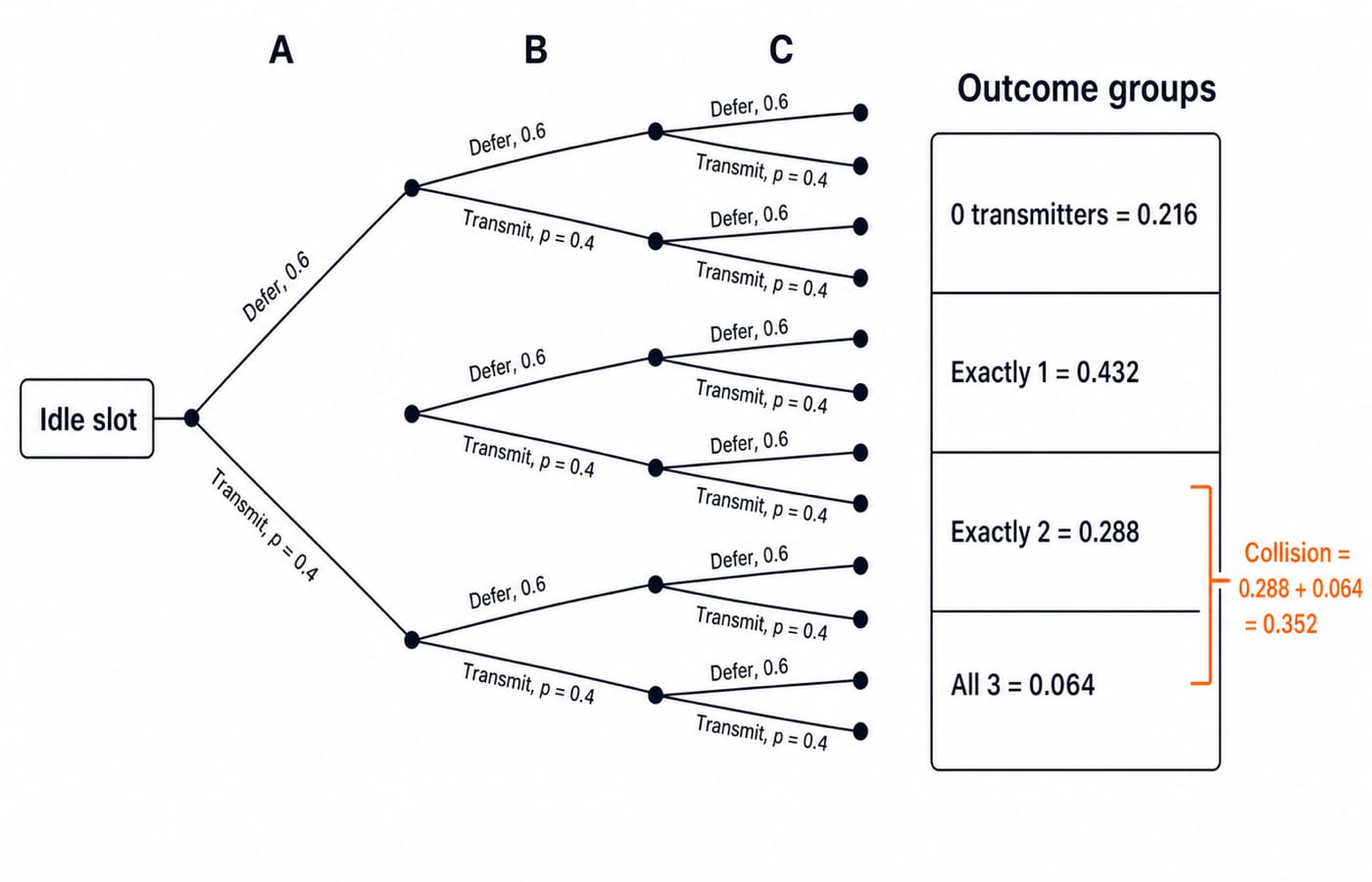
p-persistent CSMA worked example: three stations with p = 0.4
Stations A, B and C are ready in one idle slot and decide independently. Each transmits with p = 0.4 or defers with 0.6.
No station transmits:
P(0) = 0.6^3 = 0.216.Exactly one transmits:
P(1) = 3 x 0.4 x 0.6^2 = 0.432.Exactly two transmit:
P(2) = 3 x 0.4^2 x 0.6 = 0.288.All three transmit:
P(3) = 0.4^3 = 0.064.
A collision means at least two stations transmit, so:
P(collision) = P(2) + P(3) = 0.288 + 0.064 = 0.352.
The complement confirms it: 1 - 0.216 - 0.432 = 0.352. Also, 0.216 + 0.432 + 0.288 + 0.064 = 1.
A succeeds individually only if A transmits while B and C defer:
P(A succeeds) = 0.4 x 0.6 x 0.6 = 0.144.
By symmetry, 3 x 0.144 = 0.432, matching P(1). Here, exactly one transmission means success. Zero means an idle slot, not a collision.
CSMA/CD worked example: propagation delay sets the minimum frame time
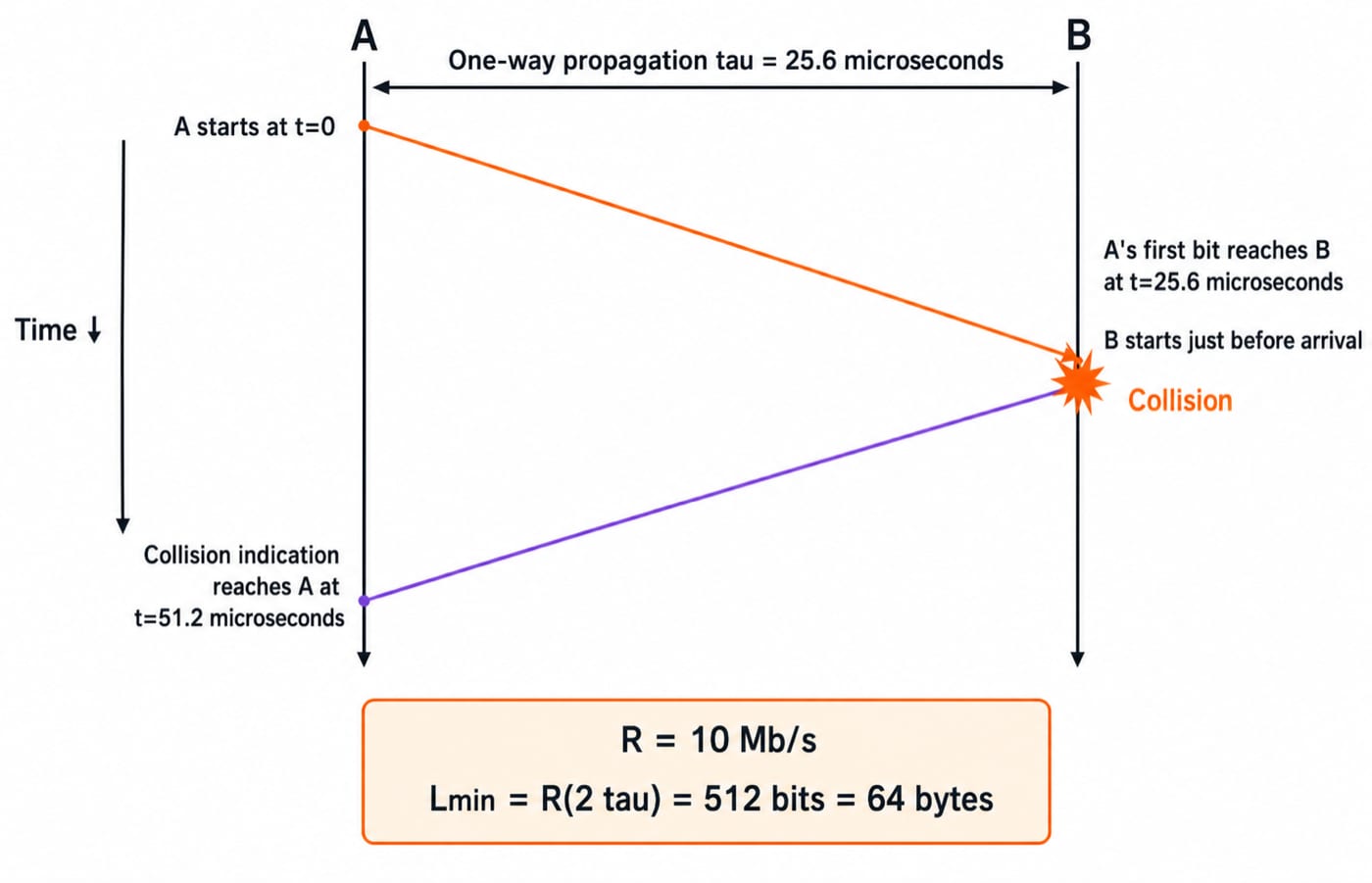
With collision detection, a station monitors the shared wire while transmitting, aborts on collision and retries after random backoff. It must still be transmitting when the worst-case collision indication returns, so frame transmission time must be at least 2tau.
Consider a shared bus with tau = 25.6 microseconds and R = 10 Mb/s.
Worst-case detection time is
2tau = 2 x 25.6 = 51.2 microseconds.Minimum frame length is
Lmin = R x 2tau.Substituting consistent units gives
Lmin = 10 x 10^6 x 51.2 x 10^-6 = 512 bits.Converting to bytes gives
512 / 8 = 64 bytes.
This is minimum transmitted frame size, not payload size.
A starts at t = 0, and its first bit reaches far-end B at t = 25.6 microseconds. B can start just before arrival because it still senses idle. The collision disturbance reaches A at about t = 51.2 microseconds. Sending 512 bits at 10 Mb/s takes 512 / (10 x 10^6) = 51.2 microseconds, exactly covering the interval. With fewer bits, A could finish before detecting the collision.
CSMA/CA avoids likely wireless collisions instead of detecting them mid-frame
On wireless links, a radio's transmitted signal can overwhelm a weaker received signal. Hidden stations may not hear each other although both reach the receiver. Mid-frame collision detection is therefore unreliable.
A station senses, waits the required quiet interval, chooses a random backoff and counts down while idle. It pauses on busy, transmits at zero and uses an acknowledgement to infer success. RTS/CTS is an optional reservation aid, not compulsory for every frame.
Suppose hidden stations A and C cannot hear each other, but both reach B. A's RTS and B's CTS let C hear B's reservation and defer, reducing simultaneous data transmissions to B.
CSMA variant traps: persistence, backoff and congestion are not synonyms
“Idle means collision-free.” A remote signal may still be propagating.
“1-persistent means one retry.” The
1is transmit probability on idle, not retry count.“Non-persistent never persists.” It waits randomly, then re-senses.
“p-persistent works continuously.” Its decisions occur in idle slots.
“CSMA/CD prevents collisions.” It detects and aborts after collision begins.
“CSMA/CA guarantees no collision.” Avoidance reduces risk, not to zero.
CSMA backoff regulates shared-link access. TCP Congestion Control for GATE explains how TCP adjusts an end-to-end sender's load during network congestion. Similar vocabulary does not make them the same layer or problem.
Comparison | CSMA/CD | CSMA/CA |
|---|---|---|
Medium assumption | Classic shared half-duplex Ethernet-style wire | Wireless shared medium |
Contention response | Detect, abort, back off | Quiet time and random backoff |
Success feedback | No collision detected | Acknowledgement received |
Hidden stations | Not characteristic | Important issue |
CSMA exam patterns: decision traces, probabilities and minimum-frame numericals
Recurring forms are identifying a variant from its rules, tracing waiting stations, calculating p-persistent outcomes, applying Lmin = R x 2tau, and distinguishing CD, CA and hidden stations.
Use this three-line checklist:
Write the channel model and whether decisions are slotted.
Define the requested event before calculating its probability.
Convert time to seconds and keep rate, bits and bytes consistent before substitution.
Check 0.432 for one of three transmitters and 512 bits for the CSMA/CD frame. For the transmit-state algorithm and binary exponential backoff, use GATE CS course hub for CSMA/CD practice. Round-trip frame sizing answers only the CSMA/CD timing question; persistence rules choose when to transmit, while CSMA/CA uses wireless avoidance and acknowledgements. For a separate numerical deep-dive, study IP Addressing and Subnetting Explained.
Review the CSMA variant rules, then choose a next study step.
1-persistent CSMA transmits immediately after sensing idle.
Non-persistent CSMA waits randomly after sensing busy.
p-persistent CSMA randomises each idle-slot decision.
CSMA/CD detects and aborts collisions on a shared wire.
CSMA/CA uses avoidance and acknowledgements on wireless media.
For this topic within the GATE CS syllabus, continue with GATE Guidance by Sanchit Sir. If you are revising only CSMA, first reproduce the 0.432 success probability and 512-bit minimum-frame calculation without looking back.
Keep learning

CSMA/CD Explained: Collision Detection, Binary Backoff and Solved Numericals
Learn why carrier sensing cannot prevent every collision, then solve propagation, minimum-frame, backoff, and efficiency questions on one consistent network.
Updated 8 Nov 20266 min readComputer Networks

CSMA/CD and ALOHA for GATE: Efficiency and Minimum Frame Size Numericals Solved
Separate one-way delay from round-trip delay, then solve the standard CSMA/CD frame-size and ALOHA throughput numericals step by step.
Updated 24 Aug 20265 min read63 viewsComputer Networks
CSMA/CA (Wireless) MCQs: 10 Solved Questions with Explanations
Solve ten CSMA/CA questions covering wireless LAN standards, contention, RTS/CTS, NAV, interframe spaces and service sets, with a careful note on one misnamed calculation.
Updated 30 Oct 20268 min read140 viewsComputer Networks MCQs

Data Link Layer and MAC Sublayer Explained: ALOHA and CSMA/CD Worked Examples
Build a precise layer map, follow an Ethernet frame across a router, and solve Pure ALOHA, Slotted ALOHA, and CSMA/CD numericals step by step.
Updated 13 Nov 20266 min readComputer Networks