Data Communication in Computer Networks: Complete Guide with Worked Examples
Build the Data Communication basics that make Computer Networks numericals easier. Learn the core terms, choose the right formula, and solve four standard patterns step by step.
KnowledgeGate Team
Exam prep & CS education
Updated 11 Aug 20266 min read51 views
Data Communication opens Computer Networks, so it is easy to dismiss as theory. That becomes costly when a Nyquist, Shannon, TDM, or switching numerical appears and the formulas are not ready. Four of them cover almost every question: the baud to bit rate relation, Nyquist for a noiseless channel, Shannon for a noisy one, and frame arithmetic for TDM and pipelined switching.
What data communication actually is: components and direction of flow
Data communication transfers data between devices through a medium under agreed rules. It has five components:
Message: the information being sent, such as a WhatsApp text, image, or voice note.
Sender: the device that originates it, such as your phone.
Receiver: the destination device, such as your friend's phone.
Transmission medium: the path carrying it, guided as in twisted pair, coaxial cable, or optical fibre, or unguided as in radio, microwave, and satellite links.
Protocol: the rules that let both ends interpret the exchange.
Direction of flow gives us three transmission modes:
Mode | Direction | Example |
|---|---|---|
Simplex | One way only | Keyboard to computer |
Half-duplex | Both ways, but one at a time | Walkie-talkie |
Full-duplex | Both ways at the same time | Phone call |
An analog signal varies continuously, while a digital signal uses discrete levels. A composite analog signal is a sum of simple sine waves, and its bandwidth is the difference between its highest and lowest frequency, which is why bandwidth is quoted in hertz. Computers process digital data, but long-distance media may carry modulated analog waves representing those bits.
Bandwidth, bit rate, and baud rate: three different quantities
These terms describe different parts of a link:
Bandwidth, measured in hertz (Hz), is the frequency range available in the medium.
Bit rate, measured in bits per second (bps), is how much binary data moves each second.
Baud rate is the number of signal elements transmitted per second.
If a signal element can take one of L levels, it carries log2(L) bits. Therefore:
Bit rate = baud rate x log2(L)
Suppose a modem uses 16-QAM, so L = 16, at 2400 baud:
Bits per signal element =
log2(16) = 4.Bit rate =
2400 x 4 = 9600 bps.
To carry 9600 bps at 2400 baud, each element must carry 9600 / 2400 = 4 bits, so L = 2^4 = 16 levels.
Baud can also exceed bit rate. Manchester encoding uses two signal changes per bit, so classic Ethernet carrying 10 Mbps requires 20 Mbaud.
Channel capacity: Nyquist and Shannon worked cold
Two capacity formulas answer different questions:
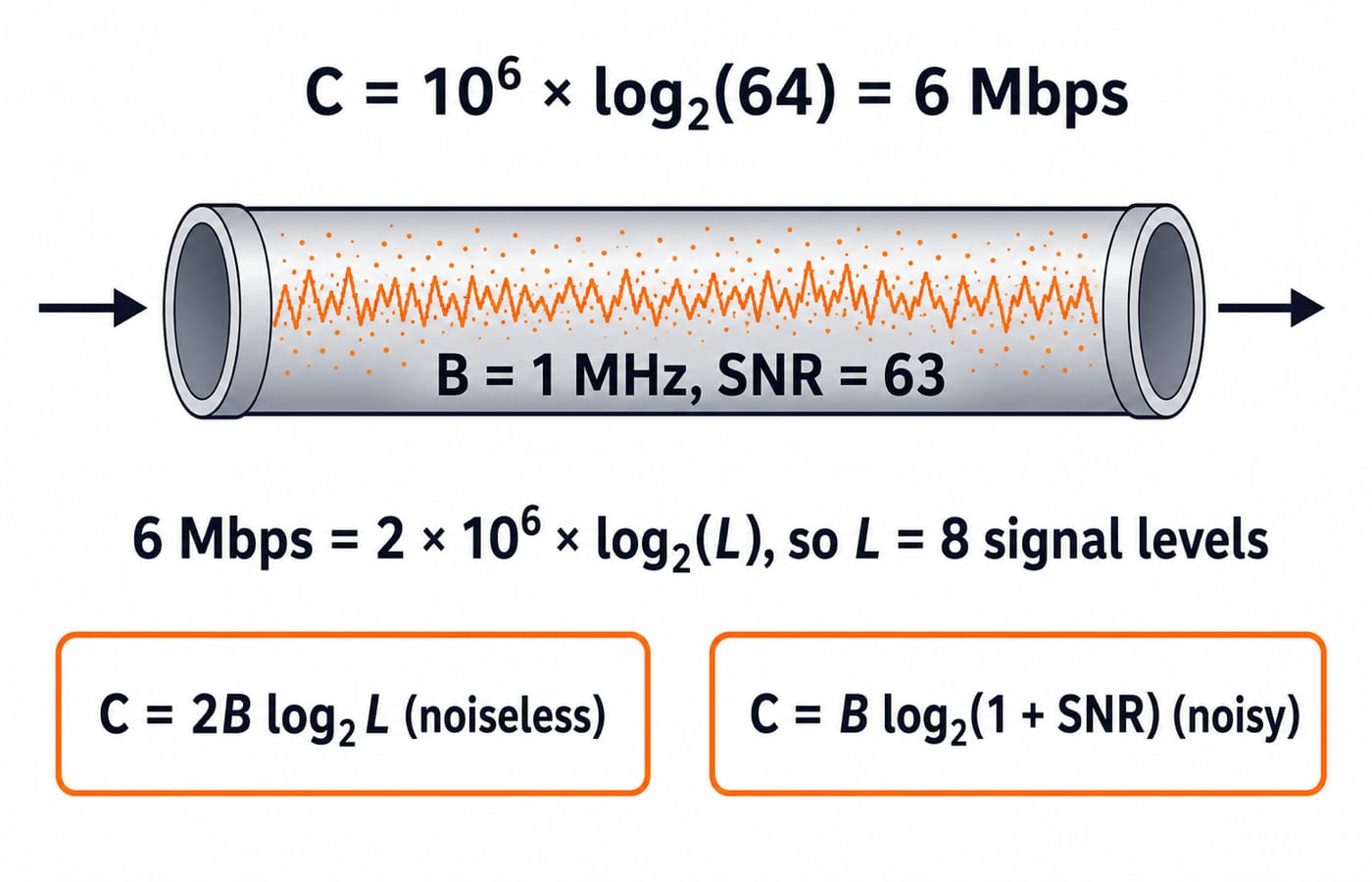
Nyquist for a noiseless channel:
C = 2 x B x log2(L)Shannon for a noisy channel:
C = B x log2(1 + SNR)
Shannon gives a noisy channel's hard ceiling. Nyquist gives the signal levels needed for a target rate on a noiseless channel.
Consider a channel with bandwidth B = 1 MHz and SNR = 63. Start with Shannon:
C = 10^6 x log2(1 + 63)C = 10^6 x log2(64)C = 10^6 x 6 = 6 Mbps
Now use Nyquist to find the levels needed to achieve 6 Mbps:
6 x 10^6 = 2 x 10^6 x log2(L)log2(L) = 3L = 2^3 = 8 levels
When SNR is in decibels, convert it first. For a telephone line with B = 3000 Hz and SNR = 30 dB:
Linear
SNR = 10^(30/10) = 1000.C = 3000 x log2(1 + 1000).C = 3000 x log2(1001), andlog2(1001)is approximately9.97.Cis about3000 x 9.97 = 29,900 bps, or roughly30 kbps.
Putting 30 directly into Shannon is the classic wrong approach.
Multiplexing: FDM, TDM, and WDM
Multiplexing lets sources share a link. FDM assigns frequency bands, as in radio and television. WDM is FDM for optical fibre. TDM assigns time slots to digital sources.
Take four sources, each sending 250 characters per second, with 8 bits per character. In synchronous TDM, each frame carries one character from every source.
Each source produces
250 x 8 = 2000 bps.One frame contains
4 x 8 = 32 bits.The system sends 250 frames per second.
Link rate =
32 x 250 = 8000 bps.
If every frame needs one additional framing bit, its size becomes 33 bits. The required link rate is then 33 x 250 = 8250 bps. Forgetting that framing bit is a deliberate exam distractor.
Switching and the delay numerical
Circuit switching reserves a dedicated path first, as in the telephone network, but wastes capacity with bursty data. Message switching stores and forwards the whole message. Packet switching pipelines smaller packets through routers and underpins the Internet.
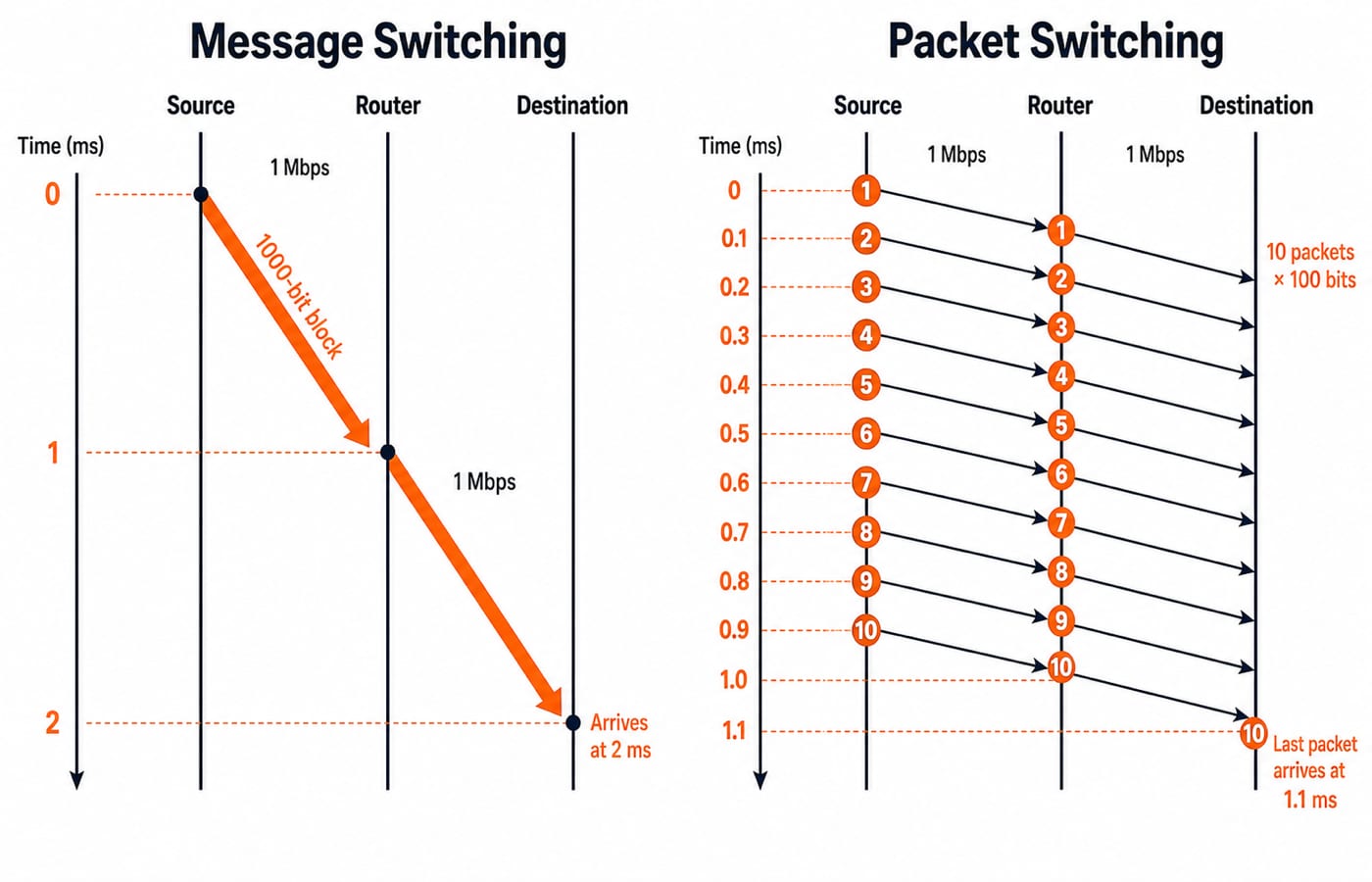
Suppose a 1000-bit message crosses two 1 Mbps links. Ignore headers and propagation delay.
For message switching, transmission on one link takes 1000 / 10^6 = 0.001 seconds = 1 ms. The router must receive the whole message before forwarding it, so two links take 2 x 1 = 2 ms.
Now split the message into ten packets of 100 bits:
One packet takes
100 / 10^6 = 0.1 msper link.The tenth packet leaves the first link at
10 x 0.1 = 1.0 ms.It crosses the second link in another
0.1 msand arrives at1.1 ms.Pipelining saves
2.0 - 1.1 = 0.9 ms.
The general delay is (packets + hops - 1) x per-link transmission time, where each link is one hop. Real packets also carry headers and require reassembly.
Traps that cost marks
Treating baud and bps as synonyms: Write
Lfirst, then calculate how many bits each signal element represents.Using SNR in dB inside Shannon: Convert with
10^(dB/10)before substituting.Choosing the wrong capacity formula: Identify whether the question describes a noiseless or noisy channel before using Nyquist or Shannon.
Confusing bandwidth with throughput: Bandwidth here is in Hz; data rate and throughput are in bps. The units identify the formula family.
Ignoring TDM overhead: Include framing and synchronisation bits when the question supplies them.
Assuming packets always win: Headers, buffering, routing, and reassembly are costs. Ignore them only when the question explicitly tells you to.
How GATE and interviews test Data Communication
GATE questions on this chapter arrive in two shapes. The first is a direct substitution: you are handed a bandwidth and an SNR, or a baud rate and a level count, and you return a single number. The second is a composite that hides an extra step, such as a TDM frame that also carries framing bits, or a switching delay that needs the packet count and the link count together. Packet, circuit and virtual circuit switching are named in the official GATE Computer Networks syllabus. Confirm the current wording and pattern on the official GATE website of the organising institute, not from remembered marks or dates.
These ideas carry straight into the layers above. The next step up is the layering model itself, in OSI vs TCP/IP Model for GATE, and after that the addressing arithmetic in Subnetting MCQs: 12 solved IP addressing questions.
Interviews check bandwidth versus latency, baud versus bit rate, simplex versus duplex, and what happens when a message is sent. The CS Fundamentals for Placements by Sanchit Sir develops that interview angle.
For practice, the KnowledgeGate question bank carries about 110 questions on Data Communication and about 2,200 across Computer Networks overall. Once the formulas are cold, use the GATE Test Series with mocks and topic-wise tests to practise them under time pressure.
The short version and your next step
Remember the five communication components and the three direction modes. Keep bit rate separate from baud rate, use Nyquist for noiseless channels, use Shannon for noisy channels after converting dB, count every TDM frame bit, and use (packets + links - 1) x per-link transmission time for pipelined switching.
Work these four numerical patterns once on paper without the steps. Then take a timed Computer Networks topic test, or use the placement course for interviews. Browse the wider path from GATE CS preparation courses and test series.
Keep learning
Computer Networks Hardware Basics: Devices, Domains and Worked Examples
Learn what hubs, switches, routers, gateways and access points actually do, then count network domains and trace frames through a two-LAN topology.
Updated 6 Oct 20266 min readComputer Networks
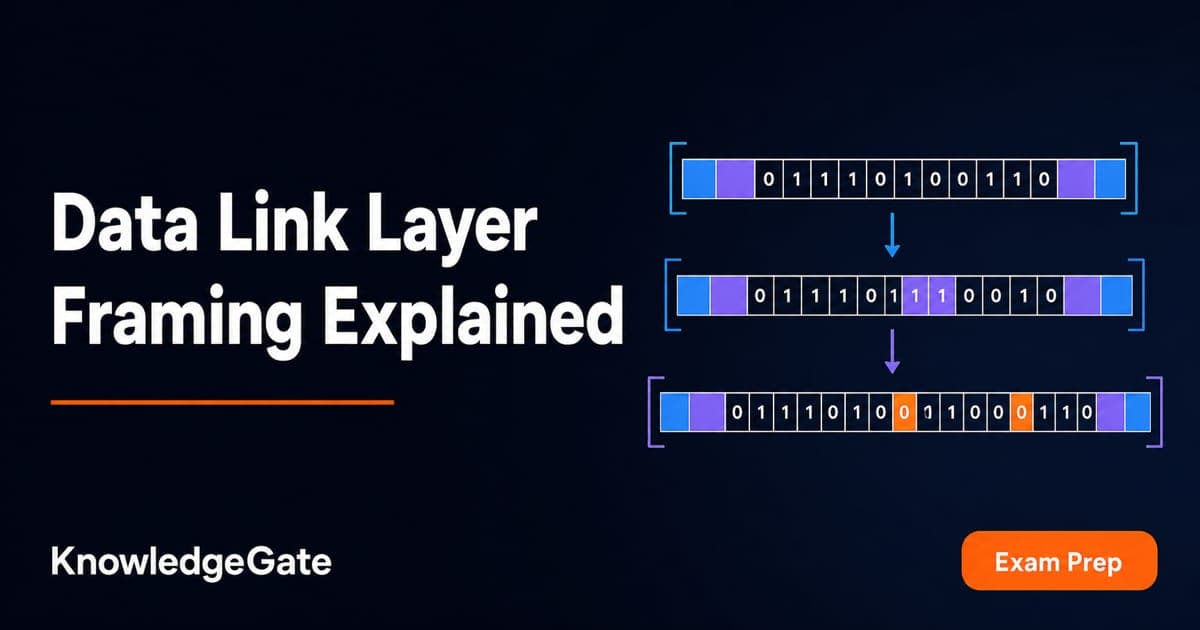
Data Link Layer Framing Explained: Byte Stuffing, Bit Stuffing and a Cross-Concept Numerical
Frame one four-byte payload in two ways, decode it, and then reuse the verified frame sizes in link-load and Stop-and-Wait calculations.
Updated 1 Oct 20266 min readComputer Networks
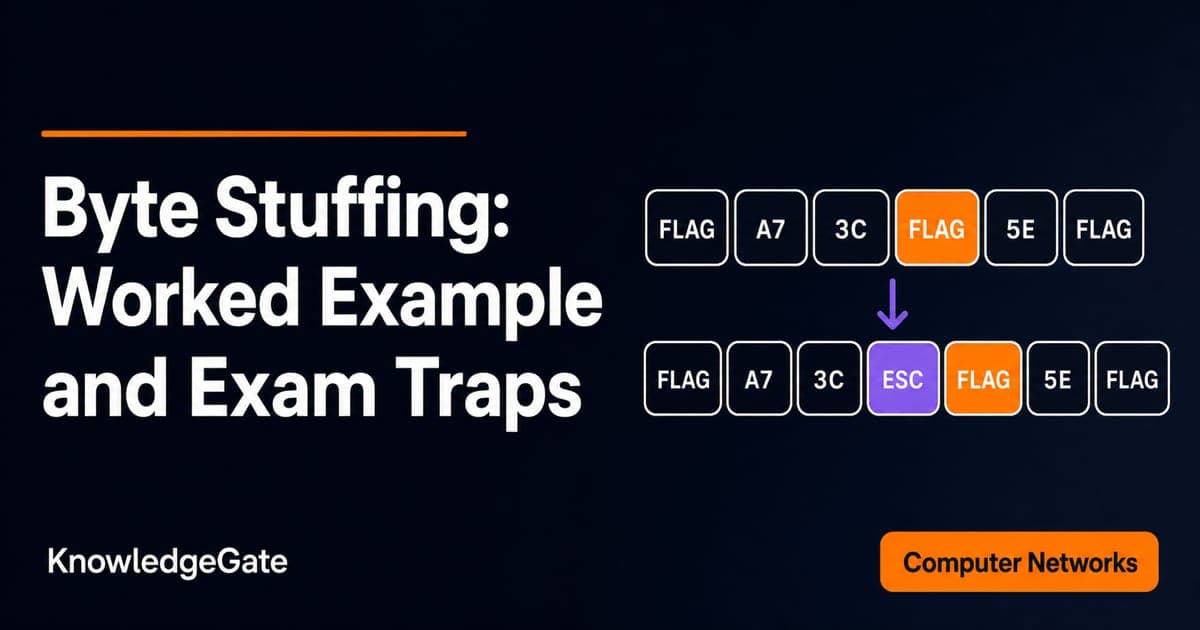
Byte Stuffing in Computer Networks: Worked Framing Example and Exam Traps
Learn a precise byte-stuffing convention, trace a payload containing both FLAG and ESC, reverse it safely, and calculate frame overhead and transmission time.
Updated 26 Sep 20266 min readComputer Networks
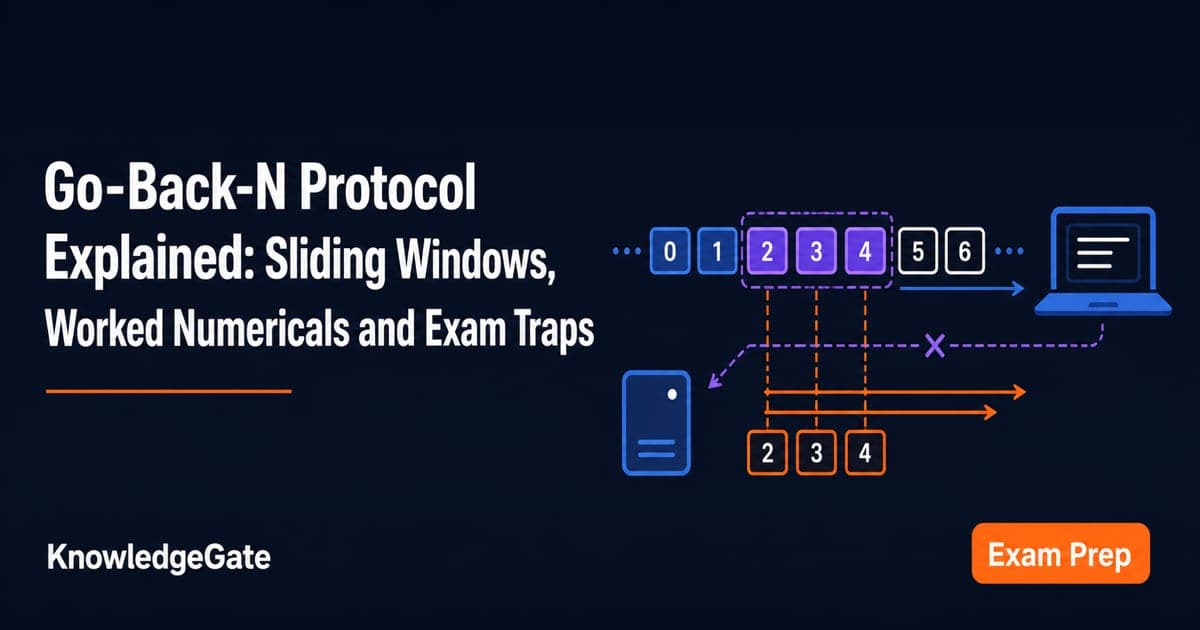
Go-Back-N Protocol Explained: Sliding Windows, Worked Numericals and Exam Traps
Trace Go-Back-N through a lost frame, calculate its legal window and link utilisation, and avoid the ACK and wrap-around traps that spoil numericals.
Updated 24 Sep 20266 min readComputer Networks