MPPSC Assistant Professor Computer Science Syllabus: Paper 1, Paper 2 and Study Order
Separate MPPSC Assistant Professor Computer Science from MP SET, map both preparation lanes, and use worked checks to decide what to revise next.
KnowledgeGate Team
Exam prep & CS education
Updated 25 Jul 20266 min read201 views
Search “MPPSC teaching syllabus” and four exams come back: Assistant Professor, MP SET, school teaching recruitment and State Service. For a computer science graduate the one that matters is Assistant Professor, whose papers pull opposite ways: Paper 1 is Madhya Pradesh general studies, Paper 2 is your degree subject. Its plan names no separate pedagogy paper, so budget none. The wider family is mapped in Teaching Recruitment (Computer Science).
MPPSC Assistant Professor syllabus: lock the exam and papers first
Lock six fields: Commission, MPPSC; Post, Assistant Professor; Subject, Computer Science; exam label, Assistant Professor Exam 2025; official exam-plan date, 6 January 2026; lanes, Paper 1 General Studies and Paper 2 Computer Science. The label year and the plan date are different fields, and confusing them means revising against a superseded plan.
The 2025 plan dated 6 January 2026 on the MPPSC syllabus index recorded Paper 1 as 50 questions, 200 marks and 1 hour, and Paper 2 as 150 questions, 600 marks and 3 hours. That is 200 written questions worth 800 marks, plus a separate 100-mark interview for 900 overall. Check the plan and corrigenda for your own cycle before timing anything on those figures.
Once confirmed, MPPSC Assistant Professor (CS) Prep gathers both lanes. Do not borrow MP SET’s structure: MP SET 2025 carries a General Paper on Teaching and Research Aptitude and Assistant Professor does not. Teaching Aptitude for CS Recruitment Exams helps if you also sit MP SET; none of it belongs in your MPPSC plan.
MPPSC Paper 1 General Studies: turn five official units into revision baskets
Official unit | Preparation basket | Best activity |
|---|---|---|
1. History of Madhya Pradesh | chronology and movements | retrieve a timeline |
2. Geography of Madhya Pradesh | land, rivers and resources | annotate a map |
3. Politics and Economy of Madhya Pradesh | institutions and infrastructure | connect causes to outcomes |
4. Tribes of Madhya Pradesh, heritage, folk culture and folk literature | communities and culture | use paired recall cards |
5. Important contemporary international, national and Madhya Pradesh events, plus ICT | current recall and technology | update a weekly sheet |
Learn geography before economy because rivers, soils, irrigation, energy and transport provide context. Pair history with tribal history and culture on one timeline. Review events and ICT weekly.
Test yourself with one prompt per unit. If History, Geography and ICT come back correct while Politics and Tribes do not, that is 3/5 correct and 2/5 missed, and each miss buys one correction block next cycle. MPPSC Assistant Professor Paper 1 (General Knowledge) 2026 follows the same unit order.
MPPSC Paper 2 foundations: structures, architecture and programming first
Start Paper 2 where the dependencies start: Discrete Mathematical Structure, then Digital Computer Organization and Architecture, then C, then Programming Languages and OOP, then Python. That order follows what feeds what. Logic, sets, relations and graphs underpin algorithms and formal languages; architecture is what an operating system manages. C arrays, pointers and functions are the substrate for data structures, and OOP and Python land once procedural control flow is stable.
For int a[4] = {12, 7, 19, 4}; and int *p = a;, the expression *(p + 2) evaluates to 19, because p + 2 steps two ints forward from the base address. A linear search for 19 compares 12, then 7, then 19: 3 comparisons, landing at zero-based index 2.
MPPSC Paper 2 core: connect DSA, operating systems and DBMS
Next are DSA, OS and DBMS: arrays, lists, trees, graphs and complexity; processes, scheduling, synchronisation, deadlocks, memory and files; and models, SQL, normalisation, transactions, concurrency and recovery.
For jobs P1(0, 5), P2(1, 2) and P3(2, 1), written as (arrival, burst), non-preemptive FCFS runs P1 -> P2 -> P3. Starts are 0, 5, 7; waits are 0, 4, 5; average wait is (0 + 4 + 5) / 3 = 9 / 3 = 3 time units.
Store the same rows in Job(pid, arrival, burst) and SELECT pid FROM Job ORDER BY arrival ASC; returns P1, P2, P3. That matches the FCFS order only because arrival time is the scheduling rule here: SQL sorts a relation, it does not schedule. Trace one table, draw one queue and run one query on a four-row relation.
MPPSC Paper 2 formal and applied areas: move from TOC to compiler
The third group places TOC before Compiler Design. Networks and Information Security, Software Engineering, and Current Trends can run parallel after the foundations.
For S -> aSb | epsilon, derive aabb as S => aSb => aaSbb => aabb. Hand total = a + b * 2; to a lexer and it emits id(total), =, id(a), +, id(b), *, num(2), ;. The parser restores precedence: with a = 4 and b = 3, multiplication binds first at 3 * 2 = 6, then 4 + 6 = 10. Tokens carry no precedence; the grammar supplies it.
Anchor machine learning in data and optimisation, cloud in systems and networks, and security in protocols, threats and controls; keep trend reading secondary to the core.
MPPSC syllabus study order: use three passes and keep Paper 1 alive
Pass 1 builds discrete structures, architecture, C, OOP and Python. Pass 2 covers DSA, OS, DBMS, TOC, compiler and networks. Pass 3 integrates software engineering, security, current technologies, mixed Paper 2 practice and revision. Start Paper 1 in week one.
A workable starting week is 12 x 45 minutes = 540 minutes = 9 hours: 7 blocks on Paper 2, 3 on Paper 1 and 2 on mixed tests plus the error log. Since 7 + 3 + 2 = 12, nothing is unallocated. Scale the count to the hours you actually have, keeping the 7:3:2 ratio.
Miss two blocks? Move one to mixed review and one to the weekend, adding at most one 45-minute daily block. If backlog lasts two weeks, cut the lowest-priority new topic and restore review.
MPPSC syllabus diagnostic: convert errors into correction blocks
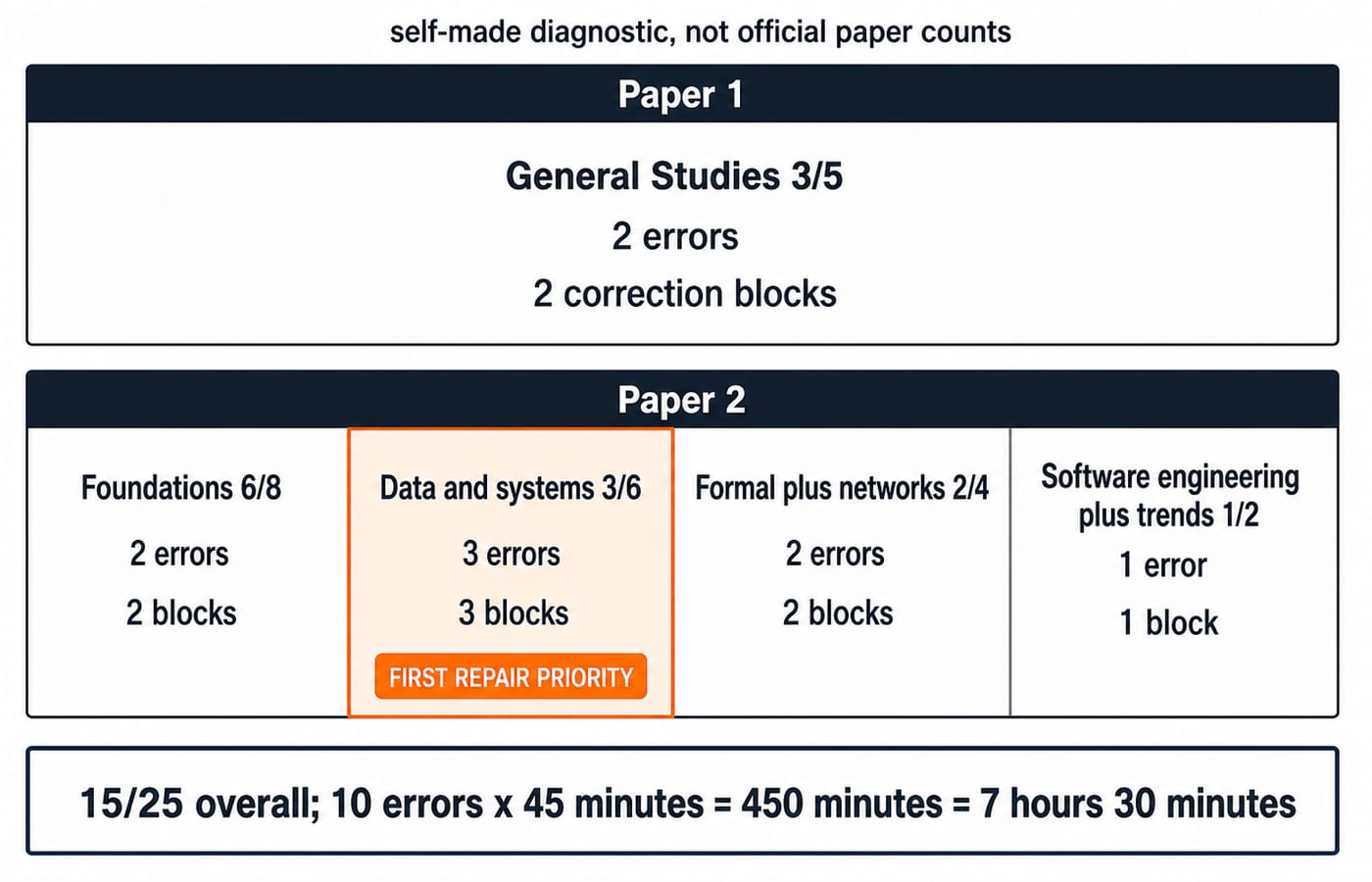
Score a 25-question check of your own by group. Say Paper 1 is 3/5, and Paper 2 is foundations 6/8, data and systems 3/6, formal plus networks 2/4, software engineering plus trends 1/2. Paper 2 is then 6 + 3 + 2 + 1 = 12/20; overall, 3 + 12 = 15/25.
Paper 1 has 2 errors. Paper 2 has 2 + 3 + 2 + 1 = 8, making 10. One correction block per error gives 10 x 45 = 450 minutes = 7 hours 30 minutes. Do the three data-and-systems blocks first, then use fresh questions.
MPPSC syllabus: the short version and next step
Confirm the Assistant Professor entry, treat Paper 1 as five Madhya Pradesh-centred units, and build Paper 2 from foundations through core systems into formal and applied areas. Follow the applicable MPPSC plan and corrigenda. Never import MP SET’s teaching-aptitude paper.
KnowledgeGate carries over 170 practice-question pages across the MPPSC Computer Science Paper 2 subjects, so practise each topic group the week you finish it.
MPPSC Assistant Professor Computer Science Paper 2 2026 gives the subject sequence already ordered; take the Paper 1 course above if Paper 1 is your only gap. If you are unsure which MPPSC exam you are sitting, settle that first on the official MPPSC index.
Keep learning

MPPSC Eligibility Criteria 2026: Age Limit, Qualification & Nationality
A practical eligibility checklist for MPPSC Assistant Professor Computer Science Advertisement 28/2025, separating age, nationality, domicile, subject equivalence, marks, qualifying routes and the revised deadline.
23 Oct 20266 min readMPPSC Teaching

MPPSC Application Form 2026: Apply Online, Last Date, Fees & Registration Process
An application-focused guide for MPPSC Assistant Professor Computer Science Advertisement 28/2025, covering revised deadlines, base and late fees, photo/signature preparation, submission, payment proof and corrections.
23 Oct 20266 min readMPPSC Teaching

MPPSC Assistant Professor CS Exam 2026: Notification, Eligibility, Exam Pattern, Syllabus & Selection Process
A Computer Science-specific guide to MPPSC Advertisement 28/2025: revised application windows, the 1 October qualification cutoff, 29 November exam, eligibility, syllabus preparation and selection.
23 Oct 20266 min readMPPSC Teaching
MPPSC vs HPSC Teaching: A Decision Rule for CS Graduates
Compare MPPSC and HPSC teaching routes with a qualification gate, a syllabus portability map and a weighted fit score before committing your study hours.
Updated 7 Aug 20266 min readMPPSC Teaching