

Controlled Access MCQs: 10 Solved Token Ring and Polling Questions with Explanations
Solve 10 controlled-access PYQs covering token bus, slotted ring, MAU, token timing, polling throughput and token-ring utilization. Each answer shows the exam move and the calculation behind it.
KnowledgeGate Team
Exam prep & CS education
Updated 5 Nov 20267 min read
Controlled access gives a station a turn through reservation, polling or token passing, replacing collisions with coordination overhead. Token bus and ring questions also separate physical layout from logical access order. Numerical questions become difficult when token rotation, propagation, frame transmission and polling delay share one timeline. A reliable solution names the protocol, converts every quantity to one time unit, draws the complete cycle and includes all overhead before computing throughput or utilization. Attempt each question before reading its explanation, then use GATE Guidance by Sanchit Sir for the wider Computer Networks learning route.
Controlled access MCQs: Start with the protocol and timing map
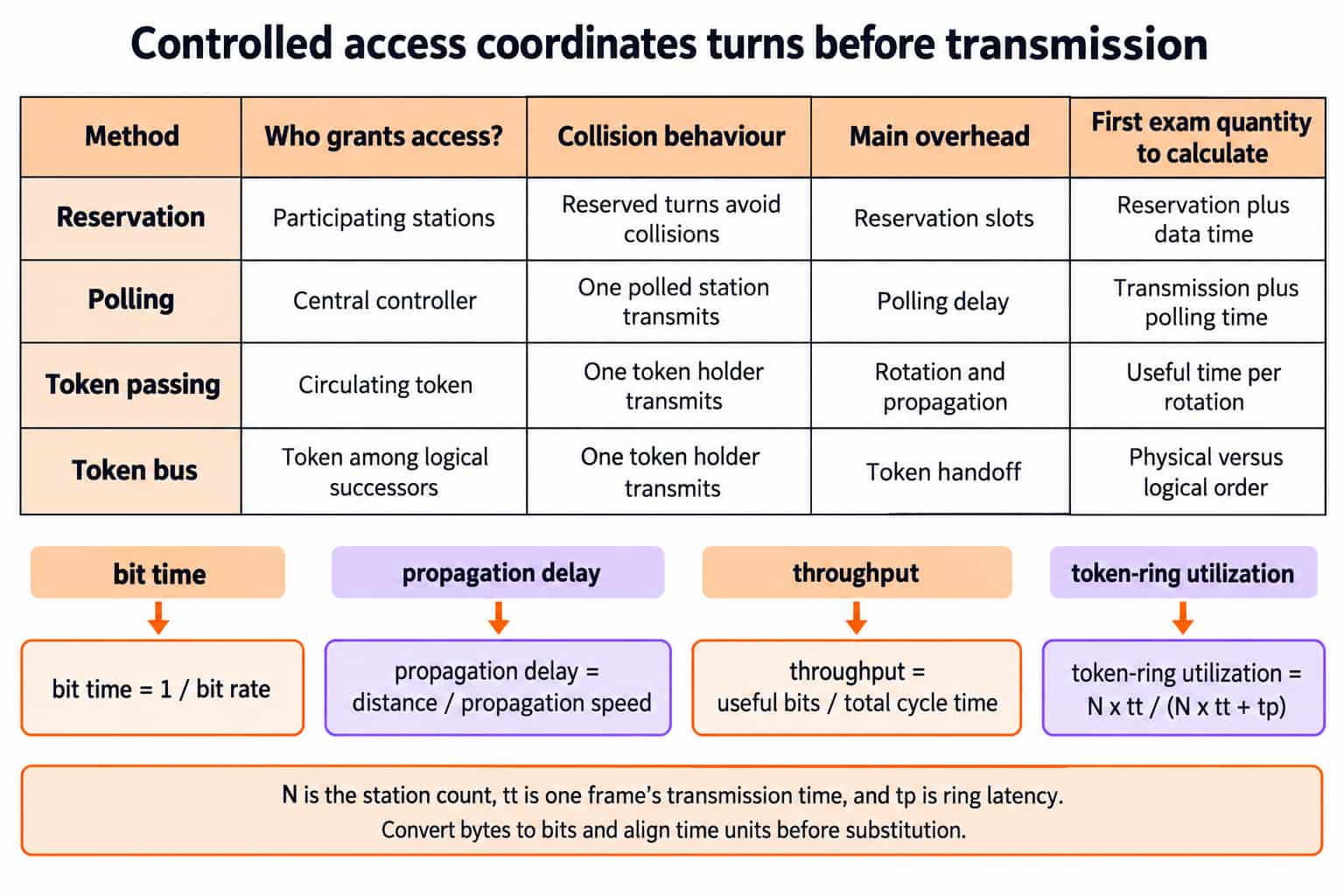
Controlled access coordinates turns before transmission, unlike a contention method such as CSMA/CD. It decides which station may use the shared medium.
Method | Who grants access? | Collision behaviour | Main overhead | First exam quantity to calculate |
|---|---|---|---|---|
Reservation | Participating stations | Reserved turns avoid collisions | Reservation slots | Reservation plus data time |
Polling | Central controller | One polled station transmits | Polling delay | Transmission plus polling time |
Token passing | Circulating token | One token holder transmits | Rotation and propagation | Useful time per rotation |
Token bus | Token among logical successors | One token holder transmits | Token handoff | Physical versus logical order |
Key timing relationships:
bit time = 1 / bit ratepropagation delay = distance / propagation speedthroughput = useful bits / total cycle timetoken-ring utilization = N x tt / (N x tt + tp)for the model in Questions 9 and 10
Here, N is the station count, tt is one frame's transmission time, and tp is ring latency. Convert bytes to bits and align time units before substitution.
Token bus, slotted ring and MAU concept MCQs
Question 1
REET 2022
Which of the following medium access control techniques is used for bus/tree?
A. Token ring
B. MAC
C. CSMA
D. Token bus
Answer: D. Token bus. Token Bus uses a physical bus or tree but passes the token in a logical order. Token Ring forms a logical ring, CSMA uses contention, and MAC alone is not a specific access technique.
Question 2
UPPSC Polytechnic Lecturer 2018
Which of the following is a token-based protocol?
A. CSMA/CD
B. Slotted ring
C. Both (a) and (b)
D. None of the above
Answer: B. Slotted ring. Slotted ring is the keyed controlled-access choice because a circulating ring control unit determines when a station may transmit. CSMA/CD is contention-based, so A and C cannot be correct.
Question 3
Kendriya Vidyalaya Sangathan 2013
The ____ houses the switches in token ring.
A. Transceiver
B. Nine-pin connector
C. MAU
D. NIC
Answer: C. MAU. MAU means Multistation Access Unit; its switching or bypass mechanism connects stations while preserving the logical ring. It is the central unit, not a station's NIC or connector.
Token ring one-bit delay MCQs
Question 4
In a token ring network the transmission speed is 10^7 bps and the propagation speed is 200 meters/micro second. The 1-bit delay in this network is equivalent to:
A. 500 metres of cable.
B. 200 metres of cable.
C. 20 metres of cable.
D. 50 metres of cable.
Answer: C. 20 metres of cable. One bit time is 1 / 10^7 s = 10^-7 s = 0.1 microsecond. The equivalent cable length is 0.1 microsecond x 200 metres/microsecond = 20 metres, with microseconds cancelling. Multiplying by the bit rate instead of taking its reciprocal is the trap.
Question 5
UGC NET 2024, Paper 2 (August)
In a token ring network the transmission speed is 10^7 bps and the propagation speed is 200 m/microsecond. The 1-bit delay in this network is equivalent to _______
A. 20 m
B. 30 m
C. 50 m
D. 40 m
Answer: A. 20 m. One bit takes 1 / 10^7 s = 0.1 microsecond, and the signal travels 0.1 x 200 = 20 m in that time. Option A matches.
Token holding, lost-token monitoring and effective data rate MCQs
Question 6
GATE 2014, Computer Science, Set 1
Consider a token ring network with a length of 2 km having 10 stations, including a monitoring station. The propagation speed of the signal is 2 x 10^8 m/s and the token transmission time is ignored. If each station is allowed to hold the token for 2 microseconds, the minimum time for which the monitoring station should wait (in microseconds) before assuming that the token is lost is _______.
This is a NAT item.
Answer: 28 microseconds. A full 2 km circulation at 2 x 10^8 m/s takes 2000 / (2 x 10^8) s = 10 microseconds. The monitor is included among 10 stations, so only the other nine can hold the token before it returns: 9 x 2 = 18 microseconds. The minimum wait is 10 + 18 = 28 microseconds.
Question 7
GATE 2004, Information Technology
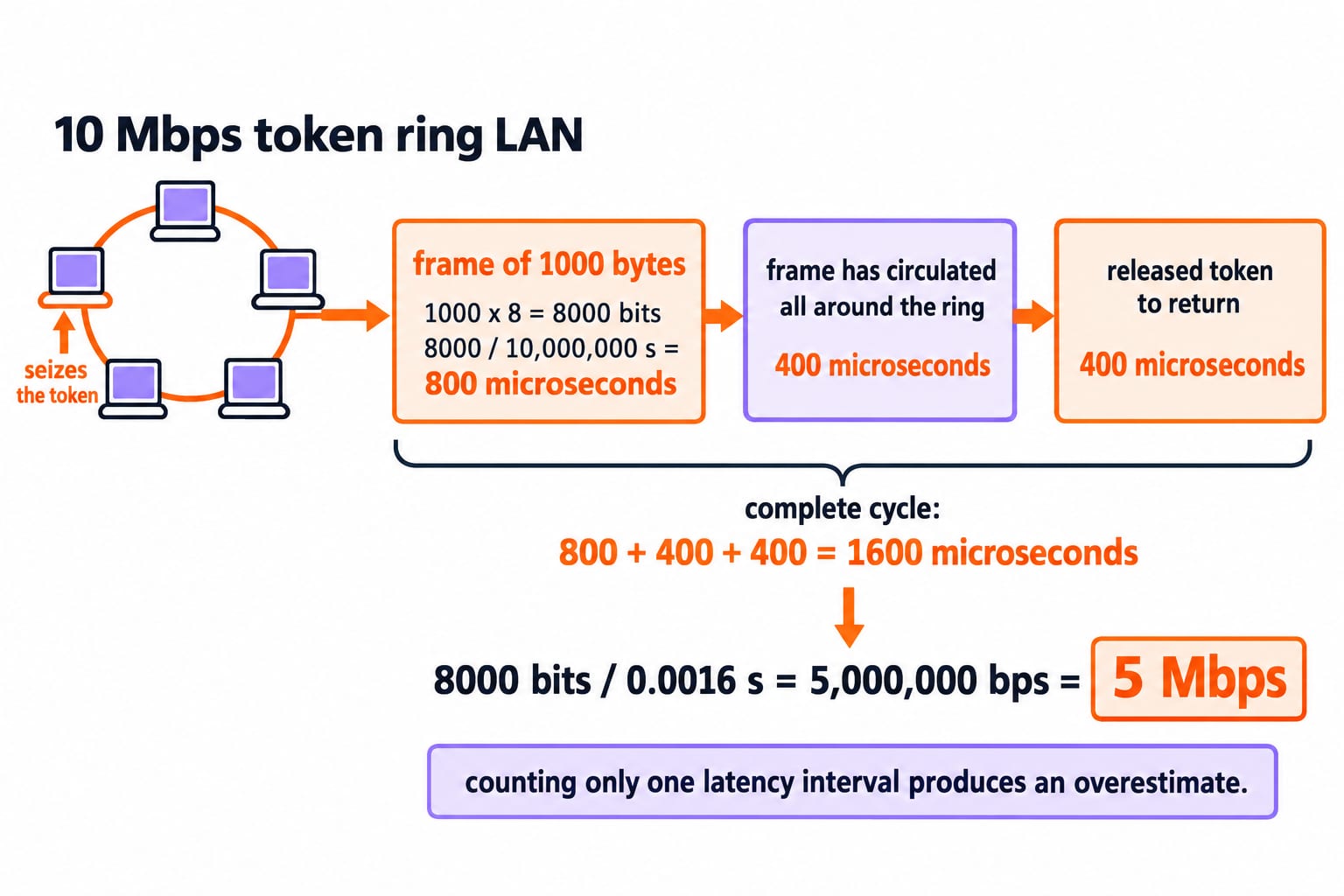
Consider a 10 Mbps token ring LAN with a ring latency of 400 µs. A host that needs to transmit seizes the token. Then it sends a frame of 1000 bytes, removes the frame after it has circulated all around the ring, and finally releases the token. This process is repeated for every frame. Assuming that only a single host wishes to transmit, the effective data rate is
A. 1Mbps
B. 2Mbps
C. 5Mbps
D. 6Mbps
Answer: C. 5Mbps. The frame contains 1000 x 8 = 8000 bits, so transmission at 10 Mbps takes 8000 / 10,000,000 s = 800 microseconds. The described cycle also has 400 microseconds for the frame to circulate before removal and 400 microseconds for the released token to return, giving 800 + 400 + 400 = 1600 microseconds. Thus the effective rate is 8000 bits / 0.0016 s = 5,000,000 bps = 5 Mbps; counting only one latency interval produces an overestimate.
Polling throughput MCQ
Question 8
GATE 2007, Information Technology
A broadcast channel has 10 nodes and total capacity of 10 Mbps. It uses polling for medium access. Once a node finishes transmission, there is a polling delay of 80 μs to poll the next node. Whenever a node is polled, it is allowed to transmit a maximum of 1000 bytes. The maximum throughput of the broadcast channel is
A. 1 Mbps
B. 100/11 Mbps
C. 10 Mbps
D. 100 Mbps
Answer: B. 100/11 Mbps. Each node sends 1000 x 8 = 8000 bits, which takes 8000 / 10,000,000 s = 800 microseconds; adding the 80-microsecond polling delay gives 880 microseconds per useful interval. Throughput is 8000 / (880 x 10^-6) = 100/11 Mbps, about 9.09 Mbps. A full ten-node check gives the same result: 80,000 bits / 8800 microseconds = 100/11 Mbps, so the node count cancels.
Token ring utilization MCQs
Question 9
GATE 2007, Information Technology
Consider a token ring topology with N stations (numbered 1 to N) running token ring protocol where the stations are equally spaced. When a station gets the token it is allowed to send one frame of fixed size. Ring latency is tp, while the transmission time of a frame is tt. All other latencies can be neglected. The maximum utilization of the token ring when tt = 3 ms, tp = 5 ms, N = 10 is
A. 0.545
B. 0.6
C. 0.857
D. 0.961
Answer: C. 0.857. Useful transmission during one rotation is N x tt = 10 x 3 = 30 ms, and the total rotation time is 30 + 5 = 35 ms. Utilization is 30 / 35 = 0.857142..., which matches 0.857. Using tt / (tt + tp) incorrectly ignores the other nine frames.
Question 10
GATE 2007, Information Technology
Consider a token ring topology with N stations (numbered 1 to N) running token ring protocol where the stations are equally spaced. When a station gets the token it is allowed to send one frame of fixed size. Ring latency is tp, while the transmission time of a frame is tt. All other latencies can be neglected. The maximum utilization of the token ring when tt = 5 ms, tp = 3 ms, N = 15 is:
A. 0.545
B. 0.655
C. 0.9375
D. 0.961
Answer: D. 0.961. Useful transmission is N x tt = 15 x 5 = 75 ms, while the total time is 75 + 3 = 78 ms. Utilization is 75 / 78 = 0.961538..., so the matching rounded option is 0.961. Compared with Question 9, more useful transmission per rotation makes the fixed ring latency a smaller part of the cycle.
Controlled access MCQ patterns and the next practice step
These questions repeatedly test five moves:
Match physical topology with logical access order.
Convert bit time into an equivalent cable length.
Separate frame transmission time from propagation time.
Add polling overhead to useful transmission time.
Include ring latency once in the stated utilization model.
Watch four traps. The monitoring station in Question 6 is already included in N, so only N - 1 other stations can hold the token. Convert bytes to bits before deriving transmission time. Question 7 includes the 400-microsecond latency twice, once for frame circulation and once for token return. Questions 5 and 6 use 10^7 and 10^8 explicitly; read the exponent before substituting.
For lateral practice, solve Subnetting MCQs: 12 Solved IP Addressing Questions for address arithmetic, then use TCP and UDP MCQs: 12 Solved Transport Layer Questions for protocol choices. The short version is to identify the method, draw the time interval, align units, and divide useful work by the complete cycle. Use the GATE Test Series for timed mixed practice or choose a wider route from GATE CS Exam Preparation Courses & Test Series.
Keep learning

Controlled Access Protocols Explained: Reservation, Polling and Token Passing with Worked Examples
Learn how reservation, polling and token passing control a shared link. Three step-by-step examples calculate cycles, waiting time, overhead and utilisation.
Updated 15 Nov 20266 min readComputer Networks

Ring and Johnson Counter MCQs: 10 Solved Questions with Explanations
Solve ten published ring and Johnson counter questions, then check each answer through state models, binary traces and compact exam-ready rules.
Updated 7 Sep 20267 min read105 viewsDigital Electronics MCQs
Friend Functions in C++: Controlled Class Access with a Worked Example
See how a non-member friend function can validate and update two Wallet objects while private balances stay hidden from ordinary callers. Includes runnable C++ and an exact trace.
Updated 12 Nov 20265 min readC++

Direct Memory Access (DMA) MCQs: 10 Solved Questions with Explanations
Test your DMA fundamentals with 10 published MCQs covering controller duties, HOLD and HLDA, transfer modes, sequencing, bandwidth, and CPU overhead. Each answer includes a focused explanation or worked calculation.
Updated 29 Aug 20267 min read84 viewsComputer Organization MCQs