

Controlled Access Protocols Explained: Reservation, Polling and Token Passing with Worked Examples
Learn how reservation, polling and token passing control a shared link. Three step-by-step examples calculate cycles, waiting time, overhead and utilisation.
KnowledgeGate Team
Exam prep & CS education
Updated 15 Nov 20266 min read

Random-access protocols let stations contend for a shared channel and then handle contention. Controlled access protocols first decide whose turn it is. Reservation, polling and token passing make that decision in three different ways. Reservation, polling and token passing differ in how they grant permission, their delay and overhead, and the exam questions they commonly generate. These are data-link-layer medium-access methods for a shared channel, within the wider Computer Networks area in CS Fundamentals.
Controlled access decides the sender before data transmission
Controlled access coordinates permission before a station sends a data frame. It is one family of medium-access control methods.
Access family | What happens before data transmission | Main idea |
|---|---|---|
Random access | A station attempts transmission | Contention is detected, avoided or resolved |
Controlled access | Permission is scheduled, invited or passed | The sender is selected before its data frame |
Channelization | The channel is divided by frequency, time or code | Stations use separate resource portions |
Reservation records demand before a data phase. Polling uses a central controller to invite stations. Token passing circulates a unique permission marker through a logical order.
Ideal operation prevents ordinary data-frame contention, but control failures remain: corrupt reservation information, a failed poller, or a lost or duplicate token.
Reservation worked example: bitmap, order and overhead
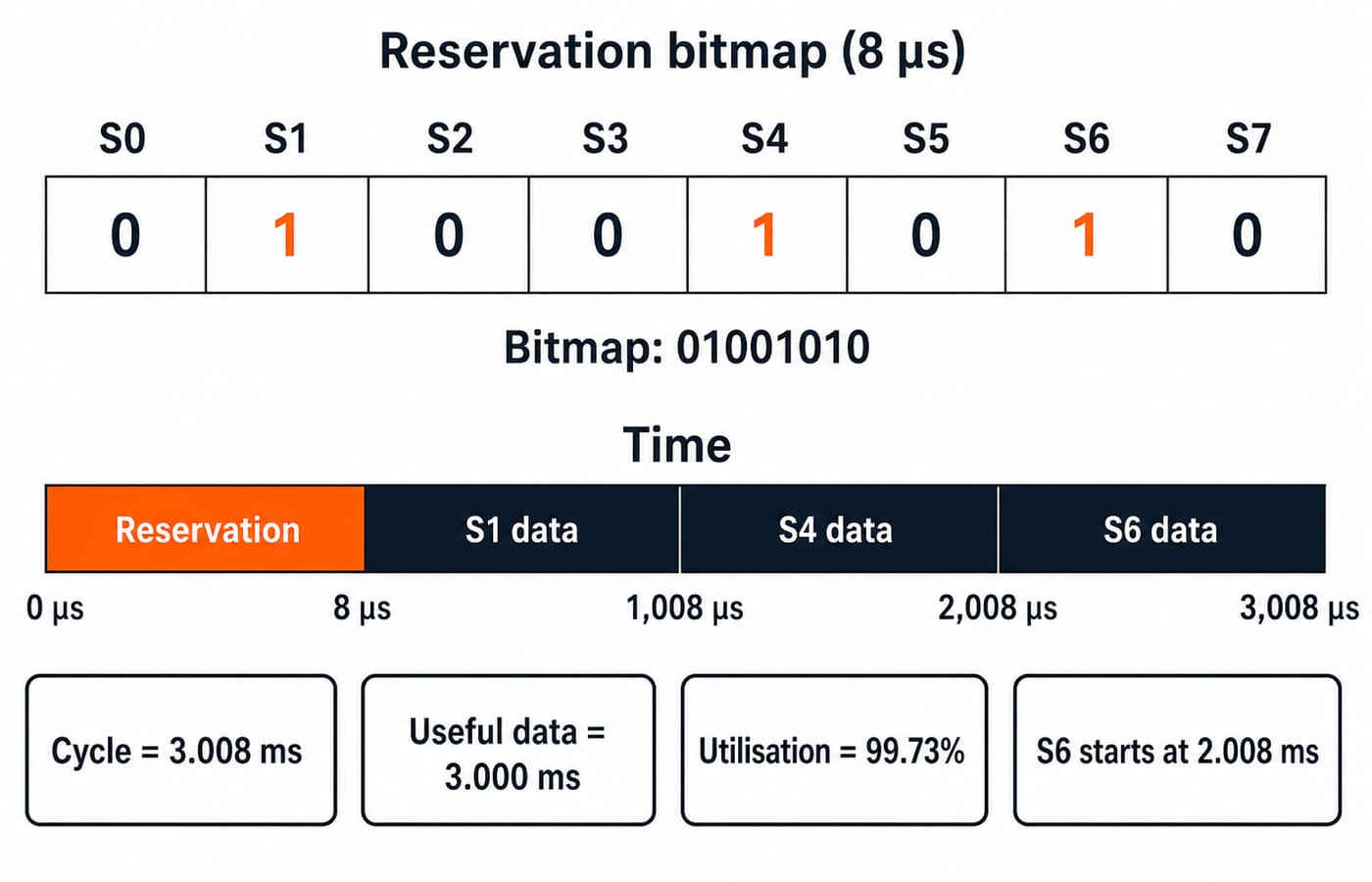
Take eight stations, S0 through S7, with one reservation bit per station in left-to-right order. On a 1 Mb/s link, S1, S4 and S6 each have one 1,000-bit frame.
The reservation map is 01001010, so the transmission order is S1 -> S4 -> S6.
Reservation time =
8 bits / 10^6 bits/s = 8 microseconds.One frame time =
1,000 / 10^6 s = 1,000 microseconds = 1 ms.Complete cycle =
8 + 3 x 1,000 = 3,008 microseconds = 3.008 ms.Useful data time =
3 x 1,000 = 3,000 microseconds.Simplified utilisation =
3,000 / 3,008 x 100 = 99.73%.
The timeline is reservation from 0 to 8 microseconds, S1 from 8 to 1,008, S4 from 1,008 to 2,008, and S6 from 2,008 to 3,008. Thus S6 begins 2,008 microseconds = 2.008 ms after reservation starts.
This answer assumes fixed-size frames, error-free reservation bits, no propagation or guard-time cost, and no additional headers.
Polling worked example: central control adds a visit cost
A controller polls four stations in the order A -> B -> C -> D. At 1 Mb/s, each 32-bit poll takes 32 microseconds. Only C has an 800-bit frame. Empty stations answer immediately; propagation, acknowledgements and separate empty responses are ignored.
The complete trace is:
Poll A: 0 to 32 microseconds
Poll B: 32 to 64 microseconds
Poll C: 64 to 96 microseconds
C data: 96 to 896 microseconds
Poll D: 896 to 928 microseconds
The cycle is 4 x 32 + 800 = 928 microseconds. Its useful fraction is 800 / 928 x 100 = 86.21%.
If B becomes ready at t = 64 microseconds, just after its poll, it waits through C's poll and data, D's poll, A's next poll and B's next poll. Permission arrives at t = 992 microseconds, so the wait is 992 - 64 = 928 microseconds. Inactive-station timeouts would make a real wait longer.
Token passing worked example: rotation and just-missed-token wait
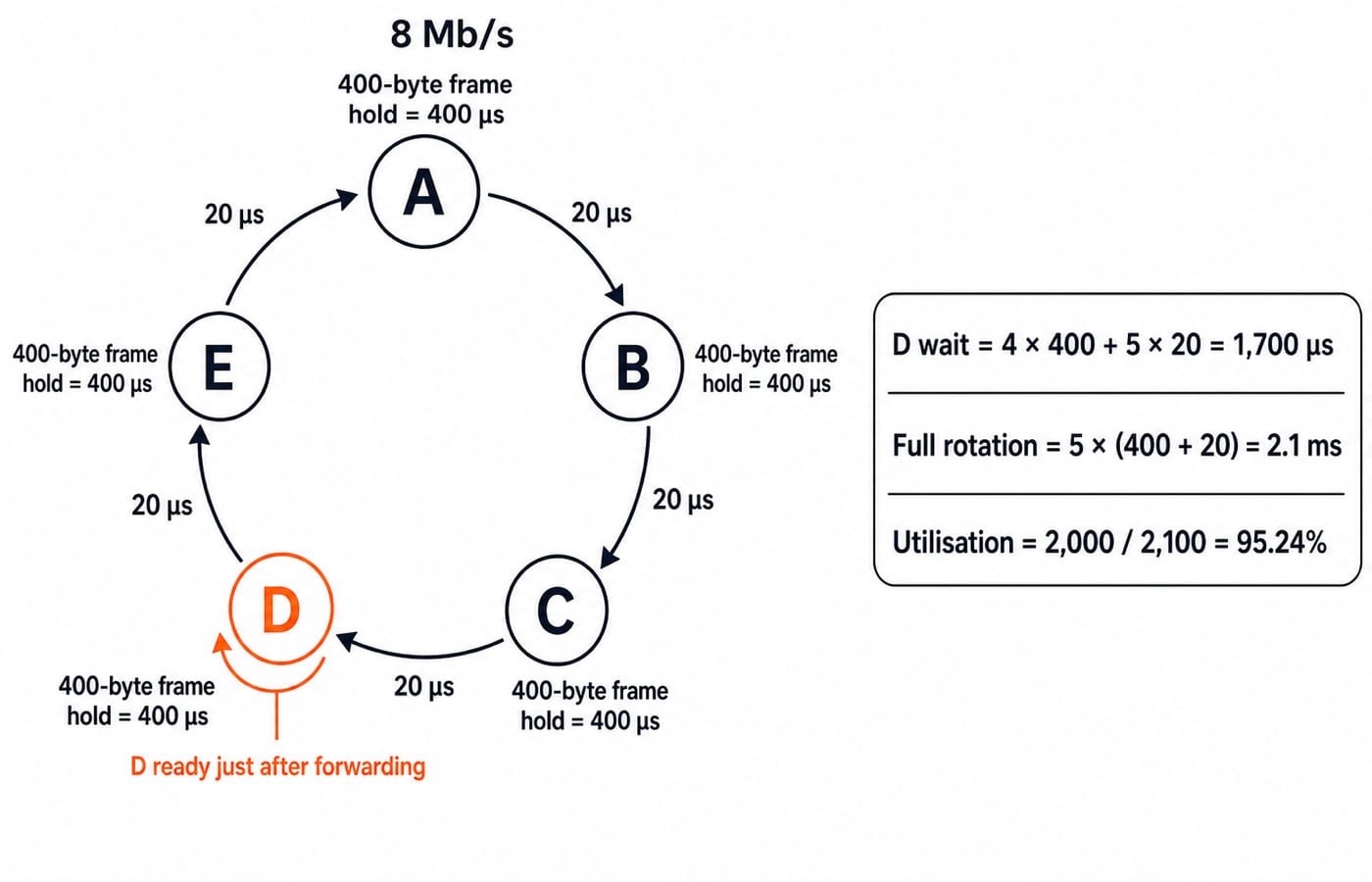
Take a logical ring A -> B -> C -> D -> E -> A at 8 Mb/s. Each active station sends one 400-byte = 3,200-bit frame per visit, taking 3,200 / (8 x 10^6) = 400 microseconds. Each adjacent token transfer costs 20 microseconds, including transmission and propagation.
With all five stations active:
Rotation time =
5 x (400 + 20) = 2,100 microseconds = 2.1 ms.Useful data time =
5 x 400 = 2,000 microseconds.Simplified utilisation =
2,000 / 2,100 x 100 = 95.24%.
If D becomes ready immediately after forwarding the token, E, A, B and C each hold it for 400 microseconds before D's next turn. The token also makes five 20-microsecond transfers from D back to D. D's wait is therefore 4 x 400 + 5 x 20 = 1,700 microseconds = 1.7 ms.
This wait is bounded under the supplied holding rule. Random-access delay instead depends on contention and retries. Token loss or duplication needs separate recovery logic.
Reservation, polling and token passing compared
Method | Who grants permission | Control overhead | Fairness or delay property | Characteristic failure |
|---|---|---|---|---|
Reservation | Station-specific request positions | One reservation interval per cycle | Demand is visible before ordered transmission | Corrupted reservation information |
Polling | Central controller | Poll visits, including visits to empty stations | Central policy can control order and priority | Controller failure or slow response |
Token passing | Current token holder forwards a unique token | Transfer cost at every logical hop | Predictable turns under the holding rule | Lost or duplicated token |
Choose by workload. Reservation exposes demand, polling centralises policy, and token passing distributes turns in order. Low load exposes control overhead; high load can favour orderly access over repeated contention.
Random-access results and the three MAC families are mapped in Data Link Layer Access Control: ALOHA and CSMA/CD Math. Reservation, polling and token passing need a different calculation: account for their complete control-and-data timelines.
Common traps: count every control interval
Unlabelled bitmap:
01001010means nothing until the first bit is assigned to S0. Only then can you deriveS1 -> S4 -> S6.Wrong utilisation denominator: include data time plus every supplied reservation, poll, token, guard, turnaround or timeout cost.
Polling equals token passing: it does not. A controller sends polling invitations, while the current token holder forwards permission in a logical ring.
Logical ring equals physical ring: logical access order and physical cabling are separate unless the question connects them.
Controlled access means zero wait: ordinary contention is removed only under the protocol assumptions. Queueing and control delay remain.
The percentages 99.73%, 86.21% and 95.24% belong only to these simplified examples, not to the methods universally.
How exams build controlled access questions
Questions may ask you to identify a method, decode a bitmap, trace a poll, calculate overhead or token rotation, match a failure mode, or distinguish the three access families.
Use this four-step checklist for numericals:
Draw the access order.
Convert every frame and control message using
transmission time = bits / bit rate.Put all control and data intervals on one timeline.
Label the denominator before calculating efficiency.
Check against a 3.008 ms reservation cycle, a 928-microsecond polling cycle and wait, a 2.1 ms token rotation, and D's 1.7 ms wait. KnowledgeGate has about 20 live practice questions on Controlled Access. After reproducing the timelines, TCP vs UDP: Transport Layer Explained is a useful next-layer comparison.
Controlled access protocols in the short version
Reservation records requests, polling asks each station, and token passing circulates permission. For all three, start with total cycle = control time + useful data time, then use utilisation = useful data time / total cycle under the stated assumptions. Recreate 01001010 -> S1, S4, S6, the 928-microsecond polling cycle and the 1.7 ms just-missed-token wait without looking back. If a result changes, check station order, control-message count and units before checking arithmetic.
Readers who want Computer Networks sequenced with DBMS, Operating Systems and other interview-facing core subjects can use Computer Science Fundamentals for Placements by Sanchit Sir.
Keep learning
Controlled Access MCQs: 10 Solved Token Ring and Polling Questions with Explanations
Solve 10 controlled-access PYQs covering token bus, slotted ring, MAU, token timing, polling throughput and token-ring utilization. Each answer shows the exam move and the calculation behind it.
Updated 5 Nov 20267 min readComputer Networks MCQs
Friend Functions in C++: Controlled Class Access with a Worked Example
See how a non-member friend function can validate and update two Wallet objects while private balances stay hidden from ordinary callers. Includes runnable C++ and an exact trace.
Updated 12 Nov 20265 min readC++

Data Link Layer Access Control: Medium Access Protocols with Worked Examples
Understand where access control sits inside the MAC sublayer, compare random, controlled and channelized access, and solve the ALOHA and CSMA/CD calculations students commonly mix up.
Updated 4 Aug 20266 min read88 viewsComputer Networks

Runtime Environments for GATE: Activation Records, Static vs Dynamic Scoping and Parameter Passing
Separate control and access links, trace static and dynamic scope, then calculate how value, reference and value-result change one program's output.
Updated 30 Oct 20266 min read54 viewsGATE Strategy & Roadmap