Computer Graphics for GATE: Syllabus Status, Weightage Reality and How to Prepare
Computer Graphics is important in a CS degree, but that does not automatically make it a GATE CS subject. See where it is tested, what overlaps with GATE, and how to allocate your study time.
KnowledgeGate Team
Exam prep & CS education
Updated 19 Sep 20265 min read
Computer Graphics is a full-semester subject in most BTech, BCA and MCA programmes, so aspirants naturally assume it must carry GATE marks. They then search for a Computer Graphics weightage table that does not exist. Your preparation should depend on where the subject stands and which exam you are preparing for.
Related reading: computer graphics fundamentals and UGC NET CS syllabus.
Computer Graphics in the GATE CS syllabus: the straight answer
The GATE Computer Science and Information Technology paper, code CS, does not contain a Computer Graphics section. Recent official syllabus documents have specified Engineering Mathematics, followed by Digital Logic, Computer Organization and Architecture, Programming and Data Structures, Algorithms, Theory of Computation, Compiler Design, Operating System, Databases and Computer Networks. Computer Graphics is not on that list.
Universities teach Computer Graphics as a core CS subject, while other CS examinations name it explicitly. Search results often mix those syllabi.
For a GATE-CS-only aspirant, the practical consequence is simple: do not reserve a separate Computer Graphics block in your schedule. Move that time to a listed section where it can directly earn marks.
UGC NET and other exams that may test Computer Graphics
Recent NTA syllabus documents for UGC NET Computer Science, subject code 87, have specified Computer Graphics within the unit paired with Programming Languages. Its scope includes areas such as scan conversion, two-dimensional and three-dimensional transformations, viewing, clipping, and curves and surfaces. Check the current syllabus document on the official UGC NET portal before fixing your plan. The UGC NET Computer Science syllabus areas guide gives the wider unit map.
Teaching-recruitment CS papers such as KVS, NVS, DSSSB and state instructor examinations may also include Computer Graphics because their coverage often follows degree curricula. In each case, use the current official syllabus rather than carrying assumptions from GATE or NET.
Computer Graphics weightage in GATE: direct and indirect relevance
Direct Computer Graphics weightage in GATE CS is zero because Computer Graphics is not a listed syllabus section. Historical question-count tables should therefore not assign it a separate weightage.
Recent official GATE information brochures and syllabus documents have specified the paper as 100 marks, 65 questions and three hours, with 15 marks for General Aptitude and 85 marks for the subject portion. They have also specified MCQ, MSQ and NAT formats. Always confirm these structural specifics against the portal for the cycle you will attempt.
There is still useful indirect overlap. Two-dimensional and three-dimensional transformations use matrix multiplication, while linear algebra belongs to GATE Engineering Mathematics. Rasterisation algorithms use incremental computation and careful branching, which strengthen the reasoning used in Algorithms. For the distribution across sections that are actually listed, see GATE CS subject weightage.
A 2D transformation that bridges Computer Graphics and linear algebra
Rotate the point P(4, 3) by 90 degrees anticlockwise about the pivot (2, 2). Rotation about a pivot requires translate, rotate, then translate back.
Translate the pivot to the origin: P becomes (4 - 2, 3 - 2) = (2, 1).
Apply the 90-degree anticlockwise rule x' = -y and y' = x. Equivalently, use rotation-matrix rows (0, -1) and (1, 0). Therefore, (2, 1) becomes (-1, 2).
Translate back by (2, 2): P' = (-1 + 2, 2 + 2) = (1, 4).
The result is P'(1, 4). If you rotate P about the origin and forget the pivot translations, you obtain (-3, 4), which is a different operation. GATE can test the matrix skill through linear algebra, while NET can ask the same computation directly as Computer Graphics.
Bresenham's line algorithm, traced completely
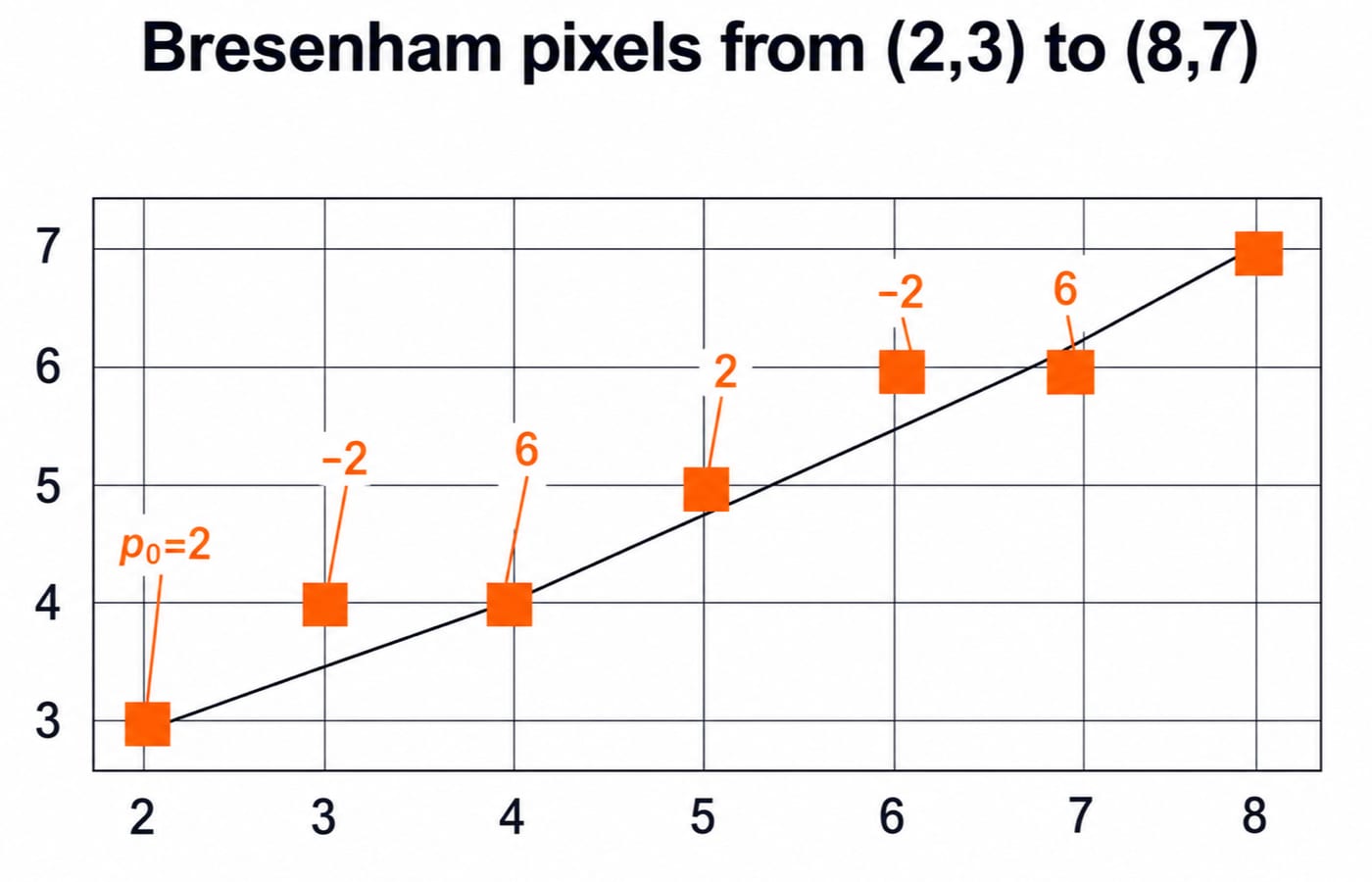
Rasterise the line from (2, 3) to (8, 7). Here, dx = 8 - 2 = 6 and dy = 7 - 3 = 4, so the slope is 4/6, which is below 1. Increase x by one at every step.
The initial decision parameter is p0 = 2dy - dx = 8 - 6 = 2. When p is non-negative, increment y and update p by 2dy - 2dx = 8 - 12 = -4. When p is negative, keep y unchanged and update p by 2dy = 8.
p before choice | Choice | Pixel plotted | Next p |
|---|---|---|---|
2 | increment y | (3, 4) | -2 |
-2 | keep y | (4, 4) | 6 |
6 | increment y | (5, 5) | 2 |
2 | increment y | (6, 6) | -2 |
-2 | keep y | (7, 6) | 6 |
6 | increment y | (8, 7) | stop |
Including the start, the pixel set is (2, 3), (3, 4), (4, 4), (5, 5), (6, 6), (7, 6), (8, 7). Bresenham's advantage is integer-only decision arithmetic. Typical questions ask for the p sequence, 2, -2, 6, 2, -2, 6, or the repeated y rows at (4, 4) and (7, 6).
Computer Graphics preparation by exam choice
GATE CS only: Skip dedicated Computer Graphics study. Put those hours into linear algebra, including transformations and eigenvalues, and Algorithms. Use the GATE Test Series, Mocks and Topic-wise Tests to give the listed sections timed exposure.
GATE plus UGC NET CS: Study Computer Graphics as a NET unit. Start with 2D transformations and homogeneous coordinates, then scan conversion using DDA, Bresenham and midpoint circle, clipping through Cohen-Sutherland outcodes, 3D viewing and projections, and finally Bezier basics. One focused week alongside GATE preparation is a reasonable planning block because the transformation foundation overlaps with linear algebra.
Teaching recruitment or semester examinations: Follow the same order, but spend more time on direct numericals such as composite transformations and raster traces.
If your examination list is undecided, settle it before choosing subjects. Computer Graphics is a textbook example of a subject whose preparation value changes completely with the paper.
The short version and the next step
Computer Graphics is not a listed GATE CS syllabus section, so its direct GATE weightage is zero.
It is tested in UGC NET Computer Science and may appear in teaching-recruitment and university examinations.
Its matrix transformations and incremental algorithms still support GATE linear algebra and Algorithms.
Prepare it only when NET, a teaching examination or a semester paper is on your list.
Verify every paper-specific detail against the current official syllabus and information brochure.
GATE Guidance by Sanchit Sir provides subject-wise sequencing and mentoring across the sections that actually carry GATE CS marks. If you are deciding where each subject fits, the GATE CS Exam Preparation category is the broader starting point.
Keep learning
Browsers and Search Engines MCQs: 9 Solved Questions with Explanations
Solve nine published browser and search engine questions, check each answer, and rebuild the browser, cache, crawler and indexing distinctions that exam distractors blur.
Updated 6 Oct 20267 min readTeaching Recruitment (Computer Science)

IT Act, 2000 Explained: Key Sections, Digital Signatures and Worked Exam Examples
Build an exam-ready map of the IT Act, then apply it to an exact digital-signature walkthrough and a section 43, 66, 66C and 66D caselet.
Updated 2 Oct 20266 min readTeaching Recruitment (Computer Science)
Emerging Trends Introduction MCQs: 12 Solved Questions with Explanations
Solve 12 Emerging Trends Introduction questions with clear answer logic, exam-year labels and a compact trap check for focused revision.
Updated 27 Sep 20268 min readTeaching Recruitment (Computer Science)
MS Word Basics MCQs with Answers: 12 Solved Questions Explained
Work through 12 MS Word questions covering everyday commands, page layout, formatting, links, file features and mail merge. Each answer explains the decisive clue and the closest distractor.
Updated 25 Sep 20267 min readTeaching Recruitment (Computer Science)