Computer Organization and Architecture for GATE: Syllabus Areas, Weightage Pattern and Prep Order
See what COA covers in GATE CS, where recent-paper questions concentrate, and how to sequence pipelining, cache, control and I/O preparation.
KnowledgeGate Team
Exam prep & CS education
Updated 19 Aug 20265 min read87 views
Computer Organization and Architecture can look like a small theory subject one day and a numerical monster the next. It is neither. COA is compact: pipelining and cache need serious practice, while the other areas reward careful reading and revision.
What the GATE syllabus actually lists under COA
The official GATE CS syllabus groups COA into five blocks:
Machine instructions and addressing modes
ALU, data path and control unit
Instruction pipelining and pipeline hazards
Memory hierarchy, including cache, main memory and secondary storage
I/O interface, including interrupts and DMA mode
This list comes from the organising institute's official syllabus. For the GATE 2026 cycle, download the CS syllabus PDF from the official GATE website before planning.
Digital logic, including Boolean algebra, K-maps, flip-flops and counters, is a separate syllabus section. COA proper also excludes deep microprogramming and processor-specific assembly. Its boundary is narrower than a semester textbook.
The weightage pattern: two blocks carry the subject
Counting question marks across recent GATE CS papers puts COA at roughly 6 to 9 marks out of 100. This is not an official quota, since the organising institute publishes no subject-wise split. COA sits in the mid-weight group alongside Operating Systems and Computer Networks.
Pipelining and cache or memory-hierarchy numericals usually carry the load. They can appear as numerical answer type questions, where there are no options to eliminate. Addressing modes, control unit and I/O more often appear as conceptual checks.
Instruction pipelining: the highest-yield block
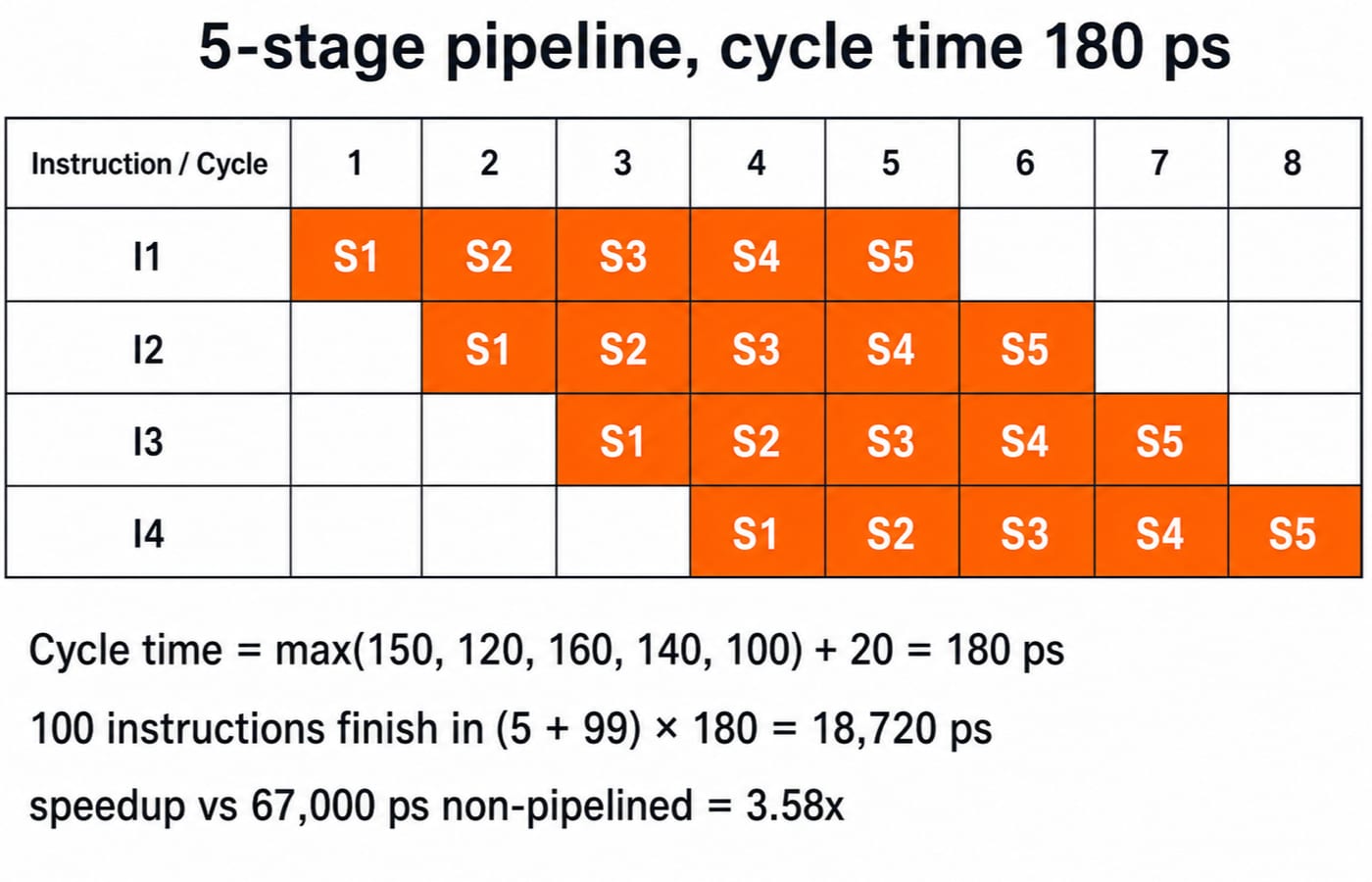
A 5-stage instruction pipeline has stage delays 150 ps, 120 ps, 160 ps, 140 ps and 100 ps, with a pipeline register (latch) overhead of 20 ps between stages.
The slowest stage takes 160 ps, so:
Pipeline cycle time = maximum stage delay + latch overhead = 160 + 20 = 180 ps.
Non-pipelined time per instruction = 150 + 120 + 160 + 140 + 100 = 670 ps.
For 100 instructions, pipelined time = (5 + 100 - 1) × 180 = 104 × 180 = 18,720 ps.
Non-pipelined time = 100 × 670 = 67,000 ps.
Speedup = 67,000 ÷ 18,720 = approximately 3.58x.
The speedup is below the ideal 5x because the slowest stage plus latch overhead fixes the clock. Reuse these formulas: cycle time = max(stage delay) + overhead; time for n instructions on a k-stage pipeline = (k + n - 1) cycles; speedup = non-pipelined time ÷ pipelined time.
Structural, data and control hazards disturb the flow. Standard fixes include forwarding and stalls, while control questions test branch penalties. Start stall-count numericals with (k + n - 1) cycles, then add bubbles.
Use Pipelining in Computer Architecture for a deeper pass through this block.
Memory hierarchy and cache: the second mark bank
Suppose cache access takes 4 ns, main memory takes 100 ns and the hit ratio is 0.95. Under hierarchical access, memory is checked only after a cache miss:
T_avg = 4 + (1 - 0.95) × 100 = 4 + 5 = 9 ns.
If cache and memory are accessed simultaneously, the convention changes:
T_avg = 0.95 × 4 + 0.05 × 100 = 3.8 + 5 = 8.8 ns.
Use hierarchical access unless the question says cache and memory operate in parallel. The 0.2 ns difference can decide the answer.
Learn direct, set-associative and fully associative mapping, then practise splitting addresses into tag, index and offset. Bit splitting is a recurring pattern. Cache Memory Mapping and Hit Ratio develops it further. Main-memory interleaving and secondary storage need a shallower pass.
Machine instructions, data path and control
Learn immediate, register, direct, indirect, register indirect, indexed, base, relative and auto-increment or auto-decrement addressing. Translate behaviour into the mode name. Effective address from a register followed by incrementing that register means auto-increment.
For instruction formats, subtract opcode and address-field bits from the word size, then assign what remains. On a single-bus data path only one transfer can occupy the bus per step, so even a plain fetch takes three steps: PC to MAR with the read issued, the incremented address written back to PC, then MDR to IR. Counting those steps is what most data-path questions are really asking for. Hardwired control favours speed; microprogrammed control favours flexibility. A horizontal microinstruction spends one bit per control signal, so it is wide, needs no decoding and can fire several signals in the same step; a vertical one packs those signals into encoded fields, so the word is short but a decoder sits in the path and parallelism drops.
I/O interface: interrupts and DMA
In programmed I/O, the CPU waits and moves the data. With interrupt-driven I/O, the CPU can do other work until the device requests service, but the CPU still handles transfers. With DMA, a controller moves blocks between the device and memory with much lower CPU involvement.
In cycle stealing the controller takes the bus for one word, returns it, then asks again, so the CPU is slowed but never stopped. In burst mode it holds the bus until the whole block has moved. That trade is why DMA pays on disk and network transfers, where a single request shifts hundreds of words. One careful reading plus flashcard revision is enough here, so schedule it late.
Prep order and time budget for COA
For a working aspirant, 30 to 40 hours is enough for COA. Split them like this:
Pipelining and hazards: 8 to 10 hours
Cache and memory hierarchy: 8 to 10 hours
Instructions and addressing modes: 5 to 6 hours
Data path and control: 4 to 5 hours
I/O, interrupts and DMA: 3 to 4 hours
Mixed PYQs and timed practice: the remaining time
This numbers-first order gives the practice-heavy blocks enough time. A repeat aspirant can compress the conceptual phases into revision. PYQs from the last several years reveal the depth expected from each syllabus line.
For a structured full-syllabus route, GATE Guidance by Sanchit Sir includes COA within the CS curriculum. You can also browse the wider GATE CS course lineup.
The short version and next step
COA is five blocks, and two of them, pipelining and cache, hold most of its marks. Prepare in that order: pipeline, cache, addressing modes, data path and control, then I/O. Carry the two conventions that decide the numericals: cycle time is the slowest stage plus latch overhead, and average access time is hierarchical unless the question says the cache and memory run in parallel.
After your first pass, pressure-test the two numerical blocks with topic tests and full mocks in the GATE Test Series. The aim is simple: recognise the convention, write the formula and finish the arithmetic without guesswork.
Keep learning
Programmed I/O: Polling, CPU Utilisation, Worked Examples and GATE Question Patterns
Follow one programmed-input transfer from control write to data read, then calculate how many polls one word costs and what a longer poll period buys.
Updated 7 Oct 20266 min readComputer Organization & Architecture
Multiprocessor Fundamentals: Architecture, Speedup and Worked Examples
Build a clear model of multiprocessor systems, then use it to calculate speedup and efficiency, trace a coherent write, and diagnose a lost update.
Updated 2 Oct 20265 min readComputer Organization & Architecture
Multiprocessor Classification: Flynn Taxonomy, Memory Models and Exam-Style Worked Examples
Learn how to choose the right multiprocessor classification axis, then solve a four-lane SIMD trace and a NUMA average-access-time problem step by step.
Updated 27 Sep 20266 min readComputer Organization & Architecture
Interrupt-Driven I/O Explained: CPU Handshake, Worked Timing Example and GATE Traps
Trace an interrupt from device request to return-from-interrupt, then compare polling, per-event interrupts, and DMA through worked timing examples.
Updated 25 Sep 20267 min readComputer Organization & Architecture