Computer Classification & Flynn’s Taxonomy MCQs: 12 Solved Questions with Explanations
Classification questions become easier when you identify the axis first. Solve 12 practice MCQs, then use a worked four-case example to distinguish SISD, SIMD, MISD and MIMD.
KnowledgeGate Team
Exam prep & CS education
Updated 26 Jul 20267 min read
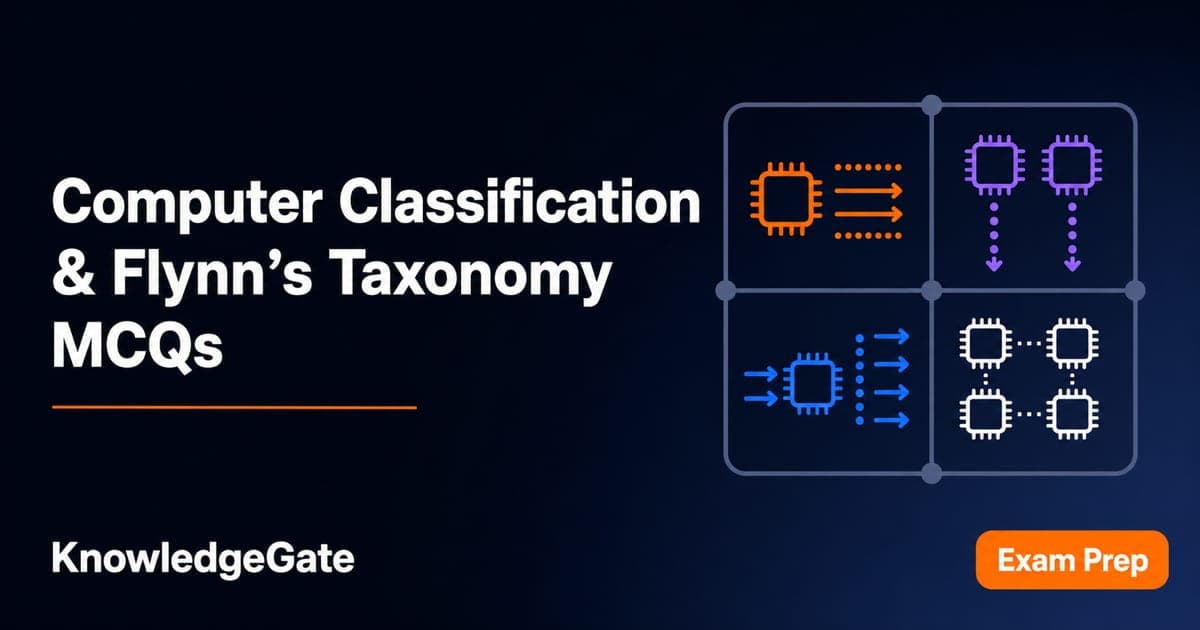
Computer-classification questions look like one chapter, but they switch among purpose, workload, processor generation, memory organisation, and instruction and data streams. The quickest way to lose a mark is to answer on the wrong axis. Name the axis first and most option lists collapse to a single survivor, whether the stem says mainframe, embedded controller, 80286 or SIMD. That habit is worth drilling early in GATE CS preparation.
Separate the classification axes before touching the options
Keep this five-axis map in mind:
Axis | Contrast |
|---|---|
Purpose | A general-purpose laptop runs many applications; an embedded washing-machine controller performs a dedicated role. |
Workload | A mainframe handles heavy transaction and I/O workloads; a supercomputer emphasises numerical performance measured in FLOPS. |
Generation | Vacuum tubes, transistors, integrated circuits, and microprocessors map to the first four generations. |
Memory organisation | Von Neumann shares instruction and data memory; Harvard separates them. |
Flynn streams | SISD, SIMD, MISD, and MIMD count instruction streams and data streams. |
The solving rule is simple: identify the axis named in the stem before judging an option. A processor can be both RISC and embedded because instruction-set design and deployment role are different axes.
Mainframes and embedded systems: Questions 1 to 4
Question 1
The term ____ is used for the larger, more powerful computers other than supercomputers. It supports a large database, has elaborate I/O hardware, and is used in a central data processing facility.
A. Minicomputer
B. Supercomputer
C. Mainframe
D. Microcomputer
Answer: Mainframe. Large databases, elaborate I/O, and centralised transaction processing are mainframe clues. Supercomputers emphasise numerical performance; microcomputers serve small systems.
Question 2
Which type of computer uses the 8-bit code called EBCDIC?
A. Minicomputers
B. Microcomputers
C. Mainframe computers
D. Supercomputer
E. Personal computers
Answer: Mainframe computers. EBCDIC means Extended Binary Coded Decimal Interchange Code and is historically associated with IBM mainframes. ASCII is common elsewhere, but current mainframes do not necessarily use only EBCDIC.
Question 3
The term ____ refers to the use of electronics and software within a product, as opposed to a general-purpose computer (laptop/desktop).
A. Complex system
B. Simple system
C. Fuzzy logic
D. Embedded system
Answer: Embedded system. A washing-machine controller reads a sensor and runs dedicated software. “Complex” and “simple” describe complexity; fuzzy logic is a technique, not the computer inside a product.
Question 4
When computers are classified by their role within a larger device, which class commonly uses microcontrollers whose program instructions and runtime data reside in separate memory systems?
A. Stored-program computers
B. RISC computers
C. CISC computers
D. Embedded computers
Answer: Embedded computers. The axis is role within a device. Many such microcontrollers use Harvard-style program and data memories. RISC and CISC describe instruction sets; stored-program describes storage. A processor may still be both RISC and embedded.
Generations, address space and speed: Questions 5 to 7
Question 5
Microprocessors as switching devices are for which generation computers?
A. First Generation
B. Second Generation
C. Third Generation
D. Fourth Generation
E. Fifth Generation
Answer: Fourth Generation. Vacuum tubes, transistors, integrated circuits, and microprocessors map respectively to generations one through four. Fifth-generation AI descriptions do not answer this switching-device clue.
Question 6
The maximum memory size of the third-generation Intel microprocessor (80286) is
A. 4 GB
B. 16 MB
C. 16 GB
D. More than one of the above
E. None of the above
Answer: 16 MB. The 80286 has a 24-bit physical address bus, so it can form:
2^24 = 16,777,216byte addresses.One MiB is
2^20 = 1,048,576bytes.Therefore,
2^24 / 2^20 = 2^4 = 16MiB, which the options give as 16 MB.
Watch the axis switch in this stem: “third generation” here labels a step in Intel’s own microprocessor line, not the vacuum-tube to microprocessor computer generations of Question 5. Either way the answer comes from the address bus width, never from the label. Cross-check it: a 20-bit 8086 address space gives 2^20 bytes, or 1 MB; a 32-bit 80386 gives 2^32 bytes, or 4 GB. See Memory Hierarchy and Virtual Memory for the broader memory picture.
Question 7
The speed of supercomputer is measured in ____ .
A. Floating-point operations per hour
B. Floating-point operations per day
C. Floating-point operations per second
D. Floating-point operations per minute
Answer: Floating-point operations per second. A FLOP is an operation; FLOPS is a rate. 1 teraFLOPS = 10^12 FLOPS, 1 petaFLOPS = 10^15 FLOPS, and 1 exaFLOPS = 10^18 FLOPS. The distractors use the wrong time unit.
Von Neumann organisation and SISD: Questions 8 to 9
Question 8
In Von Neumann architecture:
A. Data and instructions are stored in separate memories
B. Data and instructions share the same memory
C. Only data is stored in memory
D. Only instructions are stored in memory
Answer: Data and instructions share the same memory. Harvard separates their memories or paths. Address 1000 may hold an instruction and address 2000 the value 7, but both remain in one Von Neumann memory.
Question 9
Von Neumann computer architecture is _____.
A. SISD
B. SIMD
C. MIMD
D. MISD
Answer: SISD. The classic sequential model has a Single Instruction stream and Single Data stream. Shared memory is Question 8's axis; SISD is this stream axis. Pipelining is an execution technique, not a Flynn label.
Flynn’s taxonomy and parallelism: Questions 10 to 12
Question 10
Which of the following is the type of parallel processor system as per Flynn's taxonomy?
I. Single instruction, single data (SISD) stream
II. Single instruction, multiple data (SIMD) stream
A. Neither I nor II
B. Both I and II
C. Only II
D. Only I
Answer: Only II. SISD has one instruction and one data stream. SIMD applies one instruction to multiple data elements concurrently. Both are Flynn categories, but SISD is not parallel.
Question 11
What is the full form of MISD in Flynn’s taxonomy?
A. Multiple Interrupt stream and Single Data stream
B. Multiple Instruction stream and Single Data stream
C. Many Interrupt stream and Single Digital stream
D. Many Instruction stream and Single Digital stream
Answer: Multiple Instruction stream and Single Data stream. Expand each letter: Multiple, Instruction, Single, Data. “Interrupt” and “digital” are distractor substitutions.
Question 12
The SIMD is an organization which
A. contains a lot of processing units under the common control unit supervision
B. is capable of processing many programs at one time
C. contains an individual computer having control unit, processing unit and a memory unit
D. All of the above
Answer: contains a lot of processing units under the common control unit supervision. One control unit broadcasts one instruction across different data. “Many programs” implies multiple instructions; the individual-computer description fits SISD. Thus “All of the above” fails.
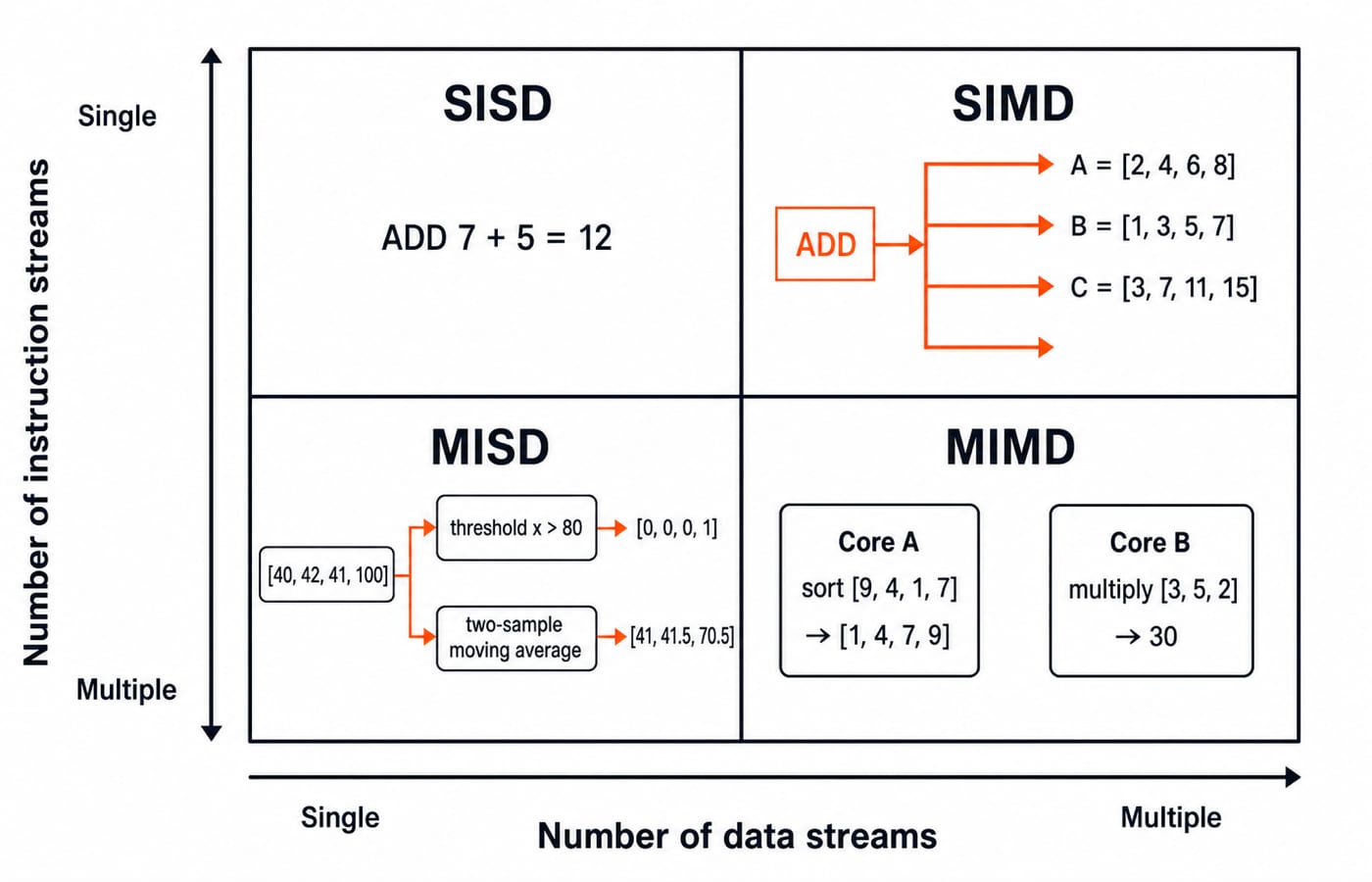
Work one four-case Flynn example from values
SISD: One scalar core performs
7 + 5 = 12, using one ADD instruction stream and one data pair.SIMD: Four lanes receive one ADD. For
A = [2, 4, 6, 8]andB = [1, 3, 5, 7], they produceC = [3, 7, 11, 15], one instruction stream over four data pairs.MISD: Two operations consume sensor stream
[40, 42, 41, 100]. Thresholdx > 80gives[0, 0, 0, 1]. A two-sample moving average gives(40 + 42) / 2 = 41,(42 + 41) / 2 = 41.5, and(41 + 100) / 2 = 70.5, hence[41, 41.5, 70.5]. Pure MISD is rare in general-purpose computing.MIMD: Core A sorts
[9, 4, 1, 7]into[1, 4, 7, 9]; Core B calculates3 x 5 x 2 = 30. Independent instructions operate on independent data.
Catch the traps these questions repeat
Wrong comparison | Correct axis |
|---|---|
Mainframe versus supercomputer | Workload emphasis |
Embedded versus general-purpose | Deployment role |
Von Neumann versus Harvard | Memory organisation |
SISD, SIMD, MISD, and MIMD | Instruction and data stream counts |
Check three details: 2^24 byte addresses mean 16,777,216 bytes, shown as 16 MB; FLOPS ends in “per second”; SIMD means multiple data, not multiple programs.
For a 30-second test, underline instruction-stream count and circle data-stream count. Map (I, D) to (1,1), (1,many), (many,1), or (many,many). Question 12 is (1,many), one instruction broadcast to many units.
Score the set and choose the next computer organisation step
Answer strip: 1 Mainframe; 2 Mainframe computers; 3 Embedded system; 4 Embedded computers; 5 Fourth Generation; 6 16 MB; 7 Floating-point operations per second; 8 Data and instructions share the same memory; 9 SISD; 10 Only II; 11 Multiple Instruction stream and Single Data stream; 12 contains a lot of processing units under the common control unit supervision.
Use a 15-minute correction loop. Spend 5 minutes rewriting the five axes, 5 minutes redrawing the four Flynn cells, and 5 minutes redoing 2^24 = 16,777,216 bytes plus the four-lane SIMD addition. Below 9 correct, repeat the set after one day. With 9 to 11 correct, repeat only missed items. With all 12 correct, continue to Cache Memory Mapping and Hit Ratio.
The short version
Find the classification axis, translate each acronym into stream counts, and calculate address space instead of guessing. For structured concept study, use GATE Guidance by Sanchit Sir. For timed scoring practice, use the topic-wise tests and mocks in the GATE Test Series.
Keep learning
Instruction Formats and Addressing Modes MCQs: 12 Solved Cross-Concept Questions
Solve 12 cross-concept COA questions that connect addressing-mode choices with PC rules, memory references, opcode fields, and byte-aligned instructions.
3 Oct 20267 min readComputer Organization MCQs
Interrupt-Driven I/O MCQs: 12 Solved Questions with Explanations
Attempt 12 previous-year interrupt-driven I/O questions, then check each answer with a concise explanation. The set covers ISR order, vectoring, priority, and CPU-time numericals.
28 Sep 20268 min readComputer Organization MCQs
Bitmap and Pixmap MCQs: 12 Solved Pixel Depth and Memory Questions
Build a reliable pixel-memory method through 12 live MCQs covering bitmaps, pixmaps, lookup tables, uncompressed storage, refresh rates, masks, and dithering.
Updated 25 Sep 20267 min readComputer Organization MCQs

Assembly & Assembler Design MCQs: 11 Solved PYQs Explained
Attempt 11 published PYQs on assembler directives, language levels, tables, register-pair instructions, debugging and fixed-width arithmetic, then check each worked explanation.
Updated 24 Sep 20267 min readComputer Organization MCQs