Computer Classification and Flynn’s Taxonomy: The Four Classes with a Worked Vector Example
A machine can belong to several computer classes at once. Learn the four classification axes, Flynn’s matrix, vector and multicore traces, and exam traps.
KnowledgeGate Team
Exam prep & CS education
Updated 11 Oct 20266 min read

A laptop can be general-purpose, digital, a microcomputer, and a mixture of MIMD and SIMD at the same time. If those labels seem contradictory, the problem is not the machine. It is the missing classification axis. Each label answers a different question about purpose, representation, role, or stream organisation. The four axes distinguish purpose, representation, role, and stream organisation; Flynn’s 2 x 2 matrix maps stream counts, and the numerical example compares SISD, SIMD, and MIMD. Classification depends on evidence, not on memorising one device per box.
Computer classification starts with the axis, not the machine name
Classification means naming a criterion before assigning a label. Four axes are especially useful: purpose (range of work), representation (how quantities are encoded), scale or role (whom the machine serves), and architecture (how instruction and data streams are organised). The GATE CS Exam Preparation route places these ideas inside the broader Computer Organisation and Architecture sequence.
Axis | Question asked | Typical labels |
|---|---|---|
Purpose | What range of work is the machine built to perform? | General-purpose, special-purpose |
Data representation | How are quantities represented during computation? | Analog, digital, hybrid |
Scale or service role | What workload and user role does it serve? | Personal computer, workstation, server, mainframe, supercomputer |
Stream architecture | How are instruction and data streams organised? | SISD, SIMD, MISD, MIMD |
Labels compete only within one axis. A computer may carry one valid label from several axes.
Computer classification by purpose and data representation
A general-purpose laptop can compile code, browse, and edit documents. A special-purpose traffic-light controller is built for one narrow control task. Programmability does not make a machine general-purpose; a controller can run software and remain dedicated.
Representation asks a different question. Analog systems operate on continuously varying physical quantities, digital systems use discrete encoded values, and hybrid systems combine both. Consider a temperature controller: 2.37 V sensor signal -> ADC -> digital value 237 -> controller decision. The converter turns the continuous voltage into a discrete code for the digital processor.
An analog input does not automatically make an analog computer. Ask where computation occurs and how quantities are represented there. The complete control system may be hybrid even though its processor is digital.
Computer classification by scale, capacity, and service role
Microcomputer, workstation, server, mainframe, and supercomputer are broad role-and-capability labels, not fixed clock-speed bands. A laptop is usually a single-user microcomputer, a transaction server serves many users, and a supercomputer targets high-throughput scientific calculation. “Minicomputer” is mainly historical, and modern boundaries overlap.
Physical size alone does not determine the class. Workload, role, capacity, and organisation matter more. Other design questions cut across these labels. For example, Cache Memory: Mapping and Hit Ratio concerns memory organisation, not a Flynn class.
Scale labels tell you what a system is built to serve. Flynn’s taxonomy instead asks how many instruction streams and data streams can be active.
Flynn’s taxonomy counts instruction streams and data streams
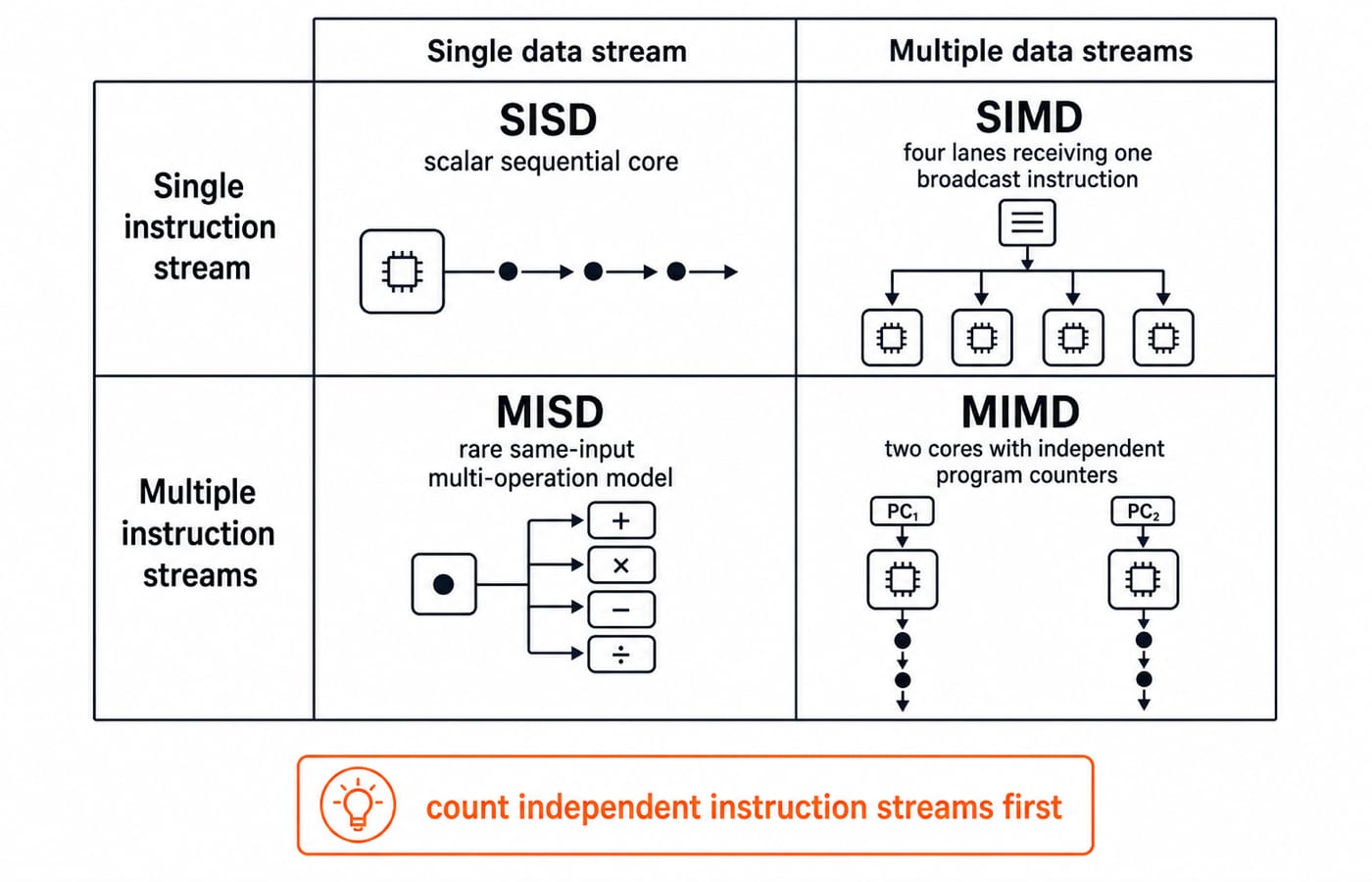
An instruction stream is the ordered sequence controlled by a processing unit or program counter. A data stream is the operand sequence being processed. Count independent logical streams from the described behaviour, not processors printed on a label.
Instruction streams | Data streams | Flynn class | Useful archetype |
|---|---|---|---|
One | One | SISD | Scalar sequential execution |
One | Multiple | SIMD | Vector or array lanes receiving one instruction |
Multiple | One | MISD | Rare conceptual or fault-tolerant same-input processing |
Multiple | Multiple | MIMD | Multicore or multiprocessor execution with independent control |
SISD applies one instruction stream to one data stream. SIMD broadcasts one instruction across multiple data elements. MISD applies multiple instruction streams to one logical data stream and is uncommon in conventional machines. MIMD lets multiple processing units follow independent instruction streams over separate data.
GPUs are often treated as SIMD-like, or described through SIMT, in exam abstractions. Thread divergence and implementation details make the complete machine more nuanced. A modern computer can also be nested: multiple cores behave as MIMD, while vector units inside each core perform SIMD operations.
Flynn’s taxonomy worked example: compute C = 3A + B
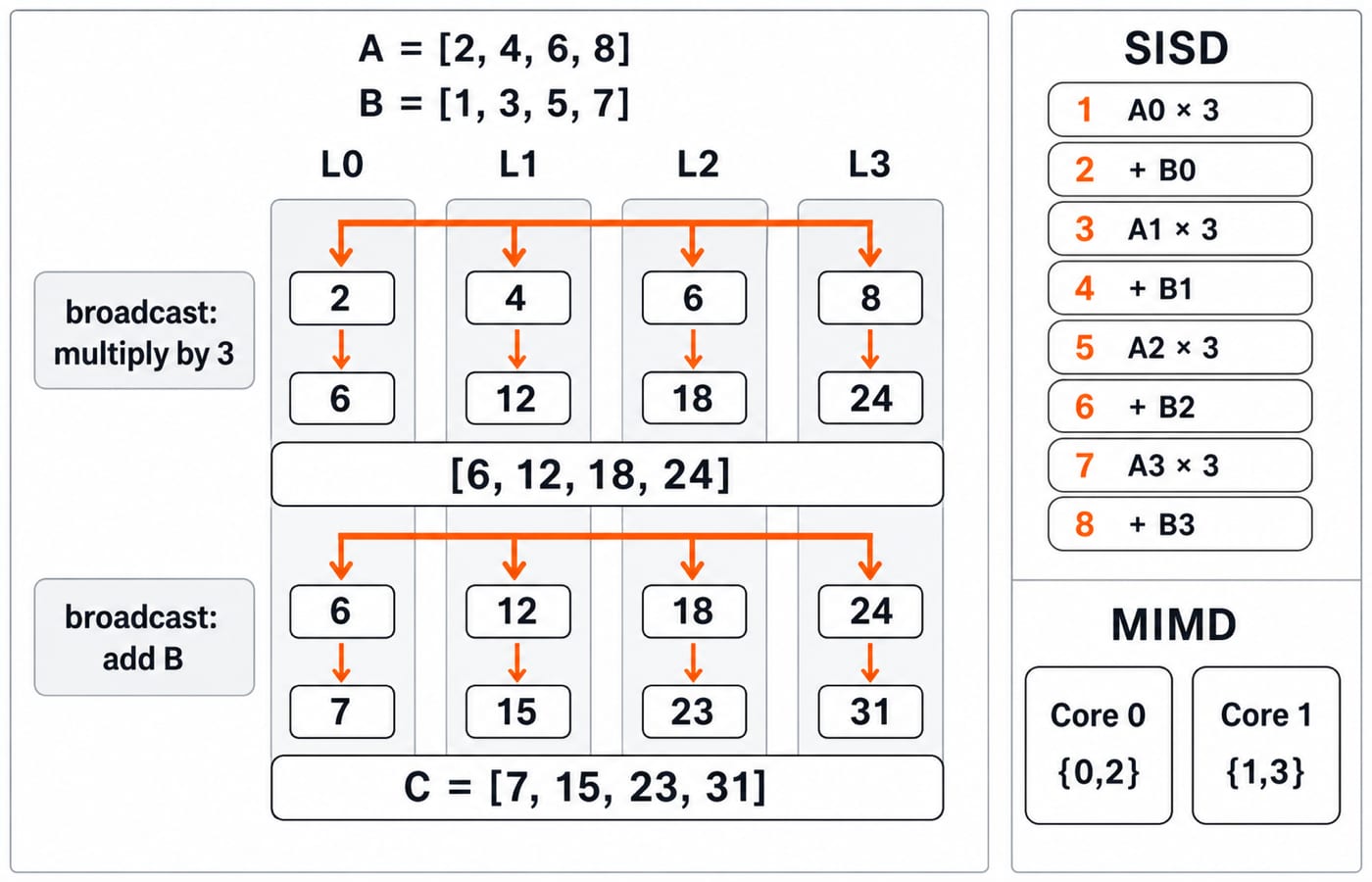
Let A = [2, 4, 6, 8] and B = [1, 3, 5, 7]. Multiplying A by 3 gives:
3A = [3(2), 3(4), 3(6), 3(8)] = [6, 12, 18, 24]
Add the corresponding elements of B:
Index 0:
3(2) + 1 = 6 + 1 = 7Index 1:
3(4) + 3 = 12 + 3 = 15Index 2:
3(6) + 5 = 18 + 5 = 23Index 3:
3(8) + 7 = 24 + 7 = 31
Thus, C = [7, 15, 23, 31].
Under SISD, one stream handles the four indices sequentially. One multiplication and one addition per index give 8 ordered arithmetic operations.
With four-lane SIMD, one instruction broadcasts “multiply by 3” and another broadcasts “add B.” The 8 lane operations become 2 issued vector instructions.
With two-core MIMD, core 0 handles indices 0 and 2 while core 1 handles 1 and 3. Their program counters advance independently, even when both run the same loop.
For a separate MISD trace, use the logical input x = 4. Four streams produce x + 1 = 5, 2x = 8, x^2 = 16, and x mod 2 = 0. This is multiple operations on one input. Real MISD examples are rare and debated. Flynn classifies stream organisation, not operation count or speed.
Flynn’s taxonomy traps: pipelines, GPUs, and multicore labels
The first trap is “many processors means SIMD.” Ask whether units receive one broadcast instruction over different elements or follow independent program counters. Shared control points to SIMD. Independent instructions and data point to MIMD.
The second trap is “every pipeline is MISD.” Several stages may work on different instructions simultaneously, but overlap alone does not establish multiple independent instruction streams over one data stream. Pipelining in Computer Architecture Explained separates temporal stages from Flynn’s logical stream count.
The third trap is assigning one label to every level of a multicore laptop. Its cores may form MIMD while vector units inside a core execute SIMD. Parallelism also differs from concurrency: parallel work overlaps physically, while concurrent work may only interleave. Speedup still depends on workload, width, dependencies, communication, and overhead.
How exams test computer classification and Flynn’s taxonomy
Use a four-step elimination method:
Identify the classification axis used in the stem.
Count independent instruction or control streams.
Count data streams or operand sets.
Map the pair to the 2 x 2 Flynn matrix.
Classify behaviour, not the device name. One control unit broadcasting ADD to four elements is SIMD. Two cores independently sorting one array and compressing another are MIMD. One scalar core processing elements sequentially is SISD. “A four-stage pipeline” is insufficient because it gives no logical stream behaviour.
Practise identifying the axis before applying the matrix. Next, Addressing Modes and Instruction Formats extends the habit of classifying from described behaviour. How many marks this topic carries varies by exam, so check the official notification for the paper you are writing.
Computer classification and Flynn’s taxonomy: the short version
Choose the axis first. For Flynn, map (instruction streams, data streams) as (1,1) SISD, (1,many) SIMD, (many,1) MISD, and (many,many) MIMD. The result C = [7, 15, 23, 31] stays identical under SISD, SIMD, and MIMD even though stream organisation differs.
For the wider subject sequence, use GATE Guidance by Sanchit Sir. Otherwise, move straight to practice and classify every stem from evidence.
Keep learning

Data Manipulation Micro-Operations in COA: Arithmetic, Logic and Shift Operations Worked Step by Step
Learn a fixed-width method for tracing arithmetic, logic, and shift micro-operations. Every example tracks register values, result bits, carry, and overflow.
Updated 19 Oct 20265 min readComputer Organization & Architecture
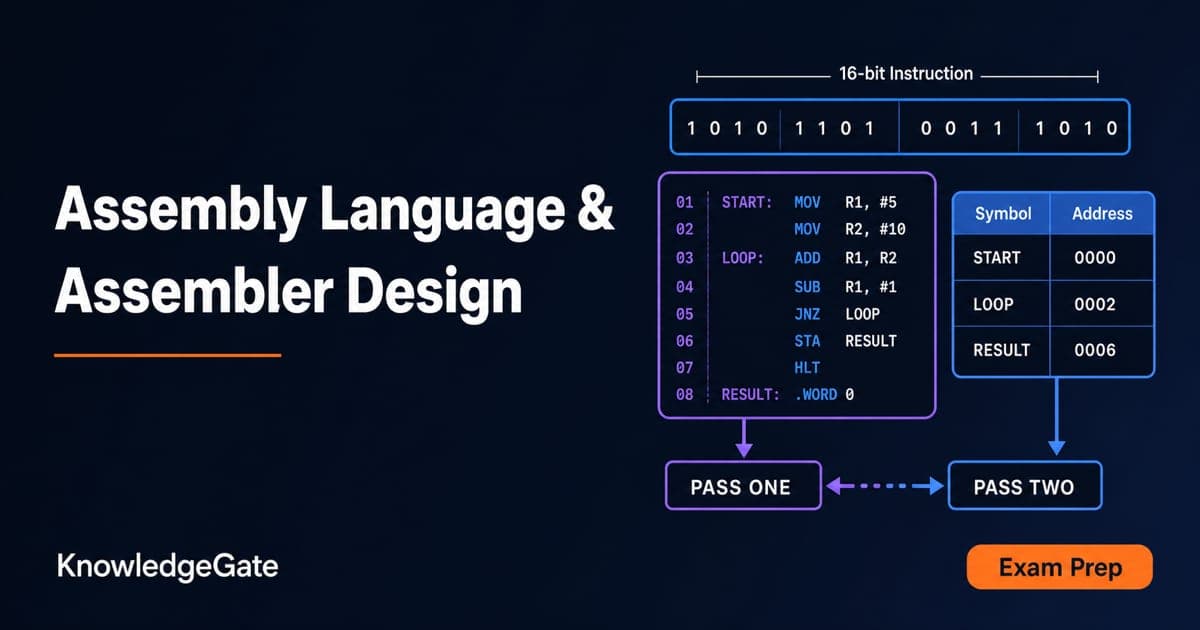
Assembly Language and Assembler Design: Two-Pass Translation with a Complete Worked Example
Follow a 16-bit Basic Computer program through pass one, pass two, hexadecimal encoding and execution, with every symbol, address and result shown.
Updated 15 Oct 20266 min readComputer Organization & Architecture

Programmed I/O: Polling, CPU Utilisation, Worked Examples and GATE Question Patterns
Follow one programmed-input transfer from control write to data read, then calculate how many polls one word costs and what a longer poll period buys.
Updated 7 Oct 20266 min readComputer Organization & Architecture

Multiprocessor Fundamentals: Architecture, Speedup and Worked Examples
Build a clear model of multiprocessor systems, then use it to calculate speedup and efficiency, trace a coherent write, and diagnose a lost update.
Updated 2 Oct 20265 min readComputer Organization & Architecture