Capgemini Recruitment Process and Test Pattern: Fresher Stages Explained
Separate Capgemini's official hiring framework from the details that vary by role. Learn what to verify, how to read an assessment invite, and what evidence to prepare.
KnowledgeGate Team
Exam prep & CS education
Updated 18 Sep 20265 min read95 views
Candidates often find one rigid Capgemini test pattern online, but the actual route can change with the role. Capgemini India itself makes some assessments and round counts role-dependent. This guide separates the official framework from the details you must confirm, then shows how placement preparation courses can support the broad skills involved.
Capgemini recruitment process at a glance
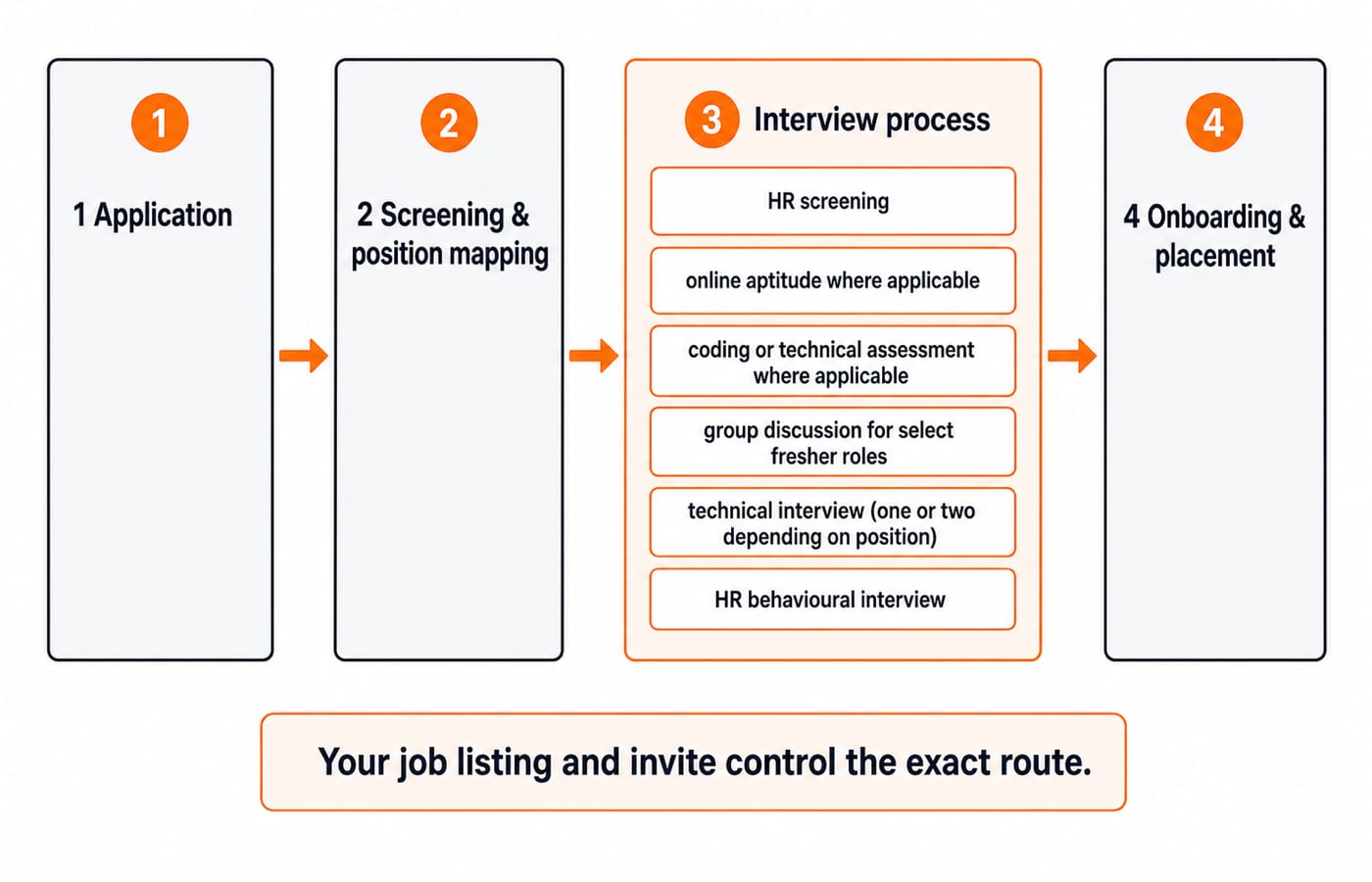
The Capgemini India recruitment-process page gives four top-level steps: application, screening and position mapping, interview process, and onboarding and placement. Its fresher FAQ describes a typical mix of online aptitude, coding or technical assessment, group discussion for select roles, technical interview, and HR interview. “Typical” matters because the route is not identical for every opening.
Official step | What Capgemini India says | What the candidate must verify |
|---|---|---|
Application | Find a role and submit the requested application details | Exact role, location and eligibility stated in that listing |
Screening and position mapping | Qualifications and experience are reviewed, then skills may be mapped to open positions | Assessment sections, time limit and permitted tools |
Interview process | Relevant assessments and interviews are arranged | Interview count, location or video mode |
Onboarding and placement | Portal-led offer, verification and onboarding steps follow | Required documents and the instructions in each message |
Stage 1: Apply against the role, not a generic pattern
Capgemini India directs candidates to roles in its job search. Its application asks for contact information and a current CV, while a cover letter is optional. These general instructions do not create eligibility rules for every role.
Here is an illustrative evidence map, not a Capgemini requirement:
Requirement | Evidence | CV line |
|---|---|---|
Java | 1 Java REST project with 8 endpoints | Built a Java REST service with 8 tested endpoints |
SQL | 1 SQL schema with 6 tables and 5 joins demonstrated | Designed a 6-table schema and demonstrated 5 joins |
Teamwork | 1 four-person project with a stated individual contribution | Delivered the API layer in a four-person project |
Quantified evidence is easier to explain and defend later than a bare list of skills.
Stage 2: Screening and position mapping
According to Capgemini India, the team reviews qualifications and experience, may contact an applicant for clarification, and maps skills to open positions before communicating next steps. This does not imply an automatic cutoff, a fixed response time, or guaranteed mapping to another role.
Prepare three things:
Keep the exact CV version you submitted.
Save the complete role description.
Build a 60-second role-fit summary using
skill -> proof -> relevance, for example:Java -> 8-endpoint REST project -> evidence for backend work.
Stage 3: Decode the test pattern from the invitation
Capgemini India says proctored online technical and language assessments may apply. Its fresher FAQ also describes online aptitude and coding or technical assessment as typical round types. The official guidance does not establish one universal question count, duration, negative-marking rule, or section order, so the invitation controls your working plan.
Consider these illustrative values, not Capgemini's universal pattern. A sample invite has 40 questions in 50 minutes: 16 quantitative, 12 logical reasoning and 12 verbal. It permits section switching, states no negative marking, and reserves 5 minutes for review.
Usable first-pass time:
50 - 5 = 45 minutes.Baseline pace:
45 / 40 = 1.125 minutes = 67.5 seconds per question.Diagnostic score:
12/16 + 8/12 + 6/12 = 26/40 = 65%.
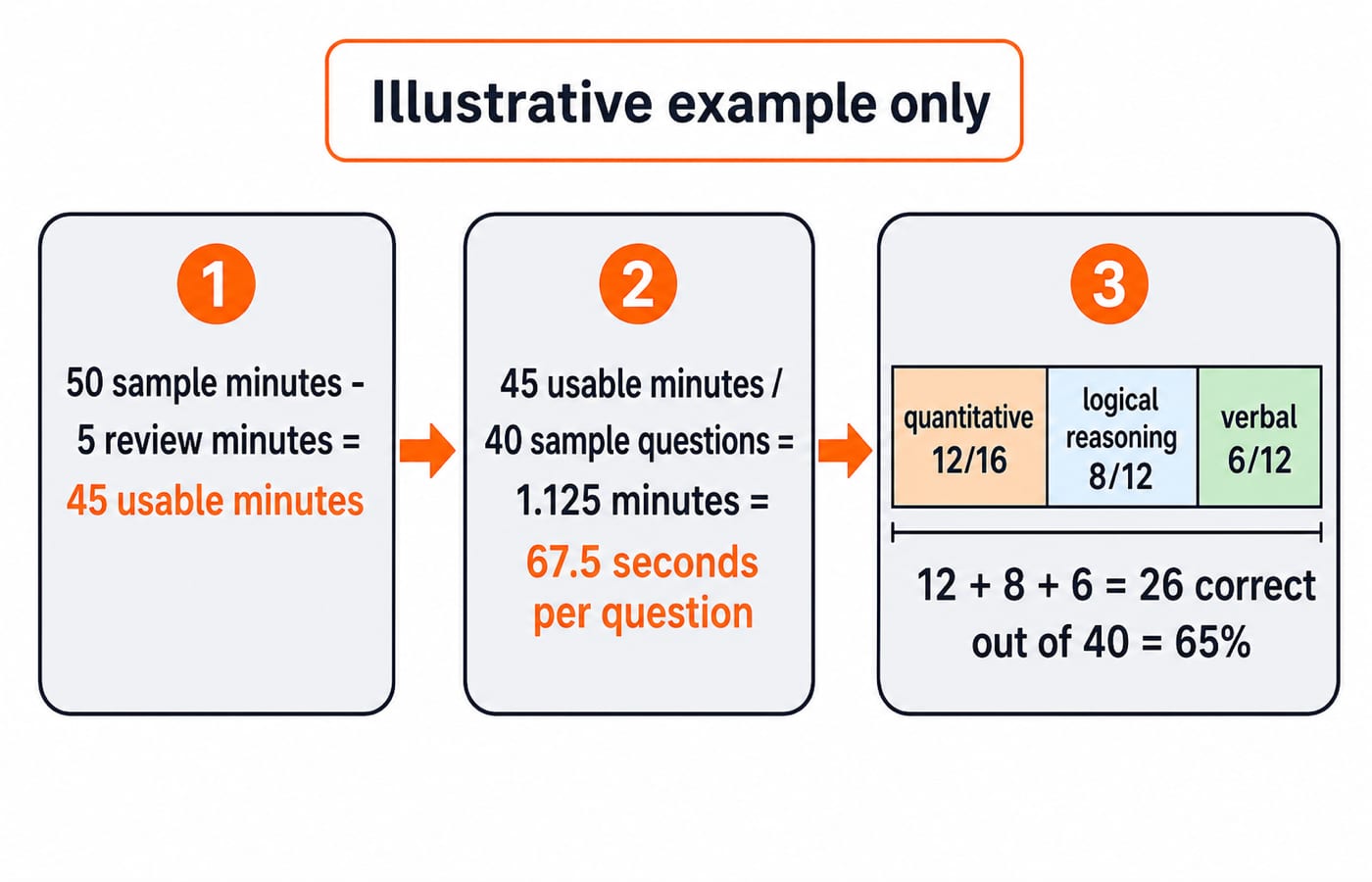
Verbal is the weakest block at 6 out of 12, followed by logical reasoning at 8 out of 12. Give verbal the largest repair block, then logical reasoning, while preserving short quantitative drills.
Preparation resource | Supported coverage | Best use |
|---|---|---|
Capgemini-oriented videos and practice tests | Build company-focused familiarity | |
Aptitude, logical reasoning and verbal ability | Repair the section diagnosed as weakest |
Stage 3 continued: Technical, group discussion, and HR rounds
Capgemini India says a technical interview may be by video or in person, and one or two may be held depending on the position. Its fresher FAQ places group discussion in select roles and describes the HR interview as covering behavioural fit, aspirations and company fit.
Round | What it screens | One proof to prepare | What to verify |
|---|---|---|---|
Technical project | Depth and ownership | Explain the 8-endpoint Java project | Expected stack and interview mode |
Technical problem-solving | Reasoning with code and data | Trace one SQL join across the 6-table schema, then use this project and pseudocode preparation guide | Tools and format |
Group discussion | Structured teamwork and communication | Give one four-person teamwork example using Situation-Task-Action-Result | Whether this round applies |
HR interview | Motivation and role fit | Prepare a 30-second motivation answer tied to the advertised role | Interview count and documents |
Stage 4: Offer, verification, onboarding, and fraud checks
The official sequence covers document submission through the candidate portal, compensation discussion after validations, formal offer and acceptance through the portal, background verification, and onboarding communication. Follow the document request you actually receive rather than a generic checklist.
Capgemini India also says candidates are not asked to pay hiring fees. Official follow-up comes through Capgemini channels, and interview communication is sent through its official ATS or CRM system. Verify suspicious contact against the official recruitment page before sharing personal or financial information.
What changes between drives, and your final verification routine
Use sources in this order:
Your current Capgemini job listing and assessment invite.
Capgemini India's recruitment page or recruiter.
Preparation articles and courses.
An Infosys process may contain familiar round names, but another company's sequence must not be copied onto Capgemini. A comparison of service-based company placement preparation can help you compare skill areas, not claim that the hiring routes are identical.
Before the drive, check six items: role and location, exact sections, duration, navigation and marking rules, proctoring and device requirements, and interview mode or documents.
The short version
Prepare the broad aptitude, technical, project and behavioural layers, but build the final plan from your actual invitation. Use the Capgemini-specific practice plan above when you want company-focused structure, or concentrate on your diagnosed weak section if that is all you need. No preparation resource can guarantee selection.
Keep learning
Accenture Coding Questions: 4 Patterns with Solved Dry Runs
Stop memorising company-question lists. Learn four reusable coding patterns through precise examples involving strings, arrays, digits, and matrices.
Updated 2 Oct 20265 min readCompany-Specific Prep
Accenture Placement Preparation: 4-Week, 56-Hour Study Plan
Turn four preparation lanes into a practical weekly calendar. Start with a baseline, move hours towards your errors, and recover missed sessions without cramming.
Updated 27 Sep 20265 min readCompany-Specific Prep
Capgemini Interview Questions: Technical and HR Rounds with Model Answers
Practise clear technical and HR answers through Java, SQL, a coding trace and one consistent project story. Each example shows what to say and how to support it.
Updated 25 Sep 20265 min readCompany-Specific Prep
Capgemini Drive Mistakes: Stage-by-Stage Rejection Risks and Fixes
Diagnose the controllable evidence gaps behind common Capgemini drive risks. Repair your CV, timed practice, code traces, project proof and behavioural stories with worked drills.
Updated 24 Sep 20266 min readCompany-Specific Prep