Coal India MT CBT Syllabus: General and Discipline Paper Map
Separate the common paper from CS and IT professional knowledge, test your baseline, and turn weak areas into a practical weekly schedule.
KnowledgeGate Team
Exam prep & CS education
Updated 26 Jul 20266 min read
The Coal India MT syllabus is not one revision list. A common general paper sits next to a discipline paper in Computer Science and IT, and the two reward opposite work: wide, fast recall on one side, connected concepts you can trace on paper on the other. Preparing both the same way is why candidates who feel comfortable with aptitude still run out of depth on the technical half. Split them from week one, then let a diagnostic decide which half gets your hours.
Start with the two-paper syllabus map
Each paper asks for a different kind of memory.
Paper | Lanes to cover | What the work looks like | Where candidates lose time |
|---|---|---|---|
Paper I | General Awareness, Reasoning Ability, Numerical Ability, General English | Build breadth, maintain current-fact hygiene, and practise short methods | Stale current-affairs notes, and arithmetic that is accurate but slow |
Paper II | Professional Computer Science and IT knowledge | Learn concepts, trace or calculate small cases, and analyse technical errors | Recognising a concept without being able to trace one small case end to end |
The division of labour matters more than the topic lists. Paper I decays slowly: a fortnight away from current affairs costs you one evening of catching up. Paper II decays the other way, because a cluster you have not traced in six weeks is effectively gone and rebuilding it costs days. That asymmetry should drive your calendar. If you already have GATE-style CS preparation behind you, Coal India MT Systems Preparation Strategy works through how much of it transfers.
Paper I: map four general lanes to concrete practice
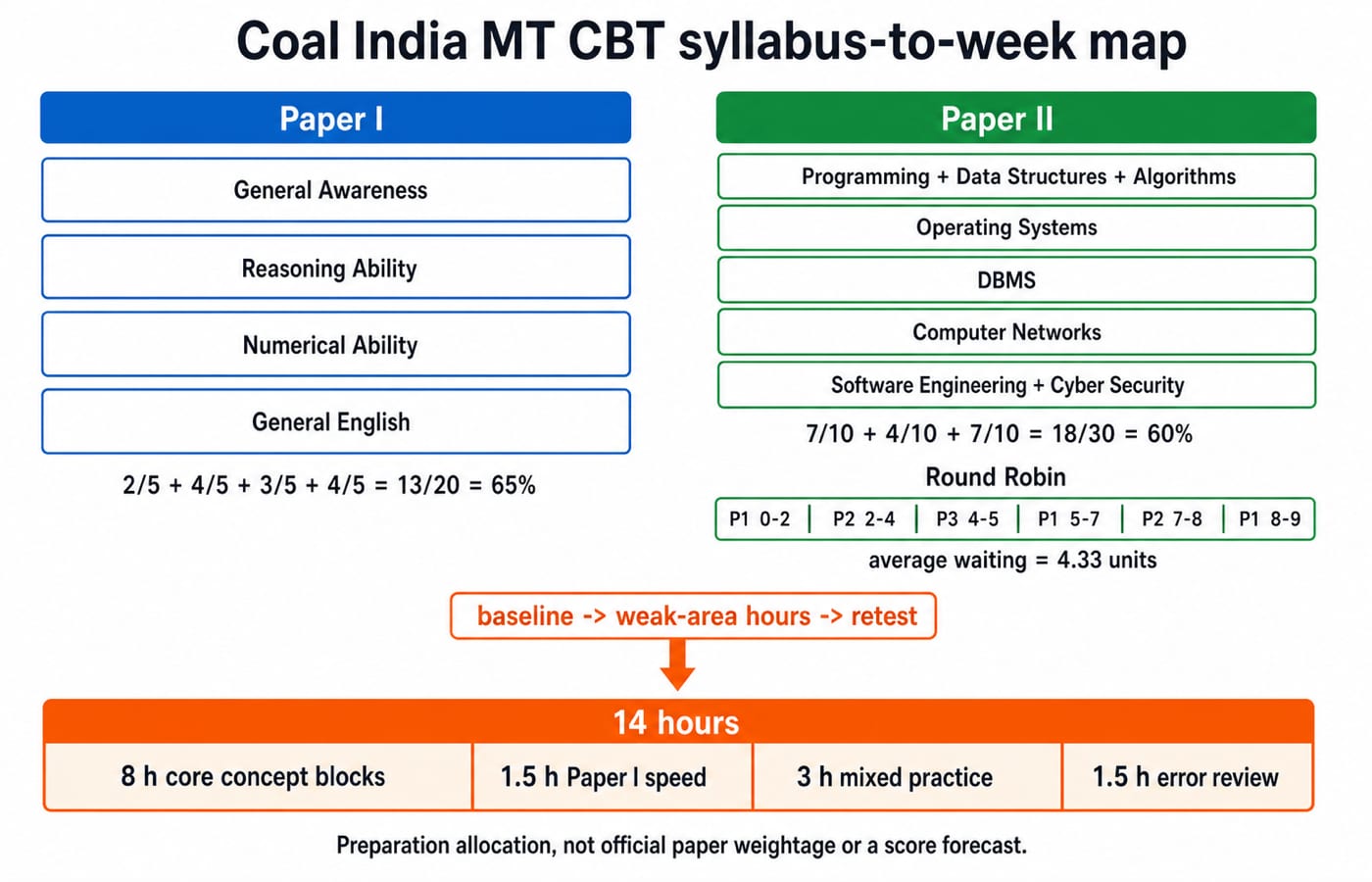
General Awareness: Current affairs, Indian economy, government schemes, awards, sports, and science and technology. Breadth is cheap here and staleness is expensive, so keep a four-column log: fact | source | source date | revision date, and revisit a row once its revision date passes a fortnight.
Reasoning Ability: Practise coding-decoding, series, blood relations, direction sense, logical reasoning, and puzzles. For the series 3, 8, 15, 24, 35, the successive differences are 5, 7, 9, 11. The next difference is 13, so the next term is 35 + 13 = 48.
Numerical Ability: Cover percentage, profit and loss, ratio and proportion, average, time and work, and speed and distance. If a value rises from 240 to 276, the increase is 276 - 240 = 36. Therefore, percentage increase = 36/240 x 100 = 15%.
General English: Work on grammar, vocabulary, comprehension, error detection, and sentence improvement. In Each of the reports is complete, the subject is the singular word Each, so is is correct.
Paper II: turn professional knowledge into five concept clusters
Professional knowledge is far easier to schedule as five clusters than as one subject:
Programming plus data structures and algorithms
Operating systems
Database management systems
Computer networks
Software engineering plus cyber security
For each cluster, train at three depths: recall the definition, trace or calculate a small case, then solve a timed mixed question. A cluster counts as done only at depth three, cold. Having read operating systems and being able to schedule three processes on paper are different states. For a worked example of auditing CS coverage cluster by cluster, the IBPS SO IT Officer Professional Knowledge topic map runs the same exercise on a different exam.
Operating systems is where that second depth pays off fastest. Three processes arrive at time 0: P1 = 5, P2 = 3, and P3 = 1 burst units. With Round Robin quantum 2, the order is P1 0-2 | P2 2-4 | P3 4-5 | P1 5-7 | P2 7-8 | P1 8-9. Completion times for P1, P2, and P3 are 9, 8, 5. Since every arrival is 0, waiting time is completion time minus burst time: 9 - 5 = 4, 8 - 3 = 5, and 5 - 1 = 4. Average waiting time = (4 + 5 + 4)/3 = 13/3 = 4.33 units. If you can rebuild that timeline without notes, the cluster is at depth two; inside ninety seconds, depth three.
Use a baseline diagnostic to decide depth
Before you allocate a single study hour, sit a 50-question diagnostic: 20 from Paper I and 30 from Paper II. The output you want is not a score, it is the identity of the two weakest blocks.
Suppose Paper I gives General Awareness 2/5, Reasoning 4/5, Numerical 3/5, and English 4/5. The total is 2 + 4 + 3 + 4 = 13/20 = 65%. In Paper II, suppose Programming/Data Structures is 7/10, Operating Systems/Networks is 4/10, and DBMS/Software Engineering/Cyber Security is 7/10. The total is 7 + 4 + 7 = 18/30 = 60%.
The first repair block is Operating Systems/Networks at 4/10 = 40%; General Awareness follows, also at 2/5 = 40%. Give the technical block concept-repair time and the awareness block source-based recall time. Two blocks is the ceiling: attacking four at once repairs none, and the diagnostic reads the same a month later.
Convert the map into a realistic 14-hour week
One week you can actually repeat beats a twelve-week plan abandoned in week three:
Day | Work |
|---|---|
Monday |
|
Tuesday |
|
Wednesday |
|
Thursday |
|
Friday |
|
Saturday |
|
Sunday |
|
The total is 2 + 2 + 2 + 2 + 1.5 + 3 + 1.5 = 14 hours. Of those, 7.5 sit on Paper II, 4.5 on Paper I, and 2 on shared review and repair, which mirrors how fast each side decays. If you miss a day, preserve Saturday's mixed block and Sunday's repair block, and move the missed concept session into the next week rather than doubling the next day. For sequenced coverage, use the Coal India MT complete course as the organising path.
Log every practice set by paper and topic
An error-log row should capture paper | topic | attempted | correct | error type | repair action | retest date. For example:
Paper II | Operating Systems | 20 | 12 | 5 concept errors + 3 rushed errors | revisit scheduling and redo misses | next Sunday
Initial accuracy is 12/20 x 100 = 60%. After revision, an 8/10 retest gives 8/10 x 100 = 80%. Retest on a fresh set of the same size, never on the questions you just reviewed, or the number only measures memory of the answer key.
Our Coal India MT test series runs 4 Paper I unit tests, 9 Paper II unit tests, and 3 full-length mock tests, leaning towards professional knowledge for the same reason your week does. Use the Coal India MT test series once a fortnight of error logs is behind you, so a timed set measures something real.
Check the notification, then start week one
Marks, question counts, duration, negative marking, eligibility and the discipline list move between recruitment cycles, so read the latest CIL recruitment notice before you fix a target score or an end date for your timetable. A topic map survives those changes; the numbers attached to it do not.
The short version is simple: map both papers, run the 20 + 30 diagnostic, spend the next week's hours on the two weakest blocks, and retest. The Coal India MT category keeps the relevant course and practice options together.
Keep learning

Coal India MT Mock Analysis: Manage Both Papers as One Exam
A combined mock score can hide which paper cost you marks. Use this worked two-paper scorecard to test section order, diagnose errors and plan the next retest.
Updated 12 Aug 20265 min read54 viewsCoal India MT

Coal India MT PYQ Analysis: Balance Paper I and Professional Knowledge
A combined Coal India MT score hides which paper is weak. Score Paper I and professional knowledge separately, classify every miss by cause, and rebalance the week from that.
Updated 10 Aug 20265 min read245 viewsCoal India MT

Coal India MT Cutoffs: Qualifying Marks vs Merit List
Learn why clearing Coal India MT's paper-wise minimum does not guarantee selection. Read the 2026 System rules in order with a worked merit example.
Updated 8 Aug 20265 min read321 viewsCoal India MT

Coal India MT Numerical Ability: Ratios, Percentages and a Worked DI Set
Learn how ratio parts, percentage bases, and table reading work together. Includes checked examples, conversion shortcuts, common traps, and a 30-minute drill.
Updated 5 Aug 20266 min readCoal India MT