

Clustering and Worker Threads in Node.js: Runnable Examples and a Decision Guide
Learn when Node.js needs Cluster, Worker Threads, or only asynchronous I/O. The examples include guarded CPU routes, a bounded pool, and measurement guidance.
KnowledgeGate Team
Exam prep & CS education
Updated 21 Nov 20266 min read

Your Node.js server can handle many network requests, then freeze when one route starts a large CPU calculation. Synchronous JavaScript has occupied the main event loop. Cluster suits process-level HTTP serving, Worker Threads suit CPU-heavy JavaScript, and ordinary asynchronous I/O suits waiting on databases or networks.
Node.js clustering and Worker Threads solve different bottlenecks
One Node.js process has one main JavaScript thread. Asynchronous I/O can overlap, but synchronous CPU work blocks it.
The Node.js API documentation describes Cluster processes sharing a port, each with its own heap and event loop. Worker Threads run inside one process. The Node.js Architecture Tutorial traces V8/libuv and fib(40) blocking. fib(45) then compares one process, four Cluster workers and a bounded two-thread pool. Study further through Free Courses & Guidance by Prashant Sir.
Workload | Start with |
|---|---|
Mostly database or network I/O | Asynchronous I/O |
More HTTP-serving processes and process isolation | Cluster |
CPU-heavy JavaScript inside a request | Worker pool |
Both process scale and CPU jobs | Carefully sized hybrid |
A single-process Node.js server shows the blocking problem
Create single-server.mjs. Its guard limits input to integers from 0 through 45.
import http from 'node:http';

function fib(n) {
  return n < 2 ? n : fib(n - 1) + fib(n - 2);
}

function readN(url) {
  const raw = url.searchParams.get('n');
  const n = Number(raw);
  return raw !== null && Number.isInteger(n) && n >= 0 && n <= 45 ? n : null;
}

http.createServer((req, res) => {
  const url = new URL(req.url, 'http://localhost');
  res.setHeader('content-type', 'application/json');
  if (url.pathname === '/health') return res.end('{"ok":true}');
  if (url.pathname !== '/fib') { res.statusCode = 404; return res.end('{"error":"Not found"}'); }
  const n = readN(url);
  if (n === null) { res.statusCode = 400; return res.end('{"error":"n must be an integer from 0 to 45"}'); }
  res.end(JSON.stringify({ n, result: fib(n) }));
}).listen(3000);
Run node single-server.mjs. While timing curl 'http://localhost:3000/fib?n=45', call curl http://localhost:3000/health in another terminal. The recurrence returns 1,134,903,170, but /health waits because the recursive handler never yields. Record your own machine-dependent timing.
Node.js Cluster example: four processes sharing port 3000
Save this as cluster-server.mjs:
import cluster from 'node:cluster';
import http from 'node:http';
import process from 'node:process';

const WORKER_COUNT = 4;
const fib = n => n < 2 ? n : fib(n - 1) + fib(n - 2);
const readN = url => {
  const raw = url.searchParams.get('n');
  const n = Number(raw);
  return raw !== null && Number.isInteger(n) && n >= 0 && n <= 45 ? n : null;
};

if (cluster.isPrimary) {
  for (let i = 0; i < WORKER_COUNT; i++) cluster.fork();
  cluster.on('exit', (worker, code, signal) =>
    console.log(`Worker ${worker.process.pid} exited`, { code, signal }));
} else {
  http.createServer((req, res) => {
    const url = new URL(req.url, 'http://localhost');
    res.setHeader('content-type', 'application/json');
    if (url.pathname === '/pid') return res.end(JSON.stringify({ pid: process.pid, workerId: cluster.worker.id }));
    if (url.pathname === '/health') return res.end('{"ok":true}');
    if (url.pathname !== '/fib') { res.statusCode = 404; return res.end('{"error":"Not found"}'); }
    const n = readN(url);
    if (n === null) { res.statusCode = 400; return res.end('{"error":"n must be an integer from 0 to 45"}'); }
    res.end(JSON.stringify({ n, result: fib(n), pid: process.pid }));
  }).listen(3000);
}
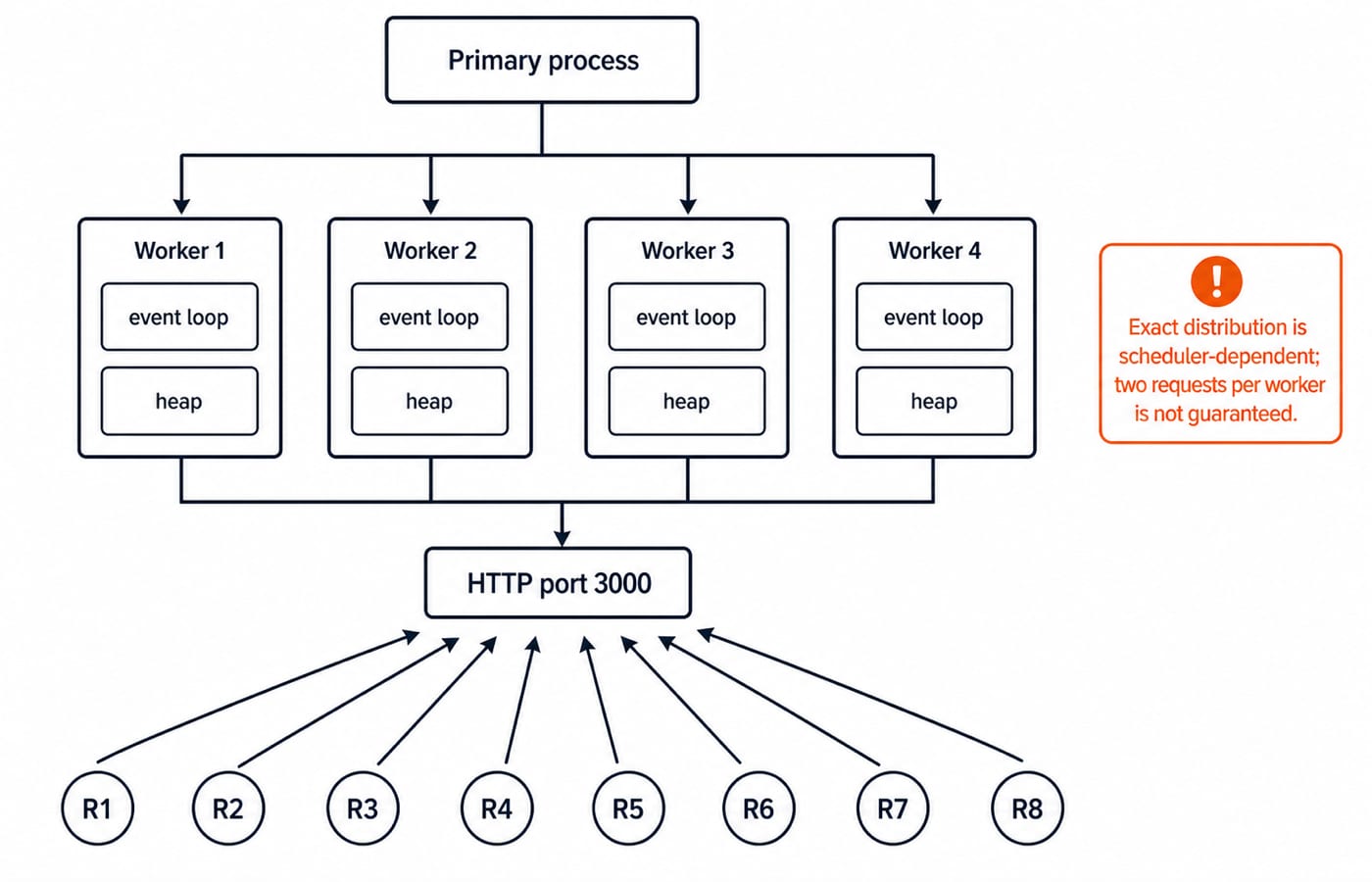
The primary forks four processes. Each child creates a server on the shared logical port. /pid exposes its process and Cluster identifiers.
Start it with node cluster-server.mjs, then make eight fresh connections:
for i in {1..8}; do curl -s -H 'Connection: close' http://localhost:3000/pid; echo; doneFresh connections can show multiple PIDs, but their distribution is scheduler-dependent. /fib?n=45 still blocks its selected worker; only another idle process can answer /health. Cluster adds serving capacity and isolation, while process heaps remain separate.
Node.js Worker Threads example: a two-thread Fibonacci pool
Worker Threads move CPU work off the main event loop. Create fib-worker.mjs:
import { parentPort } from 'node:worker_threads';

const fib = n => n < 2 ? n : fib(n - 1) + fib(n - 2);
parentPort.on('message', ({ jobId, n }) => {
  parentPort.postMessage({ jobId, n, result: fib(n) });
});
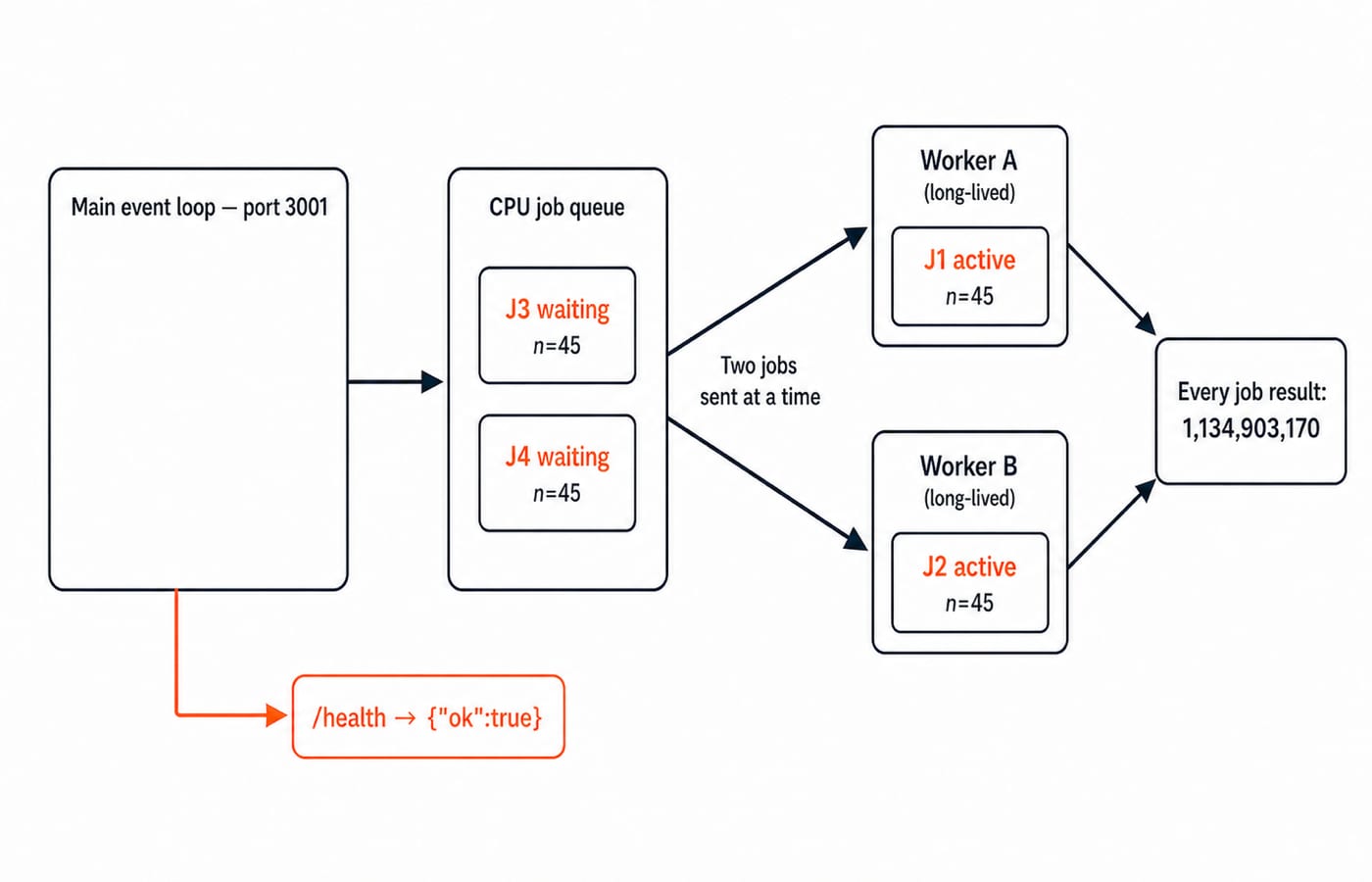
Create worker-pool.mjs with two long-lived workers and an eight-job queue:
import { Worker } from 'node:worker_threads';

export class QueueFullError extends Error {}

export class WorkerPool {
  constructor(size = 2, maxQueue = 8) {
    this.slots = [];
    this.queue = [];
    this.maxQueue = maxQueue;
    this.nextId = 1;
    for (let i = 0; i < size; i++) this.spawn();
  }

  spawn() {
    const slot = { worker: new Worker(new URL('./fib-worker.mjs', import.meta.url)), job: null, failed: false };
    this.slots.push(slot);
    slot.worker.on('message', message => {
      const job = slot.job;
      if (!job || message.jobId !== job.jobId) return;
      slot.job = null;
      job.resolve(message);
      this.drain();
    });
    slot.worker.once('error', error => this.fail(slot, error));
    slot.worker.once('exit', code =>
      this.fail(slot, new Error(`Worker exited with code ${code}`)));
  }

  fail(slot, error) {
    if (slot.failed) return;
    slot.failed = true;
    if (slot.job) slot.job.reject(error);
    this.slots = this.slots.filter(item => item !== slot);
    setTimeout(() => { this.spawn(); this.drain(); }, 1000);
  }

  run(n) {
    return new Promise((resolve, reject) => {
      const job = { jobId: `J${this.nextId++}`, n, resolve, reject };
      const idle = this.slots.find(slot => !slot.job && !slot.failed);
      if (idle) return this.assign(idle, job);
      if (this.queue.length >= this.maxQueue) return reject(new QueueFullError('CPU queue full'));
      this.queue.push(job);
    });
  }

  assign(slot, job) { slot.job = job; slot.worker.postMessage({ jobId: job.jobId, n: job.n }); }
  drain() {
    for (const slot of this.slots) {
      if (!this.queue.length) break;
      if (!slot.job && !slot.failed) this.assign(slot, this.queue.shift());
    }
  }
}
run() uses an idle slot or queues the job. jobId matches responses to promises. A failed worker rejects its active job and is replaced after one second, avoiding a tight restart loop.
Create worker-server.mjs:
import http from 'node:http';
import { QueueFullError, WorkerPool } from './worker-pool.mjs';

const pool = new WorkerPool(2, 8);
http.createServer(async (req, res) => {
  const url = new URL(req.url, 'http://localhost');
  res.setHeader('content-type', 'application/json');
  if (url.pathname === '/health') return res.end('{"ok":true}');
  const raw = url.searchParams.get('n');
  const n = Number(raw);
  if (url.pathname !== '/fib') { res.statusCode = 404; return res.end('{"error":"Not found"}'); }
  if (raw === null || !Number.isInteger(n) || n < 0 || n > 45) {
    res.statusCode = 400; return res.end('{"error":"n must be an integer from 0 to 45"}');
  }
  try {
    res.end(JSON.stringify(await pool.run(n)));
  } catch (error) {
    res.statusCode = error instanceof QueueFullError ? 503 : 500;
    res.end(JSON.stringify({ error: error instanceof QueueFullError ? 'CPU queue full' : 'CPU job failed' }));
  }
}).listen(3001);
Run node worker-server.mjs, then submit four jobs in parallel:
seq 4 | xargs -P4 -I{} curl -s 'http://localhost:3001/fib?n=45'Two jobs start and 4 - 2 = 2 wait. All return 1,134,903,170; assignment may vary. /health stays responsive. After eight jobs wait, the next receives HTTP 503 with {"error":"CPU queue full"}. This backpressure prevents an unbounded queue. Measure timings on your machine.
Cluster versus Worker Threads: choose with resource arithmetic
Cluster workers have separate memory and use IPC. Worker Threads share a process. Neither makes unbounded work safe.
On an eight-CPU host, two processes with three CPU workers each permit 2 x 3 = 6 CPU jobs. Four with four create 4 x 4 = 16 workers before main threads, oversubscribing the host. Set production counts from load tests, memory, and queue latency.
Node.js concurrency traps and their fixes
Cluster for one CPU request: the process still blocks. Use a Worker pool.
One Worker per request: concurrency becomes uncontrolled. Reuse workers.
CPU-count workers per process: budget the total to avoid oversubscription.
In-memory Cluster sessions: use an external store for shared state.
Ignored Worker failure: reject or deliberately retry affected jobs.
Immediate process replacement: prevent restart storms with backoff and supervision.
Eight /pid calls are not a benchmark. Measure throughput, tail latency, event-loop lag, CPU, memory, queue depth, and rejections. The Threads & Process Creation MCQs reinforce the distinction.
Node.js Cluster and Worker Threads questions in interviews and assessments
Choose from the bottleneck, not the word concurrency:
10,000 mostly waiting network operations: start with asynchronous I/O.
Independent HTTP-serving processes on one port: use Cluster.
Four
fib(45)jobs with a responsive main loop: use a Worker pool.One large typed-array backing store shared deliberately: consider Worker Threads with controlled shared memory.
With pool size 2, two jobs start and two wait. Cluster does not shorten one Fibonacci call. Node.js Interview Questions for Freshers combines event-loop, streams, clustering and Express questions; these scenarios isolate the Cluster-versus-Worker choice.
Node.js concurrency checklist and the next step
Keep asynchronous I/O on the event loop. Use Cluster for serving processes and a bounded Worker pool for CPU work. Combine them only after budgeting resources.
Run all three servers and compare /health. For wider study, continue with the Node.js, Express.js & MongoDB Course.
Keep learning

Testing APIs in Node.js: Jest and Supertest Tutorial with Runnable Examples
Build a small Express task API and test its routes, validation, headers, JSON responses and state changes without opening a fixed server port.
Updated 25 Nov 20266 min readWeb Development

Sessions and Cookies in Node.js: A Runnable Express Login Tutorial
Build the complete localhost flow, then trace what the browser sends, what Express stores, and why logout makes the dashboard anonymous again.
Updated 24 Nov 20266 min readWeb Development

Node.js Security Best Practices: Harden an Express API with Runnable Examples
Build and test a small Express transfer API that layers authentication, strict Zod validation, authorisation, rate limiting, safe errors and dependency hygiene.
Updated 23 Nov 20266 min readWeb Development

File Uploads in Node.js: Multer, Validation and Runnable Examples
Build and test single-file and multi-file uploads in Express. The example covers Multer disk storage, strict limits, predictable error JSON and safer production boundaries.
Updated 22 Nov 20266 min readWeb Development