Congestion Control Policy MCQs: 11 Solved Questions with Explanations
Work through 11 published congestion-control questions covering TCP window growth, timeout recovery, AIMD and token-bucket calculations, with every step shown.
KnowledgeGate Team
Exam prep & CS education
Updated 21 Sep 20268 min read
TCP congestion-control questions become difficult when per-ACK growth, per-RTT growth, timeout recovery, receiver-window caps, and token-bucket drain rates are mixed together. Treat each event as a state change: update the window or token balance, apply the relevant cap, and only then advance the clock. A broader Computer Networks route is available in the GATE CS Exam Preparation map.
Congestion control policy: separate the four ideas first
cwnd limits the sender's in-flight data for congestion control; the advertised receive window independently caps that data for receiver-side flow control. ssthresh marks the boundary between exponential slow start and additive congestion avoidance.
Under the textbook timeout model used here, a timeout halves the old window to set ssthresh and resets cwnd to 1 MSS. A token bucket drains at peak rate - refill rate during a full-rate burst. TCP and UDP behave differently here.
Slow start, TCP versus UDP, and congestion policy concepts
Question 1: What actually doubles in slow start?
Consider the following statements regarding the slow start phase of the TCP congestion control algorithm. Note that cwnd stands for the TCP congestion window and MSS denotes the Maximum Segment Size.
(i) The cwnd increases by 2 MSS on every successful acknowledgment.
(ii) The cwnd approximately doubles on every successful acknowledgement.
(iii) The cwnd increases by 1 MSS every round trip time.
(iv) The cwnd approximately doubles every round trip time.
Which one of the following is correct?
A. Only (ii) and (iii) are true
B. Only (i) and (iii) are true
C. Only (iv) is true
D. Only (i) and (iv) are true
Answer: C. Only (iv) is true. Each ACK adds roughly 1 MSS, so a window's ACKs approximately double cwnd over one RTT. Doubling per ACK is false, while +1 MSS per RTT is additive growth. Practise Question 1.
Question 2: Recognise exponential growth
In the slow start phase of the TCP congestion control algorithm, the size of the congestion window
A. does not increase
B. increases linearly
C. increases quadratically
D. increases exponentially
Answer: D. increases exponentially. The idealised RTT sequence is 1, 2, 4, 8 MSS. At the threshold or after loss changes the state, the textbook model switches to approximately linear congestion avoidance. Practise Question 2.
Question 3: Do not assign TCP controls to UDP
Consider the following two statements:
S1 : TCP handles both congestion and flow control
S2 : UDP handles congestion but not flow control
Which of the following options is correct with respect to the above statements (S1) and (S2)?
Choose the correct answer from the code given below:
A. Neither S1 nor S2 is correct
B. S1 is not correct but S2 is correct
C. S1 is correct but S2 is not correct
D. Both, S1 and S2 are correct
Answer: C. S1 is correct but S2 is not correct. TCP provides both controls, while UDP provides neither. An application can add controls above UDP, but they are not UDP features. Practise Question 3.
Question 4: Keep flow control and network congestion policy separate
Which of the following is not a congestion policy at network layer?
A. Flow Control Policy
B. Packet Discard Policy
C. Packet Lifetime Management Policy
D. Routing Algorithm
Answer: A. Flow Control Policy. Flow control matches sender output to receiver capacity. The other choices can affect overloaded paths or queued traffic, so identify the layer and purpose first. Practise Question 4.
Congestion-window calculations: ACKs, RTTs, and the receiver cap
Question 5: Two ACKs during slow start
Suppose that the maximum transmit window size for a TCP connection is 12000 bytes. Each packet consists of 2000 bytes. At some point of time, the connection is in slow-start phase with a current transmit window of 4000 bytes. Subsequently, the transmitter receives two acknowledgements. Assume that no packets are lost and there are no time-outs. What is the maximum possible value of the current transmit window?
A. 4000 bytes
B. 8000 bytes
C. 10000 bytes
D. 12000 bytes
Answer: B. 8000 bytes. Two ACKs add 2 × 2000 = 4000 bytes, so 4000 + 4000 = 8000 bytes. The 12000-byte maximum is a cap, not the next value. Practise Question 5.
Question 6: Count RTTs before switching growth modes
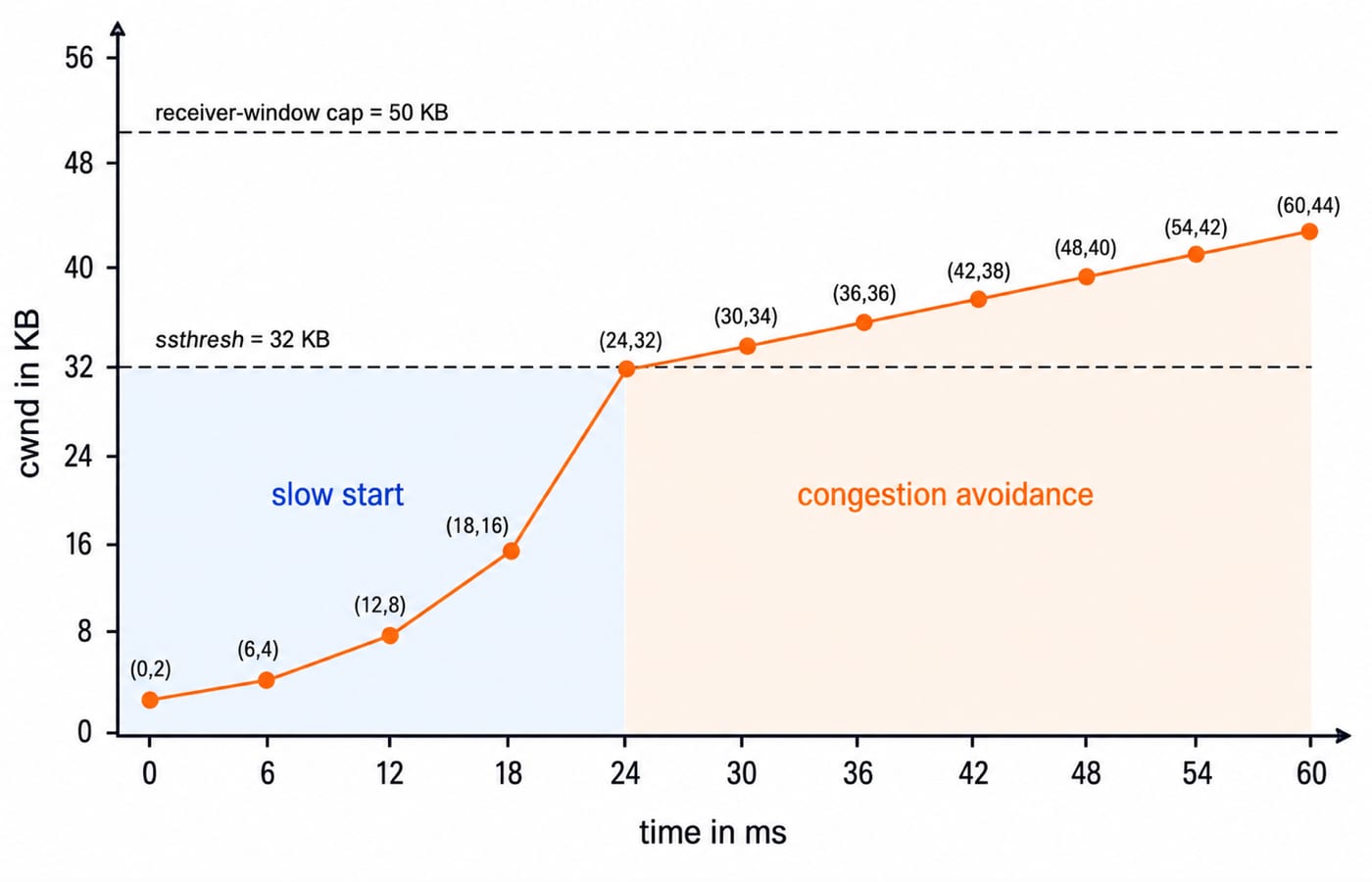
Consider a TCP connection between a client and a server with the following specifications; the round trip time is 6 ms, the size of the receiver advertised window is 50 KB, slow-start threshold at the client is 32 KB, and the maximum segment size is 2 KB. The connection is established at time t=0. Assume that there are no timeouts and errors during transmission. Then the size of the congestion window (in KB) at time t+60 ms after all acknowledgements are processed is _________ .
Answer: 44 KB. 60 / 6 = 10 RTTs; slow start reaches 32 KB from 2 KB after four RTTs. The remaining six RTTs add 6 × 2 = 12 KB, giving 32 + 12 = 44 KB. Since 44 < 50, the receiver cap does not bind. Practise Question 6.
Question 7: Read “during the third RTT” carefully
Consider a TCP connection operating at a point of time with the congestion window of size 12 MSS (Maximum Segment Size), when a timeout occurs due to packet loss. Assuming that all the segments transmitted in the next two RTTs (Round Trip Time) are acknowledged correctly, the congestion window size (in MSS) during the third RTT will be _________
Answer: 4 MSS. The timeout gives ssthresh = 12 / 2 = 6 MSS and resets cwnd to 1 MSS. It becomes 2 after one RTT and 4 after two, so the third RTT starts at 4 MSS. Practise Question 7.
Timeout recovery and AIMD calculations
Question 8: Time needed to regain the old window
Let the size of congestion window of a TCP connection be 32 KB when a timeout occurs. The round trip time of the connection is 100 msec and the maximum segment size used is 2 KB. The time taken (in msec) by the TCP connection to get back to 32 KB congestion window is _________.
Answer: 1100 msec. 32 / 2 = 16 MSS; after timeout, ssthresh = 8 MSS and cwnd = 1 MSS. Reaching 8 MSS takes three RTTs, and additive growth to 16 takes eight more, so (3 + 8) × 100 = 1100 msec. Practise Question 8.
Question 9: Track a timeout against transmission numbers
Consider an instance of TCP’s Additive Increase Multiplicative Decrease (AIMD) algorithm where the window size at the start of the slow start phase is 2 MSS and the threshold at the start of the first transmission is 8 MSS. Assume that a timeout occurs during the fifth transmission. Find the congestion window size at the end of the tenth transmission.
A. 8 MSS
B. 14 MSS
C. 7 MSS
D. 12 MSS
Answer: C. 7 MSS. End values for transmissions 1 to 4 are 4, 8, 9, 10. Transmission 5 resets cwnd to 1 and sets ssthresh = 10 / 2 = 5; transmissions 6 to 10 end at 2, 4, 5, 6, 7. Practise Question 9.
Token-bucket calculations: subtract the refill rate
Question 10: Full-rate burst duration
A Computer on a 10Mbps network is regulated by a token bucket. The token bucket is filled at a rate of 2Mbps. It is initially filled to capacity with 16 megabits. What is the maximum duration for which the computer can transmit at the full 10Mbps?
A. 1.6 seconds
B. 2 seconds
C. 5 seconds
D. 8 seconds
Answer: B. 2 seconds. Tokens arrive while data leaves, so net drain is 10 - 2 = 8 Mbps. Therefore 16 megabits / 8 Mbps = 2 seconds; 1.6 seconds ignores refill. Practise Question 10.
Question 11: Burst first, then sustained output
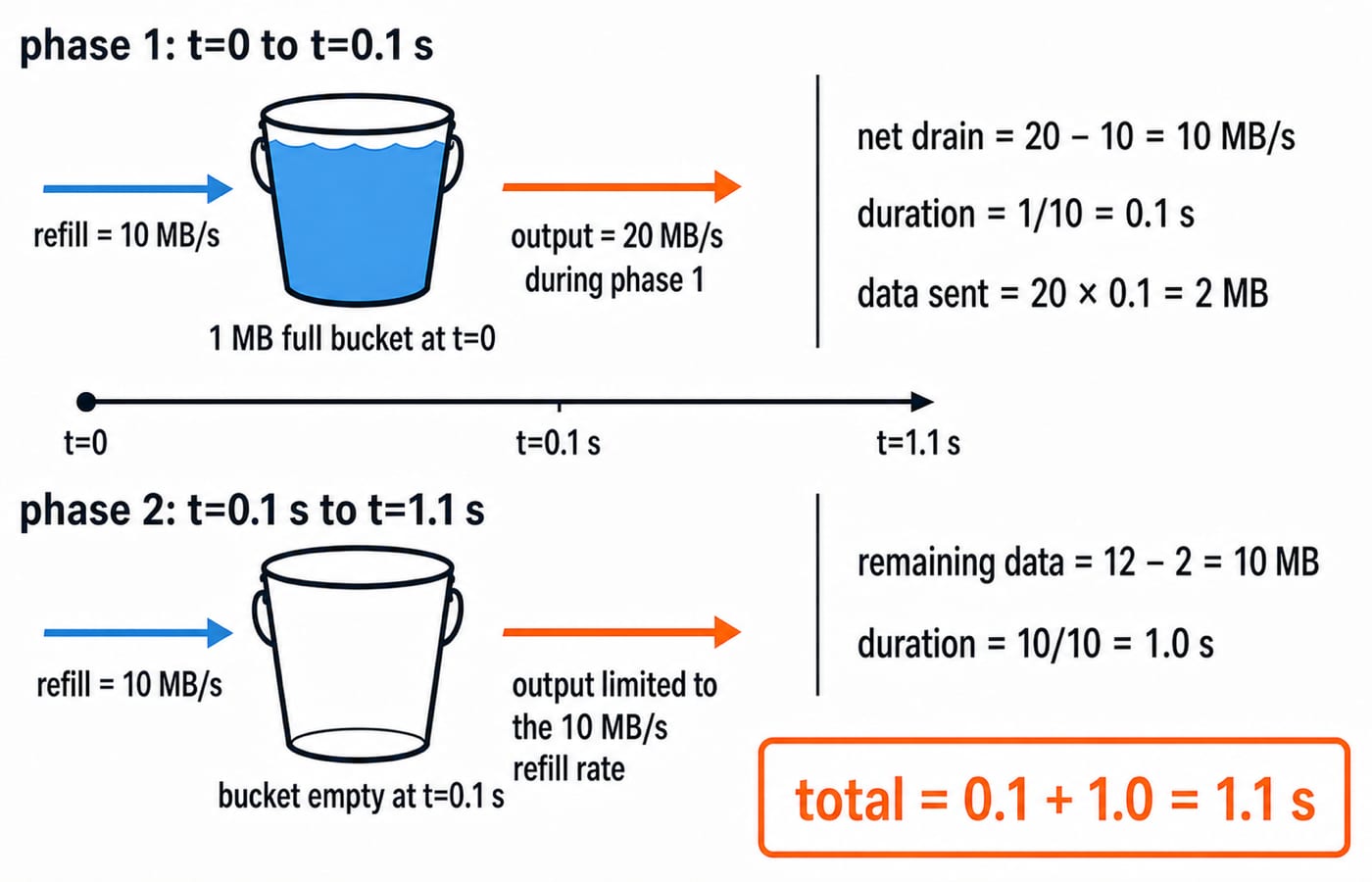
For a host machine that uses the token bucket algorithm for congestion control, the token bucket has a capacity of 1 megabyte and the maximum output rate is 20 megabytes per second. Tokens arrive at a rate to sustain output at a rate of 10 megabytes per second. The token bucket is currently full and the machine needs to send 12 megabytes of data. The minimum time required to transmit the data is ________ seconds.
Answer: 1.1 seconds. Net drain is 20 - 10 = 10 MB/s, so the 1 MB bucket lasts 0.1 s and permits 20 × 0.1 = 2 MB. The remaining 10 MB needs 10 / 10 = 1.0 s, giving 0.1 + 1.0 = 1.1 s. Practise Question 11.
Congestion control policy: five traps to revise
Revise these five corrections:
Doubling per ACK → approximately doubling per RTT.
Adding refill to consumption → subtracting refill from peak output.
Treating the receive window as the next
cwnd→ using it only as a cap.Forgetting the timeout reset → recomputing
ssthreshand restarting.Confusing the start and end of an RTT or transmission → writing a small table.
The IETF's RFC 5681 defines the standard TCP terms slow start, congestion avoidance, cwnd, and ssthresh. Actual TCP implementations can vary in their initial windows and loss handling. Token-bucket shaping is a separate traffic-control model.
Check units, elapsed RTTs, the phase boundary, and the cap, in that order. Keep megabits/Mbps in Question 10 separate from MB/MB/s in Question 11.
Congestion control MCQs: the short version and next step
Slow start is exponential across RTTs, congestion avoidance is additive here, timeouts change the threshold and window, and token-bucket bursts drain at peak minus refill. Redo all 11 questions without the working.
Use GATE Guidance by Sanchit Sir for structured Computer Networks study, the GATE Test Series for timed practice, or Computer Networks application-layer MCQs for the next layer.
Choose the weakest group, solve three more questions, and write the cwnd or token balance after every event before checking the answer.
Keep learning
Computer Networks Basics & Criteria MCQs: 12 Solved Questions with Explanations
Solve 12 Computer Networks questions, then use clear explanations and worked criteria checks to separate similar terms confidently.
3 Oct 20268 min readComputer Networks MCQs
TCP Timers, RTT Estimation & SWS: 10 Solved MCQs and NATs
Solve 10 TCP exam questions covering timer roles, Silly Window Syndrome, recursive RTT estimates, Jacobson/Karels RTO and Karn's rule.
Updated 28 Sep 20267 min readComputer Networks MCQs
RSA Algorithm MCQs: 12 Solved Questions with Step-by-Step Explanations
Practise RSA key generation, modular inverses, encryption, signatures and defining equations, with concise working for conceptual and numerical answers.
25 Sep 20268 min readComputer Networks MCQs
Firewall, VPN, IDS and IPS MCQs: 11 Network Security Questions Solved
Solve 11 previous-year questions on firewalls, VPNs, IDS and IPS. Learn rule filtering, connection state, DMZ design, IPsec modes, tunnels and signatures.
Updated 24 Sep 20267 min readComputer Networks MCQs