

Basics & Delay Analysis MCQs: 11 Solved Flow-Control Questions with Explanations
Work through 11 flow-control and network-delay problems using formulas, unit conversions and timelines for transmission, propagation, RTT and router links.
KnowledgeGate Team
Exam prep & CS education
Updated 11 Nov 20267 min read

Delay questions become error-prone when one stem mixes frame size, data rate, distance, signal speed, RTT and router count. Flow-control questions add another choice: must the sender wait, or may it keep a window of data in flight? Name the event first: sender finish, first-bit arrival, last-bit arrival or a full Stop-and-Wait cycle. Use the individual solved pages for Questions 1, 2 and 11; for Questions 3-10, continue in the Computer Networks learn module. GATE CS Exam Preparation Courses & Test Series includes Basics & Delay Analysis in a structured GATE route.
1. Basics & Delay Analysis formula map before the questions
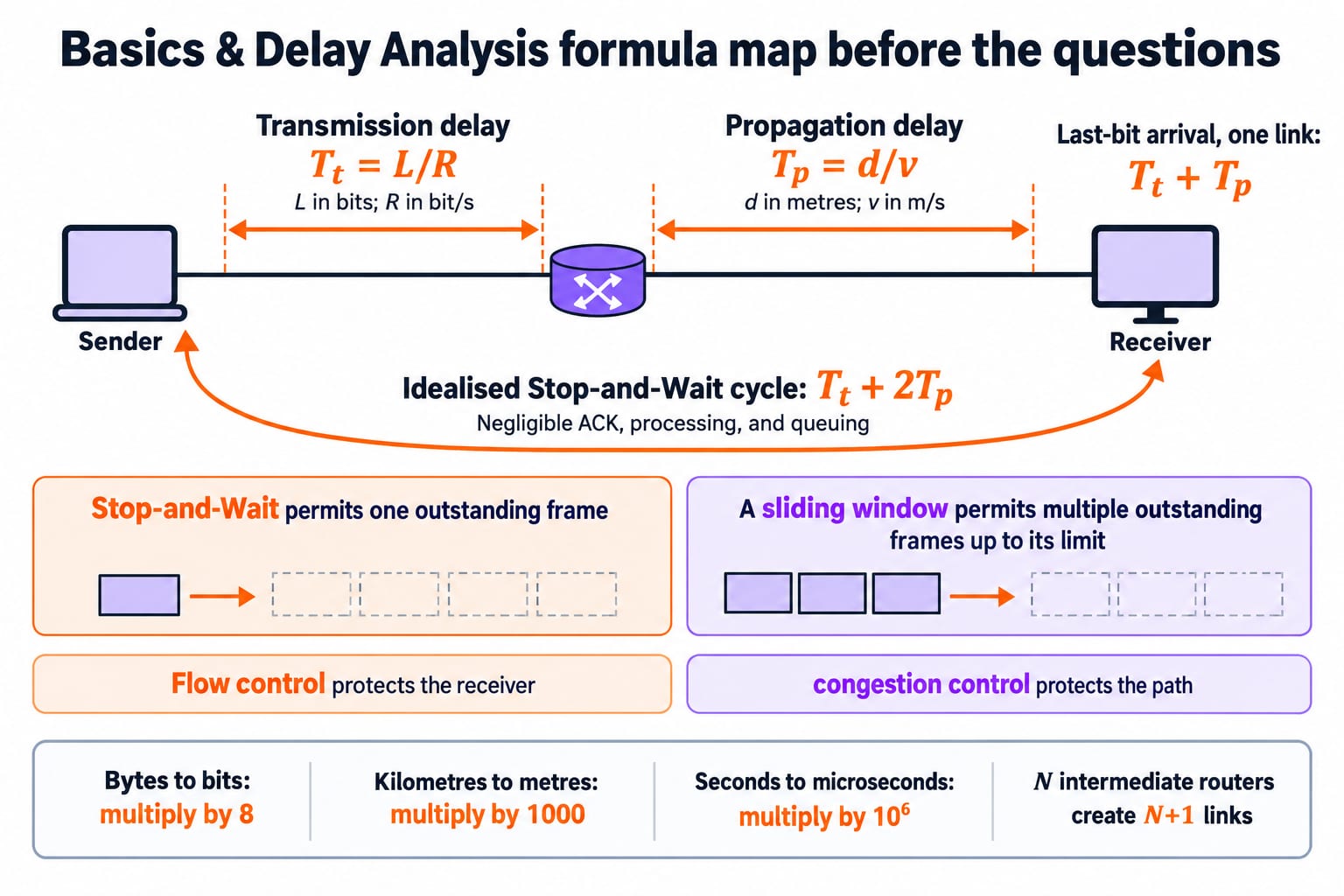
Quantity | Formula | Meaning and units |
|---|---|---|
Transmission delay |
|
|
Propagation delay |
|
|
Last-bit arrival, one link |
| Complete frame reaches receiver |
Idealised Stop-and-Wait cycle |
| Negligible ACK, processing, and queuing |
Stop-and-Wait permits one outstanding frame; a sliding window permits multiple outstanding frames up to its limit. Flow control protects the receiver; congestion control protects the path.
Check units before substituting:
Bytes to bits: multiply by
8.Kilometres to metres: multiply by
1000.Seconds to microseconds: multiply by
10^6.Nintermediate routers createN+1links.
2. Questions 1-3: Stop-and-Wait, buffering, and the TCP window
Question 1: one frame followed by one acknowledgement
UGC NET, June 2020, MCQ. Open the full solved question.
Question: "Protocols in which the sender sends one frame and then waits for an acknowledgment before proceeding for next frame are called as ______"
A. Simplex protocols
B. Unrestricted simplex protocols
C. Simplex stop and wait protocols
D. Restricted simplex protocols
Answer: C, Simplex stop and wait protocols. The sender sends one frame, then waits for its acknowledgement. The historical term is retained. Unrestricted simplex assumes continuous receiver acceptance.
Question 2: the storage device that absorbs a rate mismatch
BPSC 2023, PGT Tier-2, MCQ. Open the full solved question.
Question: "A storage device used to compensate the difference in flow of data is known as ______."
A. main memory
B. auxiliary memory
C. buffer
D. More than one of the above
E. None of the above
Answer: C, buffer. A buffer temporarily holds data when producer and consumer rates differ. Its capacity is finite, so flow control must slow or pause the sender as it fills.
Question 3: TCP's flow-control window
CDAC CCAT 2017, MCQ.
Question: "Flow control is carried out by TCP using _______ window protocol."
A. limited-size
B. sliding
C. fixed-size
D. partial
Answer: B, sliding. TCP's advertised window moves as bytes are acknowledged and buffer space changes. It handles flow control; cwnd handles congestion control. Both constrain the sender, as TCP Congestion Control for GATE explains.
3. Questions 4-6: Transmission delay, propagation delay, and first-bit versus last-bit timing
Question 4: a 1200-byte frame on a 100 Mbps LAN
Question: "A 100 Mbps Ethernet LAN has a propagation delay of 1 µs per 100 meters. For a cable length of 500 meters, calculate the time (in microseconds) required for a frame of 1200 bytes to completely leave the sender’s interface."
Literal answer: 96 µs.
L = 1200 × 8 = 9600 bits
T_t = 9600/(100 × 10^6) = 96 µs
Leaving the sender requires transmission delay alone. A 101 µs result instead describes last-bit arrival: propagation is 5 × 1 = 5 µs, so 96 + 5 = 101 µs. The wording and keyed result refer to different events.
Question 5: when the first bit arrives before the last bit leaves
Question: "An Ethernet frame of 1500 bytes is transmitted over a 5000-meter cable at a transmission rate of 10 Mbps. The propagation speed in the cable is 2×10⁸ m/s. Calculate the time difference (in microseconds) between the transmission of the last bit of the frame and the arrival of the first bit at the other end of the cable."
Answer: 1175 µs.
T_t = (1500 × 8)/(10 × 10^6) = 1200 µs
T_p = 5000/(2 × 10^8) = 25 µs
The first bit arrives at 25 µs; the last leaves at 1200 µs. Their difference is 1200 - 25 = 1175 µs. Adding would answer a different event.
Question 6: propagation plus an equipment delay
Question: "What is the total propagation delay (in microseconds) for a 2500 m cable with a propagation speed of 2×10⁸ m/s and an equipment delay of 10 µs? "
Answer: 22.5 µs. Cable propagation is 2500/(2 × 10^8) = 12.5 µs; with equipment delay, 12.5 + 10 = 22.5 µs. This is combined, not pure propagation delay.
4. Questions 7-8: RTT equality and Stop-and-Wait throughput
Question 7: data rate when transmission delay equals RTT
Question: "Consider a LAN with the sender and receiver are 30 km apart and the link works at a speed of light in the fiber. Suppose a packet of size 2KB needs to be transferred, at what data rate does the round-trip delay equal the transmission delay of the packet?"
A. 70 Mbps
B. 80 Mbps
C. 40 Mbps
D. 60 Mbps
Answer: B, 80 Mbps, the closest option. Use 3 × 10^8 m/s. One-way T_p = 30,000/(3 × 10^8) = 100 µs, so RTT is 200 µs. With 2 KB = 16,384 bits, L/R = 200 µs gives R = 81.92 Mbps, rounded to 80 Mbps. The fiber wording is loose; another speed would not fit.
Question 8: achievable Stop-and-Wait throughput over 35 km
Question: "What is the throughput achievable in stop and wait protocol by a maximum packet size of 780 bytes with a data transfer rate of 15 Mbps and network span of 35 km. Assume the speed of light in cable is 65% of the speed of light in vacuum."
A. 8.025 Mbps
B. 8.039 Mbps
C. 8.052 Mbps
D. 8.068 Mbps
Answer: C, 8.052 Mbps.
L = 780 × 8 = 6240 bits
T_t = 6240/(15 × 10^6) = 416 µs
v = 0.65 × 3 × 10^8 = 1.95 × 10^8 m/s
T_p = 35,000/(1.95 × 10^8) = 179.487 µs
With negligible ACK transmission and processing, cycle time is 416 + 2 × 179.487 = 774.974 µs. Thus 6240/(774.974 × 10^-6) = 8.051879 Mbps, rounded to 8.052 Mbps.
5. Questions 9-10: Flow-control definitions and protocol families
Question 9: objective, noiseless-channel protocols, and the two delays
Question: "Flow control plays a critical role in the Data Link Layer to ensure reliable data transmission. Explain the primary objective of this mechanism. Furthermore, distinguish between the 'Simplest Protocol' used for noiseless channels and the basic 'Stop-and-Wait Protocol'. Finally, define and provide the mathematical formulas for Transmission Delay (T_t) and Propagation Delay (T_p)."
Objective: Prevent a faster sender from overrunning a slower receiver or its finite buffer.
Simplest Protocol: Assumes an always-ready receiver, so the sender transmits continuously.
Noiseless Stop-and-Wait: Sends one frame, then waits for permission or acknowledgement.
Delays: T_t = L/R places all L bits on the link; T_p = d/v carries one bit across d. Question 5 gives 1200 µs and 25 µs respectively.
Question 10: noiseless and noisy flow-control families
Question: "How are Flow Control protocols categorized under Noiseless and Noisy channels, and what are their specific types?"
Channel | Protocol types |
|---|---|
Noiseless | Simplest Protocol; Stop-and-Wait Protocol |
Noisy | Stop-and-Wait ARQ; Go-Back-N ARQ; Selective Repeat ARQ |
Stop-and-Wait ARQ keeps one frame outstanding. Go-Back-N retransmits from the affected frame onward. Selective Repeat retransmits only affected frames and buffers acceptable out-of-order frames.
6. Question 11: Store-and-forward delay across N routers
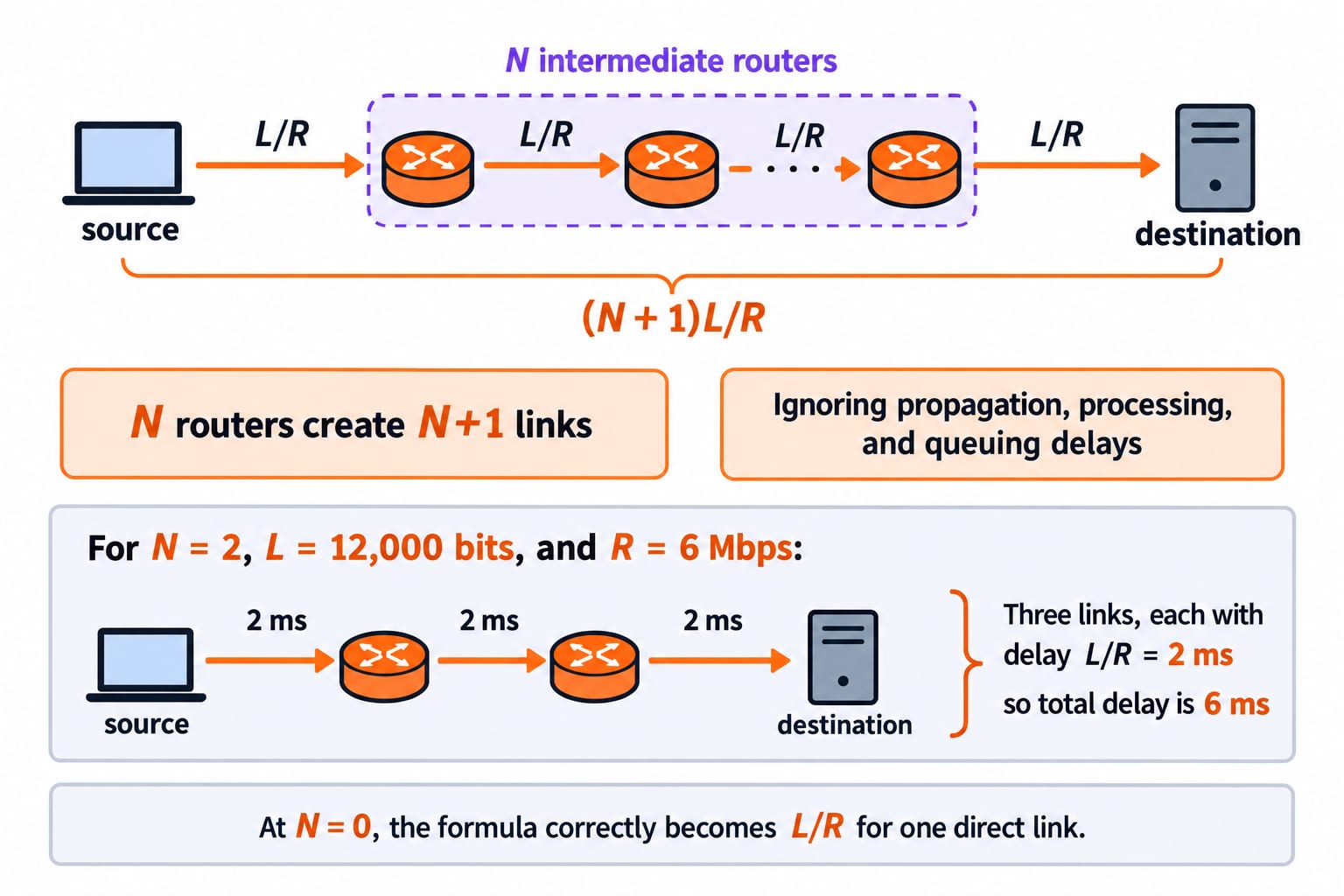
Question 11: count links, not intermediate routers
IBPS 2024, MCQ. Open the full solved question.
Question: "A packet of size L bits is transmitted from a source to a destination through N intermediate routers using store-and-forward packet switching. Each link has a transmission rate of R bits per second. Ignoring propagation, processing, and queuing delays, what is the total transmission delay?"
A. R/L
B. NL/R
C. (N+1)L/R
D. (N-1)L/R
E. L/NR
Answer: C, (N+1)L/R. N routers create N+1 links, each costing L/R. For N = 2, L = 12,000 bits, and R = 6 Mbps, three links each cost 2 ms, so total delay is 6 ms. At N = 0, the formula correctly becomes L/R for one direct link.
7. Basics & Delay Analysis traps exposed by the set
Transmission versus propagation:
L/Rgives time to leave;d/vgives travel time. Add only for complete arrival.First bit versus last bit: Question 5 compares events, so it subtracts. Complete arrival normally requires addition.
One way versus RTT: Questions 7 and 8 need
2T_p. Mark the factor of two first.Units: Write bytes in bits and kilometres in metres before substituting.
Routers versus links: Use the
N = 0check to rejectNL/Rand(N-1)L/R.Event check: Question 4 wording gives
96 µs;101 µsanswers last-bit arrival.
8. Basics & Delay Analysis one-minute revision and next practice route
T_t = L/R
T_p = d/vOne-link last-bit arrival:
T_t + T_pIdealised Stop-and-Wait throughput:
L/(T_t + 2T_p)
Nintermediate routers under store-and-forward:(N+1)L/R
One-frame waiting, finite buffering and the advertised window are the protocol cues. For arithmetic, map the wording to L/R, d/v, 2T_p or (N+1)L/R before substituting. Distinguish sender finish, first-bit arrival and last-bit arrival on a timeline.
For mixed practice, work through Computer Networks MCQs. The TCP guide above reinforces receiver protection versus network protection. For a structured concept-and-PYQ route, see GATE Guidance by Sanchit Sir; for this topic alone, stay with the free learn module.
Now redo Questions 4, 5, 8, and 11 without looking at the arithmetic. The formulas are transmission delay, propagation delay, Stop-and-Wait throughput, and store-and-forward delay; the wording traps are event timing and link counting.
Keep learning

SSA and Control Flow MCQs: 10 Solved Questions with Step-by-Step Explanations
Practise ten SSA and control-flow questions from GATE and TPSC papers, then check a worked proof for every answer. Temporary counts, total names, CFG edges and backpatch lists each count differently.
Updated 30 Oct 20268 min readCompiler Design MCQs
Congestion Control Policy MCQs: 11 Solved Questions with Explanations
Work through 11 published congestion-control questions covering TCP window growth, timeout recovery, AIMD and token-bucket calculations, with every step shown.
Updated 21 Sep 20268 min read54 viewsComputer Networks MCQs
Data Link Layer Delay Analysis: Formulas, Worked Examples and Exam Question Patterns
Learn to separate transmission and propagation delay, calculate a complete stop-and-wait cycle, and choose the minimum sliding-window size without unit traps.
Updated 22 Sep 20265 min read75 viewsComputer Networks

C Control Flow Formula Sheet and Revision Notes: Conditionals, Loops and Jumps
Revise C control flow through compact rules, boundary-safe loop formulas and exact traces for short-circuiting, switch fall-through, nested loops, break and continue.
Updated 15 Nov 20266 min readC Programming & Data Structures