CAT Eligibility: Degree Status, Final-Year Rules and Application Routes
Work out whether your CAT application belongs under a completed-degree, final-year, result-awaited or recognised professional-qualification route, then match each claim to evidence.
KnowledgeGate Team
Exam prep & CS education
Updated 25 Jul 20264 min read
You may have finished your degree, be sitting the last semester, have completed every requirement while waiting for the result, or hold a professional qualification. Your CAT application route follows from which of those is true today, and so does the proof you will be asked to produce. Marks thresholds and certificate deadlines change from cycle to cycle, so read those in the applicable notice at iimcat.ac.in, then use CAT & MBA Entrance Preparation to organise preparation once eligibility is clear.
CAT eligibility begins with the qualifying route
Screen your case in this order:
What qualification are you relying on?
Is it completed, in its final year, or result awaited?
Is its awarding body or equivalent recognised under the applicable notice?
Can you produce the required application and admission proof?
Profile today | Likely application route | Evidence to keep ready | Must confirm in the current notice |
|---|---|---|---|
Completed bachelor's degree | Completed-degree route | Result and degree records | Recognition, threshold and required proof |
Final-year bachelor's student | Appearing-in-final-year route | Mark sheets and status proof | Permission and applicable certificate |
Requirements complete, result awaited | Result-awaited or equivalent route | Mark sheets and institution proof | Exact route and later proof |
Named completed professional or equivalent qualification | Professional-qualification route | Final certificate and awarding body | Qualification and document satisfy notice |
Naming your route narrows what you have to verify; the applicable notice's wording decides whether you qualify. Clearing that minimum condition still does not guarantee an IIM shortlist.
Completed bachelor's degree route
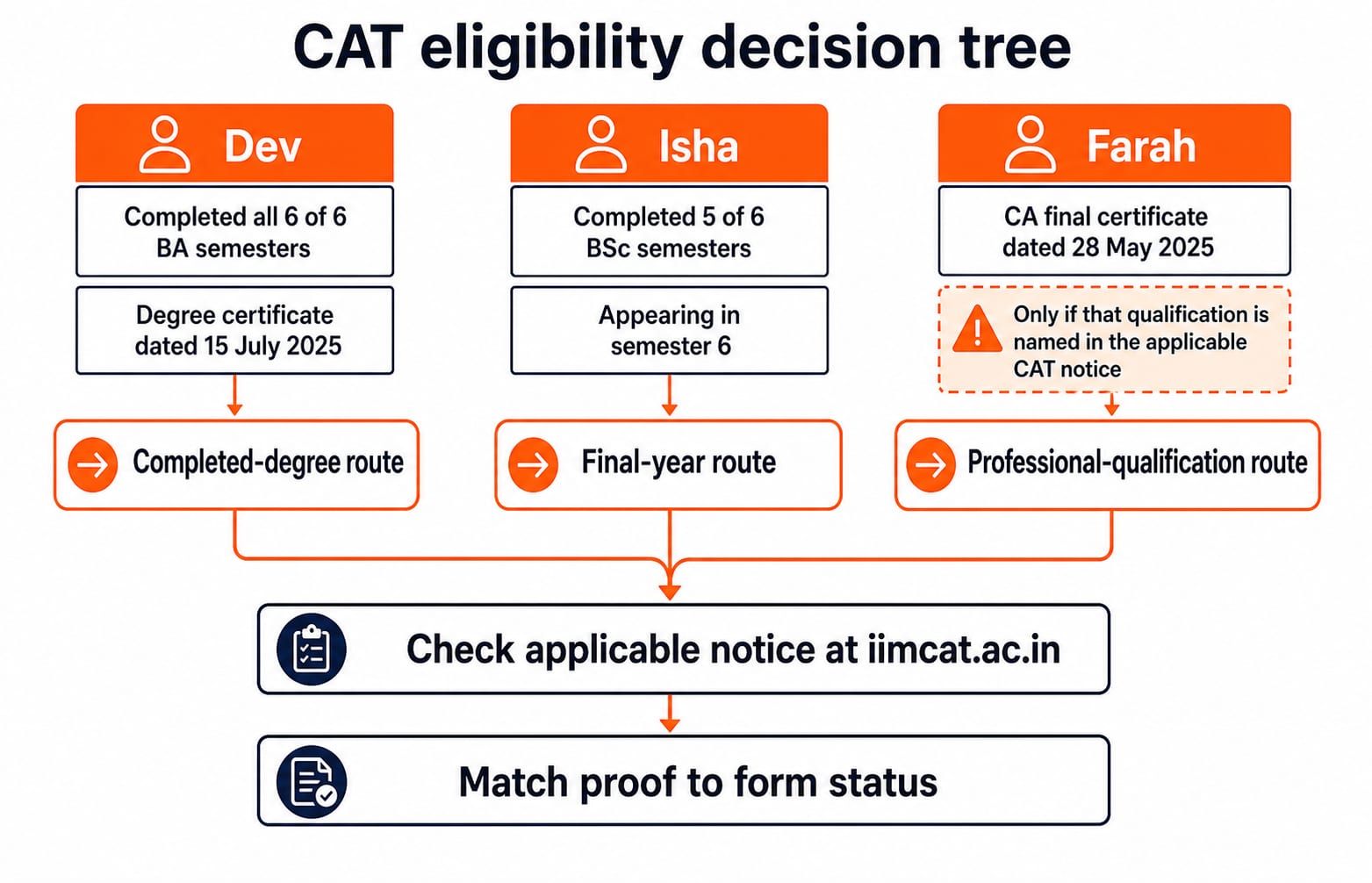
Dev completed 6 of 6 semesters, with a declared final result, consolidated mark sheet and degree certificate dated 15 July 2025. Stream does not decide his route; recognition, awarded status and the applicable threshold do.
Semester mark sheets, a consolidated result, and a degree or provisional certificate are different proofs. The official guide for your application cycle states which of them to submit, and when.
Use the exact university degree name and awarded status. Duration alone cannot settle eligibility.
Final-year and result-awaited routes are not identical
Isha is in semester 6 of a three-year BSc, with mark sheets for semesters 1 to 5 but no completed final examinations or result. Her route is appearing in final year if permitted; she needs that cycle's named institution proof.
Arjun completed all 6 of 6 semester examinations and degree requirements but awaits the consolidated result. He must use the form's result-awaited or equivalent route, not mark the degree as awarded.
CAT 2025 materials included a Final Year Certificate form, but the applicable notice and admitting institute control its signer, wording and deadline. Other entrance exams turn on the same two questions, status first and proof second: CTET Eligibility 2026: Routes and Official Checks works through both for a different exam.
Recognised degrees and equivalent qualifications need two checks
Two checks, in this order. First, copy the awarding university, institution or professional body exactly as it appears on your certificate. Second, match that awarding body against the recognition wording in the applicable notice. Affiliation, distance mode, an integrated programme or a familiar-sounding title settles neither check on its own.
Farah's CA final certificate is dated 28 May 2025. She can use a professional-qualification route only if the notice names that qualification and her certificate meets its condition. A pursuing student cannot copy her completed route.
Red flag: A brochure, coaching article, university claim or previous CAT notice cannot override the applicable notice. If recognition remains unclear, pause and seek written clarification from the CAT helpdesk or awarding institution.
Marks and CGPA follow the awarding institution's rule
Meera's six semester totals are 410, 435, 422, 460, 448 and 475, out of 600 each, and her university certifies an aggregate method:
Obtained marks:
410 + 435 + 422 + 460 + 448 + 475 = 2,650Maximum marks:
6 × 600 = 3,600Percentage:
2,650 ÷ 3,600 × 100 = 73.611...%
She rounds and records that figure exactly as her university's rule and the application form direct.
Ravi has 8.2/10 CGPA. His university's certificate says percentage = CGPA × 9.5, so 8.2 × 9.5 = 77.90%. That factor cannot be borrowed, and CGPA × 10 is not a safe default. Do not judge either figure against a cutoff quoted anywhere except the current notice, which states the applicable minimum, category treatment and any no-formula instruction.
Map every application claim to evidence
Arjun's worksheet should look like this before he submits:
Check | Arjun's entry or evidence |
|---|---|
Identity as on certificate | Degree name exactly as university record |
Qualifying route | Result awaited |
Current academic status | 6 of 6 examinations completed; consolidated result pending |
Marks or CGPA method | University-certified aggregate method |
Evidence file | Semester mark sheets plus the current-cycle certificate named in the official guide |
Compare each entry with its source: degree name, institution, status, passing or result date, marks or CGPA, and conversion method. Take field names, formats and upload limits only from the official guide.
If your form entry and your documents disagree, stop. Reread the official guide, ask the helpdesk, and save its written response. Eligibility and exam structure are separate checks; UPTET Eligibility & Exam Structure Guide covers that pairing on the teaching-eligibility side.
The short version: check first, prepare next
Before applying:
Identify the qualifying route.
Verify recognition or equivalence.
Apply your awarding institution's marks rule.
Match every form value to evidence.
Check proof obligations that arise later.
Read each target institute's admission policy separately.
Shortlisting criteria are set by each institute and published separately from the CAT notice.
Your next need | KnowledgeGate resource | Honest use |
|---|---|---|
Structured CAT lessons and practice | CAT Preparation Course | Use after the eligibility route is confirmed |
Compare an MBA entrance starting point | CAT & MBA Entrance Preparation | Use when organising preparation |
If the official check confirms your route, use the CAT Preparation Course for structured lessons and practice. If eligibility is unclear, resolve it through the official notice or helpdesk before preparing around an uncertain application.
Keep learning
CAT Mock Analysis: Diagnose Time, Accuracy and Question Choice
Turn one mock into a practical review sheet. Separate execution, selection and reach problems, then test one measurable rule per section.
Updated 22 Aug 20265 min readMBA Entrance (CAT)

CAT for Non-Engineers: Build a Quant Foundation Before Chasing Shortcuts
Use this 12-week quant plan to find your real gaps, rebuild core relationships, revisit errors and add timed mixed practice only when the foundation is ready.
Updated 20 Aug 20266 min readMBA Entrance (CAT)
CAT Preparation for Working Professionals: A Sustainable 10-Hour Week
Build a repeatable CAT week around a full-time job, then use completed work and error patterns to decide what the next 600 minutes should contain.
Updated 18 Aug 20266 min readMBA Entrance (CAT)
CAT Quant for Non-Engineers: A 16-Week Foundation Plan Without Shortcuts
Rebuild CAT quant in dependency order: a 24-question diagnostic, a 16-week 160-hour map, an exact 10-hour week, an accuracy gate and a missed-day rule.
Updated 16 Aug 20265 min readMBA Entrance (CAT)