Cognizant Aptitude Questions: High-Yield Topics with Worked Solutions
Learn how to classify and solve representative mixed aptitude problems, then use a 30-minute drill and five-session plan to turn methods into speed.
KnowledgeGate Team
Exam prep & CS education
Updated 20 Sep 20266 min read
A mixed aptitude set can punish a candidate who remembers formulas but cannot quickly classify the question as quantitative, reasoning, or verbal. Spot the structure, then choose a method before calculating. This guide gives you a topic-first route, eight fully worked original practice questions, and a timed attempt method.
These examples are representative teaching material, not recalled Cognizant questions or claimed previous-year questions. The exact assessment structure can vary by hiring drive, so align your practice with your active recruitment communication or assessment invite.
Cognizant aptitude topics to practise first
KnowledgeGate's Placement Preparation catalog separates company-specific preparation, including Cognizant, from its quantitative, reasoning, and verbal Aptitude track. The aptitude topic map and weekly plan shows how these areas fit together.
Here, "high-yield" means high transfer value across mixed practice, not guaranteed frequency or official weightage. Recognition cues:
Percentages: changing multipliers.
Ratios: total parts, then one part.
Time and work: units completed per day.
Speed and averages: total distance divided by total time.
Data interpretation: weighted raw totals.
Arrangements: fixed positions and adjacency blocks.
Series: one repeated operator.
Sentence correction: parallel grammatical forms.
KnowledgeGate has more than 23,000 published questions across Mathematics and Aptitude, Reasoning, and Verbal Ability (English). This broad pool is not a Cognizant-tagged count or evidence of topic weightage.
Percentages and ratios: keep the changing base visible
Question 1. A value is increased by 25% and then decreased by 20%. If the starting value is 640, what is the final value?
(a) 608
(b) 624
(c) 640
(d) 672
First, 640 x 1.25 = 800. Then, 800 x 0.80 = 640. The answer is (c) 640, with zero net change. Subtracting 20 from 25 wrongly suggests a 5% rise because the percentages use different bases.
Question 2. A 144-question practice plan divides quantitative, reasoning, and verbal questions in the ratio 5:4:3. How many reasoning questions does it contain?
(a) 36
(b) 48
(c) 60
(d) 72
Total parts are 5 + 4 + 3 = 12, so one part is 144 / 12 = 12. Reasoning gets 4 x 12 = 48, answer (b). Check: 60 + 48 + 36 = 144.
Use multiplication for chained percentage change. For a ratio split, find one part first.
Time and work, then average speed: calculate rates first
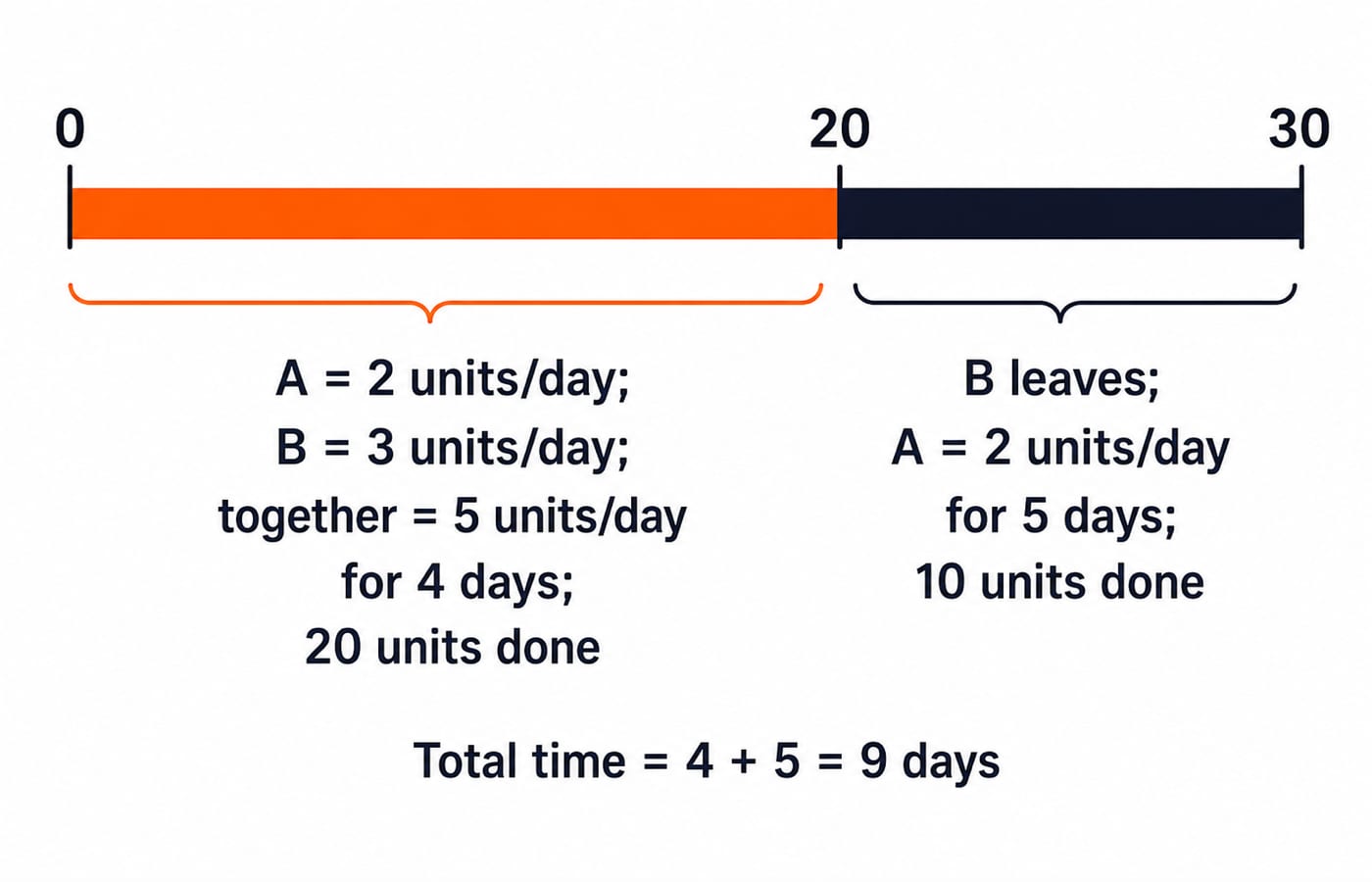
Question 3. A can finish a job in 15 days and B in 10 days. They work together for 4 days, after which B leaves. How many days are needed in total?
(a) 7
(b) 8
(c) 9
(d) 10
Take LCM(15, 10) = 30 work units. A does 30 / 15 = 2 units per day and B does 30 / 10 = 3. Together they do 5 x 4 = 20 units. The remaining 30 - 20 = 10 take A 10 / 2 = 5 days. Total time is 4 + 5 = 9 days, answer (c). Averaging or adding the completion times ignores rates.
Question 4. A candidate travels 90 km at 45 km/h and another 90 km at 60 km/h. What is the average speed for the full journey?
(a) 50 km/h
(b) 51.4 km/h
(c) 52.5 km/h
(d) 54 km/h
The legs take 90 / 45 = 2 hours and 90 / 60 = 1.5 hours. Average speed is 180 / 3.5 = 51.428... km/h, or 51.4 km/h, answer (b). (45 + 60) / 2 = 52.5 is wrong because equal distances produce unequal travel times.
Data interpretation: compare percentages, then recombine totals
Accuracy is correct / attempted x 100.
Week | Attempted | Correct |
|---|---|---|
Week 1 | 40 | 30 |
Week 2 | 50 | 42 |
Week 3 | 60 | 48 |
Week 4 | 50 | 45 |
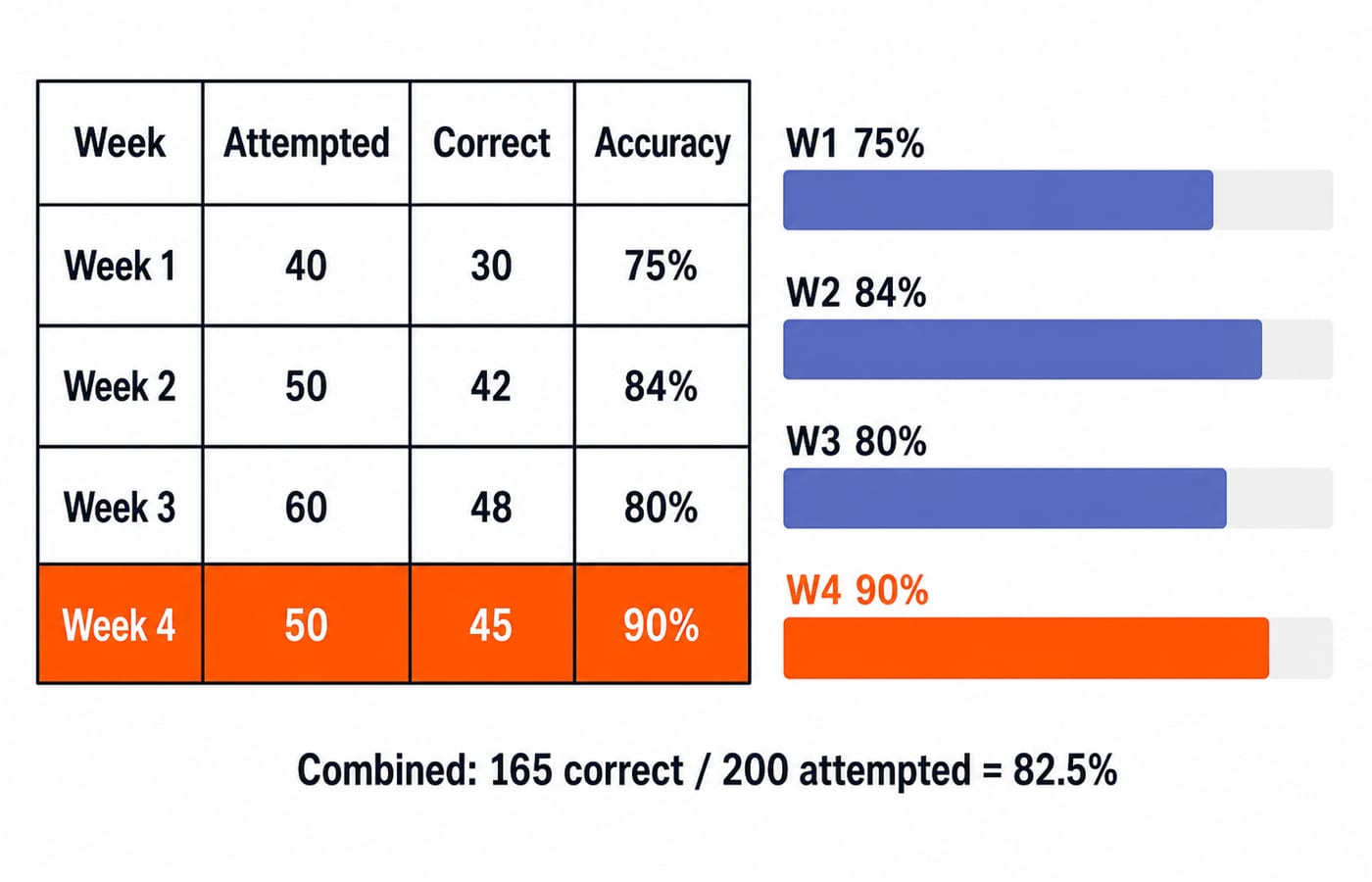
Question 5a. Which week has the highest accuracy? The results are 30 / 40 = 75%, 42 / 50 = 84%, 48 / 60 = 80%, and 45 / 50 = 90%. Week 4 is highest.
Question 5b. What is the combined accuracy? Correct answers total 30 + 42 + 48 + 45 = 165; attempts total 40 + 50 + 60 + 50 = 200. Combined accuracy is 165 / 200 x 100 = 82.5%.
The unweighted mean, 82.25%, is not the combined accuracy because attempt counts differ. During a 30-day aptitude practice routine, record attempted, correct, and error type after each set.
Logical reasoning: make constraints visible
Question 6. Five people A, B, C, D, and E sit in a row. D is at the left end. B sits immediately to the right of A. C sits immediately to the left of E. The A-B block is left of the C-E block. Which order is valid?
(a) D-A-B-C-E
(b) D-C-E-A-B
(c) A-B-D-C-E
(d) D-A-C-B-E
Write [A B] and [C E] as blocks. D occupies position 1, and [A B] precedes [C E], giving D-A-B-C-E, answer (a). Option (b) reverses the blocks, (c) moves D, and (d) breaks A-B adjacency.
Question 7. Find the next term: 3, 8, 18, 38, 78, ?
(a) 118
(b) 148
(c) 156
(d) 158
Apply x2 + 2: 3 x 2 + 2 = 8, 8 x 2 + 2 = 18, 18 x 2 + 2 = 38, and 38 x 2 + 2 = 78. Thus 78 x 2 + 2 = 158, answer (d). Differences 5, 10, 20, and 40 confirm it, but the operator is quicker.
Turn adjacency into blocks, position words into slots, and number movement into operators before checking options.
Verbal ability: test structure before vocabulary
Question 8. The role involves analysing data, writing reports, and to present findings clearly.
(a) No change
(b) Replace
to presentwithpresenting(c) Replace
to presentwithpresented(d) Replace
to presentwithpresentation
The answer is (b). The verb involves governs the parallel gerunds analysing, writing, and presenting. Familiar wording can still fail a structural check.
For agreement, underline the subject and verb. Around and, or, or a three-item list, compare forms. In passages, separate stated facts from inferences and reject options that add absent claims.
Build a timed attempt method, then align it to the active drive
Use this representative 25-question, 30-minute mixed drill:
Pass | Time | Task |
|---|---|---|
1 | 8 minutes | Inspect all questions and solve about 10 direct classification or one-step items. |
2 | 14 minutes | Work through up to 10 rate, DI, and short-constraint items. |
3 | 6 minutes | Return to marked items. |
Final check | 2 minutes | Check units, selected options, and skipped answers. |
The split is 8 + 14 + 6 + 2 = 30. After 75 seconds without a multiplier, ratio part, rate, table, constraint block, operator trace, or grammar rule on paper, mark and move.
For 22 attempts with 19 correct, accuracy is 19 / 22 x 100 = 86.36...%, or 86.4%. Classify the three errors. Fix one concept gap by revision, one calculation slip by a slow repeat, and one rushed read with a final keyword check.
For a simulation, take the order, section names, counts, timing, navigation, negative marking, eligibility, cutoff, and sequence from your active Cognizant communication. Placement preparation courses give wider context.
Short version and the next five practice sessions
Classify first. Use multipliers for chained percentages, parts for ratios, units per day for work, total distance divided by total time for speed, weighted raw totals for DI, blocks for arrangements, repeated operators for series, and parallel forms for sentence correction.
Session 1: 10 successive-percentage and 10 ratio questions.
Session 2: 12 time-and-work and 8 average-speed questions.
Session 3: Four DI tables, each with a combined-total question.
Session 4: 12 arrangement and 12 series questions.
Session 5: 15 grammar questions, then the 25-question, 30-minute mixed drill.
Re-solve every wrong or skipped item without a timer. If you miss a session, move the sequence forward one day and do not double the next.
Choose Cognizant-specific preparation for company context, or broader aptitude preparation to strengthen transferable methods across placement tests.
Keep learning
Accenture Coding Questions: 4 Patterns with Solved Dry Runs
Stop memorising company-question lists. Learn four reusable coding patterns through precise examples involving strings, arrays, digits, and matrices.
Updated 2 Oct 20265 min readCompany-Specific Prep
Accenture Placement Preparation: 4-Week, 56-Hour Study Plan
Turn four preparation lanes into a practical weekly calendar. Start with a baseline, move hours towards your errors, and recover missed sessions without cramming.
Updated 27 Sep 20265 min readCompany-Specific Prep
Capgemini Interview Questions: Technical and HR Rounds with Model Answers
Practise clear technical and HR answers through Java, SQL, a coding trace and one consistent project story. Each example shows what to say and how to support it.
Updated 25 Sep 20265 min readCompany-Specific Prep
Capgemini Drive Mistakes: Stage-by-Stage Rejection Risks and Fixes
Diagnose the controllable evidence gaps behind common Capgemini drive risks. Repair your CV, timed practice, code traces, project proof and behavioural stories with worked drills.
Updated 24 Sep 20266 min readCompany-Specific Prep