Campus GD Debrief Rubric: Score Ideas, Clarity and Teamwork
Turn a recorded campus group discussion into useful evidence. This five-part rubric helps you justify each score and choose one behaviour to test in your next mock.
KnowledgeGate Team
Exam prep & CS education
Updated 23 Sep 20265 min read

After a mock group discussion, candidates often remember only whether it felt good or bad. That feeling does not show which contribution helped the group or what to practise next. A repeatable debrief turns the recording into evidence across ideas, clarity, reasoning, listening and teamwork, without treating speaking time as performance. For a wider placement routine, use KnowledgeGate's placement preparation courses. The method below is specifically for analysing what happened inside one GD.
Debrief evidence before judging the performance
Run a 12-minute campus GD mock with six candidates, labelled A to F, on this prompt: Should colleges make one industry internship compulsory before graduation? Record the discussion with everyone's consent, then reserve 30 minutes for review.
Use two passes:
First pass, 12 minutes: watch without pausing. Write only the discussion arc, such as the opening position, major disagreements, alternatives and closing state.
Second pass, 18 minutes: pause as needed. Timestamp each meaningful contribution and record its exact content and effect.
Do not award scores from memory. That is one of the most common placement preparation mistakes. Build a compact log from the same 12-minute mock:
Timestamp | Speaker | Move | Evidence or reasoning | Response to others | Group effect |
|---|---|---|---|---|---|
01:10 | C | New angle | Connects college learning with work expectations | None | Expands the prompt |
03:40 | C | Example | Hypothetical student who discovers weak documentation skills on the job | None | Makes the claim concrete, though the example is unverified |
04:05 | D | Interruption | Repeats “industry exposure is important” with no new reason | Cuts across B mid-sentence | Stalls the thread |
06:25 | C | Builds on an earlier point | College-arranged alternatives where local opportunities are scarce | Names B’s access concern and develops it | Answers a live objection |
10:50 | C | Synthesis | States the agreement and the unresolved quality-control question | Draws the earlier turns together | Closes with a shared position |
Separate observation from interpretation. “C referred to B's access concern at 06:25” is observable. “C is a natural leader” is not, unless translated into behaviour.
Use a five-part rubric that rewards contribution quality
Score each dimension from 0 to 4 with the same anchors:
0: absent or harmful
1: visible once, but weak or largely irrelevant
2: useful but inconsistent
3: usually relevant and effective
4: consistently advances the discussion
Apply those anchors to five dimensions:
Dimension | What to look for |
|---|---|
Ideas and contribution quality | A distinct, relevant angle |
Clarity and structure | A claim, reason and order that are easy to follow |
Evidence and reasoning | Examples or mechanisms that support the claim |
Listening and linkage | A meaningful connection to an earlier contribution |
Teamwork and group behaviour | Behaviour that helps the group progress |
The maximum is 20, but the pattern matters more than the total. Note talk time separately, never as a sixth dimension. A short synthesis may beat several long repetitions.
Recruiters may weight these dimensions differently. Treat 16/20 as a practice baseline for comparing your own mocks, not as a predicted selection result.
Worked GD debrief: score one candidate from exact timestamps
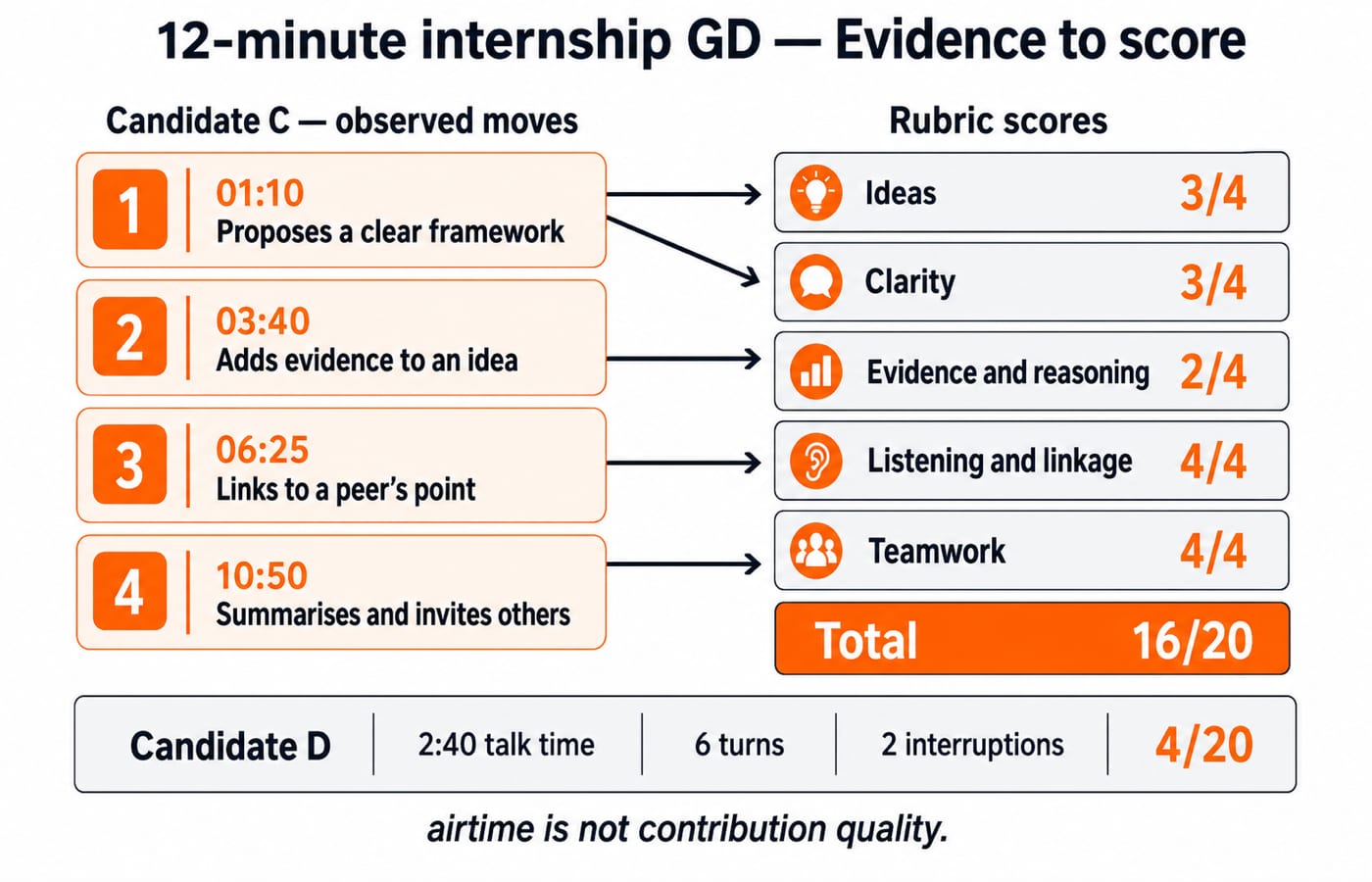
Candidate C makes four recorded moves:
01:10: proposes that compulsory internships can reduce the gap between classroom knowledge and workplace expectations.
03:40: gives a hypothetical example of a student discovering weak documentation skills.
06:25: says, “adding to B's access concern,” then proposes college-arranged alternatives for students without local opportunities.
10:50: summarises the agreement and the unresolved question of quality control.
Score C as follows:
Ideas, 3/4: the classroom-to-workplace gap and access alternatives are two distinct, relevant ideas.
Clarity, 3/4: the contributions mostly follow a claim-and-reason structure.
Evidence and reasoning, 2/4: the documentation example is hypothetical, not verified evidence.
Listening and linkage, 4/4: the 06:25 entry explicitly connects to B's access concern and develops it.
Teamwork, 4/4: the 10:50 synthesis captures agreement and the unresolved issue.
The arithmetic is 3 + 3 + 2 + 4 + 4 = 16, so C scores 16/20.
Now compare Candidate D. D speaks for 2 minutes 40 seconds across six turns, repeats “industry exposure is important,” interrupts twice at 04:05 and 07:15, and introduces no new reason. The scores are ideas 1, clarity 2, evidence 0, listening 0 and teamwork 1. Therefore, 1 + 2 + 0 + 0 + 1 = 4, or 4/20. D has more airtime, but much lower contribution quality.
Turn the score into one precise next-mock experiment
For every dimension below 3, write an evidence-backed diagnosis and an observable experiment. C's lowest score is evidence and reasoning at 2/4. The next-mock target is therefore: make one claim, explain the mechanism, and support it with one specific example before yielding the floor.
Use this template:
At [timestamp], I [observable action]. It caused [group effect]. In the next mock, I will [one behaviour], measured by [count or timestamp].
Avoid goals such as “be more confident” or “speak more.” Keep one primary experiment and one maintenance target per mock. For C, these are one claim-mechanism-example chain and one explicit link to another speaker.
Test one behaviour under comparable GD conditions
Run the next mock with the same duration, a similar group size and a prompt of comparable difficulty. Change only the target behaviour. If C is testing evidence, the observation is whether one claim-mechanism-example chain appears before yielding the floor; listening and teamwork remain maintenance checks.
Compare the target dimension and its timestamps, not only the total. A rise from 2/4 to 3/4 is useful only if the log shows stronger support and a group response. If group size or prompt difficulty changes sharply, keep the result as a note rather than calling it improvement.
A missed group mock cannot be replaced with a solo recording for listening or teamwork. Solo practice can test clarity and evidence, while the interaction dimensions stay unscored until peers are present.
Resolve peer-scoring disagreements by replaying one GD turn
Each reviewer should record two timestamped observations before seeing another score. If one reviewer gives listening 2 and another 4, replay the candidate's turn plus 20 seconds before and after it. Check whether the candidate names or clearly answers an earlier contribution, develops it and changes the group's next move.
Do not average 2 and 4 automatically. Agree on which anchor the evidence supports. If the turn is ambiguous, keep the lower score with both interpretations in the note. Replace labels such as aggressive, timid or natural leader with observable actions.
The HR Interview Questions for Freshers: How to Answer Honestly article owns one-to-one answer rehearsal; this debrief scores multi-speaker effects, so every judgement needs a timestamp and a group response.
Short version: leave with evidence and a next action
Record with consent, log timestamps, score the five dimensions, justify each score, choose one experiment, and compare it in the next mock. Finish every review with this five-line debrief card:
Strongest timestamp
Weakest timestamp
Five-dimension score
Next-mock experiment
Maintenance target
For structured follow-through beyond the GD, use the Interview & Resume Preparation Course. It covers interview and resume preparation, including resume review and mock-interview support. Your debrief is complete only when it produces one behaviour you can observe in the next session.
Keep learning
Placement Mock Analysis: One Error Ledger Across Every Test Round
Use one error ledger without flattening unlike round results. This worked example shows how to find the first wrong step, prioritise repairs and close errors only after fresh retests.
Updated 4 Oct 20265 min readInterview Corner
Internship to PPO: Build a Weekly Evidence Trail Before the Final Review
Use a weekly outcome ledger to make your internship work visible before the final review. This practice model shows how to record delivery, feedback, effect and handoff honestly.
Updated 28 Sep 20265 min readInterview Corner
DSA Mock Interview Rubric: A 100-Point Scorecard for Reasoning, Code and Communication
A practical six-part scorecard for running comparable DSA mocks, grading visible evidence and turning weak areas into the next week's practice.
Updated 25 Sep 20265 min readInterview Corner
Campus Recruitment Timeline: Stage by Stage from Pre-Placement Talk to Written Offer
Follow a campus drive without guessing. Build an evidence sheet, verify eligibility, plan each preparation window and check the written offer before responding.
Updated 24 Sep 20265 min readInterview Corner