C to C++ Transition: Syntax Changes, Classes and Runnable Examples
Move a working C record into an encapsulated C++ class, then replace common pointer, buffer, and allocation patterns with clearer C++ alternatives.
KnowledgeGate Team
Exam prep & CS education
Updated 16 Aug 20267 min read
C++ keeps the loops, functions, arrays, and pointers that make C feel familiar, but compiling a .c file as C++ is not the same as writing good C++. Different type rules can stop a program, while a successful build can still preserve manual-memory and procedural habits. One small Account record covers the whole distance: a C struct edited by a free function becomes a class that owns its balance and refuses a negative deposit outright. That move from procedure to ownership is the one that carries into the rest of the Coding & DSA track, containers and data structures included.
C and C++ are related languages, not a copy-and-rename exercise
Both languages recognise if, for, while, arithmetic expressions, function calls, and much basic declaration syntax. C++ was strongly influenced by C, but it is not a strict superset. Some valid C is ill-formed in C++, and a few expressions that look shared follow different rules.
Start with this C baseline:
#include <stdio.h>

struct Account {
    char owner[20];
    double balance;
};

void deposit(struct Account *account, double amount) {
    if (amount > 0.0) {
        account->balance += amount;
    }
}

int main(void) {
    struct Account account = {"Asha", 1250.50};
    deposit(&account, 249.50);
    printf("%s: %.2f\n", account.owner, account.balance);
    return 0;
}
The update is 1250.50 + 249.50 = 1500.00, so the program prints Asha: 1500.00. Keep .c and .cpp versions side by side and enable compiler warnings. If tracing this original program is not yet comfortable, use the C Language course as the prerequisite path.
First-pass C++ changes: headers, streams, types and safer defaults
A first translation replaces <stdio.h> and printf with <iostream>, <iomanip>, and std::cout. Names such as cout, string, and vector belong to the std namespace. Keep the prefix explicit in teaching code instead of placing using namespace std; globally.
bool valid = amount > 0.0;
const char *label = "Asha";
int *missing = nullptr;
bool is a built-in C++ type. nullptr expresses a null pointer without the integer ambiguity of 0. The literal assigned to label must not be treated as writable. When the program owns text and may change it, prefer std::string label = "Asha";.
C++ also makes a deliberate numeric conversion visible:
int total = 321;
int count = 4;
double average = static_cast<double>(total) / count;
Here, 321.0 / 4 = 80.25. By contrast, total / count performs integer division and produces 80 before any later assignment. Prefer a named C++ conversion such as static_cast over a C-style cast.
Worked migration: turn the C Account record into a C++ class
Here is the complete C++ version:
#include <iomanip>
#include <iostream>
#include <string>

class Account {
private:
    std::string owner_;
    double balance_;

public:
    Account(const std::string& owner, double opening_balance)
        : owner_(owner), balance_(opening_balance) {}

    void deposit(double amount) {
        if (amount > 0.0) {
            balance_ += amount;
        }
    }

    void print() const {
        std::cout << owner_ << ": "
                  << std::fixed << std::setprecision(2)
                  << balance_ << '\n';
    }
};

int main() {
    Account account("Asha", 1250.50);
    account.deposit(249.50);
    account.deposit(-100.00);
    account.print();
    return 0;
}
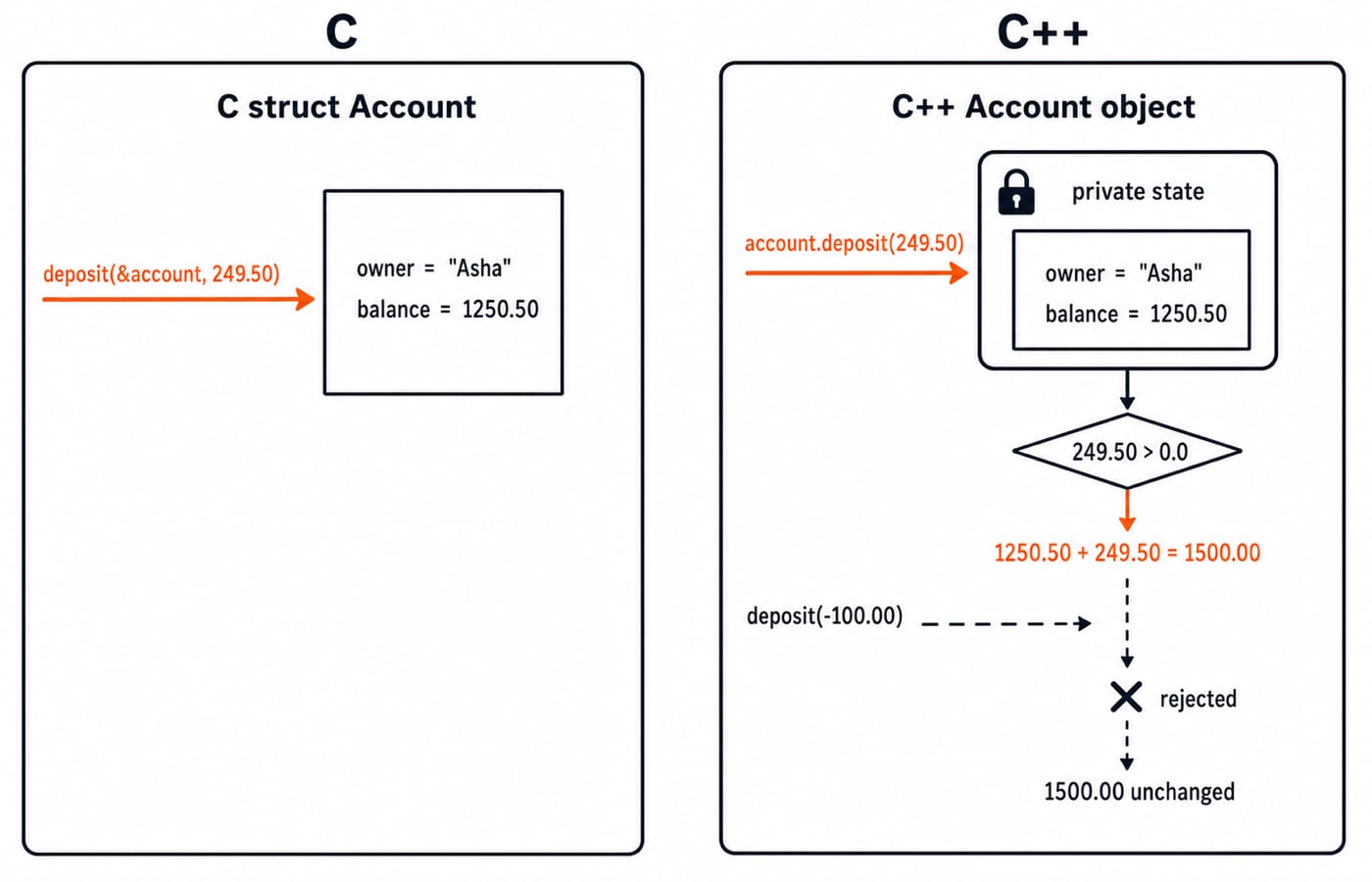
The opening state is owner Asha and balance 1250.50. The first guard sees 249.50 > 0.0, so the new balance is 1250.50 + 249.50 = 1500.00. The second guard rejects -100.00, leaving the balance at 1500.00. The exact output is Asha: 1500.00, followed by a newline.
The design gain matters more than the punctuation. Callers cannot directly break the private balance invariant. Construction establishes a usable object, and behaviour travels with its data. The const on print promises not to modify object state. A C++ struct can also have methods. Its members are public by default, while a class has private members by default.
References, overloads and namespaces replace common C patterns
A C function might accept void add_bonus(double *balance, double bonus) and be called as add_bonus(&balance, 200.00). C++ can express a required existing object with void add_bonus(double& balance, double bonus) and the call add_bonus(balance, 200.00). Starting at 1500.00, both intended updates calculate 1500.00 + 200.00 = 1700.00. Use const T& when a parameter should avoid a copy but must not be changed.
Overloading lets one coherent operation use different parameter lists:
int area(int side) { return side * side; }
int area(int width, int height) { return width * height; }
area(5) returns 5 * 5 = 25, while area(5, 3) returns 5 * 3 = 15. C normally needs separate function names. Namespaces prevent larger programs from crowding every name together: declare namespace geometry { int area(int side); }, then call geometry::area(5). Pointers still suit optional targets, arrays, low-level work, and C-library interoperation. References do not replace every pointer.
Move from manual buffers to std::string, std::vector and RAII
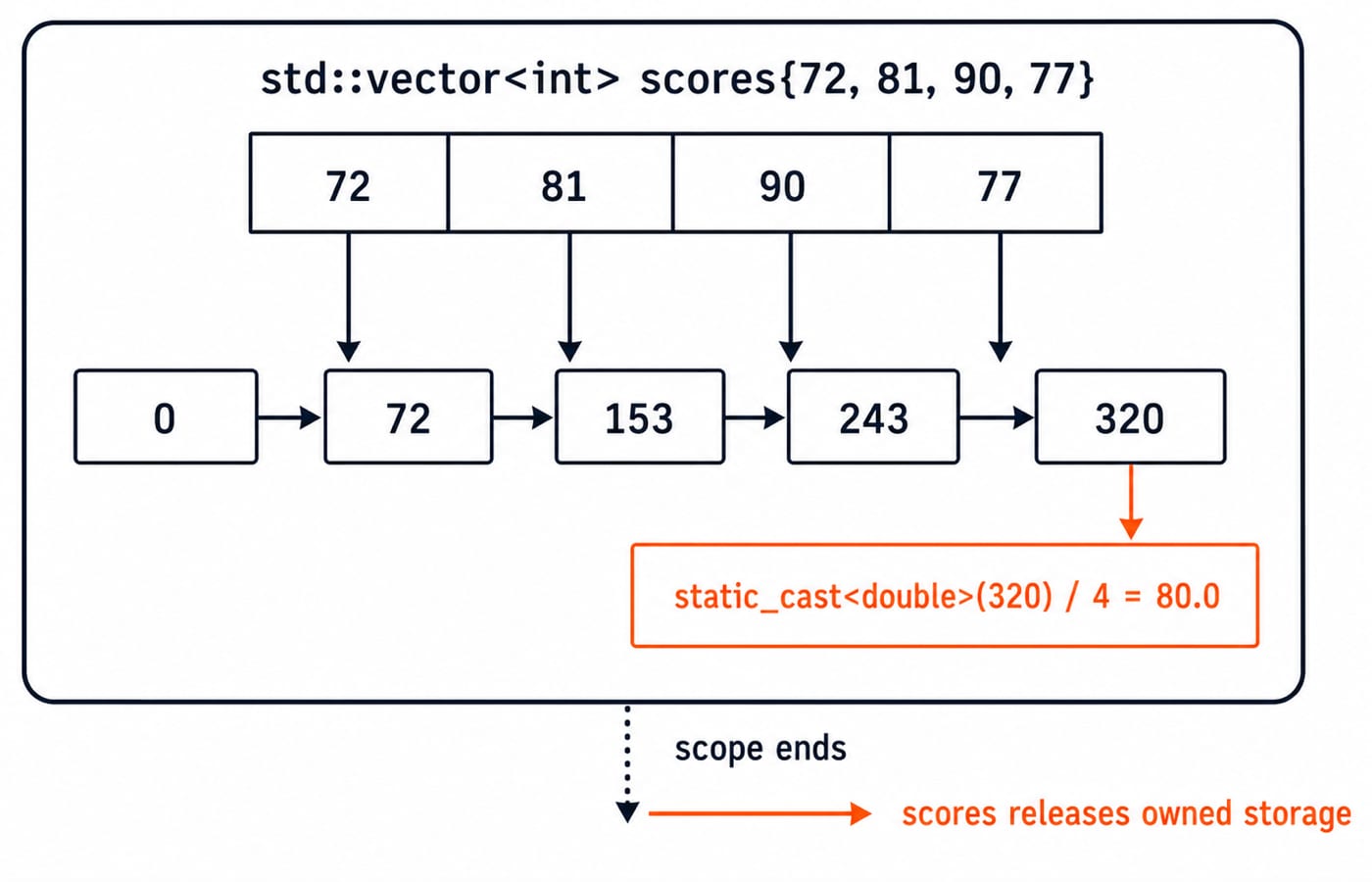
Suppose C code allocates four int values, stores {72, 81, 90, 77}, computes their total, and later calls free. The arithmetic is 72 + 81 + 90 + 77 = 320, followed by 320 / 4.0 = 80.0. Merely replacing malloc with new[] still leaves manual cleanup and exception-path risk.
The standard container owns that storage:
#include <iomanip>
#include <iostream>
#include <numeric>
#include <vector>

int main() {
    std::vector<int> scores{72, 81, 90, 77};
    int total = std::accumulate(scores.begin(), scores.end(), 0);
    double average = static_cast<double>(total) / scores.size();

    std::cout << "Total: " << total << '\n';
    std::cout << "Average: " << std::fixed
              << std::setprecision(1) << average << '\n';
}
It prints Total: 320 and Average: 80.0. RAII means the vector owns its elements and releases its storage automatically when it leaves scope. std::string applies that same ownership to text. The C baseline fixed the name at char owner[20], which is 19 characters plus a terminator, so a longer owner needs a bigger array or a truncating copy; std::string owner_ sizes itself to whatever it is given and releases that storage on its own. Standard owning types should be the first choice, though raw pointers remain useful for non-owning access and low-level interfaces.
The next container step is Stacks and Queues: Operations, Applications and the Exam Angle. You can then practise sorting algorithms on container data and compare how their time and space costs differ.
C code that breaks or misleads during a C++ transition
Compiler errors can reveal old patterns that need replacement.
C-shaped code | What happens in C++ | Why | C++ fix |
|---|---|---|---|
| Assignment fails | No implicit | Prefer |
| Ill-formed | A literal is not writable text | Use |
| Not standard C++ | No standard variable-length array | Use |
| Parsing fails |
| Rename it. |
| May differ from C | The literal is | Check the type, and do not assume equal sizes. |
Use extern "C" on the C++ side only if the C header lacks that guard.
How assessments and interviews test the C to C++ transition
Common checks ask you to identify a C fragment that fails as C++, predict constructor and method output, distinguish pointer and reference parameters, explain access control, or replace manual allocation with an owning standard type.
Three exact answers provide a self-test:
After
deposit(249.50)and thendeposit(-100.00), the Account output remainsAsha: 1500.00.char *name = "Asha";must be rejected or corrected, not made writable.With the two overloads,
area(5)is25, andarea(5, 3)is15.
Now refactor struct Point { int x; int y; }; plus void move(struct Point *p, int dx, int dy) into a class with a move method. Keep the fields private, construct a valid point, and add const accessors. Starting at (2, -1), applying (dx, dy) = (5, 3) must give (2 + 5, -1 + 3) = (7, 2). Compare your design with the Account migration.
C to C++ transition: the short version and next step
First make types and library calls valid C++. Then introduce std::string and std::vector, use references when a required existing object is clearer, group invariants and behaviour into classes, and let owning objects manage resource lifetime. A successful compile begins the migration. It does not prove the result is idiomatic C++.
For a structured route across C++, C, and other placement languages, continue with Coding for Placements. Once you can trace both the Account and vector examples, move on to Dynamic Programming Explained with a Worked 0/1 Knapsack.
Keep learning

ctype.h Functions in C: Classify Characters and Convert Case Safely
Learn which character test to choose, trace a complete C classifier, and avoid signed-char and EOF mistakes. Worked examples separate classification from case conversion.
Updated 5 Oct 20266 min readC

Key Features of the C Programming Language: Code Examples
What do C's features actually do in a program? Follow an even-number sum and a pointer update, then test your understanding with small code changes.
Updated 30 Sep 20266 min readC

Preprocessor and Macros in C: Expansion Rules and Worked Examples
Learn what happens before C compilation, expand object-like and function-like macros by hand, and avoid precedence and repeated-evaluation bugs.
Updated 18 Sep 20266 min readC

Variables and Data Types in C: Declarations, Conversions and Runnable Examples
Learn how C types control stored values, expressions and I/O. Compile a complete marks program, trace its conversions and repair common type mistakes.
Updated 17 Sep 20266 min readC