Number System Basics and Decimal Conversion MCQs: 12 Solved Questions
Practise 12 number system MCQs with fresh, step-by-step solutions covering radix, valid digits, decimal conversions, binary fractions, and base grouping.
KnowledgeGate Team
Exam prep & CS education
Updated 5 Aug 20268 min read
Number system conversions look easy until the direction changes. Learners often know both procedures but reverse them, read division remainders from the wrong end, or continue integer place values across the radix point instead of switching to negative powers.
All 12 questions below are previous-year MCQs from UGC NET and state recruitment papers, printed with the exam and year that set them. Attempt each one before reading the calculation, and write the base beside every intermediate value. KnowledgeGate's bank carries about 40 questions on number system basics and decimal conversion inside CS Fundamentals, and each question heading here opens that question's own solved page. For broader mixed practice, keep the Number System MCQs set beside this one.
1. The two conversion directions in one worked map
Keep the operation and its direction together:
Task | Method | Direction check | Worked check value |
|---|---|---|---|
Base | Positional expansion | Multiply each digit by its power of |
|
Decimal integer to base | Repeated division by | Read remainders from last to first |
|
Binary fraction to decimal | Negative powers to the right of the point | The first fractional weight is |
|
Binary to octal or hexadecimal | Group around the point | Use groups of 3 for octal and 4 for hexadecimal |
|
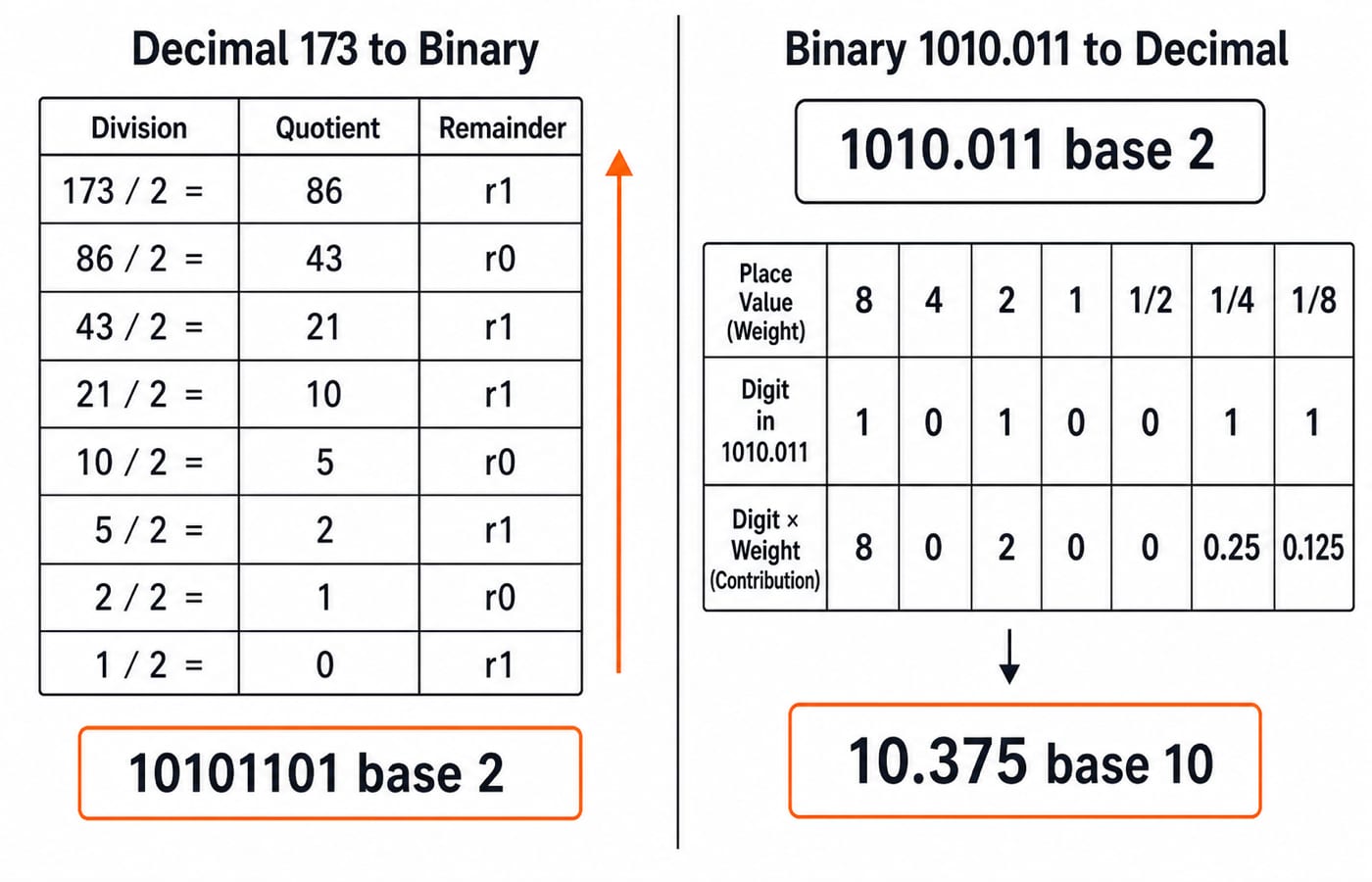
For decimal 173, divide repeatedly: 173 / 2 = 86 r1, 86 / 2 = 43 r0, 43 / 2 = 21 r1, 21 / 2 = 10 r1, 10 / 2 = 5 r0, 5 / 2 = 2 r1, 2 / 2 = 1 r0, 1 / 2 = 0 r1. Reading upward gives 10101101_2.
In the other direction, (1010.011)_2 = 1x2^3 + 0x2^2 + 1x2^1 + 0x2^0 + 0x2^-1 + 1x2^-2 + 1x2^-3 = 8 + 2 + 0.25 + 0.125 = 10.375. Use Number Systems and Base Conversions: GATE Worked Examples when you want a slower concept-first walkthrough.
2. Questions 1-4: radix, positional notation, and valid digits
Question 1 (MPPSC 2025)
Every number system has a "base", base is also called as
A. Power
B. Exponent
C. Radix
D. Operand
Correct answer: C. Radix.
Radix is the number of digit symbols in a positional system. Binary has radix 2 and digits 0, 1. Decimal has radix 10 and digits 0 through 9. Hexadecimal has radix 16 and digits 0 through 9 plus A through F. Powers and exponents describe place weights such as 2^3; an operand is a value used in an operation.
Question 2 (DSSSB 2021)
Which of the following is a non-positional number system?
A. Decimal
B. Roman
C. Octal
D. Binary
Correct answer: B. Roman.
In a positional system, contribution depends on place. The two 2s in decimal 22 contribute 20 and 2. Decimal, octal, and binary all use place weights. Roman numerals instead use symbols and ordering rules, so X does not gain a fixed power-of-base value from its column.
Question 3 (UP Police 2016)
Total different symbols used in hexadecimal number system are ________
A. 8
B. 4
C. 16
D. 2
Correct answer: C. 16.
The full set is 0, 1, 2, 3, 4, 5, 6, 7, 8, 9, A, B, C, D, E, F. That is ten numeric symbols plus six letter symbols, so 10 + 6 = 16. The largest single hexadecimal digit is F, which represents decimal 15.
Question 4 (UGC NET 2024)
Consider the given number (45)_y, where y is the base of the number. Some of the possible values of y are given below.
(A) 5
(B) 6
(C) 7
(D) 8
Choose the correct answer from the options given below:
A. (A), (B) and (C) Only
B. (B), (C) and (D) Only
C. (A), (C) and (D) Only
D. (A), (B), (C) and (D)
Correct answer: B. (B), (C) and (D) Only.
A base must be greater than every digit in the number. The highest digit in (45)_y is 5, so y > 5. Base 5 is invalid because its digits stop at 4. Bases 6, 7, and 8 allow both digits, making (B), (C), and (D) the valid set.
3. Questions 5-7: decimal to binary and minimum bit width
Question 5 (UGC NET 2020)
What is the binary number for decimal number 9?
A. 1100
B. 1001
C. 0111
D. 1011
Correct answer: B. 1001.
Use place values: 9 = 8 + 1 = 2^3 + 2^0. The coefficients of 8, 4, 2, 1 are therefore 1, 0, 0, 1, giving 1001_2. As a check, distractor 1011_2 = 8 + 2 + 1 = 11, not 9.
Question 6 (Beltron Programmer 2025)
What is the binary equivalent of the unsigned decimal number 173?
A. 10101101
B. 10101100
C. 10101111
D. 10101011
Correct answer: A. 10101101.
The repeated divisions in Section 1 produce remainders that read upward as 10101101_2. Verify independently by place values: 10101101_2 = 128 + 32 + 8 + 4 + 1 = 173. Option B clears the final bit and equals 172, so the least significant 1 is necessary.
Question 7 (DSSSB 2022)
How many bits should there be in a binary number that is equivalent to decimal number 780?
A. 10
B. 9
C. 8
D. 11
Correct answer: A. 10.
Bracket 780 between consecutive powers: 2^9 = 512 <= 780 < 1024 = 2^10. Nine bits represent unsigned values only up to 2^9 - 1 = 511, while ten bits cover 780. Check by expansion: 780 = 512 + 256 + 8 + 4, so 780_10 = 1100001100_2, a ten-bit number.
4. Questions 8-10: binary integers and fractions to decimal
Question 8 (UGC NET 2025)
The decimal number equivalent to binary digit 110 is __________.
A. 4
B. 5
C. 6
D. 7
Correct answer: C. 6.
Label the positions 2^2, 2^1, 2^0. Then 110_2 = 1x4 + 1x2 + 0x1 = 6. The value 7 would require every weight, which is 111_2, not 110_2.
Question 9 (UP LT Grade 2026)
The decimal conversion of binary number (1010.011)_2 is:
A. (10.395)_10
B. (10.375)_10
C. (11.395)_10
D. (11.375)_10
Correct answer: B. (10.375)_10.
Split at the point. The integer part is 1010_2 = 8 + 2 = 10. The fraction is .011_2 = 0x1/2 + 1x1/4 + 1x1/8 = 0.375. Therefore 10 + 0.375 = 10.375. The first position after a binary point is 2^-1, not a decimal tenths place.
Question 10 (RSSB 2023)
Convert the fractional number 0.1011 to decimal. Choose the correct answer.
A. 6875
B. 0.6875
C. 0.6900
D. 6900
Correct answer: B. 0.6875.
The stem sits in a binary context, so read 0.1011 as a binary fraction. Expand its fractional positions: 0.1011_2 = 1/2 + 0/4 + 1/8 + 1/16 = 0.5 + 0.125 + 0.0625 = 0.6875. Dropping the point produces distractors 6875 and 6900, while rounding too early can tempt 0.6900.
5. Questions 11-12: decimal to base 4 and one binary value in three bases
Question 11 (DSSSB 2018)
Which of the following is the base-4 representation of the decimal number 213?
A. (1111)_4
B. (3113)_4
C. (3133)_4
D. (3111)_4
Correct answer: D. (3111)_4.
Divide by 4: 213 / 4 = 53 r1, 53 / 4 = 13 r1, 13 / 4 = 3 r1, 3 / 4 = 0 r3. Reading upward gives 3111_4. Verify it: 3x4^3 + 1x4^2 + 1x4 + 1 = 192 + 16 + 4 + 1 = 213.
Question 12 (RSSB 2022)
Binary 101110.11 is equal to:
A. (56.6)₈ Only
B. (46.75)₁₀ Only
C. (2E.C)₁₆ Only
D. All options are correct
Correct answer: D. All options are correct.
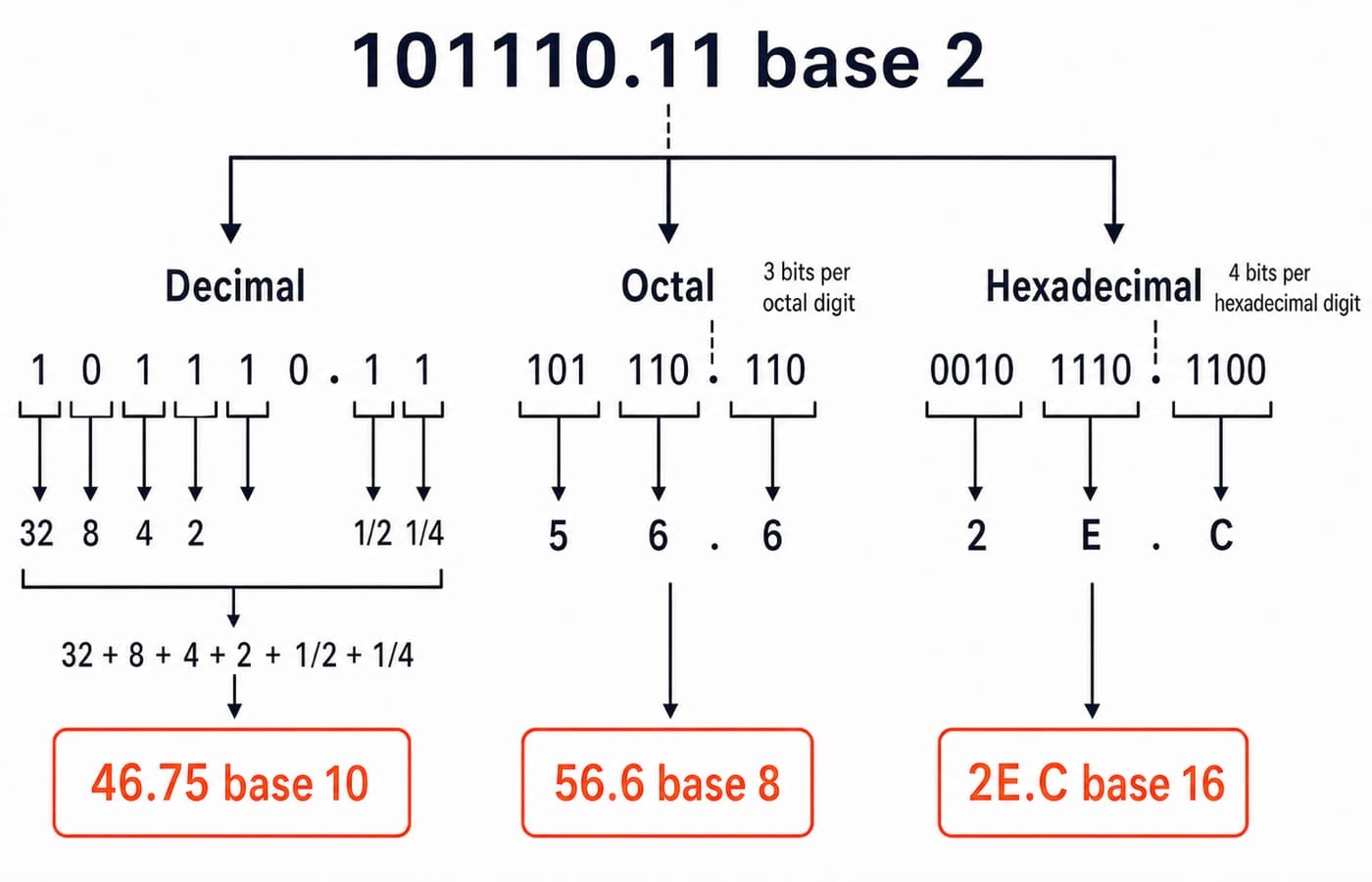
Check every representation. In decimal, 101110.11_2 = 32 + 8 + 4 + 2 + 1/2 + 1/4 = 46.75. For octal, group as 101 110 . 110, which maps to 56.6_8. For hexadecimal, pad outward and group as 0010 1110 . 1100, giving 2E.C_16. A, B, and C are true, so D is correct.
6. The conversion error ledger
Mistake | Why it happens | What goes wrong | What to do instead |
|---|---|---|---|
Calling any symbol string valid in any base | The base looks like a label |
| Require each digit to be smaller than the base; |
Reading remainders top-down | The table suggests normal reading order | For 173, top-down gives | Reverse it to get |
Continuing integer powers after the point | The radix point is ignored |
| Use |
Guessing bit width from decimal digits | Decimal length is confused with binary range | Three decimal digits suggest a fixed bit count | Use |
Grouping from the far left | The point is not the anchor | Octal or hexadecimal groups shift | Start at the point and pad outward: |
Whenever the arithmetic is short, convert your chosen option back to the source base. For Question 11, 3111_4 = 3x4^3 + 1x4^2 + 1x4 + 1 = 213 in one line.
7. The short version and the next practice step
Write the source and target bases first. Reject every digit that is not smaller than its base. Use positional expansion when going to decimal and repeated division when leaving a decimal integer. On the fractional side, use negative powers for decimal conversion or grouping for octal and hexadecimal.
Make this a 15-minute drill. Spend 8 minutes answering all 12 without explanations, 5 minutes writing the first incorrect step for every miss, and 2 minutes converting two correct answers back. The next day, redo only the missed items without looking at the options. For broader practice, move to Digital Electronics MCQs.
If you want a structured fundamentals route, continue with Zero to Hero: Complete CS Course. For placement-focused revision, use CS Fundamentals for Placements by Sanchit Sir.
Keep learning
Special Logic Circuits MCQs: 12 Solved Questions on Adders, Encoders, PLA and DAC
Solve 12 special logic circuits MCQs covering recognition, hardware counts, Boolean identities and numerical calculations. Each answer includes the reasoning you should reproduce in an exam.
19 Sep 20268 min readDigital Electronics MCQs
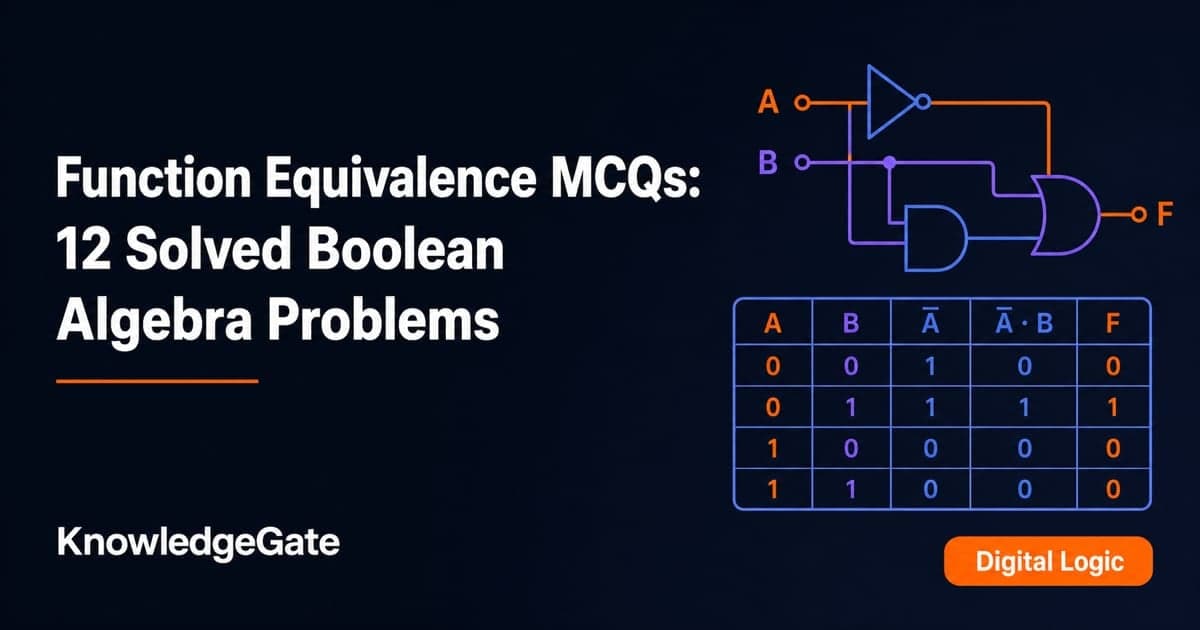
Function Equivalence MCQs: 12 Solved Boolean Algebra Problems
Solve 12 function-equivalence questions step by step, from De Morgan's law and absorption to minterm sets, counterexamples and a four-option MSQ.
Updated 17 Sep 20268 min readDigital Electronics MCQs

CLA & Arithmetic Logic MCQs: 10 Solved Questions with Explanations
Solve ten CLA and arithmetic logic MCQs with compact workings for carry equations, timing paths, hardware sizing and operand-pair counting.
Updated 16 Sep 20267 min readDigital Electronics MCQs
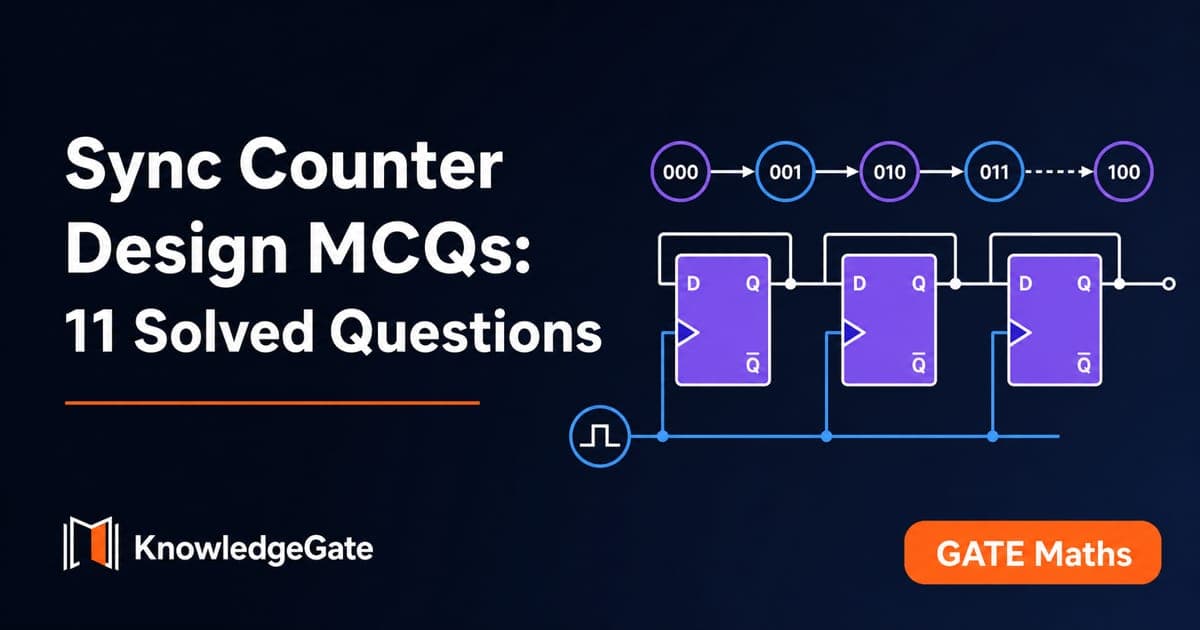
Sync Counter Design MCQs: 11 Solved Questions on Modulus, State Sequences and Excitation Logic
Solve 11 synchronous-counter questions covering modulus boundaries, repeated outputs, common-clock tracing, excitation equations, enables and composite states.
Updated 14 Sep 20267 min readDigital Electronics MCQs