1's Complement MCQs: 10 Solved Questions with Explanations
Solve 10 previous-year MCQs on 1's complement, signed magnitude, binary fractions, radix complements and fixed-point representation. Each explanation shows the decisive conversion or range check.
KnowledgeGate Team
Exam prep & CS education
Updated 8 Aug 20267 min read54 views
Knowing that 1's complement means flipping bits is not enough. You can still lose the answer by forgetting the fixed width, confusing sign-magnitude with 1's complement, or treating the radix point as a digit. All ten questions below are previous-year problems: GATE 1998, 1999, 2002, 2017 and 2019, UGC NET 2011, DSSSB 2018 and 2021, AMCAT 2025 and Bihar STET 2025. They run from signed zero and the symmetric range through binary fractions, radix complements and fixed-point width. For each question, choose an option and write one conversion line before reading the explanation. That small pause exposes whether you know the rule or merely recognise it. More GATE CS topic guides are listed under GATE CS Exam Preparation.
Fix the width first: sign-magnitude, 1's complement and end-around carry
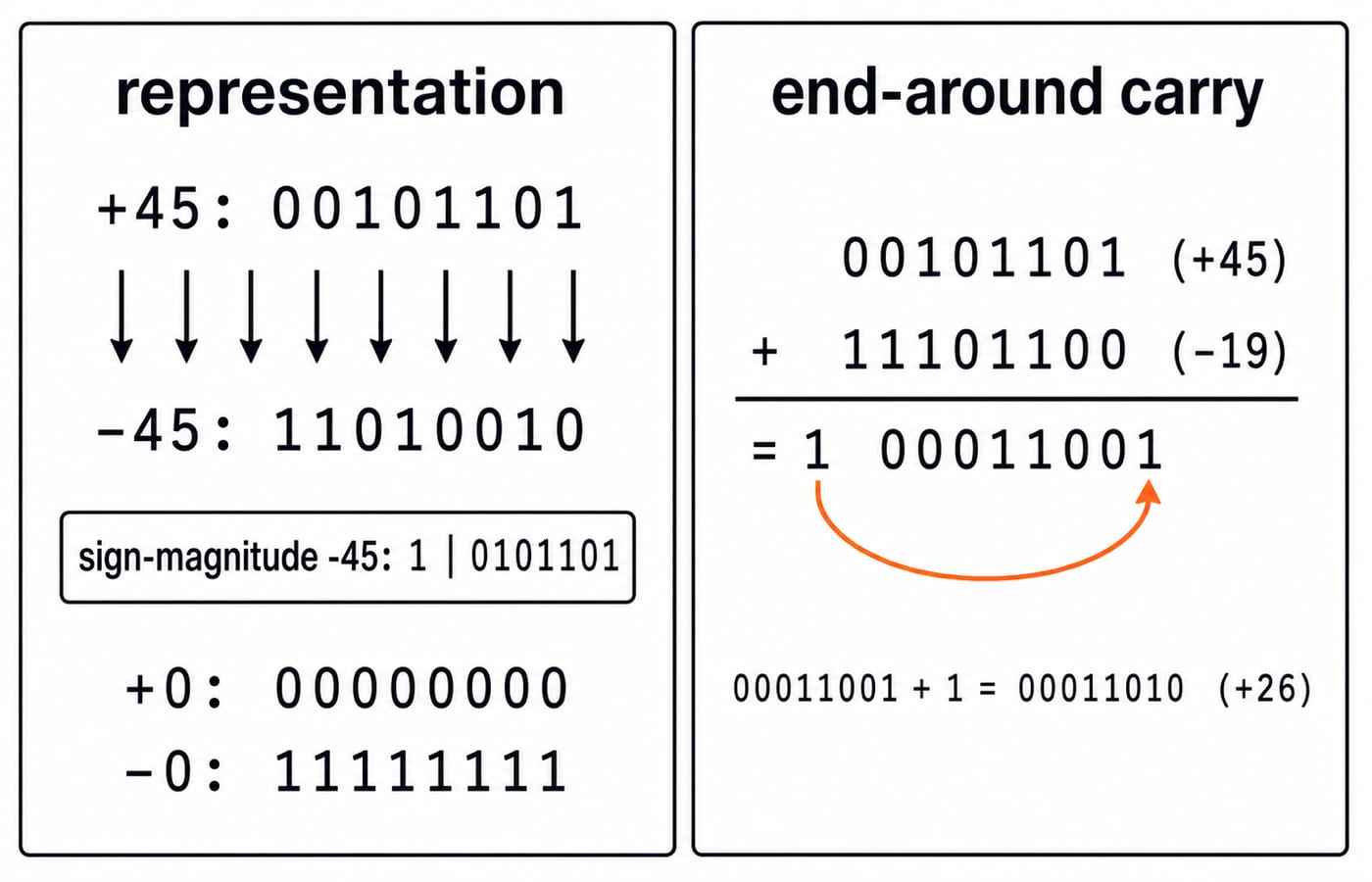
An n-bit sign-magnitude value uses one sign bit and n-1 magnitude bits. An n-bit 1's-complement negative value is made by flipping every bit of the fixed-width positive form. Its range is -(2^(n-1)-1) through +(2^(n-1)-1). It also has two zeros. In eight bits, they are 00000000 and 11111111.
The fixed width matters because leading zeros participate in the flip. Dropping them changes the pattern and can change the represented value.
For example, +45 = 00101101. Flip all eight bits to get -45 = 11010010. Flipping that result again recovers 00101101 = 45. Sign-magnitude is different: -45 = 10101101, or 1 | 0101101.
Now add +45 and -19. We have +19 = 00010011, so -19 = 11101100 in 1's complement.
  00101101
+ 11101100
=1 00011001
Add the carry-out back to the low bit. This second addition is the end-around carry: 00011001 + 1 = 00011010 = +26.
If the conversions need a refresh, read Number Systems and Base Conversions first.
1's complement MCQs 1 and 2: two zeros and the symmetric range
Question 1
Appeared in GATE 1999. Find it in the number-representation PYQ list.
Zero has two representations in:
a) Sign-magnitude representation
b) 1's complement representation
c) 2's complement representation
d) None of the above
A. Only a
B. a and b
C. a and c
D. a, b and c
Correct answer: B. a and b.
In four-bit sign-magnitude, zero can be 0000 or 1000. In four-bit 1's complement, it can be 0000 or 1111. Two's complement has only 0000: invert zero and add one, and the discarded carry returns the same pattern. Statements a and b are therefore true.
Question 2
Appeared in Bihar STET 2025. See the full solution.
The range of numbers that can be represented in an n-bit 1's complement system is from:
A. -2^(n-1) to 2^(n-1) - 1
B. 0 to 2^n - 1
C. -(2^(n-1) - 1) to 2^(n-1) - 1
D. -2^n to 2^n - 1
Correct answer: C. -(2^(n-1) - 1) to 2^(n-1) - 1.
The 2^n patterns mirror positive and negative magnitudes, but two patterns encode zero. With n=4, 0000 is +0, 0111 is +7, 1000 is -7, and 1111 is -0. The range is -7 to +7, which generalises to option C. Option A is the two's-complement range.
MCQs 3 to 5: signed magnitude, binary fractions and a negative fraction
Question 3
Appeared in AMCAT 2025. See the full solution.
Express -15 as a 6-bit signed binary number.
A. 001111
B. 101111
C. 101110
D. 001110
Correct answer: B. 101111.
The options make sign-magnitude the intended convention. Six bits give one sign bit and five magnitude bits. Since 15 = 01111, attach the negative sign bit: 1 | 01111 = 101111. A stem that says only "signed binary" is otherwise ambiguous. In six-bit 1's complement, -15 would be 110000.
Question 4
Appeared in GATE 2002. Find it in the number-representation PYQ list.
The decimal value 0.25 is:
A. is equivalent to the binary value 0.1
B. is equivalent to the binary value 0.01
C. is equivalent to the binary value 0.00111....
D. cannot be represented precisely in binary
Correct answer: B. is equivalent to the binary value 0.01.
Binary fractional places have weights 1/2, 1/4, 1/8, and so on. Thus 0.1₂ = 1/2, while 0.01₂ = 0/2 + 1/4 = 0.25₁₀. It terminates exactly because 0.25 is a power-of-two fraction. Continue with Number System MCQs: 12 Solved GATE Questions for mixed base-conversion practice.
Question 5
Appeared in UGC NET 2011. See the full solution.
8-bit 1’s complement form of −77.25 is
A. 01001101.0100
B. 01001101.0010
C. 10110010.1011
D. 10110010.1101
Correct answer: C. 10110010.1011.
First, 77 = 64 + 8 + 4 + 1, so +77 = 01001101. Also, 0.25 = 0.01₂, padded to four fractional places as .0100. Therefore +77.25 = 01001101.0100. Flip every stored bit on both sides, leaving the radix point in place: 01001101.0100 -> 10110010.1011. Option D fails because .1101 is not the inverse of .0100.
MCQs 6 and 7: radix complements in base 7 and hexadecimal
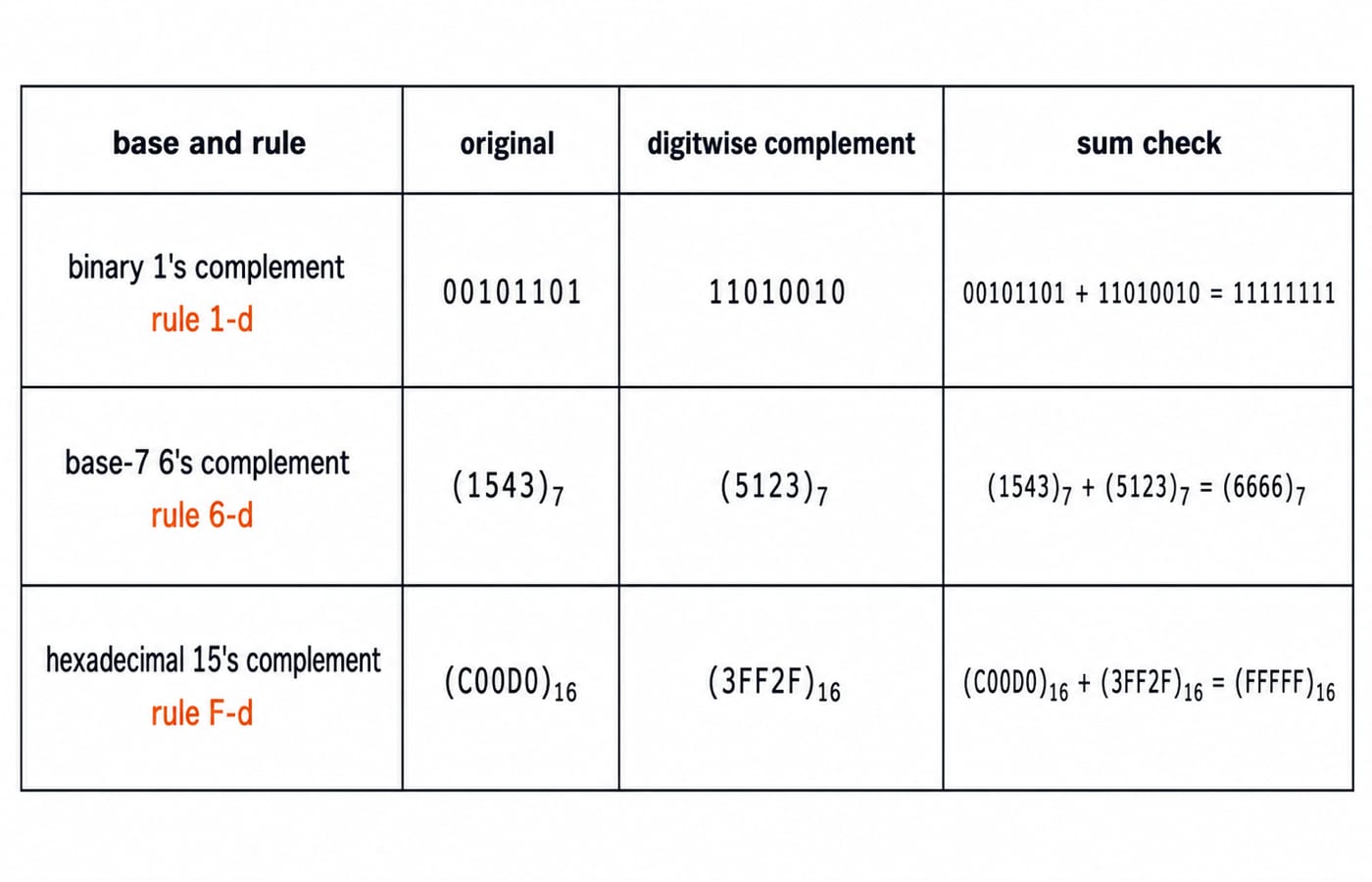
The (r-1)'s complement of a fixed-width base-r number is found digit by digit: subtract every digit from r-1. Do not add 1, since that would make the r's complement. As a check, add the original and its complement. The result must be a full row of r-1 digits.
Question 6
Appeared in DSSSB 2021. See the full solution.
What is the 6’s complement of (1543)₇?
A. (6132)₇
B. (5132)₇
C. (5123)₇
D. (5432)₇
Correct answer: C. (5123)₇.
Subtract without borrowing: 6-1=5, 6-5=1, 6-4=2, and 6-3=3. This gives (5123)₇. The check is (1543)₇ + (5123)₇ = (6666)₇. Option B swaps the complements of the last two digits.
Question 7
Appeared in DSSSB 2018. See the full solution.
What is the 15's complement of the hexadecimal number (C00D0)₁₆?
A. (2FF3F)₁₆
B. (3FF2F)₁₆
C. (3EE2E)₁₆
D. (2EE3E)₁₆
Correct answer: B. (3FF2F)₁₆.
In hexadecimal, 15 is F. Apply F-C=3, F-0=F, F-0=F, F-D=2, and F-0=F. The result is (3FF2F)₁₆, checked by (C00D0)₁₆ + (3FF2F)₁₆ = (FFFFF)₁₆. A 15's-complement operation has no carry or add-one step.
MCQs 8 and 9: fixed-point range and the width of a signed result
Question 8
Appeared in GATE 2017. See the full solution.
The n-bit fixed-point representation of an unsigned real number X uses f bits for the fraction part. Let i = n - f. The range of decimal values for X in this representation is
A. 2^(-f) to 2^i
B. 2^(-f) to (2^i - 2^(-f))
C. 0 to 2^i
D. 0 to (2^i - 2^(-f))
Correct answer: D. 0 to 2^i - 2^(-f).
An all-zero unsigned word gives the minimum, 0. The maximum has every bit set: (2^i-1) + (1-2^-f) = 2^i-2^-f. Check n=8, f=3, i=5: 11111.111₂ = 31 + 7/8 = 31.875 = 32 - 0.125.
Question 9
Appeared in GATE 2019. See the full solution.
Consider Z = X – Y, where X, Y and Z are all in sign-magnitude form. X and Y are each represented in 𝑛 bits. To avoid overflow, the representation of Z would require a minimum of:
A. 𝑛 bits
B. 𝑛 − 1 bits
C. 𝑛 + 1 bits
D. 𝑛 + 2 bits
Correct answer: C. 𝑛 + 1 bits.
An n-bit sign-magnitude operand has maximum magnitude 2^(n-1)-1. The largest possible magnitude of X-Y is +(2^(n-1)-1) - (-(2^(n-1)-1)) = 2^n-2. That needs n magnitude bits and one sign bit, or n+1 bits total. For n=4, +7 - (-7) = +14, represented as 0 | 1110 in five bits.
Next, use Number Representation and Floating Point MCQs for another representation set. Fixed-point layout and floating-point encoding are different systems.
MCQ 10 and the traps that connect storage to representation
Question 10
Appeared in GATE 1998. See the full solution.
Suppose the domain set of an attribute consists of signed four digit numbers. What is the percentage rate of reduction in storage space of this attribute if it is stored as an integer rather than in character form?
A. 80%
B. 20%
C. 60%
D. 40%
Correct answer: C. 60%.
Under the storage model intended here, character form needs five bytes, one for the sign and four for the digits. A two-byte integer stores the same domain. The saving is 5-2=3 bytes, so the reduction is (3/5) × 100 = 60%. Those assumed byte counts matter. This is not a context-free rule for every language or database.
Before selecting an answer, audit four traps:
Fix the width before flipping any bit.
Do not add 1 for a 1's or
(r-1)'s complement.For a fraction, flip stored bits on both sides of the radix point, not the point.
Distinguish sign-magnitude from 1's complement when a stem merely says "signed binary".
The 20-second routine is simple: label the encoding, write the width or radix, apply the digit rule, then reverse the operation or add the original to reach all 1 or r-1 digits. Select the option only after that check.
Answer-pattern audit and the next practice step
The answer sequence is B, C, B, B, C, C, B, D, C, C. The useful memory is the reason pattern behind it: two zeros, a symmetric 1's-complement range, an explicit signed encoding, powers-of-two fractions, digitwise (r-1) complements, and width derived from the largest possible magnitude.
Redo Questions 5, 7 and 9 without looking. They test three separate operations: flipping fractional bits, applying a radix complement, and sizing a result before arithmetic. When those checks are automatic, use the GATE Test Series for timed practice across the wider syllabus. Record the rule behind any wrong option, not just the correct letter.
Keep learning
Special Logic Circuits MCQs: 12 Solved Questions on Adders, Encoders, PLA and DAC
Solve 12 special logic circuits MCQs covering recognition, hardware counts, Boolean identities and numerical calculations. Each answer includes the reasoning you should reproduce in an exam.
19 Sep 20268 min readDigital Electronics MCQs
Function Equivalence MCQs: 12 Solved Boolean Algebra Problems
Solve 12 function-equivalence questions step by step, from De Morgan's law and absorption to minterm sets, counterexamples and a four-option MSQ.
Updated 17 Sep 20268 min readDigital Electronics MCQs
CLA & Arithmetic Logic MCQs: 10 Solved Questions with Explanations
Solve ten CLA and arithmetic logic MCQs with compact workings for carry equations, timing paths, hardware sizing and operand-pair counting.
Updated 16 Sep 20267 min readDigital Electronics MCQs
Sync Counter Design MCQs: 11 Solved Questions on Modulus, State Sequences and Excitation Logic
Solve 11 synchronous-counter questions covering modulus boundaries, repeated outputs, common-clock tracing, excitation equations, enables and composite states.
Updated 14 Sep 20267 min readDigital Electronics MCQs