

Physical Security Controls and Access Management: Three-Zone Worked Example and Exam Notes
Learn how layered physical controls work with authentication, authorization and audit. Then test four requests against a complete three-zone access policy.
KnowledgeGate Team
Exam prep & CS education
Updated 20 Nov 20266 min read
A lock, camera, badge and biometric reader are easy to list. The harder question is what each control actually does, and why a person who authenticates successfully can still be denied access. Assets and zone boundaries define the context; authentication, authorization and accountability distinguish the decisions; the three-zone policy determines whether each request is allowed.
Physical security controls protect assets through layers
Physical security protects people, facilities, equipment, media and utilities from unauthorised access, damage, interference, theft and environmental disruption. Though distinct from logical security, it cannot be isolated. A stolen server, restricted-room device or power cut can bypass strong software controls.
Control function | Deployed purpose | Example |
|---|---|---|
Deterrent | Discourages attempts | Lighting and warning signs |
Preventive | Blocks or restricts | Fence and turnstile |
Detective | Discovers and records | Door contact and CCTV alert |
Corrective | Limits damage after detection | Guard response |
Recovery | Restores operation | Alternate power and access-controller restoration |
Compensating | Supplies an alternate safeguard | Staffed sign-in while a badge reader is down |
Classify by deployed purpose, not device. A badge-checking guard is preventive; one watching cameras is detective. Cameras help only with defined recording, monitoring and response.
Layered physical security: perimeter, building, room and rack
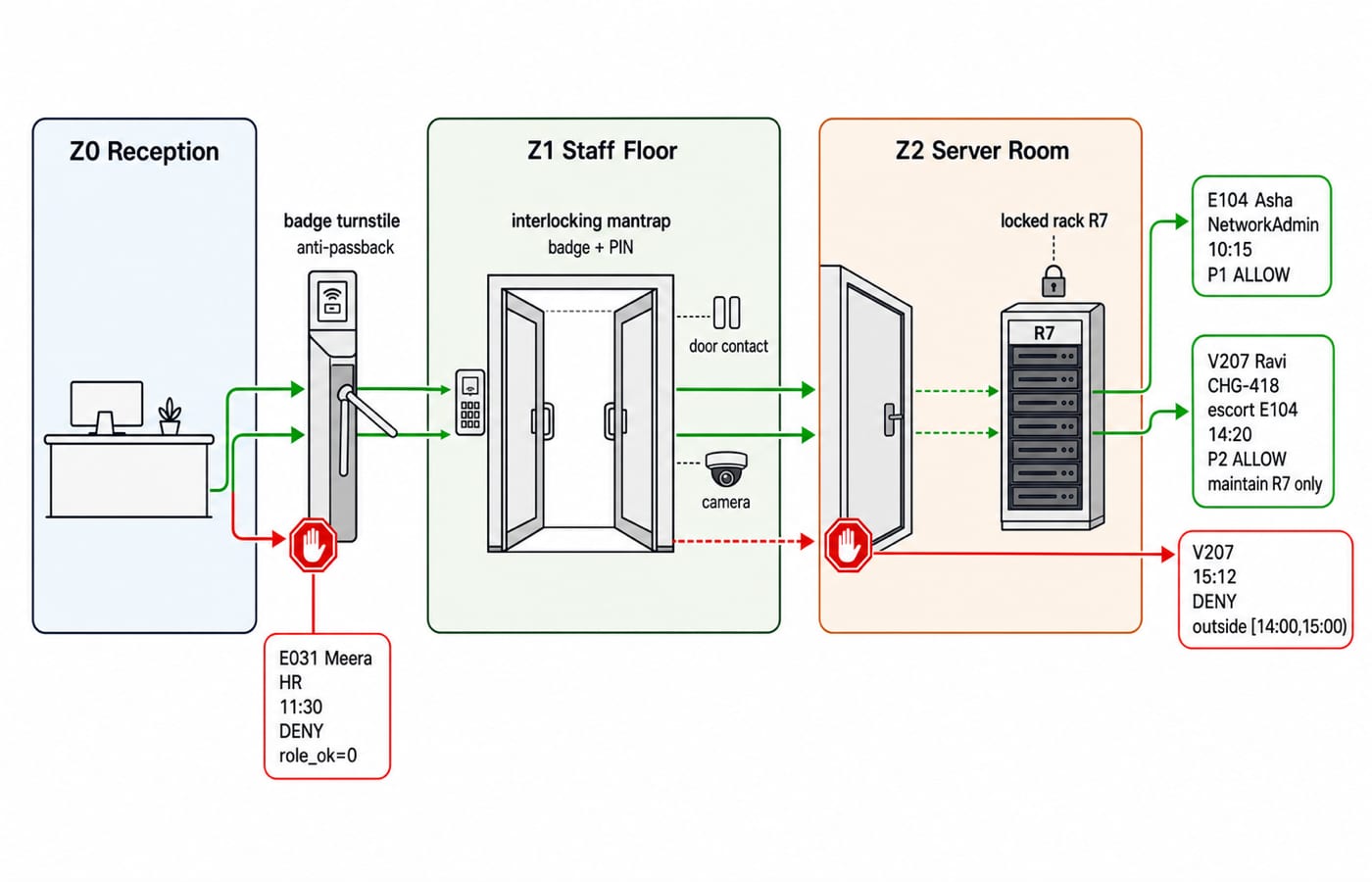
Defence in depth nests boundaries around an asset. Facility: Z0 Reception, Z1 Staff Floor, Z2 Server Room, rack R7 inside Z2. The site boundary uses lighting and a monitored gate. Z0 to Z1 has a badge turnstile with anti-passback. Z1 to Z2 has an interlocking mantrap, badge plus PIN, door contact and camera. R7 adds a lock and separate maintenance permission.
Each boundary needs prevention, detection and response. A reader rejects an inactive badge and logs the attempt, but cannot stop tailgating alone. The mantrap and occupancy sensor address that path. A door contact detects forcing or holding; response procedures determine what follows.
Two identical readers at one door mainly add availability, not layers. A badge, PIN, mantrap, monitored alarm and guard response address different failure paths.
Access management: identify, authenticate, authorize and account
Identification claims identity E104; authentication checks its evidence. Authorization decides whether that subject may perform an action on a resource. Accountability records who requested what, when, where and with which result. The exam trap: a valid badge or PIN can authenticate someone while policy denies Z2.
Apply default deny, least privilege, need-to-know, separation of duties, time bounds and prompt revocation. A PIN is known, a badge held, and a fingerprint inherent. Badge plus PIN uses two factor types; two badges do not.
Model | Decision basis |
|---|---|
DAC | An owner grants access to an owned resource |
MAC | Central classifications and clearances that ordinary users cannot change |
RBAC | Permissions assigned to roles such as |
ABAC | Subject, resource, action and environmental attributes such as status, zone, ticket and time |
The worked facility combines RBAC with ABAC conditions.
Worked example: evaluate four requests against the three-zone policy
Declare the whole policy first. P1 permits employee entry to Z2 when role=NetworkAdmin, badge_active=1, PIN_ok=1 and 08:00 <= time < 20:00. P2 permits vendor entry only when badge_active=1, ticket=CHG-418, escort_role=NetworkAdmin and 14:00 <= time < 15:00. The vendor may only maintain R7, never use general consoles or other racks. P3 denies every unmatched request. Both intervals are half-open, excluding the end time.
Request | Authentication | Authorization inputs | Boolean result | Decision |
|---|---|---|---|---|
Asha | Active badge, correct PIN | Employee, |
| P1 allows entry |
Ravi | Active temporary badge |
|
| P2 allows only those actions |
Ravi | Temporary badge expired at 15:00 | Ticket and escort match, time outside |
| P3 denies entry |
Meera | Active badge, correct PIN | Employee, HR role, P1 time |
| P3 denies entry |
Audit records include an allowed Z2 entry by V207 at 14:20:08 under P2 for CHG-418, with E104 as escort, and a denied Z2 entry by V207 at 15:12:03 because it was outside the permitted window. The first supports accountability, not prevention. The second fails on two counts at once: the temporary credential expired at 15:00 and the time falls outside the permitted window. Meera's 11:30 attempt is the cleaner split, where authentication succeeds and authorization fails.
Access lifecycle and audit: joiner, mover, leaver and review
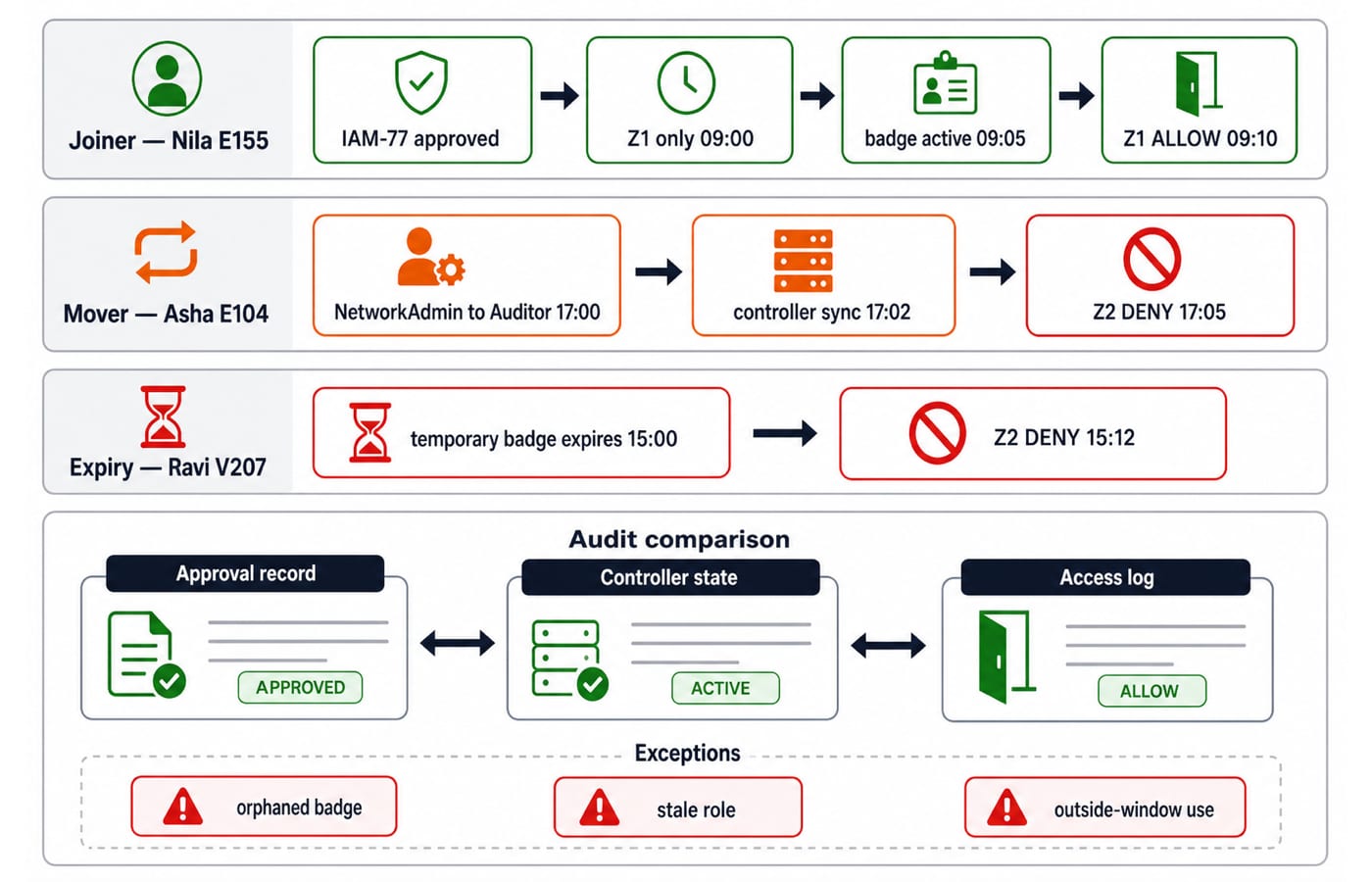
The lifecycle is: request access, establish identity, obtain approval, assign minimum roles and attributes, issue and activate the credential, synchronise enforcement points, monitor and review use, modify after role change, then revoke credentials and sessions. Approval, provisioning and enforcement are separate states that must reconcile.
Joiner:
IAM-77grants NilaE155Z1 only at09:00. Her badge activates at09:05; Z1 entry at09:10is allowed.Mover: Asha
E104changes fromNetworkAdmintoAuditorat17:00. The controller receives the change at17:02, and her Z2 request at17:05is denied.Leaver or expiry: Ravi's temporary credential expires at
15:00, so his15:12request is denied.
Review the approved role, controller configuration and access log. Flag orphaned badges, outside-window access and permissions surviving a role change.
Physical security and access-control traps
CCTV prevents entry-> Incomplete. It is principally detective unless paired with monitoring and response.A valid badge means access must be allowed-> False. Authentication may succeed while authorization fails.RBAC checks only a person's name-> False. Permissions attach to roles, then people receive roles.MAC lets the resource owner delegate-> False. Central labels and clearances govern mandatory access control.
Shared badges destroy accountability, so issue individual credentials. Held-open doors bypass readers, so monitor contacts and respond. Post-transfer access violates least privilege, so trigger prompt reprovisioning and review.
Physical access control means entry to places and equipment, not data-link medium access control. Do not confuse mandatory access control with Media Access Control.
Physical security questions: a repeatable exam method
Use four steps: identify asset and boundary; name subject, action and resource; separate authentication from authorization; classify the control or test every condition. Apply default deny if one fails.
Three quick drills:
Badge accepted, HR role requests Z2: authenticated but unauthorized, so deny.
Camera records a forced door and sends an alert: detective, with response needed for correction.
A resource owner grants a colleague read permission: DAC. A centrally imposed clearance rule is MAC.
Physical Security and Cryptography Basics: Controls, Keys and Worked Examples owns the wider connection between facility controls, risk scoring and cryptographic primitives. This post instead tests request-level authorization and joiner-mover-leaver evidence in one three-zone policy. Use the NET CS Exam category for broader preparation, and check your exam body's current notification for syllabus scope and paper pattern.
Physical security controls and access management: the short version
Recall: layer boundaries; combine prevention, detection and response; authenticate the subject; authorize the exact action under least privilege and context; log, review and revoke. Asha at 10:15 and escorted Ravi at 14:20 are allowed within their permissions. Ravi at 15:12 and Meera are denied.
Redraw the policy and recompute all four decisions from scratch. For the lab-assistant route, the BTSC Lab Assistant (CS) 2026 Course carries these topics further; for the operator route, use the UP Police Computer Operator Course.
Go deeper with the full courseGATE Guidance by Sanchit Sir
Keep learning

Physical Security Assets and Risk Factors: Worked Audit, Controls and Exam Traps
Follow a fictional college server-room audit from asset inventory to residual risk. Calculate four priorities, test power continuity, and avoid common exam traps.
Updated 6 Nov 20266 min readUGC NET Computer Science

Physical Security and Disaster Control: Layered Controls, RPO and RTO Worked Example
Learn how physical controls, disaster planning and recovery targets work together. Follow an exact incident timeline to test RPO, RTO and a warm standby.
Updated 6 Nov 20266 min readTeaching Recruitment (Computer Science)

Physical Security and Cryptography Basics: Controls, Ciphers and Worked Examples
Connect physical and logical security through Lab L-07. Learn layered controls, calculate residual risk, trace XOR, compare SHA-256 outputs and choose the right primitive.
Updated 25 Oct 20265 min readDSA & Algorithms

Physical Security and Cryptography Basics: Controls, Keys and Worked Examples
Learn how physical and cryptographic controls work together, then apply them in a four-asset server-room model and a step-by-step toy RSA example.
Updated 13 Oct 20265 min read50 viewsDSA & Algorithms