Infosys Assessment Recovery Plan: A 4-Week Schedule for Pseudocode, Puzzles and Verbal Ability
Use one diagnostic and a weekly reallocation rule to repair weak pseudocode, puzzle and verbal skills. Follow Riya through four weeks of worked practice.
KnowledgeGate Team
Exam prep & CS education
Updated 4 Sep 20266 min read
Four weeks can disappear into the section that already feels comfortable while pseudocode tracing, constraint puzzles or verbal accuracy stays below a usable level. Start with a baseline, apply a repeatable minute-allocation rule, work through three examples, retest weekly and use a missed-day rescue rule. Build the diagnostic from your own practice questions and use it to compare your weekly scores; once you have classified one mock's errors, carry them into a four-week calendar whose minutes change after every retest. For a broader view of sections and preparation, follow the Infosys Placement Preparation: Sections, Roles, Study Plan.
Start with a 30-question baseline, not your favourite topic
Take 30 questions in 60 minutes: 10 pseudocode traces, 10 constraint puzzles and 10 verbal questions, 20 minutes per bucket. Score +1 for correct, 0 for wrong or skipped, with no assumed negative marking.
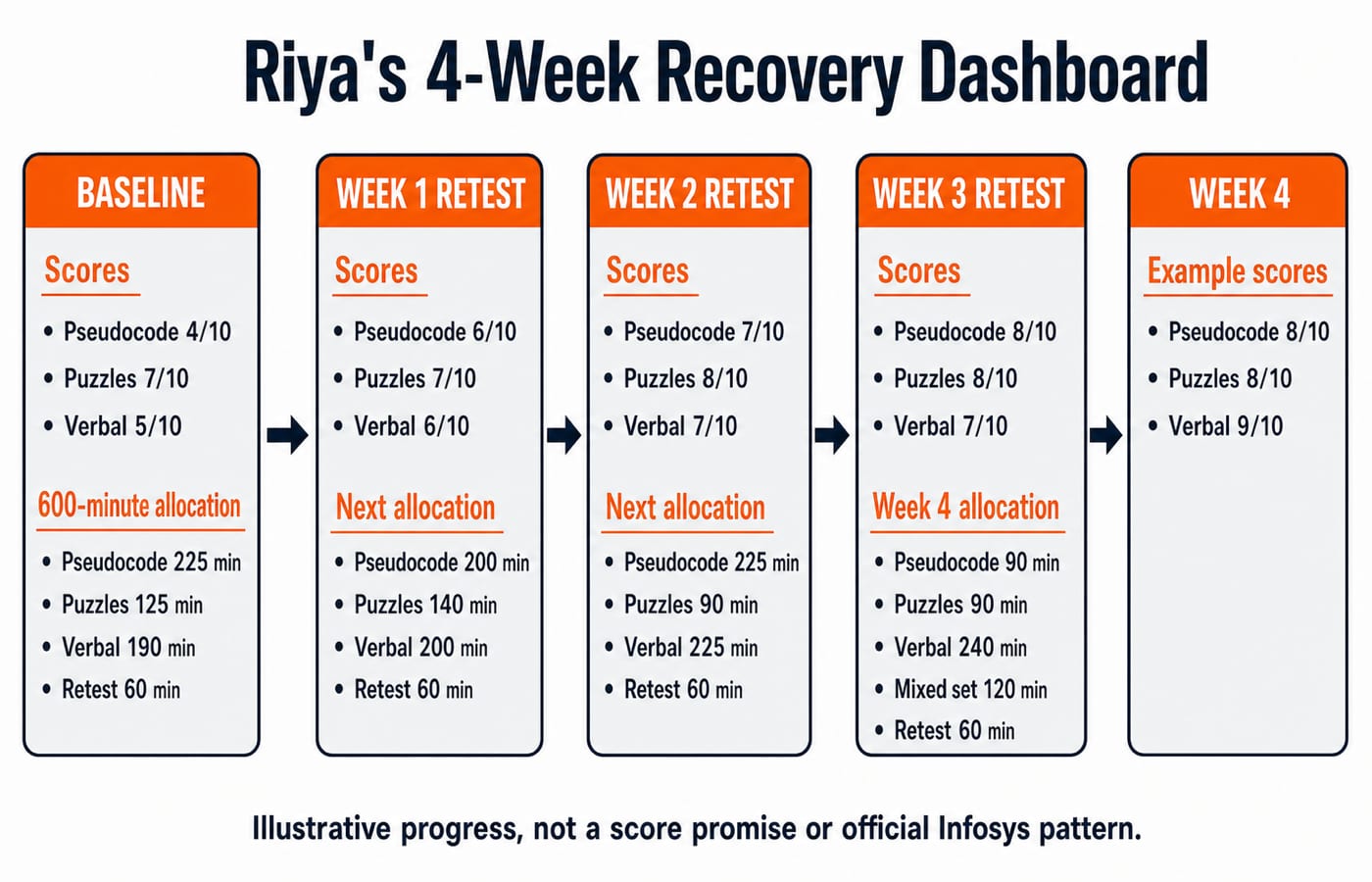
Hypothetical learner Riya scores pseudocode 4/10, puzzles 7/10 and verbal 5/10, giving 16/30. Her pseudocode misses are bad trace updates and operator or condition slips, her puzzle misses are missed constraints and timing, and her verbal misses are inference, vocabulary in context and rushed grammar.
Repair 4/10 first, 5/10 second, and maintain 7/10. Never let one strong bucket hide a weak one.
Turn the baseline into a 10-hour weekly recovery budget
Across six days, split 600 minutes: 60 for the weekly retest, 270 for maintenance at 90 per skill, and 270 distributed by weakness. Leave one day free.
Calculate gap = max(0, 8 - score). Riya's gaps are 4, 1 and 3, totalling 8:
Pseudocode:
270 x 4/8 = 135Puzzles:
270 x 1/8 = 33.75, rounded to 35Verbal:
270 x 3/8 = 101.25, rounded to 100
Add the 90-minute maintenance floor to each: pseudocode 135 + 90 = 225, puzzles 35 + 90 = 125, and verbal 100 + 90 = 190. Check: 225 + 125 + 190 + 60 = 600 minutes.
Day | Work |
|---|---|
Monday | 100 minutes pseudocode |
Tuesday | 95 minutes verbal |
Wednesday | 100 minutes puzzles |
Thursday | 100 minutes pseudocode |
Friday | 25 pseudocode, 25 puzzles, 50 verbal |
Saturday | 45 verbal error-log review, then the 60-minute retest |
Week 1: rebuild pseudocode tracing one assignment at a time
Use columns i, updated x, condition and updated y. Copy values after assignments, test after updating, and circle the output. The loop includes i = 1, 2, 3, uses integers, and MOD means remainder.
x = 3, y = 5
FOR i = 1 TO 3
    x = x + i
    IF x MOD 2 = 0
        y = y + x
    ELSE
        y = y - 1
    END IF
END FOR
PRINT x, y
i | Updated x | Condition | Updated y |
|---|---|---|---|
1 | 4 |
| 9 |
2 | 6 |
| 15 |
3 | 9 |
| 14 |
Output: 9, 14. Traps are testing parity before updating x, resetting y, and treating MOD as division. Split 225 minutes into 75 each for slow tracing, operator and condition drills, and timed mixed traces. Finish each block by re-solving one error without notes. Apply the same update-first method across the 17 solved traces in Infosys Pseudocode Questions: How to Trace Them Fast, with 17 Solved Examples.
Week 2: solve puzzles by placing constraints before guessing
List entities and slots, place fixed or linked constraints, then test the order. A, B, C, D and E use slots 1 to 5. C is immediately before D, A immediately after D, B before C, and E in slot 5.
The linked block is [C, D, A]. Slots 1 to 3 leave no place for B before C; slots 3 to 5 conflict with E. The block must use slots 2 to 4. B takes slot 1, producing [B, C, D, A, E]. The third presenter is D.
Then use the weekly retest to reallocate time. Riya's Week 1 retest is 6/10, 7/10, 6/10. Gaps 2, 1, 2 give weakness shares of 110, 50, 110; adding 90 maintenance to each produces 200 pseudocode + 140 puzzles + 200 verbal + 60 retest = 600. Use 50 puzzle minutes for untimed tables, 50 for timed sets and 40 for blank-grid re-solves.
Week 3: make verbal answers prove themselves from the sentence
Separate inference, vocabulary in context and grammar in the error log:
A team replaced one long weekly coding test with three shorter drills. Average attempts rose, but the share of correct answers stayed unchanged. The change therefore improved practice frequency, not demonstrated accuracy.
What follows?
A. Shorter drills improved accuracy
B. The team practised more frequently without evidence of higher accuracy
C. The long test was cancelled because scores were low
D. Every learner attempted all three drills
Answer B follows from attempts rose and correct share stayed unchanged. A, C and D add unsupported claims.
Change “Neither the trainees nor the mentor were willing to skip the review” to “Neither the trainees nor the mentor was willing to skip the review”. The nearer subject mentor is singular.
Use the next retest to update the weekly plan. Riya's Week 2 retest is 7/10, 8/10, 7/10. With gaps 1, 0, 1, puzzles receive only their 90-minute maintenance floor, while pseudocode and verbal each add 90 maintenance to a 135-minute weakness share. Thus, 225 pseudocode + 90 puzzles + 225 verbal + 60 retest = 600. Verbal gets 75 minutes for inference, 60 vocabulary, 60 grammar and 30 error replay. The Aptitude Course for Placement supports broader aptitude practice.
Week 4: switch from isolated repair to mixed timed decisions
Repeat the self-made 30-question, 60-minute design. At Riya's Week 3 scores of 8/10, 8/10 and 7/10, only verbal has a gap, so its block would reach 360 minutes (270 weakness + 90 maintenance). Cap it at 240 so one bucket does not swallow the week, then redirect the 120-minute excess to mixed timed sets, this week's real goal: 90 pseudocode + 90 puzzles + 240 verbal + 120 mixed + 60 final retest = 600.
Use two 60-minute mixed sets, each with 10 questions per bucket. Answer clear-method items first, then return to trace-heavy or constraint-heavy ones. Compare each bucket only with your own earlier practice times.
Riya's example finishes at 8/10 pseudocode, 8/10 puzzles and 9/10 verbal, or 25/30 versus 16/30. Stay in recovery if any bucket is below 6/10.
Protect the plan from missed days and misleading scores
Never double the next day. Move the highest-priority 50 minutes to the free day, drop the rest, and keep the 60-minute retest. After two misses, use 30 untimed questions and mark the trend non-comparable.
Turn each wrong answer into a named rule you retest: log question ID, wrong move, correct rule, redo date. Example: P-07 | tested x before x=x+i | update first, then test parity | Thursday. Recovery requires two blank-paper solves on separate days.
Reject memorised sets: they inflate a score you cannot repeat cold. Reject a rising total that hides one bucket still falling, and never mistake faster answering for progress when it is rushed guessing. Judge each bucket's score and error type, not the headline total.
The short version and the next step
Use baseline -> calculate gaps -> allocate 600 minutes -> practise by error type -> retest -> reallocate. Scores 4, 7, 5 create gaps 4, 1, 3 and minutes 225, 125, 190, plus 60 for retesting.
Complete the 30-question diagnostic in 60 minutes and schedule three weekly practice blocks, one per skill. For a shorter week, scale the three allocations equally; if you must shorten the diagnostic, label it non-comparable.
Infosys-focused readers can use the Infosys Superset Preparation Course alongside this plan; the Company-Specific Placement Courses category collects tracks for other recruiters. Run the 30-question baseline first, then let its error pattern, not the comfortable topic, decide where the 600 minutes go.
Keep learning
HCLTech Recruitment Process and Test Pattern: Build Your Drive Map
Build a source-controlled HCLTech drive map from the current role page and invitation, then use worked diagnostics to prepare for each assigned stage.
Updated 23 Oct 20265 min readCompany-Specific Prep
Capgemini Coding Questions: 4 Patterns with Step-by-Step Solutions
Learn four transferable coding patterns through constructed Capgemini preparation examples. Each solution includes an invariant, complete trace, complexity and edge-case checks.
Updated 19 Oct 20266 min readCompany-Specific Prep
Capgemini Placement Preparation: An 8-Week Test-Matched Study Plan
Build an eight-week Capgemini preparation timetable from the route you are actually invited to take. Use two baselines and an error log to decide where every study hour goes.
Updated 15 Oct 20265 min readCompany-Specific Prep
Cognizant Recruitment Process and Test Pattern: What Each Stage Screens
Learn how to read a Cognizant drive invitation, map each possible stage to the skill it screens, and turn the stated test blocks into a focused study plan.
Updated 11 Oct 20265 min readCompany-Specific Prep