Agent Architecture and Program Types in AI: A Worked Warehouse Example and Exam Traps
Separate architecture, program and agent function, then compare four program types through one fully worked warehouse routing problem.
KnowledgeGate Team
Exam prep & CS education
Updated 25 Oct 20266 min read
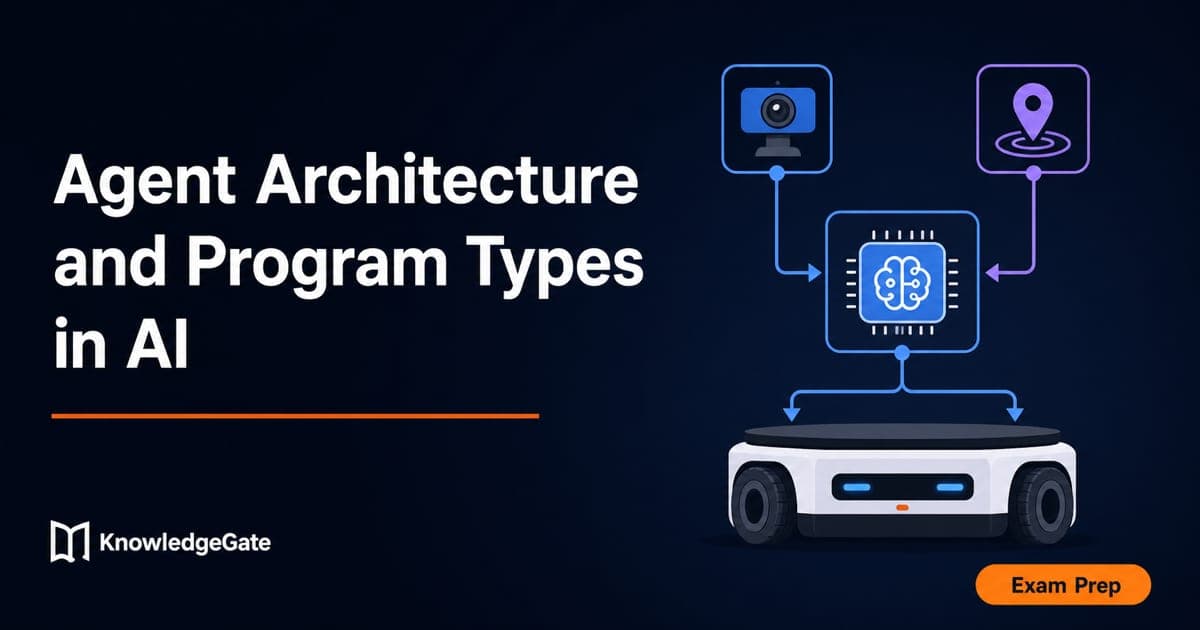
Agent architecture, agent program and agent function describe different layers. The same warehouse robot can host four program types; expected-utility routing, learning and messages show how those layers change its behaviour. For the wider syllabus, use the NET CS Exam category.
Agent architecture, agent function and agent program are different layers
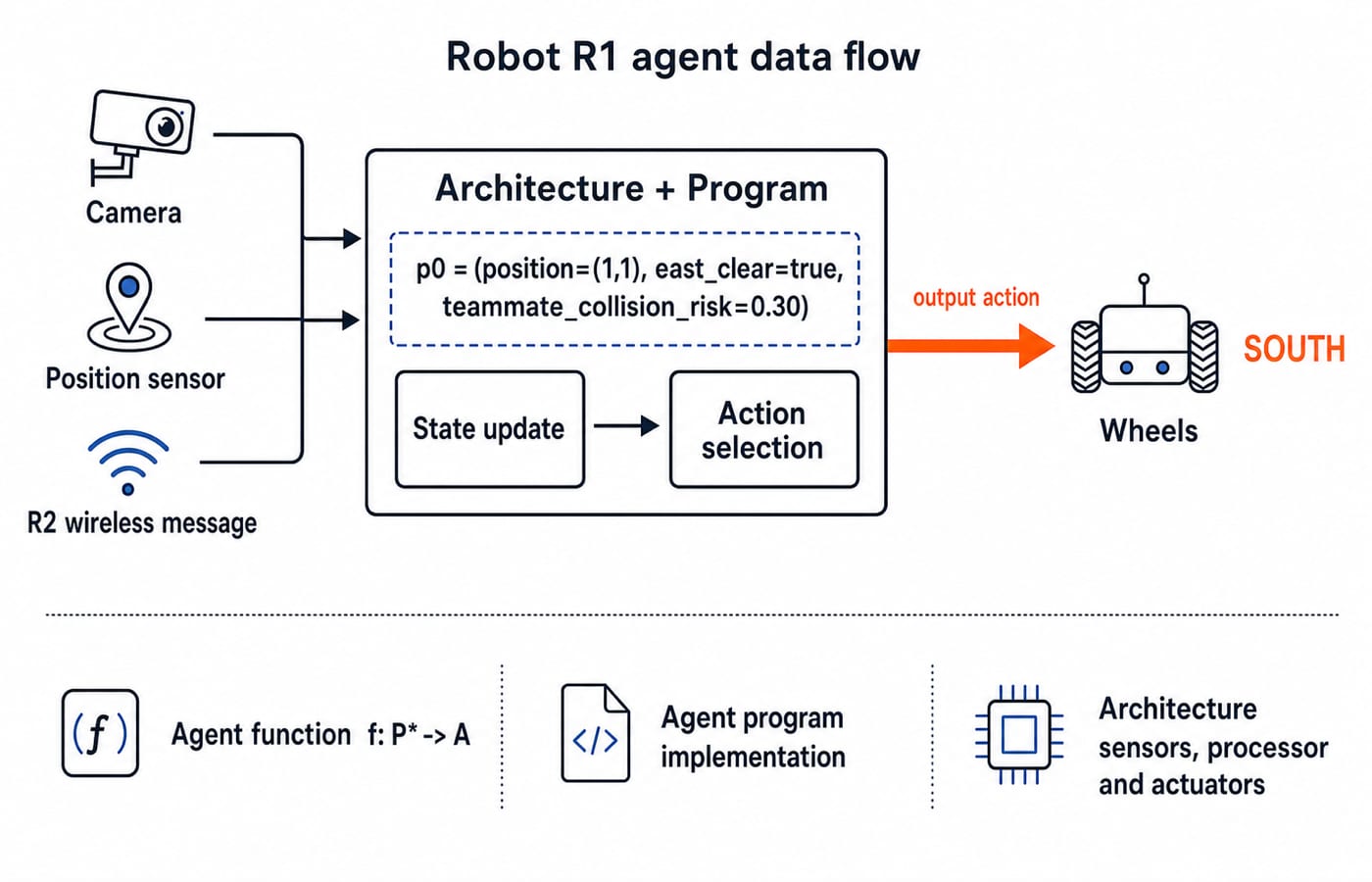
An agent receives percepts through sensors and affects its environment through actuators. Its function is the abstract mapping f: P* -> A, where P* contains finite percept sequences and A is the action set.
A program implements that mapping on a machine or software architecture. Hence, agent = architecture + program.
R1 has a camera, position sensor, wireless receiver, processor, wheels and gripper. Its program receives p0 = (position=(1,1), east_clear=true, teammate_collision_risk=0.30) and returns SOUTH.
Layer | Question it answers |
|---|---|
Architecture | What can sense, compute and act? |
Program | How is the next action computed? |
Function | Which action corresponds to every possible percept history? |
A rational agent chooses the best expected action from available evidence. It does not know the future with certainty. The Intelligent and Rational Agents in AI guide develops PEAS determinants, Bayesian belief updates and coordination payoffs; R1's warehouse trace instead isolates architecture, the four program types and utility-based routing.
PEAS and environment properties determine the required design
PEAS specifies the performance measure, environment, actuators and sensors. For our warehouse task:
Performance:
+10for delivery at goal G,-1per move and-20for a collision.Environment: a 2 by 3 grid shared by cooperative robots R1 and R2.
Actuators:
NORTH,SOUTH,EAST,WEST,WAITandSEND.Sensors: current cell, whether an adjacent cell appears clear and a teammate message.
The task is partially observable because R1 sees nearby cells only, stochastic because shortcut collision probability is 0.30, and sequential because actions change later states. It is dynamic because R2 moves, discrete because cells and actions are countable, and multi-agent because both robots affect each other. This pushes the design beyond a current-percept-only rule.
Multi-agent does not automatically mean cooperative. R1 and R2 cooperate here because they share the delivery performance measure. Give them separate rewards for reaching one exclusive dock first, and the same grid becomes competitive.
Four agent program types use different decision information
Program type | Information used | Internal state | Decision rule | Warehouse action |
|---|---|---|---|---|
Simple reflex | Current percept | No |
|
|
Model-based reflex | Percept plus stored model | Yes |
|
|
Goal-based | State, actions and goal | Usually | Search for a sequence reaching | Plan to G |
Utility-based | Outcomes, probabilities and utility | Usually | Maximise expected utility | Compare two routes |
A model-based reflex agent can remember an unseen obstruction without having a goal. A goal-based agent compares future states without ranking their desirability. A utility-based agent trades route length against collision risk.
All four can run on R1, so they are not four robot bodies. A model-based update may be state_t = update(state_(t-1), action_(t-1), percept_t). Check whether action depends only on percept_t, or also on stored state, a goal or utility.
Worked example: calculate route utility and break-even risk
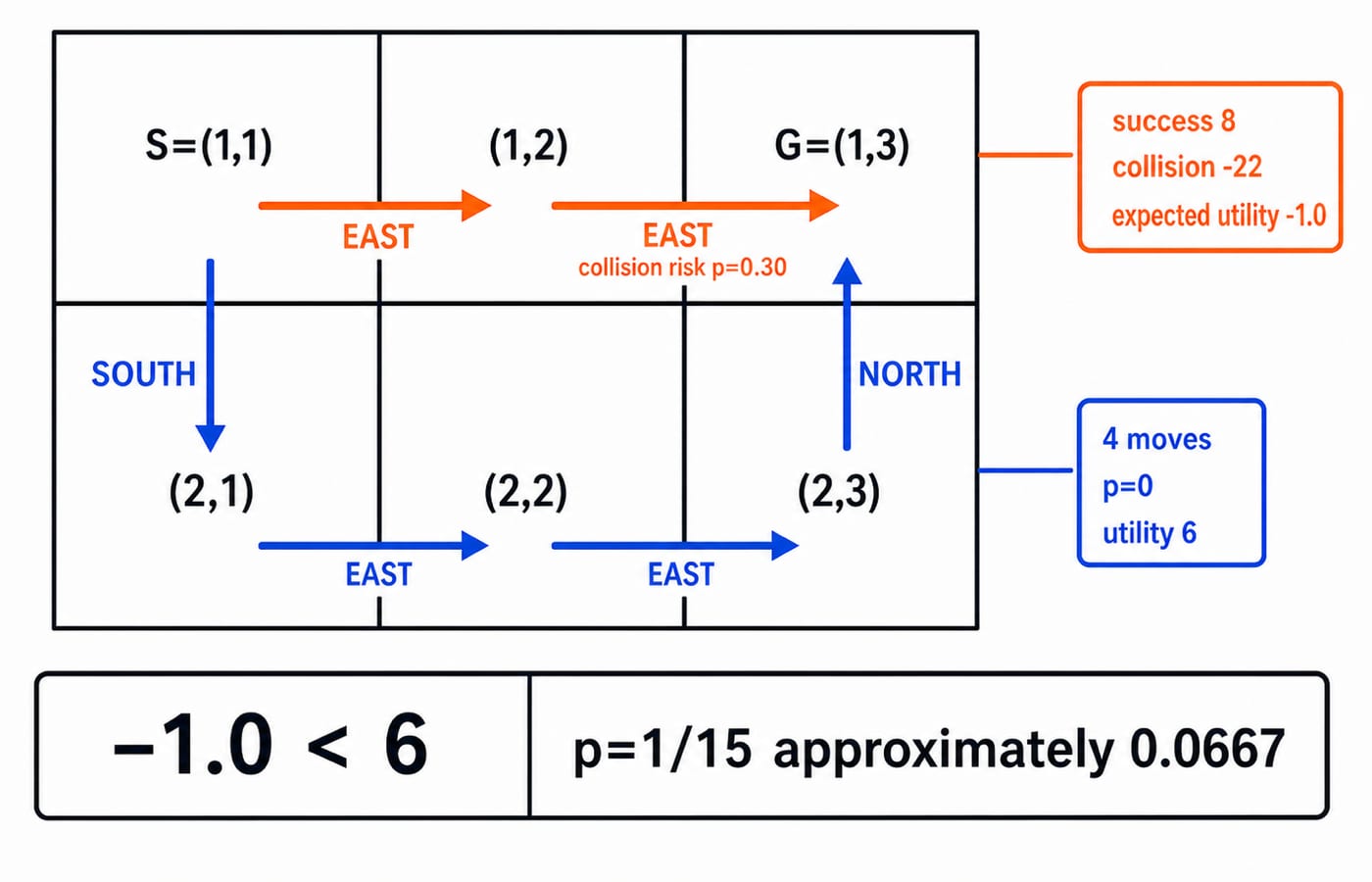
The top row is S=(1,1), (1,2), G=(1,3). The bottom row is (2,1), (2,2), (2,3).
The shortcut is EAST, EAST, so it costs two moves. Its second east edge has collision probability 0.30, and the collision outcome includes both move costs.
Shortcut success:
10 - 2 = 8.Shortcut collision:
-20 - 2 = -22.EU(shortcut) = 0.70(8) + 0.30(-22) = 5.6 - 6.6 = -1.0.
The safe detour is SOUTH, EAST, EAST, NORTH. It has four moves and zero collision probability, so its utility is 10 - 4 = 6. Since 6 > -1.0, the utility-based program selects the detour:
(1,1) -> (2,1) -> (2,2) -> (2,3) -> (1,3)
For collision probability p:
EU(shortcut) = (1-p)8 + p(-22) = 8 - 30p
Set it equal to 6: 8 - 30p = 6, so p = 2/30 = 1/15, approximately 0.0667. At p=0.05, utility is 8 - 30(0.05) = 6.5, so the shortcut wins. At p=0.30, it is 8 - 9 = -1.0, so the detour wins. These results belong to this performance measure, not every utility agent.
Learning agents and multi-agent messages change the policy
A learning agent separates four roles. The performance element chooses a route. The critic reports utility such as 8, -22 or 6. The learning element updates collision probability. The problem generator proposes safe exploration.
Learning is an overlay, not simply a fifth mutually exclusive program type. It can improve a reflex, model-based, goal-based or utility-based program.
After 10 shortcut attempts with 3 collisions, p_hat = 3/10 = 0.30. Then 8 - 30(0.30) = -1.0, so R1 prefers the detour. This estimate is not the only learning method.
R2 can send collision_risk=0.30; R1 stores it and recomputes the route. Alternatively, a central coordinator assigns both routes. Architecture, program, performance measure and protocol remain separate.
Common traps in architecture and program-type questions
Agent function is source code: false. The function is an abstract mapping; the program implements it.
Architecture is the policy: false. Architecture supplies the sensing, computation and action machinery.
Model-based means goal-based: false. Stored state does not prove that the agent searches for a goal.
A goal test represents cost and risk: false. It says whether a target state has been reached, not how alternatives are ranked.
Rational means omniscient: false. Rational action uses available evidence; omniscience would require the actual future outcome.
Simple reflex can be sufficient in a fully observable, static task. Learning does not prove utility reasoning, and communication does not prove cooperation. Classify cooperation by the performance measure and program type by percept-to-action logic.
How exams test agent architecture and program types
Expect definition matching, action traces and expected utility. Threshold 0.25 with stored risk 0.30 produces SOUTH; utilities -1.0 and 6 select the detour.
In an assertion-reason question, "The critic evaluates behaviour" is true, but "The critic selects every external action" is false. Selection belongs to the performance element.
Cue in the question | Likely program type |
|---|---|
Current percept only | Simple reflex |
Stored state or world model | Model-based reflex |
Desired end state | Goal-based |
Ranked outcomes or expected value | Utility-based |
For the surrounding unit, use the UGC NET Computer Science syllabus areas guide. The UGC NET Computer Science high-yield topics guide helps prioritise revision. Once each classification cue is clear, practise by deriving the action from the available percept, stored state, goal or utility.
The short version and the next useful step
Simple reflex reacts. Model-based reflex remembers. Goal-based plans towards a target. Utility-based compares preferences under trade-offs. Learning updates behaviour from feedback.
Architecture provides the machinery, the program computes actions, and the agent function describes the complete percept-history-to-action mapping. As a final check, recompute the shortcut at p=0.10: 8 - 30(0.10) = 5. The safe route still wins because its utility is 6.
For a structured route through Artificial Intelligence and Multi Agent Systems within the wider syllabus, continue with NTA-UGC-NET Paper - 2. If you need only this concept, redraw the grid, trace all four program types and explain why the break-even risk is 1/15.
Keep learning
Logical Reasoning Principles in AI: Syntax, Entailment and a Worked Resolution Proof
Learn how facts, rules, models and proof procedures fit together in AI knowledge representation. Follow a robot-safety query from truth values to an empty clause.
Updated 26 Oct 20266 min readML & Data Science
Problem Representation in AI: State Space, Worked Water-Jug Example and Exam Traps
Learn how states, operators, goals and costs turn a verbal task into a search problem. The worked water-jug trace separates valid states from reachable ones.
Updated 23 Oct 20265 min readML & Data Science
Foundations and Evolution of AI: Approaches, Timeline and a Worked Rational-Agent Example
Build a connected map of AI foundations, historical shifts and major paradigms, then calculate how a rational agent chooses under uncertainty.
Updated 19 Oct 20266 min readML & Data Science
Natural Language Processing Explained: Pipeline, TF-IDF Worked Example and Exam Patterns
Start from raw text, build BoW and TF-IDF vectors, compute cosine similarity, examine ambiguity, and finish with evaluation and exam-style checks.
Updated 15 Oct 20266 min readML & Data Science