Application Layer in Computer Networks: Protocols, Worked Examples, and How GATE Tests It
Build a clear application-layer model, work through DNS and HTTP timing problems, revise the major protocols, and avoid the traps that cost easy marks.
KnowledgeGate Team
Exam prep & CS education
Updated 29 Jul 20266 min read

The application layer is where Computer Networks stops feeling abstract. You use DNS, HTTP, and email every minute, yet many candidates memorise ports without being able to trace a DNS lookup or count RTTs. Two numericals settle that: a cold DNS chain that costs 160 ms, and one HTML file with three images that lands anywhere from 800 ms down to 300 ms depending only on how the TCP connection is reused.
Where the application layer sits and what it actually does
The application layer is layer 7 in OSI and the top layer in TCP/IP. In TCP/IP it also absorbs presentation and session duties, such as encoding, encryption support, and dialogue management. Application processes reach the network through the transport layer's socket interface.
Applications follow two broad architectures. In client-server systems, such as the web and email, a server responds to clients. In peer-to-peer systems, hosts can play both roles. A process is identified by an IP address and port number. Servers normally listen on well-known ports from 0 to 1023, while clients use ephemeral ports.
Transport choice follows the application's need for reliability, throughput, or low delay. TCP provides a reliable byte stream; UDP offers a lighter datagram service. Revise this common fact family with the TCP and UDP Transport Layer MCQs.
DNS: the worked resolution example every question builds on
DNS is a distributed, hierarchical database. A host asks a local resolver, which consults root, top-level domain (TLD), and authoritative servers as required. Learn these records: A maps a name to IPv4, AAAA to IPv6, CNAME creates an alias, MX identifies a mail exchanger, and NS identifies a name server. Each record has a time to live, or TTL.
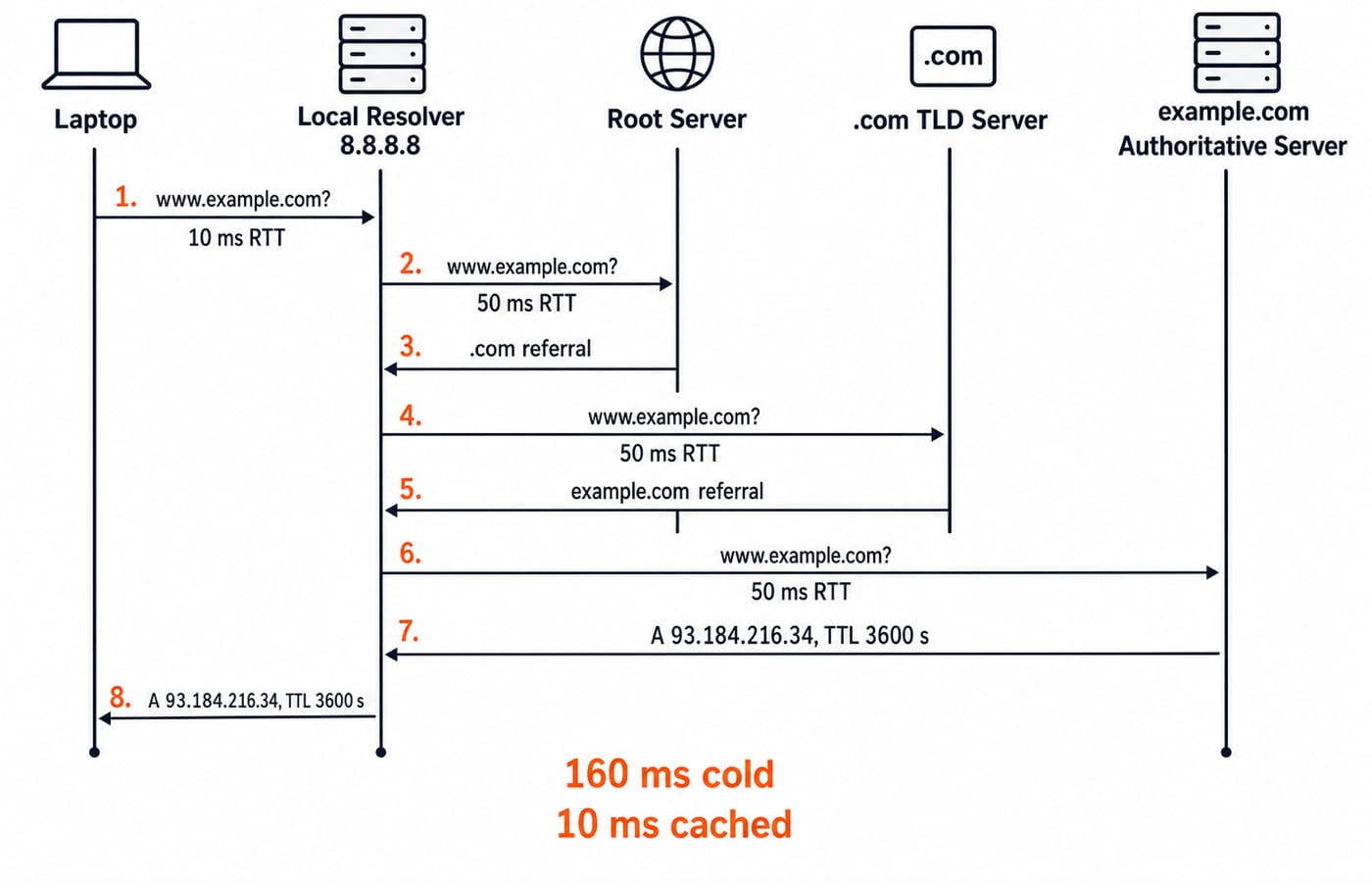
Consider a laptop using resolver 8.8.8.8 to resolve www.example.com with a cold cache. The host-to-resolver RTT is 10 ms; each resolver-to-DNS-server RTT is 50 ms. The resolver works iteratively:
The root server refers it to the
.comTLD server.The TLD server refers it to the authoritative server for
example.com.The authoritative server returns
A 93.184.216.34with TTL 3600 seconds.
The cold-cache time is therefore:
10 + (3 × 50) = 10 + 150 = 160 ms
A second lookup within the TTL comes from the resolver's cache in 10 ms. The host-to-resolver request is recursive because it expects a final answer. The resolver's three lookups are iterative because servers may return referrals.
Ordinary DNS queries normally use UDP port 53. Zone transfers between DNS servers use TCP port 53. TTL controls how long a record may remain in a cache, not how long a transport connection stays open.
HTTP: counting RTTs with non-persistent and persistent connections
HTTP is a stateless request-response protocol over TCP port 80; HTTPS uses port 443. Cookies let applications maintain state across requests without making HTTP stateful.
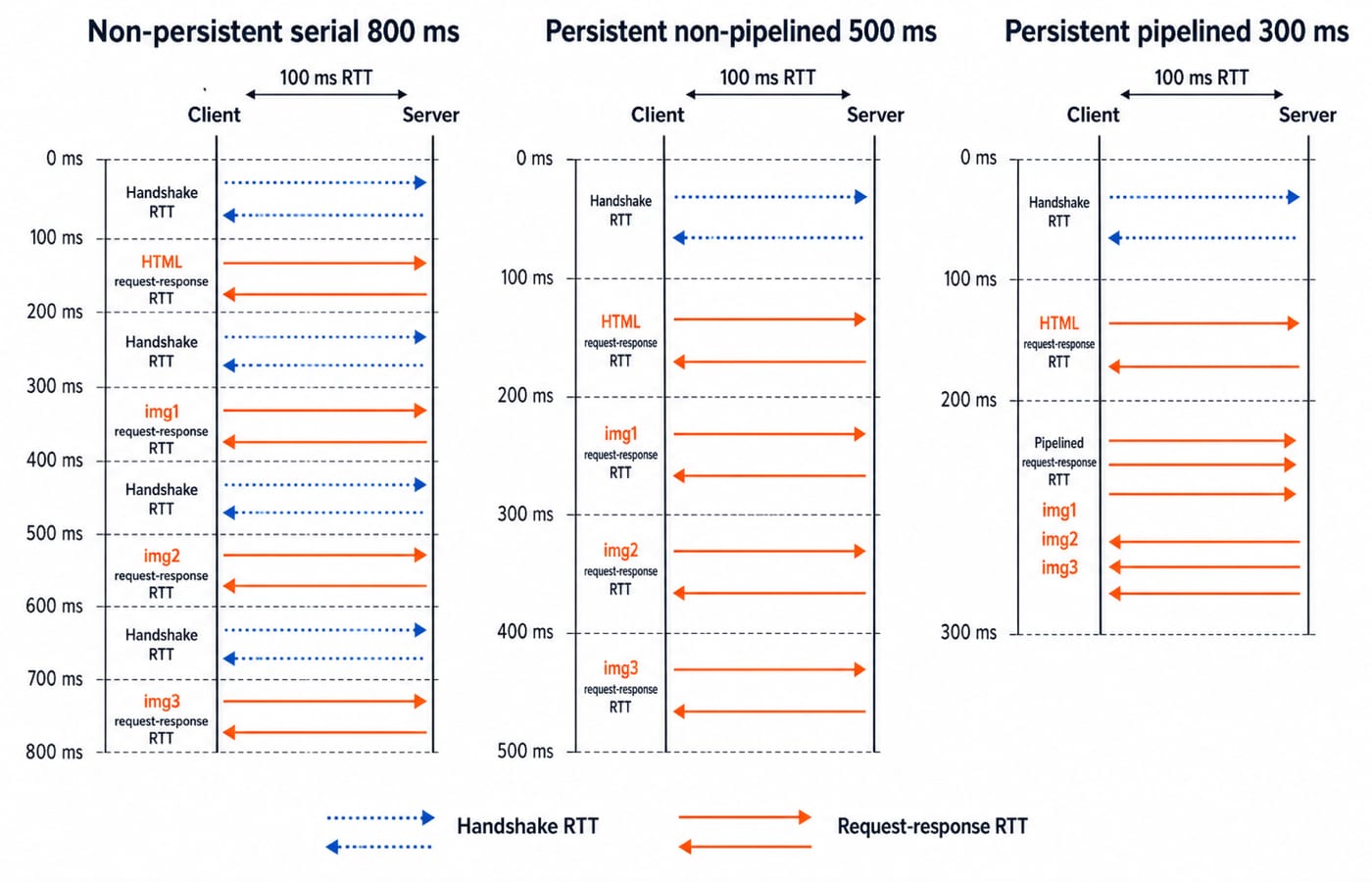
Suppose one server holds a base HTML file and three images. RTT is 100 ms, transmission time is negligible, and DNS is resolved. A fresh connection's first object costs 2 RTTs: one for the TCP handshake and one for request-response.
Non-persistent, serial connections: four objects each need a fresh connection.
4 × 2 RTT = 8 RTT = 800 ms.Persistent, without pipelining: the base file needs the handshake and request-response, then each image needs 1 RTT.
2 + 3 = 5 RTT = 500 ms.Persistent, with pipelining: the base file needs 2 RTT, then all three image requests go back-to-back and complete in 1 more RTT.
2 + 1 = 3 RTT = 300 ms.Non-persistent, parallel image connections: the base file takes 2 RTT, and the three images complete together in another 2 RTT.
2 + 2 = 4 RTT = 400 ms.
HTTP methods, the 2xx to 5xx status-code families, and the recursive versus iterative distinction are set out at length in Application Layer Protocols: DNS and HTTP. Read that one first if the concepts are still shaky; the ladders above are what an exam actually asks you to number.
Email and file transfer: SMTP, POP3, IMAP, and FTP
Mail travels from the sender's user agent through the sending and receiving mail servers to the receiver's user agent. SMTP uses TCP port 25 and pushes mail towards the receiving server. POP3 on TCP 110 and IMAP on TCP 143 pull mail for the reader. IMAP retains mail and folders on the server; POP3 can use download-and-delete.
SMTP was designed around 7-bit ASCII. MIME supplies the encoding and metadata needed for attachments and other content types.
FTP uses TCP and separates control from data. Its control connection uses port 21, remains open across the session, and carries commands. In active mode, the server uses port 20 for a separate data connection for each transfer. This out-of-band, two-connection design is a recurring multiple-select fact.
Port numbers and protocol properties to revise
Protocol | Transport and port | Property to remember |
|---|---|---|
DNS | UDP 53, TCP 53 for zone transfer | Hierarchical naming and caching |
HTTP | TCP 80 | Stateless request-response |
HTTPS | TCP 443 | HTTP protected by TLS |
SMTP | TCP 25 | Pushes mail |
POP3 | TCP 110 | Pulls downloaded mail |
IMAP | TCP 143 | Pulls while retaining server state |
FTP | TCP 21 control, TCP 20 data in active mode | Separate control and data connections |
Telnet | TCP 23 | Remote terminal without SSH protection |
SSH | TCP 22 | Secure remote access |
DHCP | UDP 67 server, UDP 68 client | Dynamic host configuration |
SNMP | UDP 161 | Network monitoring and management |
Group the table by properties, not just numbers. DNS queries, DHCP, and SNMP commonly use UDP. SMTP pushes, while POP3, IMAP, and HTTP retrieve or request data. HTTP is stateless, while FTP maintains a control session.
Traps that cost easy marks
Treating “DNS uses TCP” as always false. Normal queries generally use UDP, while zone transfers and some large responses use TCP. “DNS can use TCP” may therefore be correct in a multiple-select question.
Counting one RTT too few or too many. Drop a single handshake from the non-persistent serial case and 800 ms becomes 700 ms; repeat the handshake once on the persistent non-pipelined case and 500 ms becomes 600 ms. Both wrong values are sitting in the options. Write “2 RTT for a fresh connection's first object, then 1 RTT per sequential object” before calculating.
Calling cookies a violation of statelessness. HTTP remains stateless. The application uses cookie data to connect separate requests.
Using SMTP to read mail. SMTP moves mail towards the receiving server. POP3 or IMAP retrieves it for the reader.
How GATE and interviews test the application layer
Application-layer concepts sit inside Computer Networks in the GATE CS syllabus. For the current concept list and paper pattern, check the official GATE website and that year's organising institute brochure. Recent official papers show one-mark protocol-property questions, two-mark RTT calculations, and DNS ordering questions.
In interviews, “What happens when you type a URL?” is the classic prompt. A strong answer chains DNS resolution, the transport connection, and the HTTP request. Follow-ups often probe caching and persistent connections.
Build recall by solving the 12 Solved Computer Networks Application Layer MCQs, then attempt topic-wise networking tests under time pressure.
The short version and next step
The application layer sits above transport and reaches it through sockets.
A cold DNS chain here costs
10 + 3 × 50 = 160 ms; a cached answer costs 10 ms.The HTTP cases cost 800 ms serial, 500 ms persistent without pipelining, and 300 ms with pipelining.
SMTP pushes mail; POP3 and IMAP retrieve it.
FTP separates its persistent control connection from data connections.
Learn ports together with transport and protocol properties.
A focused practice week looks like this. Day one, redo both numericals from a blank page with the resolver-to-server RTT and the HTTP RTT both set to 40 ms and the image count raised to five: the cold DNS chain should come to 10 + 3 × 40 = 130 ms, and the HTTP cases to 480 ms serial, 280 ms persistent without pipelining, and 120 ms pipelined. Day two, write the port table out from memory and mark it against the one above. Day three, work ten mixed application-layer questions at 90 seconds each and re-derive every miss instead of reading its answer.
To learn Computer Networks from these fundamentals upward, follow the Zero to Hero Complete CS Course. To test the topic against the clock, use the GATE Test Series with mocks and topic-wise tests. You can also browse the wider set of GATE CS subject notes before choosing the next topic.
Keep learning
Computer Networks Hardware Basics: Devices, Domains and Worked Examples
Learn what hubs, switches, routers, gateways and access points actually do, then count network domains and trace frames through a two-LAN topology.
Updated 6 Oct 20266 min readComputer Networks
Data Link Layer Framing Explained: Byte Stuffing, Bit Stuffing and a Cross-Concept Numerical
Frame one four-byte payload in two ways, decode it, and then reuse the verified frame sizes in link-load and Stop-and-Wait calculations.
Updated 1 Oct 20266 min readComputer Networks
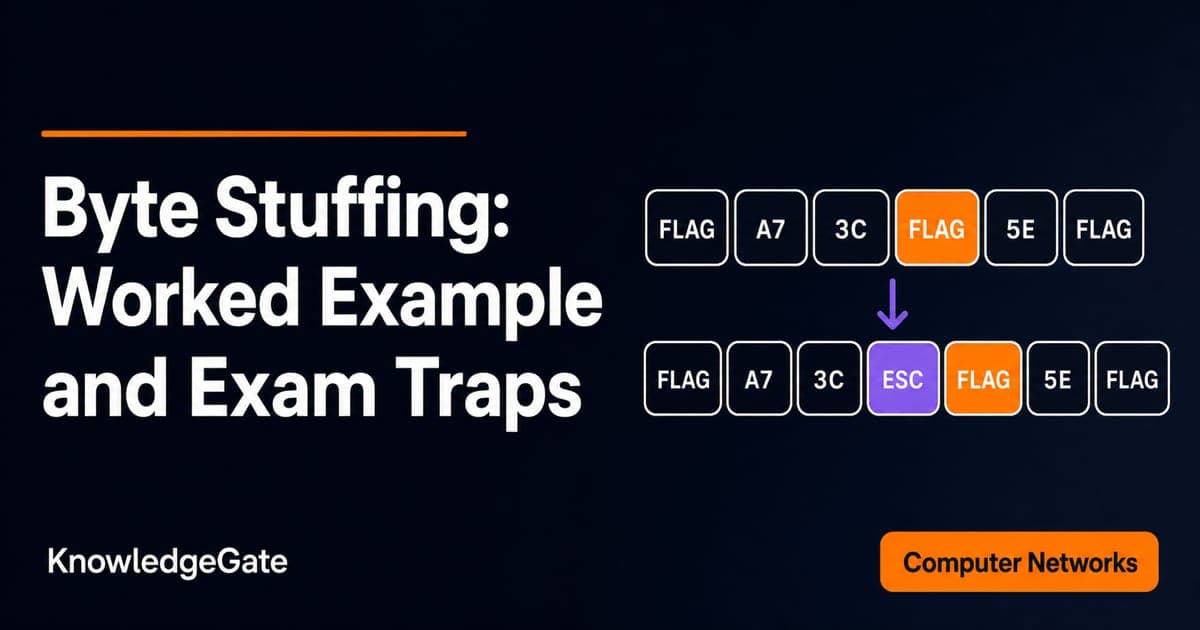
Byte Stuffing in Computer Networks: Worked Framing Example and Exam Traps
Learn a precise byte-stuffing convention, trace a payload containing both FLAG and ESC, reverse it safely, and calculate frame overhead and transmission time.
Updated 26 Sep 20266 min readComputer Networks
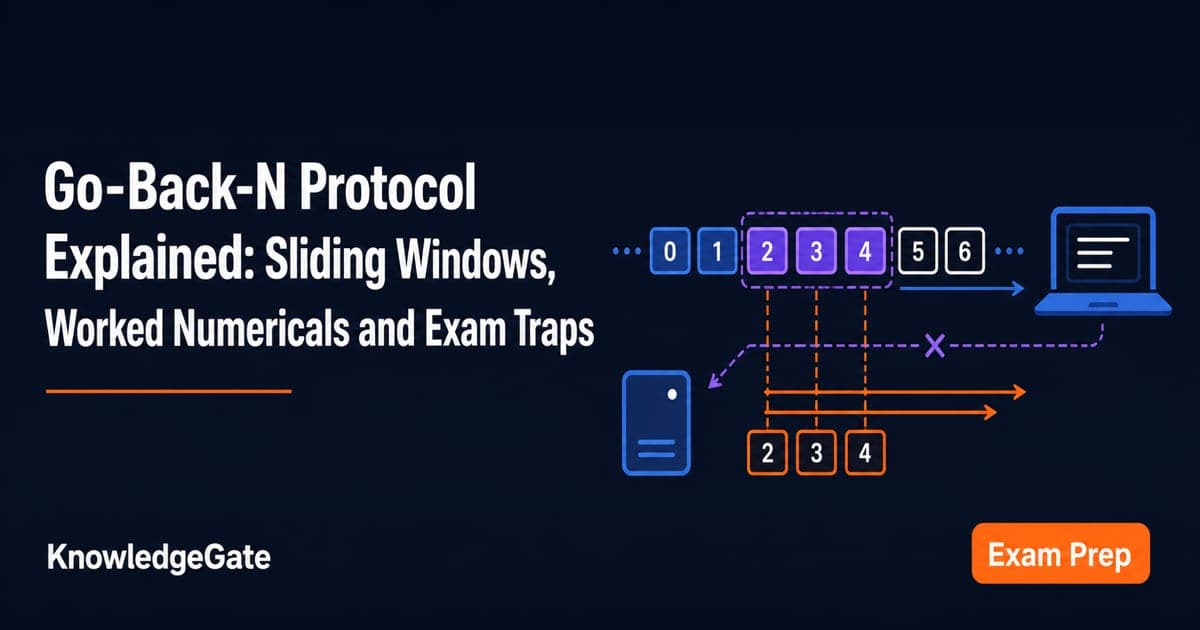
Go-Back-N Protocol Explained: Sliding Windows, Worked Numericals and Exam Traps
Trace Go-Back-N through a lost frame, calculate its legal window and link utilisation, and avoid the ACK and wrap-around traps that spoil numericals.
Updated 24 Sep 20266 min readComputer Networks