AMCAT Sample Paper Analysis: Turn Misses into Module Priorities
Turn each miss, skip, and slow attempt into a ranked repair backlog, then plan seven focused hours and re-test fairly.
KnowledgeGate Team
Exam prep & CS education
Updated 2 Aug 20265 min read658 views

After a disappointing AMCAT sample paper, revising everything feels sensible. The useful output, however, is not a score forecast but a repair backlog built from four things: the misses, the skips, the slow attempts, and the answers you got wrong while feeling certain. On the 48-question paper worked through here, that backlog becomes seven study hours split 150, 90, 60 and 30 minutes; the module names and counts belong to that example, not a live AMCAT paper.
1. Treat the sample paper as a diagnostic, not a score forecast
Work from the paper in front of you. Confirm its module names, duration, scoring, and employer requirements on the official AMCAT website or in your invite. If you sat an adaptive AMCAT mock rather than a fixed sample paper, per-question counts are not comparable between attempts, so use AMCAT mock analysis instead.
For illustration, four modules have 12 questions each: Quantitative Ability, Logical Ability, Verbal Ability, and Computer Programming. The 90-second benchmark is one you set yourself: 12 questions inside an 18-minute module works out to 90 seconds each, so treat it as your own pace target rather than a published limit.
Complete one clean sitting, with no answer checks midway. Mark each attempt H, M, or L for confidence and record module minutes. Do not infer a percentile or selection result.
2. Build one evidence sheet from attempts, misses, skips, and time
Accuracy uses attempts; skips stay separate.
Module | Total | Attempted | Correct | Wrong | Skipped | Time | Attempted accuracy | Seconds per attempt | High-confidence wrong |
|---|---|---|---|---|---|---|---|---|---|
Quantitative Ability | 12 | 11 | 7 | 4 | 1 | 18 min | 63.6% | 98 | 2 |
Logical Ability | 12 | 11 | 9 | 2 | 1 | 16 min | 81.8% | 87 | 1 |
Verbal Ability | 12 | 11 | 8 | 3 | 1 | 15 min | 72.7% | 82 | 0 |
Computer Programming | 12 | 10 | 6 | 4 | 2 | 21 min | 60.0% | 126 | 3 |
Quant gives 7 / 11 = 63.6%, not 7 / 12, and 18 x 60 / 11 = 98 seconds. Programming gives 6 / 10 = 60.0%; two skips signal coverage.
Logical leads on accuracy and pace. Programming is weakest on accuracy, pace, skips, and confident errors. Equal time ignores this.
3. Tag each bad outcome by cause before assigning a chapter
Give each wrong answer one topic and one cause: concept gap, method gap, time trap, reading error, or blind guess. Tag skips as concept gaps or time traps.
Module | Logged outcome and primary cause |
|---|---|
Programming | Wrong: array tracing x2 (method gap), loop boundary (reading error), SQL JOIN (concept gap). Skipped: recursion x2 (concept gap). |
Quant | Wrong: percentages x2 (method gap), time and work (time trap), ratio (blind guess). Skipped: data interpretation (time trap). |
Verbal | Wrong: subject-verb agreement x2 (concept gap), inference (reading error). Skipped: vocabulary (concept gap). |
Logical | Wrong: syllogism (method gap), number series (blind guess). Skipped: arrangement (time trap). |
Three of four Programming errors were high-confidence, exposing a trusted fault.
For a = [3, 1, 4, 1] and a[i] = a[i] + a[i-1], i = 1, 2, 3 produce [3, 4, 4, 1], [3, 4, 8, 1], then [3, 4, 8, 9]. The learner wrote [3, 4, 5, 5], adding the original a[1] = 1 and a[2] = 4 instead of the 4 and 8 just written into the array. Tag method gap: failed to carry the updated previous value, not “arrays weak”.
4. Rank modules with a transparent priority score
Score each module on three of those measures, weighted by how much each one costs you. The result is a planning number of your own, not an AMCAT score:
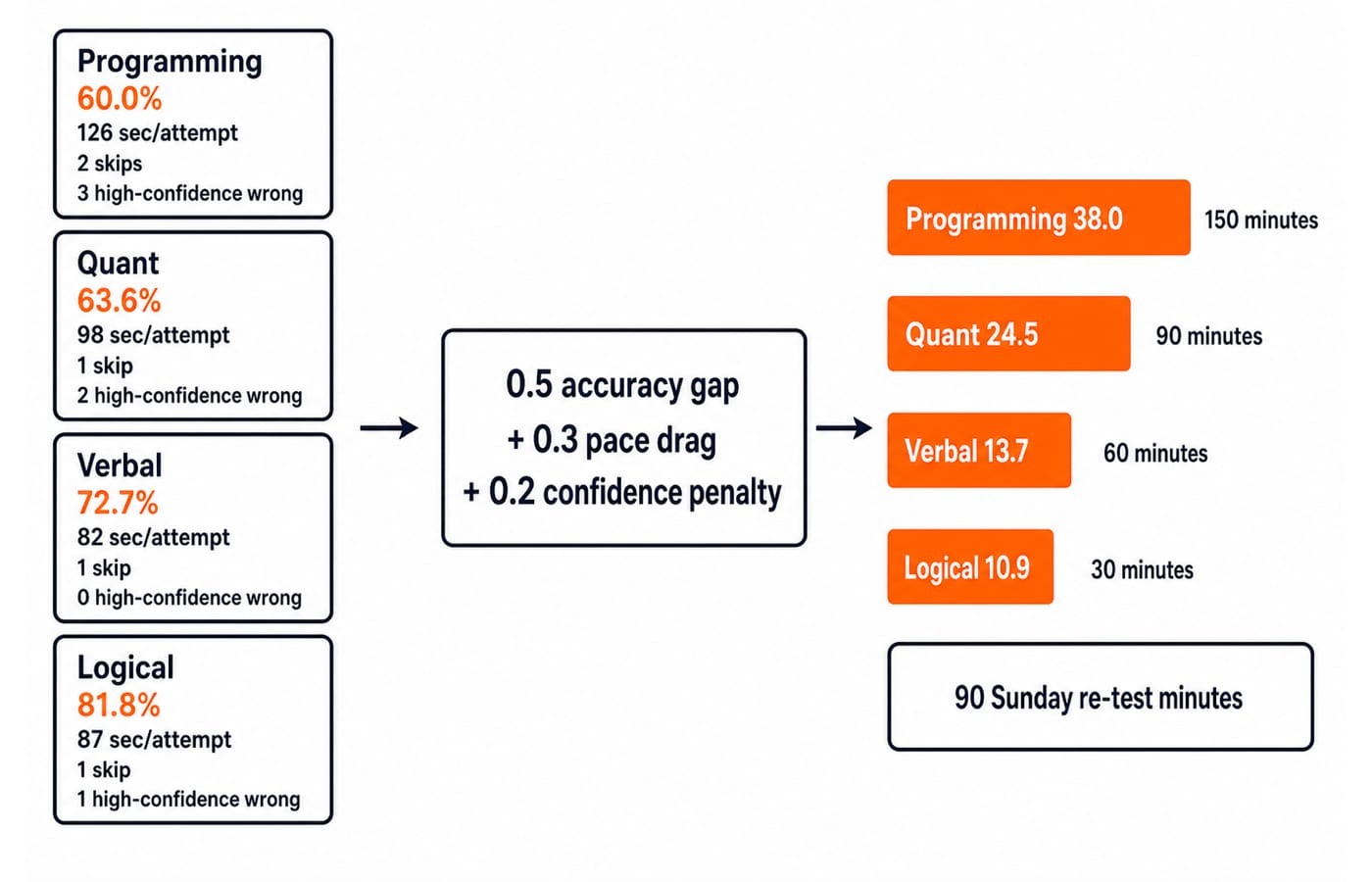
priority = 0.5 x accuracy gap + 0.3 x pace drag + 0.2 x confidence penalty
Accuracy gap is 100 - attempted accuracy. Pace drag is max(0, seconds per attempt - 90) / 90 x 100, capped at 100. Confidence penalty is high-confidence wrong / attempted x 100. With displayed one-decimal inputs:
Programming:
0.5(40.0) + 0.3(40.0) + 0.2(30.0) = 38.0Quant:
0.5(36.4) + 0.3(8.9) + 0.2(18.2) = 24.5Verbal:
0.5(27.3) + 0.3(0) + 0.2(0) = 13.7Logical:
0.5(18.2) + 0.3(0) + 0.2(9.1) = 10.9
Order: Programming, Quant, Verbal, Logical. Skips stay out of that number, since accuracy is measured on attempts only; each skip enters the backlog as coverage work instead, which is why recursion sits on the Programming repair list without moving its score. The log replaces “study programming” with array tracing, loop boundaries, JOIN logic, and recursion.
5. Convert the ranking into a realistic seven-hour repair week
Allocate 420 minutes: Programming 150, Quant 90, Verbal 60, Logical 30, and Sunday re-test and review 90.
Day | Work |
|---|---|
Monday | Programming, 60 min |
Tuesday | Quant, 45 min; Logical, 15 min |
Wednesday | Verbal, 30 min; Programming, 30 min |
Thursday | Quant, 45 min; Logical, 15 min |
Friday | Verbal, 30 min; Programming, 30 min |
Saturday | Programming, 30 min |
Sunday | Re-test and review, 90 min |
Monday: 15 minutes relearn one rule, 25 solve five targeted questions, 15 explain misses without notes, and 5 log. A 30-minute block uses 10 review, 15 for three questions, and 5 logging.
Never double the next weekday. Move at most one missed 60-minute block to Saturday, capped at 90 minutes. Otherwise protect Sunday and roll the lowest-priority unfinished block forward. The AMCAT Exam Complete Preparation course runs Quant, Logical Reasoning, Verbal, and the coding and core-CS modules in sequence, if you would rather follow a built order than assemble each block.
6. Re-test with matched mini-sets and update the backlog
On Sunday, use a fresh matched set of eight questions per module and the same learner-set 90-second benchmark.
Module | Attempted | Correct | Wrong | Skipped | Time |
|---|---|---|---|---|---|
Programming | 7 | 5 | 2 | 1 | 11 min |
Quant | 7 | 6 | 1 | 1 | 10 min |
Verbal | 8 | 7 | 1 | 0 | 9 min |
Logical | 8 | 7 | 1 | 0 | 9 min |
Compare accuracy, pace, skips, and confidence, not raw counts across unmatched sets. Programming rises from 60.0% to 5 / 7 = 71.4% and from 126 to about 11 x 60 / 7 = 94 seconds, while Quant rises from 63.6% to 6 / 7 = 85.7%. Programming still carries the widest accuracy gap (100 - 71.4 = 28.6 against Logical's 100 - 87.5 = 12.5) and the only pace above 90 seconds, so it keeps the largest block. Each Sunday, rerun the priority line on the new row, strike a tagged cause only after two clean sittings, and re-cut the week's minutes in the new order.
The 30-day aptitude routine supplies a repeatable daily rhythm; the priority order decides which module those minutes buy.
7. Keep the live AMCAT rules separate from your study model
The short version: capture evidence, tag causes, rank repairs, allocate time, and re-test under matched conditions. Every number in that loop is one you generated, so read the module mix, duration, and scoring straight off your invite before the next real attempt, and let your log speak only about your own preparation.
Aptitude for placements supplies the broader Quant, Reasoning, and Verbal map, and the IT Recruitment Exams category carries the wider course set for campus tests.
Analyse one full paper today. Circle only the top two modules, then schedule the first 60-minute repair block.
Keep learning

TCS NQT Eligibility: Check Backlogs, Gaps and Degree Rules
Use a closed TCS hiring notice as a worked checklist for degree, backlog, course-duration and academic-gap rules, then verify the current drive.
Updated 2 Sep 20264 min readIT Recruitment Exams

CoCubes Preparation Plan: Six Weeks for Campus Hiring Tests
Build a practical six-week CoCubes study plan around the modules in your own test invitation, your diagnostic results, and 72 hours of focused work.
Updated 1 Sep 20266 min readIT Recruitment Exams

eLitmus Retake Decision: Read Section Percentiles Before Testing Again
Do not retake eLitmus on disappointment alone. Use your section pattern, target-job evidence, and fresh timed practice to decide whether to go, wait, or rebuild.
Updated 30 Aug 20264 min readIT Recruitment Exams

eLitmus Mock Analysis: Diagnose Knowledge Gaps and Attempt Errors
A worked mock-review method to separate concept gaps from calculation, reading and decision errors, recover marks, and plan the next four weeks.
Updated 29 Aug 20265 min readIT Recruitment Exams