Artificial Intelligence for ICT Exams: Concepts, Tools and Worked Examples
Build a clear AI concept ladder, learn the main learning types, calculate classifier metrics step by step, and apply a practical tool-checking routine.
KnowledgeGate Team
Exam prep & CS education
Updated 23 Sep 20266 min read
Chatbots, recommendation systems, robots and rule-based software often get placed in one bucket called AI. That makes basic questions harder than necessary. Artificial intelligence, machine learning and deep learning form a progression; data and statistics support classifier evaluation; AI tools require careful selection and checking. Artificial intelligence concepts, data basics, classifier metrics and AI-tool verification are relevant to Knowledge of ICT for Computer Science teaching recruitment and general interview awareness.
Related reading: neural network fundamentals and constraint satisfaction problems.
Artificial intelligence, machine learning and deep learning are not synonyms
Artificial intelligence is the broad field of systems that perform perception, language, reasoning, prediction or decision-support tasks. Machine learning builds AI by learning patterns from data. Deep learning is a machine-learning family using multi-layer neural networks.
The nesting is deep learning -> machine learning -> artificial intelligence. These are related levels, not synonyms.
A rule-based filter marks a message urgent when its subject contains the exact word URGENT. A learned classifier instead uses labelled examples to estimate whether a new message is urgent. The first follows an explicit rule; the second learns a decision boundary from data.
Current AI is narrow and task-specific: classify an image, transcribe speech, recommend an item or generate text. It is not human-like general intelligence, conscious or guaranteed truthful.
Data, features, labels and a small statistics toolkit
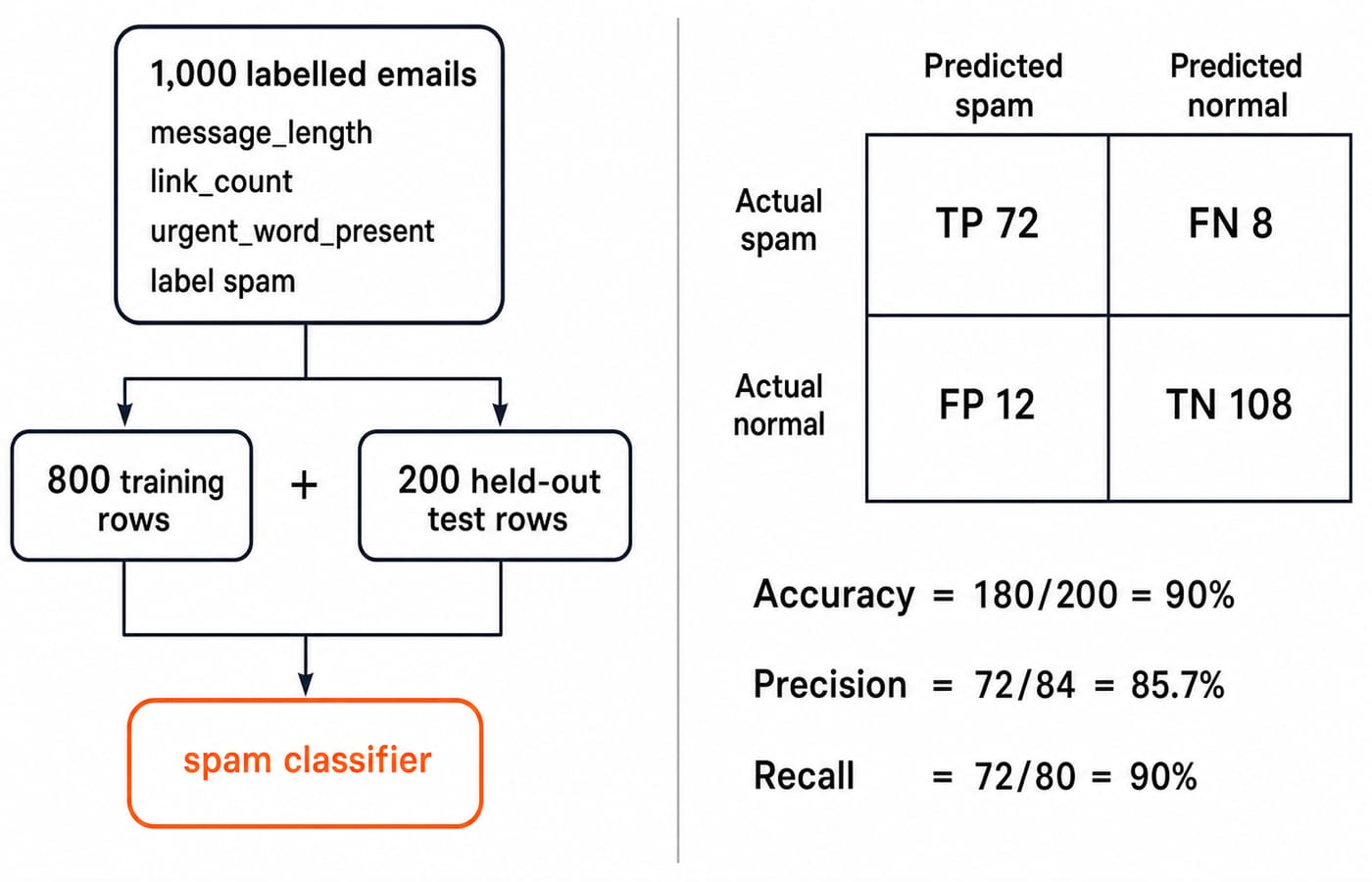
Take 1,000 labelled emails with message length, link count and whether an urgent word is present, where spam is the outcome to predict. Split them into 800 training rows and 200 held-out test rows. Message length, link count and urgent-word presence are features; spam is the label.
Now take five illustrative response times in seconds: [12, 15, 15, 18, 20].
Mean:
(12 + 15 + 15 + 18 + 20) / 5 = 80 / 5 = 16 seconds, the arithmetic average.Median: the ordered middle value is
15 seconds.Mode:
15 seconds, the most frequent value.Range:
20 - 12 = 8 seconds, the distance from smallest to largest.
No single summary describes every pattern. Check that examples are relevant, labels are correct, coverage is representative and there are enough rows for the task. Prevent leakage too. A final spam decision must not be used as an input when spam is the outcome to predict because it reveals the answer.
Supervised, unsupervised and reinforcement learning by task
Supervised learning uses labelled examples. Classification predicts a category such as spam/not spam; regression predicts a number such as an illustrative delivery time of 18.5 minutes. A numeric prediction is still an estimate.
Unsupervised learning finds structure in unlabelled data. Group 300 learners using weekly minutes and quiz attempts, then inspect the results. Clusters are descriptive groups; inspect them before assigning a meaning.
Reinforcement learning uses an agent, environment, action, reward loop. An agent starts at (1,1), earns +10 at (3,3), receives -5 for a blocked cell and -1 per move. It learns a policy from consequences, not a correct label for every action.
Fully worked example: evaluate the email classifier
Of 80 actual spam emails, the model flags 72 and misses 8. Of 120 actual normal emails, it leaves 108 alone and wrongly flags 12.
That gives TP = 72, FN = 8, TN = 108 and FP = 12. First check the total:
72 + 8 + 108 + 12 = 200.
Now calculate the metrics without changing the denominator:
Accuracy:
(TP + TN) / 200 = (72 + 108) / 200 = 180 / 200 = 90%.Precision for predicted spam:
TP / (TP + FP) = 72 / (72 + 12) = 72 / 84 = 85.7%to one decimal place.Recall for actual spam:
TP / (TP + FN) = 72 / (72 + 8) = 72 / 80 = 90%.
An accuracy of 90% does not make both errors equally acceptable. Here, 12 legitimate emails are blocked and 8 spam emails pass through. Ask which error matters more before selecting a model or threshold.
Match AI technologies to inputs and outputs
Natural language processing handles text or speech, computer vision handles images or video, and expert systems apply domain rules. Recommenders rank suggestions, robotics joins sensing with physical action, and generative AI creates candidate text, images, audio or code.
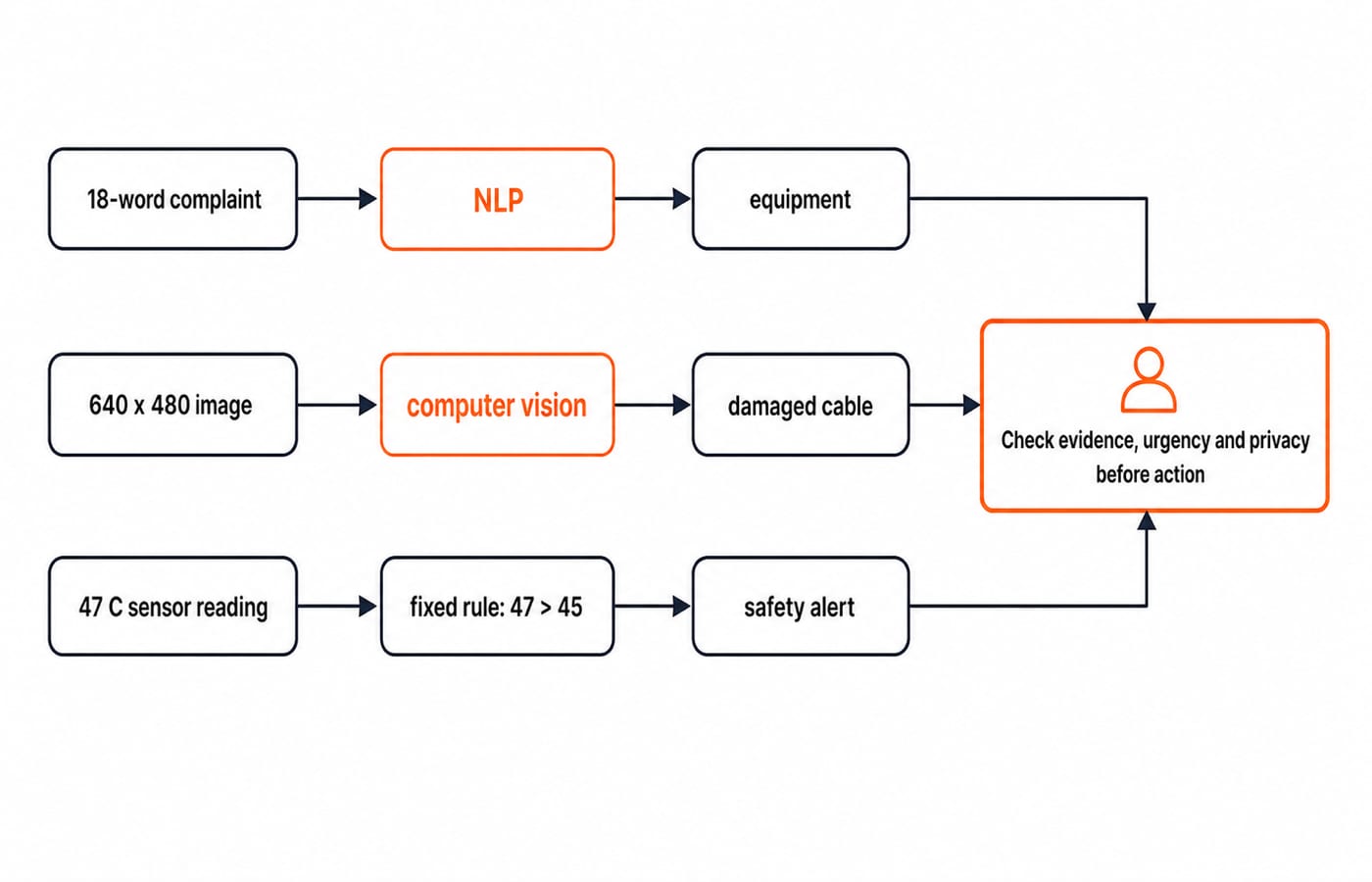
A robot can use fixed automation, while AI can be entirely software. At a maintenance desk:
The 18-word complaint
Projector in Lab 2 switches off after ten minutes and restarts only when the power cable is reconnectedgoes to an NLP classifier, which assignsequipment.A
640 x 480image goes to a vision model, which proposesdamaged cable.A
47 Creading triggers a fixed safety rule because47 > 45.
These are text classification, image classification and a threshold rule. Technology selection is technical; deciding when it supports learning is pedagogical. See Computer Science pedagogy for teacher exams.
Use generative AI tools with a verification loop
Use the prompt frame task + context + constraints + output format + check:
From my 120-word note on supervised learning, create 5 one-answer MCQs with 4 options each. Use only that note, mark the answer, and add a one-sentence explanation.
Format does not ensure correctness. Compare every stem and answer with the note. Reject duplicates, require one defensible answer, remove unsupported claims, and keep items a teacher can explain. If 2 of 5 fail, keep 3 and repair or discard 2. Never call unreviewed output verified.
Never paste identifiable student records or confidential exam material into an unapproved tool. Check relevant-group bias, separate fluency from evidence, and retain human accountability for consequential decisions.
Common traps and the elimination method
Correct common claims directly:
Every automation is AI -> fixed rules can automate without learning.
AI equals machine learning -> machine learning is one part of AI.
All robots use AI -> some robots follow fixed control programs.
High training accuracy proves quality -> held-out evaluation is still required.
Correlation proves cause -> correlation alone does not establish causation.
Confident generated text is correct -> fluency is not verification.
Now ask: Which task is regression: (A) spam/not spam, (B) group unlabelled learners, (C) predict delivery time in minutes, (D) select actions from rewards?
Identify the output type. A is classification, B clustering, C a numeric prediction, and D reinforcement learning. The answer is C, regression.
One more trap is mixing the two metrics: 72 / 80 is recall because 80 counts actual spam. Precision uses predicted spam: 72 / (72 + 12) = 72 / 84 = 85.7%.
How objective exams and interviews test AI
Questions may ask you to classify AI, ML or fixed automation; match technology to input; distinguish learning types; calculate mean or classifier metrics; identify data-quality or responsible-use problems; or explain an application.
More than 300 Artificial Intelligence questions are available for practice on KnowledgeGate. Start with 20 and log concept, wrong choice, reason, correction. Revise weak areas, then retry.
Confirm AI's presence and depth in your current syllabus or notification. Use Teaching CS exams compared for orientation, not as official authority.
The short version and your next step
Identify the task, data and learning setup, then evaluate the output and its risks. This sequence handles concept questions and tool decisions.
For wider context, use the Government Teaching Jobs course hub. The DSSSB TGT Computer Science Section B course and HPSC PGT Computer Science course are structured next steps. Match each course outline against your syllabus.
Keep learning
Intelligent and Rational Agents in AI: PEAS, Worked Decisions and Exam Traps
Learn what makes an AI agent rational, specify its task with PEAS, update a belief using Bayes' rule, and see why coordination matters in multi-agent systems.
Updated 7 Oct 20266 min readML & Data Science
A* Search Algorithm: Step-by-Step Worked Example, Heuristics and Exam Traps
Learn A* from first principles, follow every relaxation on a weighted graph, and test optimality, tie-breaking, parent updates and heuristic quality.
Updated 2 Oct 20266 min readML & Data Science
Philosophical and Theoretical Approaches to AI: Four Classical Views, Major Schools and a Worked Example
Separate the goals, engineering schools and philosophical claims behind AI. Then compare four classical approaches through one route-choice problem.
Updated 27 Sep 20265 min readML & Data Science
Artificial Intelligence for GATE: An 8-Week Topic-by-Topic Study Plan
Turn a 12-hour weekly budget into an eight-week AI study cycle with dependency-led concepts, hand-solved traces, timed sets, and error-driven revision.
25 Sep 20265 min readML & Data Science