Accenture Placement Preparation: 4-Week, 56-Hour Study Plan
Turn four preparation lanes into a practical weekly calendar. Start with a baseline, move hours towards your errors, and recover missed sessions without cramming.
KnowledgeGate Team
Exam prep & CS education
Updated 27 Sep 20265 min read
A topic list does not tell you what to study tonight, how many hours each skill deserves, or what to cut after a missed week. This plan turns cognitive, technical, coding and communication preparation into four visible weeks and 56 accountable hours, with diagnostic results guiding how you allocate them.
Match the study map to the Accenture invitation first
Use two sources. First, copy the role name, section names, order, total time, platform, permitted language and completion window exactly from your current invitation. Leave a field blank if the invitation does not mention it. Second, use the preparation lanes in the KnowledgeGate course to organise cognitive, technical, coding and communication work.
Accenture says some roles may include an online activity assessing technical skills, natural strengths or decision-making. It describes technical assessments as evaluating problem-solving, logical reasoning and applied technical knowledge, while the number of interviews depends on the role. Read the fuller Accenture rounds and preparation guide if you need that background.
Planning disclaimer: This 56-hour schedule is a coaching framework based on KnowledgeGate course lanes, not an official Accenture test pattern, section weightage, cutoff, predicted score or rule set, and not a promise that every role or drive uses all four lanes. Assessments vary by role, so treat your current invitation as the source of truth instead of a senior's screenshot or an old pattern table.
Build the default 56-hour budget, then let evidence move hours
Work lane | Hours |
|---|---|
Invitation setup and baseline diagnostic | 2 |
Cognitive | 12 |
Technical | 12 |
Coding | 14 |
Communication | 6 |
Timed sets, mocks and review | 10 |
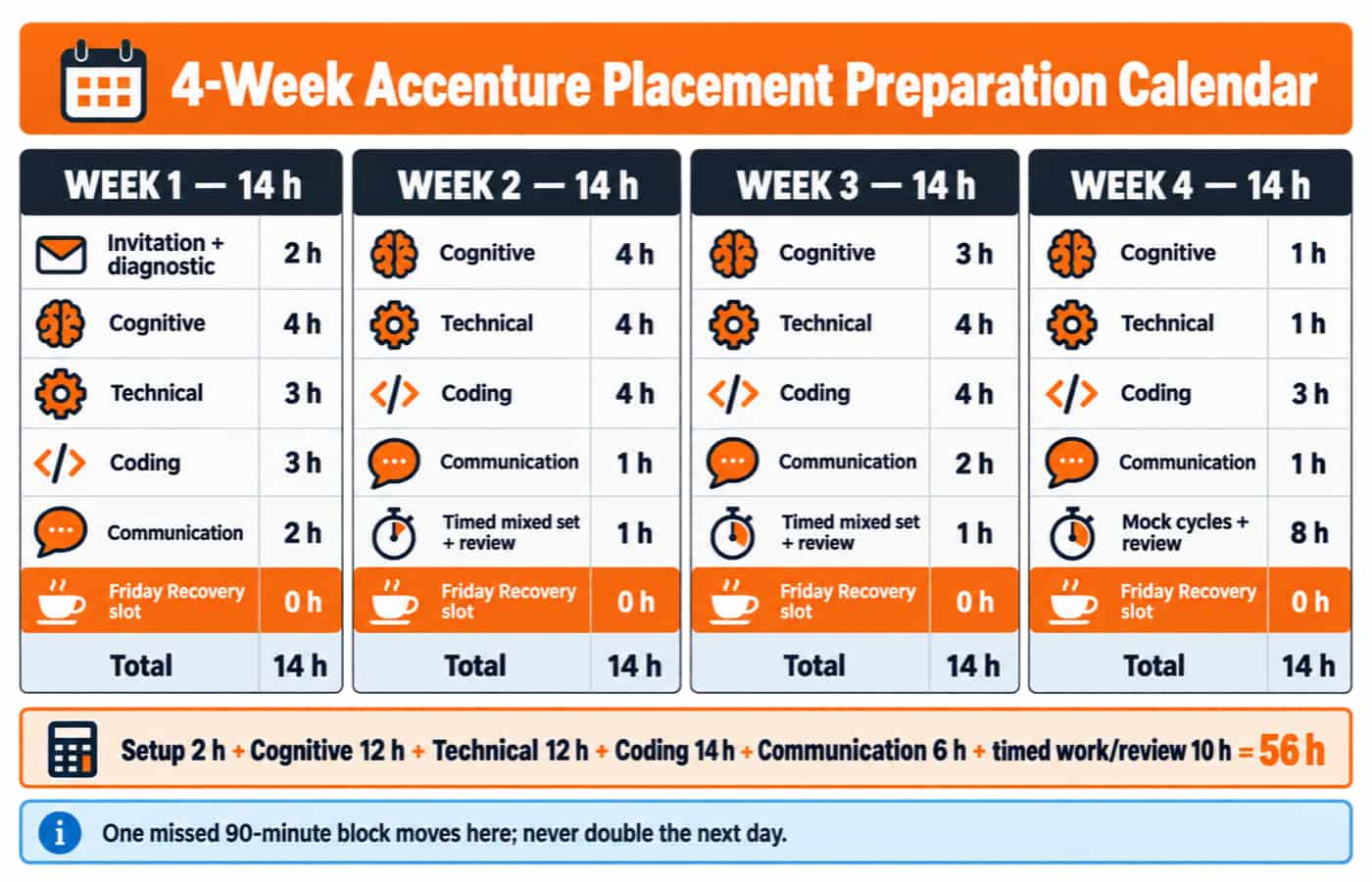
Check 2 + 12 + 12 + 14 + 6 + 10 = 56 hours. Study 90 minutes Monday through Thursday, keep Friday empty, and use four hours on Saturday and Sunday. Thus 4 x 90 minutes = 360 minutes = 6 hours; 6 + 4 + 4 = 14 hours weekly; 14 x 4 = 56 hours overall.
Example baseline: cognitive 24/30, technical 12/25, coding 7/15 test cases and communication 14/20. Error rates are 6/30 = 20%, 13/25 = 52%, 8/15 = 53.3% and 6/20 = 30%. Since both exceed twice the cognitive rate, shift three cognitive hours, two to technical and one to coding. Content changes from 12/12/14 to 9/14/15; 9 + 14 + 15 + 6 + 10 + 2 = 56.
Week 1 produces a baseline, three small outputs and one error log
Week 1 gives two hours to setup and diagnosis, four to cognitive work, three to technical work, three to coding and two to communication: 2 + 4 + 3 + 3 + 2 = 14 hours. Spend 30 minutes copying invitation facts, then run a 90-minute baseline using its named sections. If its limit is shorter, obey it and analyse errors with the remaining time.
For a technical trace, start with sum = 0. From i = 1 to 5, add i x i when i is even and i otherwise. The states are 1 -> 5 -> 8 -> 24 -> 29, giving 29.
Check three coding outputs: [-2, 5, 0, 7] gives positive count 2 and sum 12; "accenture" has 4 vowels; [2, 2, 3, 5, 5, 5] gives value 5 with frequency 3. Communication gets four 30-minute recordings, each ending with a 60-second summary and one replay note. Keep one error log.
Weeks 2 and 3 replace isolated study with timed mixing
Week 2 uses four hours each for cognitive, technical and coding work, one for communication, and one for timed mixed work plus review. Week 3 uses three cognitive hours, four technical, four coding, two communication and one timed hour. Each totals 14 hours. The Aptitude for Placement course can structure aptitude, logical reasoning and verbal practice inside the cognitive block.
Repeat this 90-minute loop: 20 minutes recalling without notes, 45 solving timed problems, 20 correcting, and five scheduling the next repair. Check: 20 + 45 + 20 + 5 = 90 minutes.
In the first mixed set, 40 items in 45 minutes produce 28 correct, eight wrong and four skipped. Attempts are 28 + 8 = 36, so attempted accuracy is 28/36 = 77.8%. Classify the 12 non-correct outcomes as three concept gaps, two trace errors, two misreads, one time loss and four skips. Start the next session with three concept cards, two fresh traces, a five-item slow-reading set and one eight-minute speed set.
Week 4 rehearses the invitation's conditions and turns errors into repairs
Week 4 keeps one hour each for cognitive repair, technical repair and communication, three for coding, and eight for mock cycles plus review: 1 + 1 + 3 + 1 + 8 = 14 hours. Before exact timing arrives, use four coaching cycles of 60 minutes attempting and 60 reviewing. Thus 4 x (60 + 60) = 480 minutes = 8 hours. Then resize attempts to the invitation's limit, keep review time roughly equal, and retain the eight-hour budget.
Accenture's official recruiting FAQ says its technical assessment is online, completed in one sitting within the stated window, usually within 72 hours, and most take about 30 to 90 minutes. The invitation confirms the allowed time. Accenture also prohibits external AI tools. Follow the current instructions, use a laptop or desktop, and arrange stable internet and uninterrupted time.
End reviews with error, cause, next drill. Repeated causes set priority.
Compress to 14 days or recover missed sessions without pretending time returns
The 14-day plan has 28 hours: setup and baseline 1, cognitive 6, technical 6, coding 7, communication 3, and timed work plus review 5. Verify: 1 + 6 + 6 + 7 + 3 + 5 = 28 hours. Those five hours are two 60-minute timed attempts, two 60-minute reviews and one 60-minute error-log consolidation. Cut repeated notes and one mock cycle before removing coding or communication practice.
One missed 90-minute weekday block moves into Friday's empty slot. If you miss two, recover one on Friday and replace Sunday's lowest-priority 90-minute mixed block with the other. Do not force a three-hour double session onto the next college day. If a whole week disappears, resume from the diagnostic evidence, not the abandoned date.
If several recruiter applications share your calendar, the service-based company preparation comparison helps separate reusable aptitude and coding work from the Accenture-specific layer.
Finish with a 48-hour checklist and one measurable next action
At 48 hours, stop adding topics and work only from repeated error categories. At 24 hours, re-read the invitation and confirm the login route, device, internet, permitted language and quiet location. In the last study block, spend 30 minutes on error cards, cap one familiar coding problem at 30 minutes, make one 15-minute speaking recording, then stop.
Your next action is measurable: copy the invitation fields, reserve four weeks of 14 hours, and complete the baseline before changing the default allocation. Use the ACCENTURE Superset course as a structured company-specific route across the preparation lanes, or compare recruiter-focused resources in the Company-Specific Placement category.
Keep learning
Accenture Coding Questions: 4 Patterns with Solved Dry Runs
Stop memorising company-question lists. Learn four reusable coding patterns through precise examples involving strings, arrays, digits, and matrices.
Updated 2 Oct 20265 min readCompany-Specific Prep
Capgemini Interview Questions: Technical and HR Rounds with Model Answers
Practise clear technical and HR answers through Java, SQL, a coding trace and one consistent project story. Each example shows what to say and how to support it.
Updated 25 Sep 20265 min readCompany-Specific Prep
Capgemini Drive Mistakes: Stage-by-Stage Rejection Risks and Fixes
Diagnose the controllable evidence gaps behind common Capgemini drive risks. Repair your CV, timed practice, code traces, project proof and behavioural stories with worked drills.
Updated 24 Sep 20266 min readCompany-Specific Prep

Cognizant Interview Questions: Technical and HR Model Answers
Prepare clear technical and HR responses through worked programming, SQL, project and STAR examples, then test them in a timed self-review mock.
Updated 22 Sep 20266 min readCompany-Specific Prep